How to calculate IFTA fuel tax, step by step (worked quarter)
Everything below is the International Fuel Tax Agreement (IFTA) quarterly return, for diesel, United States rules. The arithmetic is the same in every member jurisdiction because it comes from the return itself; the worked example uses the official Q1 2026 diesel rates from New York's Form IFTA-105 (3/26), and rates change every quarter, so treat the dollar figures as a worked example rather than this quarter's answer. Registration thresholds, licences and decals are not covered here — this is only about how the number on the bottom line is made, because that is the part homemade spreadsheets get wrong.
How is IFTA calculated, in one paragraph?
Take every mile the fleet ran and every gallon it bought, divide them into a fleet-average MPG, and use that MPG to work out how many gallons were burned in each state — miles in that state divided by fleet MPG. From each state's burned gallons subtract the gallons you bought there; multiply what is left by that state's rate. A state where you bought more than you burned becomes a credit at its own rate, and credits cancel debts inside the same return. Add the surcharge lines for Indiana, Kentucky and Virginia, which are never reduced by purchases, and the sum is the cheque — or the refund.
Each of those rules is quoted from the instructions to Form IFTA-101 (New York State's IFTA-101-I); the exact wording is in the sources at the end.
A worked quarter
A tractor runs 5,400 miles in the quarter: 3,200 in Texas, 1,400 in Ohio, 600 in Kentucky, plus 200 miles outside IFTA jurisdictions. It buys 850 gallons of diesel: 700 in Texas, 150 in Kentucky, none in Ohio. The same trip is preloaded in our free IFTA calculator — against the rate table of whichever quarter the page names — so you can change any number and watch the return re-form.
Fleet MPG = 5,400 ÷ 850 = 6.35 (the form rounds MPG to two decimal places).
| Line | Taxable miles | Taxable gallons | Tax-paid gallons | Net gallons | Rate | Tax |
|---|---|---|---|---|---|---|
| Texas — fuel | 3,200 | 504 | 700 | −196 | $0.20 | −$39.20 |
| Ohio — fuel | 1,400 | 220 | 0 | 220 | $0.47 | $103.40 |
| Kentucky — fuel | 600 | 94 | 150 | −56 | $0.22 | −$12.32 |
| Kentucky — surcharge | — | 94 | not subtracted | — | $0.105 | $9.87 |
| Total due | $61.75 |
Fuel lines net to $51.88, the surcharge adds $9.87, and the quarter costs $61.75 — despite two of the three states owing the driver money. Diesel rates: Q1 2026 per Form IFTA-105 (3/26).
Why do I owe Ohio when I never bought fuel there?
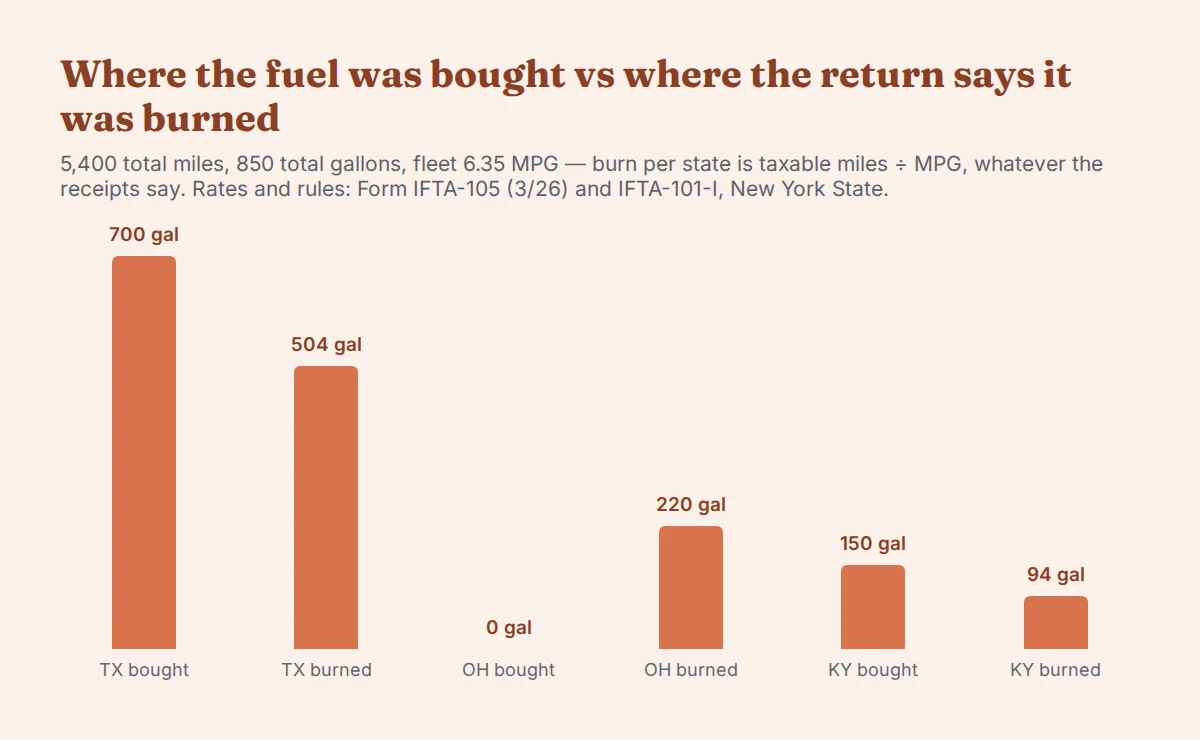
Because IFTA taxes consumption, and consumption follows the odometer, not the receipts. The form's own rule: taxable gallons for a jurisdiction are its taxable miles divided by the fleet's average MPG — 1,400 Ohio miles ÷ 6.35 MPG = 220 gallons of Ohio diesel, and at Ohio's $0.47 that is $103.40, whoever sold the fuel.
The mirror image is Texas: 700 gallons bought, only 504 burned, so 196 gallons of Texas tax were paid at the pump on fuel that was burned elsewhere. Those become a credit at Texas's own rate — 196 × $0.20 = $39.20 — and inside the same return that credit pays down most of the Ohio bill. This is the whole design of IFTA: you pay at the pump wherever is convenient, and the quarterly return moves the tax to where the miles happened.
How is fleet MPG worked out, and why does everything round?
Fleet MPG is total miles everywhere ÷ total gallons everywhere — including miles and fuel outside IFTA jurisdictions, which is why the 200 non-IFTA miles in the example sit inside the 6.35 even though no report line exists for them. The instructions round it to two decimal places (their own example: 4.567 becomes 4.57), and miles and gallons are reported as whole numbers, halves rounding up (1234.5 becomes 1235).
The rounding is not cosmetic. Every state's taxable gallons are divided out of the same fleet MPG, so a fill-up that nudges MPG by one hundredth moves every line of the return at once — which is why two spreadsheets fed the same trips can disagree by real dollars when one of them rounds at a different step. Our calculator rounds where the form rounds, at every step, and shows each intermediate value so you can check it against your own sheet.
What is the surcharge line, and why is it owed even when the state owes me?
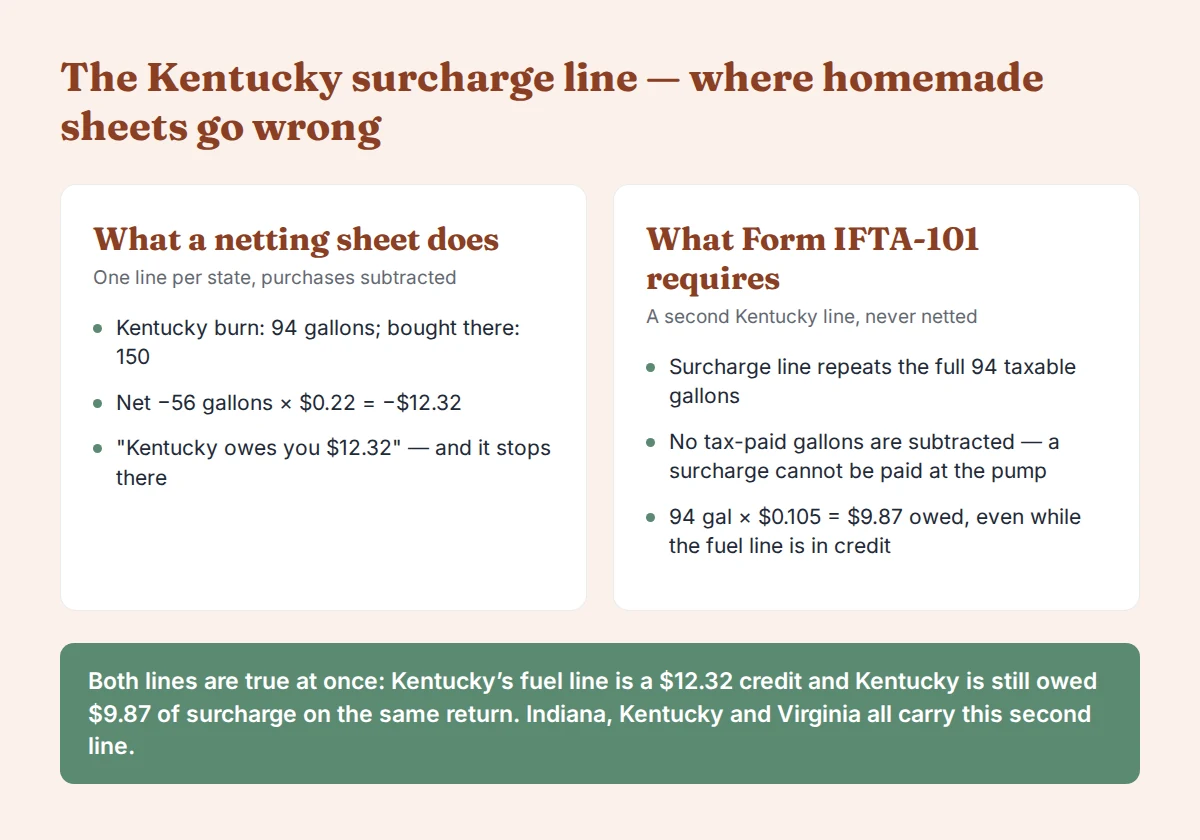
Indiana, Kentucky and Virginia add a second line to the return: a surcharge on the full taxable gallons burned there, with nothing subtracted for fuel bought there — because a surcharge is not collected at the pump, it cannot have been prepaid, so it is always owed.
In the worked quarter that produces the strangest-looking pair of lines a first-time filer meets. Kentucky's fuel line is a credit: 94 burned − 150 bought = −56 gallons × $0.22 = −$12.32. And Kentucky is still owed $9.87: the surcharge line repeats the full 94 taxable gallons × $0.105. Both lines are correct at once, and a sheet that nets them into one Kentucky number misreports both.
One honesty note: in the official rate table we verified, Indiana's surcharge rate was not legible, so our calculator marks Indiana's surcharge line "not verified" rather than printing a guessed number. Check the current IFTA, Inc. rate matrix or your base state's table for Indiana before filing.
Does it matter where I buy fuel?
On the return, enormously; in your bank account, much less than the return makes it look. The same 5,400 miles and the same 850 gallons produce a $61.75 bill when the big fills all happen in Texas, $34.75 if 100 of those gallons are bought in Ohio instead, and $3.47 if purchases match the burn state by state — a $58.28 swing with identical driving.
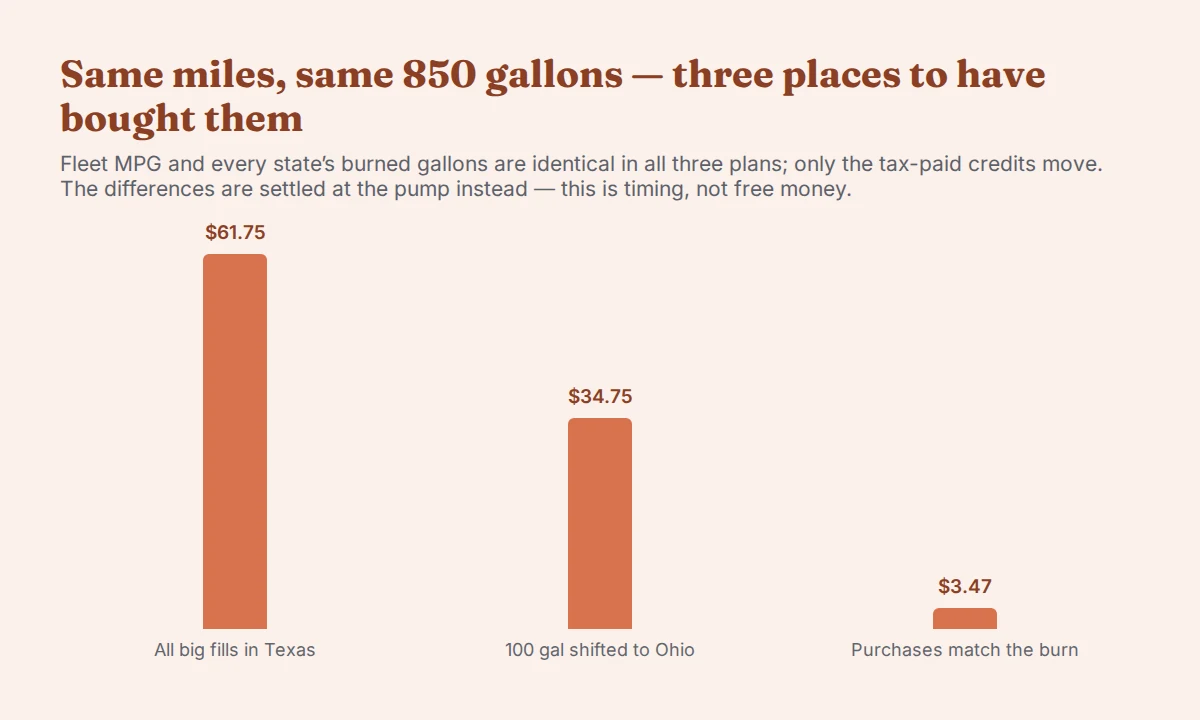
But the swing is timing, not free money. The tax you do not owe on the return is tax you already paid at the pump: buying in Ohio hands Ohio its $0.47 per gallon at the point of sale instead of at filing time. What actually changes the cost of the quarter is the pre-tax pump price — a state with a low pump price because its fuel tax is low, like the Texas of this example, sends the difference back to you as a return-time bill, not a saving. Comparing pump prices with each state's fuel tax stripped out is the comparison that pays; the return then simply settles the tax to where the miles were, as it was designed to.
When are 2026 IFTA returns due?
The quarterly due dates, per the Colorado Department of Revenue's IFTA FAQ: 30 April (January–March), 31 July (April–June), 31 October (July–September) and 31 January (October–December), and "if the due date falls on a weekend or state holiday, then the due date is the next business day." In 2026, 31 October falls on a Saturday, so the third-quarter return lands on the next business day — confirm the exact date with your base jurisdiction.
What this walkthrough leaves out
Real returns carry pieces this article deliberately does not compute, and saying so beats pretending otherwise: late-filing interest (the instructions set it at two points over the federal underpayment rate, but the month-by-month mechanics are their own subject); fuels other than diesel, which have their own rate columns; Kentucky's KYU weight-distance tax, New York's HUT and Oregon's weight-mile tax, which are separate taxes that ride alongside IFTA rather than inside it; and exempt-mile rules, which differ by jurisdiction. If a spreadsheet claims to do all of that in one tab, ask it to show its sources line by line.
The short version
Fleet MPG from all miles and all gallons; burn per state from miles ÷ MPG; subtract what you bought there; multiply by the state's rate; let credits offset debts; add the Indiana, Kentucky and Virginia surcharges untouched by any purchase. The free IFTA calculator runs exactly this arithmetic with every intermediate value visible and needs no sign-up. If the quarter's paperwork is the wider problem — receipts, per-truck logs, the ledger behind Schedule C — that is what our bookkeeping spreadsheet exists for, and an owner-operator's own quarterly income tax estimates are the subject of the US self-employed tax engine. The free sample pack shows how we build these files before you spend anything.
Where these numbers come from. Every figure in this article — the worked table, both credits, the surcharge, the three purchase plans — is recomputed at build time by the same independently verified model our calculator page is held against (14 fixtures, 1,658 checks), and the article fails to build if any figure drifts from the model. Nothing here is typed by hand.
Sources. Form IFTA-101-I, Instructions for Form IFTA-101 (New York State) — fleet MPG (item E), taxable gallons (column K), tax-paid gallons and credits (columns L, M, O), surcharge line rules and the Indiana–Kentucky–Virginia list, rounding examples · Form IFTA-105 (3/26), New York State — final Q1 2026 diesel rates used in the worked example · Colorado Department of Revenue, IFTA FAQ — quarterly due dates and the next-business-day rule (accessed 2 September 2026)