Budgetteren met ADHD als normaal budgetteren niet werkt
Standaard budgetadvies gaat uit van drie dingen: dat je eraan denkt om aankopen te noteren, dat je merkt dat een vervaldatum nadert, en dat een beslissing van zondag je gedrag op donderdag om 9 uur 's avonds nog steeds stuurt.
Als die aannames voor jou zouden kloppen, zou je dit waarschijnlijk niet aan het lezen zijn.
Dit is geen stuk over harder je best doen. Het gaat over een geldsysteem bouwen dat blijft draaien op de dagen dat dat extra-je-best-doen niet beschikbaar is — en dat zijn de meeste dagen die ertoe doen.
Eén opmerking vooraf: dit is algemene educatieve inhoud over budgetteren, geen medisch advies. Het stelt geen diagnose en behandelt niets, en niets hier vervangt je arts, je voorschrijver, je therapeut of een ADHD-coach. Zit je met achterstanden of incassobureaus, dan helpt gratis, gereguleerd schuldadvies je meer dan welke planner ook — en dat bestaat in de meeste landen. Gebruik het.
Waarom het standaardadvies mislukt, heel precies
Russell Barkleys model van ADHD (Barkley, 1997, Psychological Bulletin) beschrijft het niet in de eerste plaats als een aandachtstekort, maar als een moeite met gedragsinhibitie — de korte pauze tussen een impuls en een handeling — en met de executieve functies die die pauze mogelijk maakt. In zijn kader horen daarbij het werkgeheugen, de geïnternaliseerde spraak (de stem die je door een taak heen praat), de zelfregulatie van emotie en motivatie, en het plannen.
Barkley beschrijft ADHD ook als een soort bijziendheid voor de toekomst: gebeurtenissen voorbij een korte tijdshorizon trekken veel minder aan het gedrag van nu dan bij andere mensen. Daarbij aansluitend vindt meta-analytisch werk dat mensen met ADHD uitgestelde beloningen steiler afwaarderen dan vergelijkingsgroepen (Jackson en MacKillop, 2016) — een beloning over zes maanden weegt nu minder.
Kijk nu wat een gewoon budget van je vraagt:
| Het budget vraagt je | Wat vereist |
|---|---|
| Eraan denken elke aankoop te noteren | Werkgeheugen, urenlang |
| Merken dat er volgende week een rekening vervalt | Tijdshorizon op de toekomst |
| Bij de kassa kiezen tussen 30 categorieën | Snelle beslissingen onder tijdsdruk |
| Het ding niet kopen | Gedragsinhibitie |
| Motivatie voelen voor een doel over drie jaar | Verdragen van uitgestelde beloning |
Elke rij raakt precies de functies die het model als geraakt beschrijft. Het systeem faalt niet omdat je geen discipline hebt. Het faalt omdat het is ontworpen door en voor mensen van wie het werkgeheugen een vervaldatum twee weken vasthoudt zonder herinnering.
Dus draait het ontwerpprincipe om. In plaats van je brein te vragen die vijf dingen betrouwbaar te doen, verplaats je het werk uit je hoofd naar je omgeving.
Principe 1: Zet alles buiten je hoofd
Alles wat alleen in het werkgeheugen leeft, loopt gevaar. Alles wat aan een muur hangt, in een kalender staat of op een vel papier op de koelkast zit, niet.
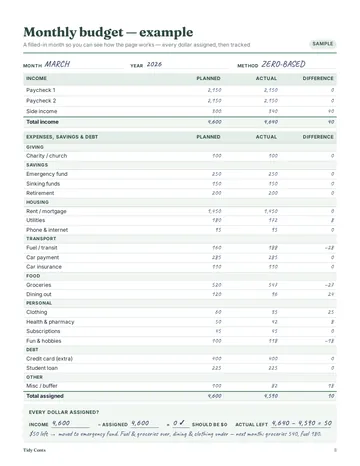
De geldkaart op één pagina. Eén vel papier. Waar het inkomen binnenkomt, naar welke rekening het gaat, welke rekeningen automatisch de deur uit gaan, wat naar sparen gaat, en het ene getal dat overblijft om van te leven. Geen budget — een schema van hoe geld fysiek door je rekeningen beweegt. Hang het waar je het ziet zonder iets te openen.
De meeste mensen met ADHD kunnen hun inkomen beschrijven en ongeveer wat ze uitgeven, maar kunnen de vraag "van welke kaart gaat de sportschool af?" niet beantwoorden zonder te kijken. Precies dat gat — de grote lijn kennen maar niet de details — is een werkgeheugenkwestie, en één pagina lost het blijvend op.
Maak het onzichtbare zichtbaar. Een wandkalender met de rekeningen in grote cijfers, of een grote papieren thermometer die je inkleurt. Iets waar je niet voorbij kunt scrollen. Een vervaldatum die alleen in een bank-app bestaat, is een vervaldatum die niet bestaat.
Principe 2: Automatiseer wat kan, maak de rest stroef
Dit is het principe met het hoogste rendement op deze pagina, en het is het principe met het stevigste bewijs buiten het ADHD-onderzoek.
Standaardinstellingen zijn buitengewoon krachtig. Madrian en Shea (2001, Quarterly Journal of Economics) vonden dat het omzetten van een bedrijfspensioen naar automatische deelname — zelfde regeling, zelfde geld, uitstappen in plaats van instappen — een drastisch hogere deelname opleverde. Aan de werknemers veranderde niets. Aan de standaard wel.
Toegepast op jouw geld:
- Elke rekening op automatische incasso. Werkelijk elke rekening die het toelaat.
- Plus een herinnering dat het gebeurd is. Dit is het deel dat mensen overslaan, en het telt: automatische betaling faalt geruisloos wanneer een kaart verloopt of het saldo tekortschiet. Een agendaherinnering twee dagen na elke betaling, met "check of de huur eruit is", is een controle van vijf seconden die de storing vangt voordat er kosten van komen.
- Sparen via een periodieke overboeking, op betaaldag. Geld dat vertrekt voordat je het ziet, vraagt helemaal geen inhibitie.
- Eén overboeking, geen twaalf. Werk je met spaarpotjes, stuur dan één bedrag naar één spaarrekening en laat een lijstje het verdelen. Twaalf handmatige overboekingen per maand zijn twaalf kansen om te stoppen.
Draai de logica vervolgens om voor het uitgeven. Waar automatisering de wrijving weghaalt bij goed gedrag, wil je bij snel gedrag juist wrijving toevoegen:
- Verwijder opgeslagen kaarten uit de winkels waar je te veel uitgeeft. Jezelf naar je portemonnee laten lopen is een echte ingreep, geen kleinigheid.
- Zet bestellen met één klik uit.
- Log uit bij de apps.
- Houd de kaart die impulsaankopen betaalt fysiek onhandig.
Alles wat dertig seconden tussen impuls en aankoop schuift, doet het werk dat anders van de gedragsinhibitie had gemoeten.
Principe 3: Waarom "schrijf gewoon alles op" mislukt, en wat je in plaats daarvan doet
Elke transactie bijhouden in een systeem met 30 categorieën mislukt om een heel specifieke reden: het maakt een beslissing van iets dat automatisch zou moeten zijn. In een winkel staan bedenken of een zak ijs Boodschappen, Vermaak of Huishouden is, is een verklede werkgeheugentaak — en na vier dagen wordt de app verwijderd.
Drie oplossingen, op volgorde van hoeveel ze helpen:
Gebruik drie tot vijf categorieën, geen dertig. Vaste lasten. Eten. Vervoer. Al het andere. Daar kun je echt een huishouden op draaien, en bij de kassa is er geen aarzeling.
Gebruik één getal, geen budget. Rekeningen en sparen vertrekken automatisch aan het begin van de betaalperiode. Wat overblijft, gedeeld door de dagen tot je volgende loon, is jouw getal — één cijfer, voor alles. "Ik heb $70 per dag" is een regel die een mens echt kan volgen. "Ik heb deze maand $340 voor boodschappen, $90 voor vervoer, $120 voor persoonlijke dingen en $80 voor vermaak" zijn vier regels, vier lopende totalen en vier kansen om de draad kwijt te raken.
Kijk naar het saldo, noteer de uitgave niet. Achteraf bijhouden is een geheugentaak. Naar één getal in je bank-app kijken is een waarnemingstaak. Waarnemen is veel goedkoper. Zodra je vaste lasten geautomatiseerd zijn, vertelt het saldo van de uitgavenrekening je bijna alles wat het logboek had verteld.
De wekelijkse geldafspraak van 15 minuten
Geen maandelijkse terugblik. Maandelijks is te ver weg om echt te voelen, en het wordt een reconstructieklus van negentig minuten die wordt overgeslagen.
Vijftien minuten, elke week op dezelfde dag en tijd, timer aan, stoppen als hij afgaat.
| Minuten | Wat |
|---|---|
| 0-2 | Open de bank-app. Lees het saldo hardop voor. |
| 2-5 | Loop de afgelopen week na op iets geks — dubbele afschrijvingen, abonnementen, kosten. |
| 5-8 | Check wat er vervalt vóór de volgende geldafspraak. |
| 8-11 | Verplaats het geld: spaarpotjes, sparen, een aflossing. |
| 11-14 | Schrijf één getal en één actie voor volgende week op. |
| 14-15 | Stop. Klap de laptop dicht. |
De details die het laten overleven:
- Zet een timer. Zichtbaar én hoorbaar. Vijftien minuten met een afgebakend einde beginnen veel makkelijker dan "mijn geldzaken op orde brengen", dat geen einde heeft en dus geen begin.
- Plak het vast aan iets dat al gebeurt. Na het zondagse eten. Vóór de serie die je elke week kijkt. Een nieuwe gewoonte zonder anker is wéér iets om te onthouden.
- Zelfde dag, zelfde tijd. De regelmaat doet meer werk dan de inhoud.
- Doe het met iemand erbij. Doe het terwijl iemand anders in de kamer met eigen dingen bezig is, of in een videogesprek met een vriend die hetzelfde doet. Veel mensen met ADHD merken dat een taak die alleen onmogelijk is, eenvoudig wordt met een ander erbij. Het is geen trucje; het is een van de meest betrouwbaar gerapporteerde strategieën die er zijn.
- Een slechte geldafspraak telt ook. De app openen, het saldo lezen en dan stoppen is een geslaagde geldafspraak. De reeks telt zwaarder dan de diepgang.
De impulsaankoop-pauze
De literatuur over implementatie-intenties — concrete als-dan-plannen die vooraf worden gemaakt (Gollwitzer, 1999, American Psychologist) — behoort tot de best onderbouwde bevindingen in gedragsverandering, met een meta-analyse van Gollwitzer en Sheeran (2006) die een middelgroot tot groot effect laat zien over een brede waaier aan doelen. Waarom het hier past, is precies aan te wijzen: het plan wordt rustig en vooraf gemaakt, en uitgevoerd als reflex in plaats van als beslissing. Het leent van het moment waarop je inhibitie werkt, om uit te geven op het moment waarop ze dat niet doet.
Schrijf ze concreet uit, in als-dan-vorm:
- Als ik op het punt sta iets boven de $50 te kopen dat ik niet had gepland, dan gaat het op de verlanglijst en kijk ik over 24 uur opnieuw.
- Als ik aan het winkelen ben en opwinding voel, dan leg ik het in het mandje, sluit ik de app en zet ik een timer van een uur.
- Als ik iets koop om me beter te voelen, dan zeg ik dat eerst hardop.
Dan de mechaniek die ze ondersteunt:
Een verlanglijst van 24 uur. Niets is verboden. Het wordt alleen vandaag niet gekocht. Het meeste wat erop komt, blijft erop staan, en de lijst zelf levert vaak al een deel van de dopamine waar de aankoop voor bedoeld was — en dat is een prima uitkomst.
Plan het plezier in. Een budget met nul plezier-geld overleeft geen week. Geef de impuls een legitiem, onbetwist potje. Geld in de pleziercategorie wordt per definitie zonder schuldgevoel uitgegeven, en dat haalt de schaamtelus weg die overbesteding laat opstapelen.
Benoem het gevoel. Een groot deel van ongeplande uitgaven is verveling, uitputting of een rotdag. Hardop zeggen "ik heb een vreselijke dag gehad en ik wil iets kopen" houdt de aankoop niet altijd tegen, maar het maakt van automatisch gedrag opgemerkt gedrag — en daar begint kiezen.
De 'ADHD-taks'
Dit is een term uit de community, geen klinische, en hij beschrijft iets echts: het geld dat specifiek verloren gaat aan moeite met executieve functies, niet aan te veel uitgeven. Aanmaningskosten terwijl het geld er was. Twee exemplaren van iets omdat het eerste onvindbaar was. Spoedverzending om een vergeten deadline te redden. Weggegooid eten. Een gratis proefperiode die een abonnement werd. Een terugbetaling die nooit is opgeëist.
Het doet meer pijn dan de meeste uitgaven, omdat het helemaal niets koopt. Het loont om er recht op af te gaan, en het reageert goed op structuur:
| Het lek | De oplossing |
|---|---|
| Aanmaningskosten terwijl het geld er is | Automatische incasso plus een bevestigingsherinnering |
| Vergeten proefperiodes | Opzegdatum in de agenda op de dag dat je je aanmeldt, met een alarm 3 dagen vooraf |
| Zombie-abonnementen | Eén jaarlijkse doorlichting: bankafschrift, appwinkel, PayPal, mail doorzoeken op "bon" |
| Dubbele aankopen | Eén vaste plek voor de dingen die je kwijtraakt; koop bewust goedkope reserves |
| Niet-opgeëiste terugbetalingen en retouren | Eén lijst van geld dat jou toekomt, nagelopen op de geldafspraak |
| Parkeer-, boete- en roodstandkosten | Roodstandmeldingen aan, en een kleine buffer die permanent op de rekening blijft |
Twee dingen over die lijst. Ten eerste: de meeste oplossingen zijn eenmalige inrichting in plaats van blijvende inspanning — precies het soort oplossing dat werkt. Ten tweede — houd het totaal drie maanden bij zonder oordeel. "$340 vorig kwartaal, waarvan $180 aanmaningskosten" zien, maakt van het vage gevoel slecht met geld te zijn een concreet, oplosbaar, niet-moreel probleem.
Je gaat het systeem laten liggen. Plan daarvoor.
Elk systeem wordt ooit losgelaten. Er komt een periode van twee weken waarin niets wordt geopend, en de traditionele reactie is een schuldspiraal die van twee weken zes maanden maakt.
Bepaal nu hoe herstarten eruitziet, en maak het beschamend klein: app openen, saldo lezen, app sluiten. Dát is de herstart. Niet drie weken aan registraties inhalen — juist die achterstand laat herstarten onmogelijk voelen, dus geef jezelf uitdrukkelijk toestemming om dat nooit te doen. De gemiste weken zijn voorbij. Begin bij het saldo van vandaag.
Ook daarom telt automatisering zo zwaar. Als het handmatige deel stilvalt, blijft het automatische deel de rekeningen betalen en het spaargeld verplaatsen. Een goed gebouwd systeem faalt niet als jij afhaakt; het stopt alleen met beter worden.
Zo ziet het geheel eruit
- Eén pagina die laat zien hoe het geld beweegt. Aan de muur.
- Elke rekening op automatische incasso, elk met een bevestigingsherinnering.
- Sparen dat automatisch vertrekt op betaaldag.
- Drie tot vijf categorieën, en één dagelijks uitgavengetal.
- Vijftien minuten per week, op dezelfde tijd, timer aan.
- Uitgeschreven als-dan-regels en een verlanglijst van 24 uur.
- Een benoemd, onbetwist plezierbudget.
- Een herstartplan van dertig seconden.
Dat is het hele systeem, en het is met opzet klein. Onze ADHD-budgetmap is deze acht dingen als printbare pagina's — de geldkaart, de automatische-piloot-checklist, de pauzekaarten, het script van de geldafspraak en de herstartpagina — maar je kunt elk ervan bouwen met een pen en een middag, en dan werkt het net zo goed.
Er zijn ook gratis printbare voorbeeldpagina's als je eerst wilt zien of werken op papier je ligt voordat je je ergens aan verbindt.
Wat je ook gebruikt: beoordeel het op of het twee slechte weken overleeft, niet op hoe goed het er de eerste week uitziet. Dat is hier de enige maatstaf die telt.