Budgetteren met een onregelmatig inkomen (de percentielmethode)

Bijna elke budgetmethode die je leest, gaat uit van iets wat voor jou niet klopt: dat er elke maand op dezelfde dag hetzelfde bedrag binnenkomt.
Werk je als freelancer, op provisie, voor fooien, als zzp'er of met een seizoensbedrijf, dan loopt het standaardadvies al bij de eerste stap vast. «Neem je maandinkomen en verdeel het 50/30/20» is niet te beantwoorden als het eerlijke antwoord luidt: welke maand? En het gebruikelijke lapmiddel, «neem gewoon je gemiddelde», is erger dan helemaal geen advies, om een reden die je meteen ziet als je de getallen in een grafiek zet.
Deze gids is in plaats daarvan het rekenwerk. Eén realistisch jaar freelance-inkomen, vier berekeningen en de reden waarom elk daarvan de berekening is die je moet gebruiken in plaats van een alternatief.
Waarom het gemiddelde het verkeerde getal is
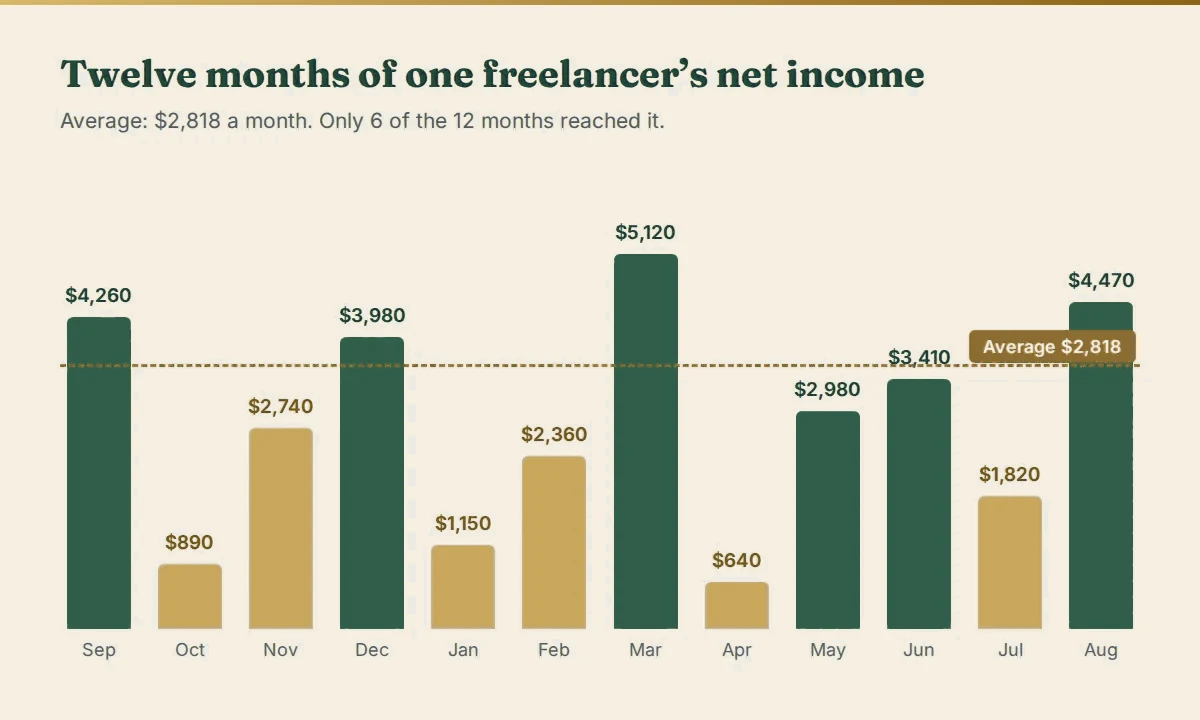
De twaalf maanden hierboven komen samen op $33,820, gemiddeld $2,818 per maand. Dat getal is rekenkundig correct en praktisch nutteloos.
Kijk hoeveel staven boven de gestippelde lijn uitkomen: zes van de twaalf. De helft van het jaar ligt onder het gemiddelde, en flink eronder: oktober op $890, april op $640. Een budget dat op $2,818 is gebouwd, is een budget dat zes van de twaalf maanden niet klopt, en in één maand tot $2,178 naast zit.
Dat is geen pech. Het is wat een gemiddelde doet met een scheve reeks. Eén maand van $5,120 trekt het gemiddelde voor alle twaalf omhoog, dus het gemiddelde is een getal dat je vaak niet haalt, geen getal waar je op kunt rekenen. Gemiddelden beschrijven een reeks getallen. Ze beloven niets over het volgende.
Een budget heeft geen beschrijving nodig. Het heeft een bodem nodig.
Berekening 1: je eigen salaris
Regel: betaal jezelf het 25e percentiel van je netto-inkomen van de afgelopen twaalf maanden.
salaris = PERCENTILE(netto_laatste_12, 0.25)
Voor het jaar hierboven is dat $1,652.50.
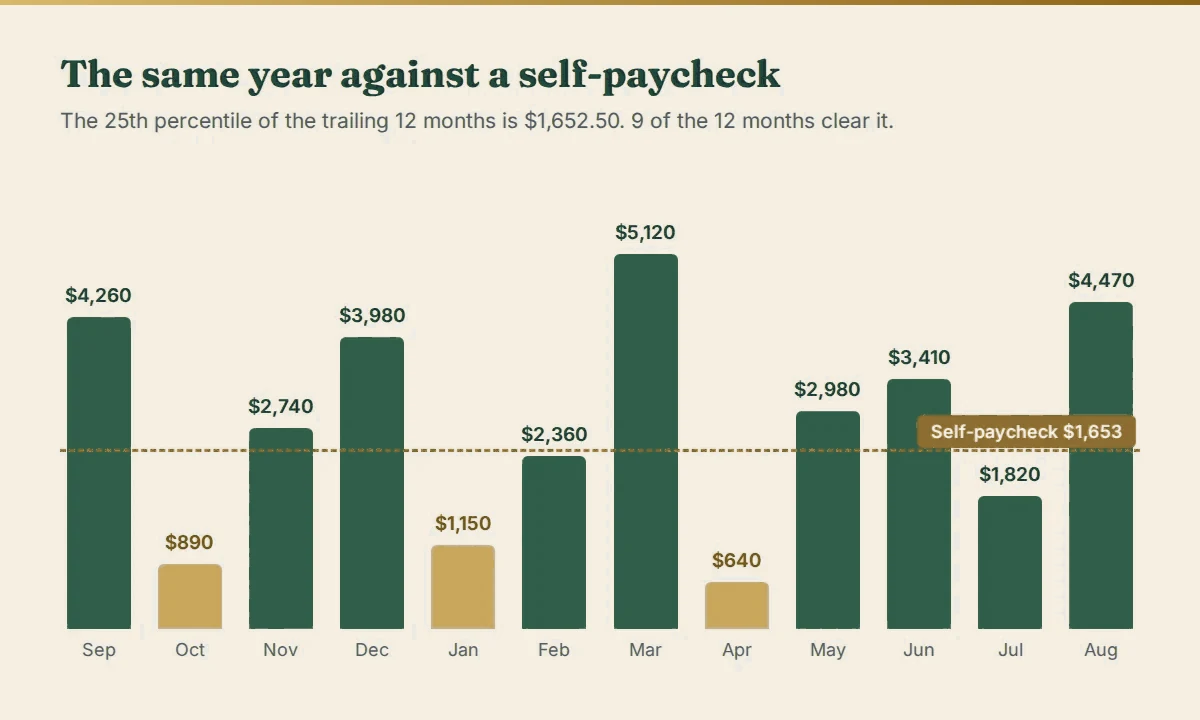
Het 25e percentiel is de waarde waar ongeveer een kwart van je maanden onder valt: drie van de vier maanden verdien je dus minstens dit bedrag. Hier komen negen van de twaalf maanden erboven, en dat is precies wat je wilt van een bedrag dat je je elke maand vastlegt om uit te geven.
Waarom niet de mediaan? De mediaan ($2,860) wordt per definitie maar zes van de twaalf maanden gehaald. Een salaris dat je jezelf de helft van de tijd kunt betalen, is geen salaris. Waarom niet het minimum ($640)? Omdat dat de slechtste maand van een jaar is, en permanent leven op het niveau van je slechtste maand is onnodige soberheid; je zou het jaar eindigen met een enorm ongebruikt overschot en twaalf maanden onnodige beperking.
Het 25e percentiel ligt waar die twee fouten elkaar opheffen: hoog genoeg om een echt inkomen te zijn, laag genoeg om het bijna altijd te halen.
Bereken dit niet op drie maanden geschiedenis. Met minder dan zes gegevens is een percentiel ruis met een decimaalteken. Houd eerst de maanden bij; het getal wordt zinvol zodra je een half jaar hebt en betrouwbaar zodra je er twaalf hebt.
Berekening 2: hoe wisselvallig ben je precies
Twee freelancers kunnen allebei gemiddeld $2,800 verdienen en toch totaal verschillende systemen nodig hebben. Wat telt is de spreiding, en de standaardmaat daarvoor is de variatiecoëfficiënt:
CV = STDEV(netto_laatste_12) / AVERAGE(netto_laatste_12)
Voor dit jaar: standaardafwijking $1,485.98 ÷ gemiddelde $2,818.33 = CV 0.53.
De CV is een verhouding, en dat maakt hem bruikbaar: hij haalt de omvang van je inkomen weg en laat alleen de vorm over, zodat een freelancer met $2,000 per maand en een bureau met $20,000 per maand direct te vergelijken zijn. In gewone woorden:
| CV | Wat het betekent |
|---|---|
| onder 0.20 | Stabiel. Dicht bij een salaris. |
| 0.20 – 0.45 | Hobbelig. Normaal voor freelancewerk. |
| 0.45 – 0.75 | Wisselvallig. Je buffer moet echt werk doen. |
| boven 0.75 | Vette en magere jaren. De buffer is niet optioneel. |
Met 0.53 zit deze persoon midden in «wisselvallig», en dat bepaalt het volgende getal.
Berekening 3: een buffer afgestemd op je eigen spreiding
«Drie tot zes maanden uitgaven» is de vaakst herhaalde regel voor een noodfonds in de persoonlijke financiën, en voor een wisselend inkomen is hij in beide richtingen tegelijk fout: te veel voor een stabiele zzp'er, gevaarlijk te weinig voor iemand met een CV van 0.8.
Stem hem af op de volatiliteit die je echt hebt gemeten:
maanden_nodig = MIN(12, MAX(3, ROUNDUP(3 + 12 × CV, 0)))
bufferdoel = maanden_nodig × (salaris + vaste_kosten)
Drie maanden is de ondergrens voor iedereen. Elke 0.1 CV voegt er ongeveer 1.2 maanden aan toe, omdat een meer gespreid inkomen zowel diepere dalen als langere reeksen ervan oplevert. Twaalf maanden is het plafond: daarboven houd je geld aan dat zou moeten werken.
Met een CV van 0.53 en vaste kosten van $1,850 per maand:
- maanden nodig = ROUNDUP(3 + 12 × 0.5273) = ROUNDUP(9.33) = 10 maanden
- bufferdoel = 10 × ($1,652.50 + $1,850) = $35,025
Dat is een groot getal, en dat hoort ook: het is wat het echt kost om een CV van 0.53 op te vangen. Het is ook een doel, geen toegangseis. Het nuttige van het berekend hebben, is dat je de afstand ziet en die ziet krimpen, in plaats van te gokken naar een rond bedrag dat iemand anders heeft gekozen.
Berekening 4: het getal dat niemand je verkoopt
Dit is het getal dat er op een slechte dinsdag het meest toe doet.
slechtste_maand = MIN(netto_laatste_12)                              = $640
tekort          = MAX(0, salaris + vaste_kosten − slechtste_maand)   = $2,862.50
maanden_runway  = buffersaldo ÷ (salaris + vaste_kosten)
De slechtste maand van dit jaar bracht $640 op tegenover $3,502.50 aan vastgelegde uitgaven: een gat van $2,862.50 in één maand. Dat is de omvang van de gebeurtenis die je systeem moet overleven, en die is al een keer gebeurd, dus het is geen theorie.
Runway maakt van je buffer de enige eenheid die iets betekent: zonder inkomen houd je het N maanden vol. Een saldo van $8,000 is geen informatie. «Vier komma twee maanden» wel.
Wat er echt verandert als je dit doet
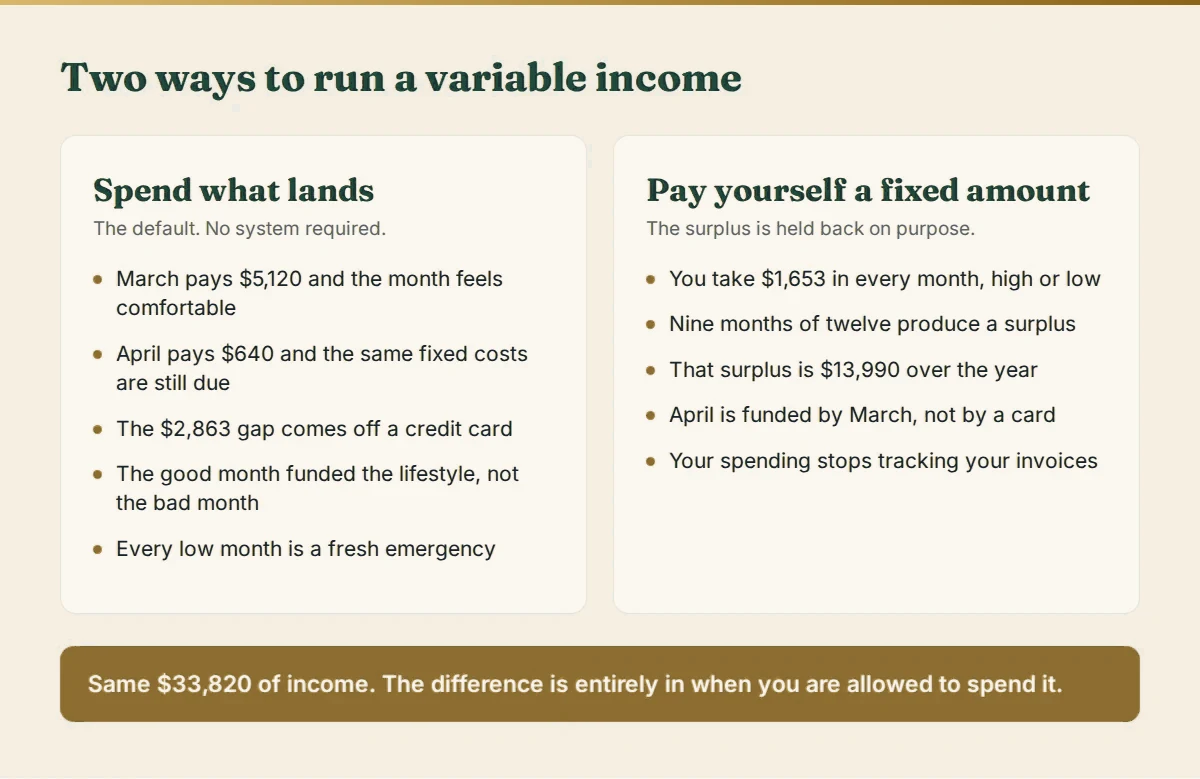
Neem elke maand je eigen salaris en laat de rest op de bufferrekening staan, en over dit jaar is het overschot dat je achterhoudt $13,990. Het gat van $2,862.50 in april wordt gevuld met de $3,467.50 die maart boven de lijn opleverde: geld dat in het systeem van uitgeven-wat-binnenkomt al verdwenen was.
Het inkomen veranderde niet. Er werd niets anders verdiend, geen klant vervangen, geen tarief verhoogd. De enige verandering is dat een goede maand geen toestemming meer is om uit te geven en een slechte maand geen noodgeval meer is.
Dat is de hele methode, en daarom overleeft ze de confrontatie met een echt jaar.
Het elke maand doen
Zes stappen, één keer per maand, ongeveer een kwartier:
- Noteer elke betaling netto, na platformkosten en zakelijke uitgaven. Bruto-inkomen is een getal voor je belastingaangifte, niet voor je huishoudbudget.
- Bereken het salaris opnieuw over twaalf voortschrijdende maanden, niet over een vast jaar. Het hoort mee te bewegen als je werk verandert.
- Zet het salaris over naar je privérekening op dezelfde dag elke maand. Eén overboeking, altijd hetzelfde bedrag.
- Zet de belastingreservering meteen apart, als percentage van het bruto, op een aparte rekening. Dit is alleen van jou in de zin dat de jas van een vreemde in jouw gang van jou is.
- Alles wat overblijft gaat naar de buffer tot die het doel bereikt, daarna naar waarvoor je daarna spaart.
- Controleer de CV elk kwartaal opnieuw. Stijgt hij, dan stijgt het bufferdoel mee: dat is het mechanisme dat werkt, geen fout.
Het enige deel dat saai wordt, is stap 2, omdat een voortschrijdend percentiel plus een standaardafwijking plus een voorwaardelijke bufferregel niet iets is wat je elke maand in een nieuwe spreadsheet wilt nabouwen. Zet het één keer op met de formules hierboven, PERCENTILE, STDEV, AVERAGE, MIN, MAX en ROUNDUP werken allemaal hetzelfde in Excel, Google Sheets en LibreOffice, en het rekent zichzelf opnieuw door als je rijen toevoegt.
De eerlijke grenzen hiervan
- Er is geschiedenis nodig. Onder de zes bijgehouden maanden betekent geen van deze getallen iets. Begin nu met bijhouden en begin ze in het voorjaar te gebruiken.
- Het gaat ervan uit dat de volatiliteit ongeveer stabiel is. Een carrièreswitch of het verlies van je grootste klant maakt de afgelopen twaalf maanden onbruikbaar; begin opnieuw en bouw het weer op.
- Het maakt geen geld. Ligt je 25e percentiel onder je vaste kosten, dan lost geen budgetindeling dat op: het probleem is de bodem van je inkomen of je kostenbasis, en de taak van de berekening is je dat duidelijk te vertellen in plaats van het in een gemiddelde te verstoppen.
- Niets hiervan is belastingadvies. Het percentage dat je reserveert, bepaal je zelf of krijg je van een boekhouder. Het rekenwerk houdt alleen bij of je het geld hebt verplaatst dat je zei te verplaatsen.
De korte versie
Gemiddelden beschrijven je verleden. Percentielen zijn waar je mee kunt plannen. Betaal jezelf het bedrag dat je negen van de twaalf maanden haalt, stem de buffer af op je eigen gemeten volatiliteit in plaats van op een standaardregel, en ken je runway in maanden in plaats van in dollars.