
Can I afford to hire an employee? A cash-first test

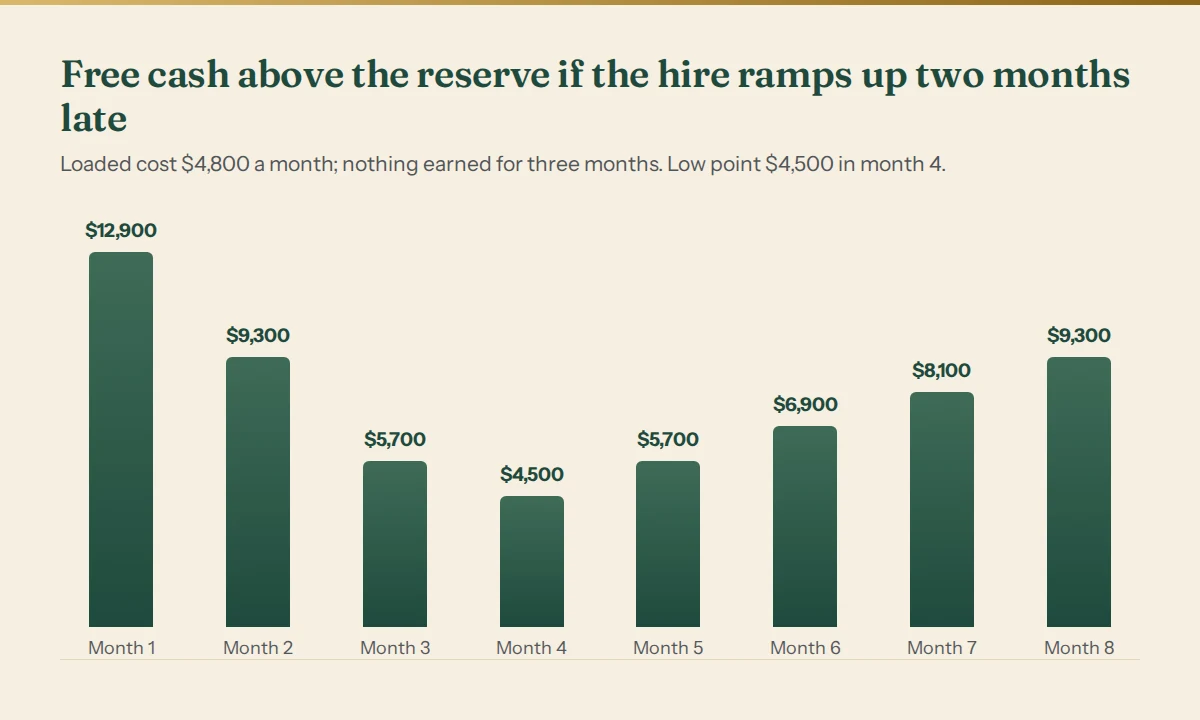
You can afford a hire when two things are true: the extra gross profit the role brings in covers its fully loaded cost, and your cash stays above your reserve during the months before it does. Most owners check only the first. The second is the one that breaks payroll — for the business below, a two-month delay in the new person getting productive takes the cash cushion from $11,700 down to $4,500.
This is a question of timing as much as profit. A hire that is clearly profitable in month six can still be unaffordable in month two.
The two tests
Test 1 — does the role pay for itself?
Revenue the role must add each month = fully loaded monthly cost ÷ your gross margin.
"Fully loaded" means the wage plus everything that comes with it: employer payroll taxes, insurance, benefits, paid leave, equipment and software seats. The load varies by country and by contract, so use your own figures; the example below uses 20% purely to keep the arithmetic readable.
Test 2 — does your cash survive the ramp?
Month by month, from today: free cash + your current monthly surplus + the extra gross profit the role has brought in so far − the loaded cost. Free cash means cash above your reserve, after one-off hiring costs. If that running balance never goes below zero, the reserve is untouched.
Step by step
- Price the role fully loaded — wage plus your real on-costs.
- Divide by your gross margin to get the revenue the role needs to generate.
- Write a realistic ramp: how much of that revenue arrives in month one, two, three.
- Start from cash above your reserve, minus one-off costs such as recruiting and equipment.
- Walk the months forward and find the lowest point.
- Repeat with the ramp two months slower. If the slow version still stays above zero, the hire is affordable on cash as well as on paper.
A worked example
A design agency plans to hire someone at $4,000 a month. With a 20% load the role costs $4,800 a month. The agency's gross margin is 60%, so the role must bring in $8,000 of revenue a month to pay for itself: $4,800 ÷ 0.60.
The agency has $30,000 in cash and keeps a $12,000 reserve. Recruiting and a laptop cost $1,500, which leaves $16,500 of free cash on day one. Without the hire it makes a $1,200 monthly surplus.
The plan: no extra revenue in month one, $4,000 in month two, the full $8,000 from month three.
| Month | Extra revenue | Extra gross profit | Free cash at month end |
|---|---|---|---|
| 1 | $0 | $0 | $12,900 |
| 2 | $4,000 | $2,400 | $11,700 |
| 3 | $8,000 | $4,800 | $12,900 |
| 4 | $8,000 | $4,800 | $14,100 |
The low point is $11,700 above the reserve. On plan, the hire is comfortably affordable.
The slow version: nothing for three months, $4,000 in month four, full revenue from month five. Free cash falls to $12,900, $9,300, $5,700, then bottoms out at $4,500 in month four before it recovers. Still above the reserve — but with a third of the cushion, and one lost client away from trouble.
The ceiling: on the slow ramp, the most this role could cost fully loaded without ever touching the reserve is $5,925 a month. That is the useful number when you negotiate salary: above it, you are betting the reserve on the ramp going to plan.
Common mistakes
- Budgeting the salary, not the loaded cost. On-costs are real cash and they start on day one.
- Assuming revenue arrives with the person. New people need weeks to become productive, and customers still pay on their usual terms after the work is done.
- Using revenue instead of gross profit. If the role sells work that carries direct costs, only the margin pays the wage.
- Testing only the average month. The dangerous month is the lowest one, usually the second or third.
- Forgetting the one-off costs — recruiting fees, equipment, the overlap while you train someone.
FAQ
How much cash should I have before hiring?
Enough that the month-by-month balance never falls below your reserve, even on a slow ramp. A rule of thumb in months of salary cannot tell you that, because it ignores your margin, your current surplus and how fast the role earns.
Is a contractor cheaper than an employee?
Often per hour it is not, but it is more flexible: you can stop paying when work stops. Run the same two tests with the contractor's rate and no one-off costs, and compare the low points.
What if the role does not generate revenue directly?
Then test 1 becomes "which costs does it remove or which capacity does it free up?" — for example the owner hours it releases for sales. Test 2 is unchanged: the cost is certain, the benefit is not, so the cash walk matters even more.
Can I hire part-time first?
Yes, and the same method tells you whether it helps: a lower loaded cost raises the low point during the ramp. Run both and compare.
Quick check first: the free hiring cash calculator runs a hire month by month from your own numbers — full monthly cost, lowest cash balance, payback month and the largest salary your cash can carry above its reserve.
Check your own numbers
The Business Decision X-Ray includes a Decision Lab that tests a hire against your whole business day by day — payroll dates, customer payment terms, quarterly tax — and gives the largest safe monthly cost from a start date you choose. Open demo of every section, no sign-up; then from $40 a month.
This is decision support, not financial, tax, legal or employment advice. Employer on-costs depend on where you are; check them with your accountant or payroll provider.

