
Commission clawback calculation: tiers, splits and returns
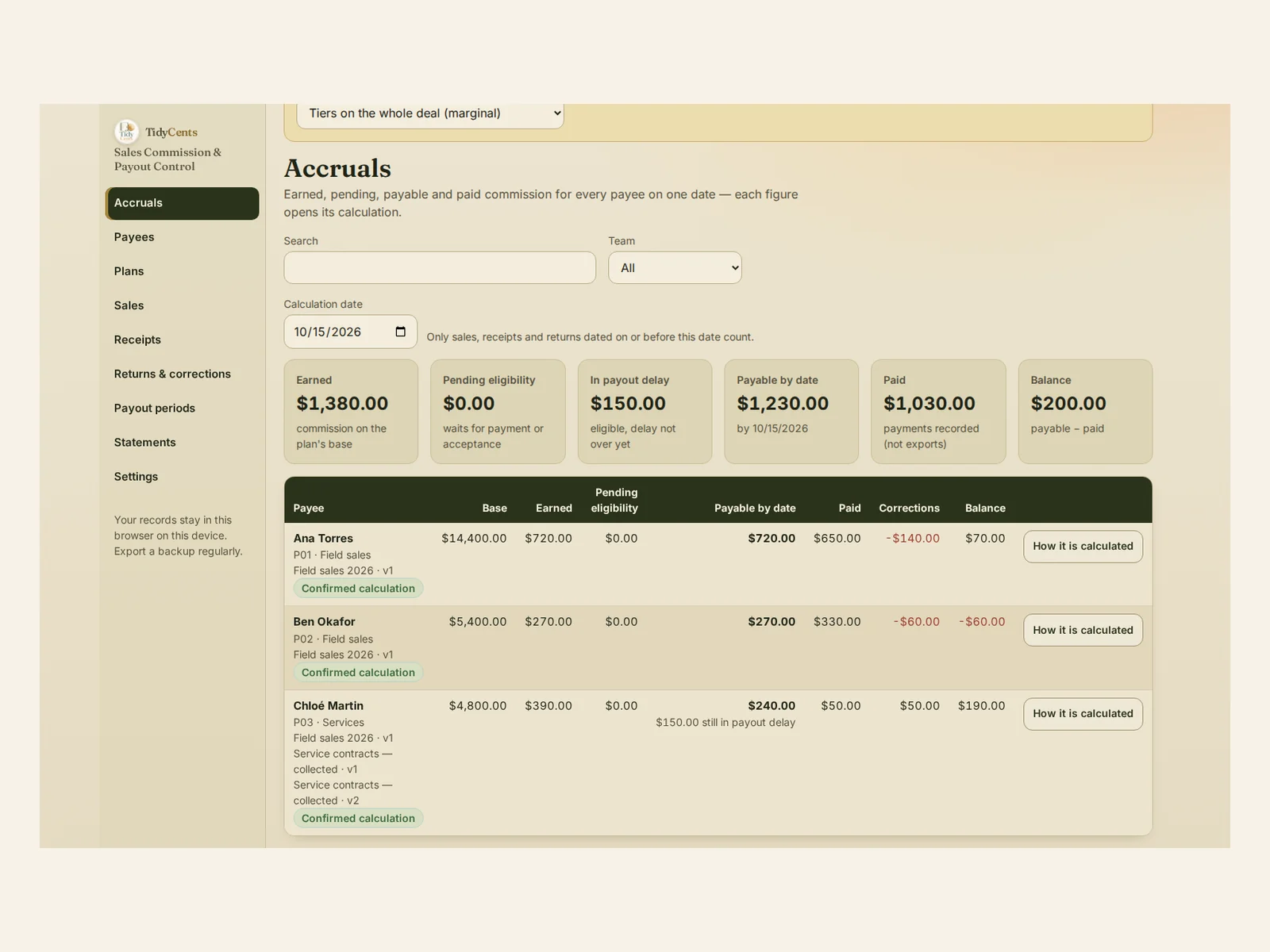
A commission clawback is calculated as the new target commission after the return minus the commission already posted for that sale, using the original period and the original plan version. The difference is posted as a correction in the next open period; the closed period is not rewritten, and a negative balance is a figure to discuss, not an automatic pay deduction. In the example below, a $2,000 return on a $12,000 deal turns $700 of commission into $500, so the two sellers get corrections of −$140 and −$60.
Why commission is harder than a percentage
The rate is the easy part. The hard part is which money earned it and when:
- Tiers can be marginal or retroactive. The same sale can pay very different amounts.
- Split deals need a rule. Tiers can apply to the whole deal or to each seller's own total for the period.
- Collected revenue is not the invoice. Part of a payment is tax, and part of the invoice may still be unpaid.
- Returns arrive late. Often after the period was approved and paid.
- Corrections must not repeat. Running the calculation again should never post the same clawback twice.
The formula
- Marginal tiers = each part of the base × the rate of its own tier.
- Retroactive tiers = the whole base × the rate of the highest tier reached.
- Collected net base = payment received × net amount ÷ invoice total including tax.
- Seller's commission = commission of the deal × the seller's share (deal scope), or tiers on the seller's own share of the base (seller scope).
- Clawback or correction = new target commission − commission already posted.
A worked example
The numbers come from the plan used in the demo of Sales Commission & Payout Control: 5% on the first $10,000 of net sales in a month and 10% above it. A $12,000 deal is split 70/30 between two sellers.
Marginal or retroactive?
| Method | Calculation | Commission |
|---|---|---|
| Marginal | $10,000 × 5% + $2,000 × 10% | $700 |
| Retroactive | $12,000 × 10% | $1,200 |
Whole deal or each seller? With tiers on the whole deal, the $700 is split 70/30: $490 and $210. With tiers on each seller's own base, the $12,000 is split first into $8,400 and $3,600. Both are below $10,000, so both earn 5%: $420 and $180. Neither answer is wrong, which is why the plan has to say which one applies before anything is calculated.
Commission on collected revenue. An invoice is $1,000 before tax plus $100 tax. The customer pays $550. The collected net base is $550 × 1,000 ÷ 1,100 = $500, and at 10% the commission is $50 — not $55, because tax never earns commission.
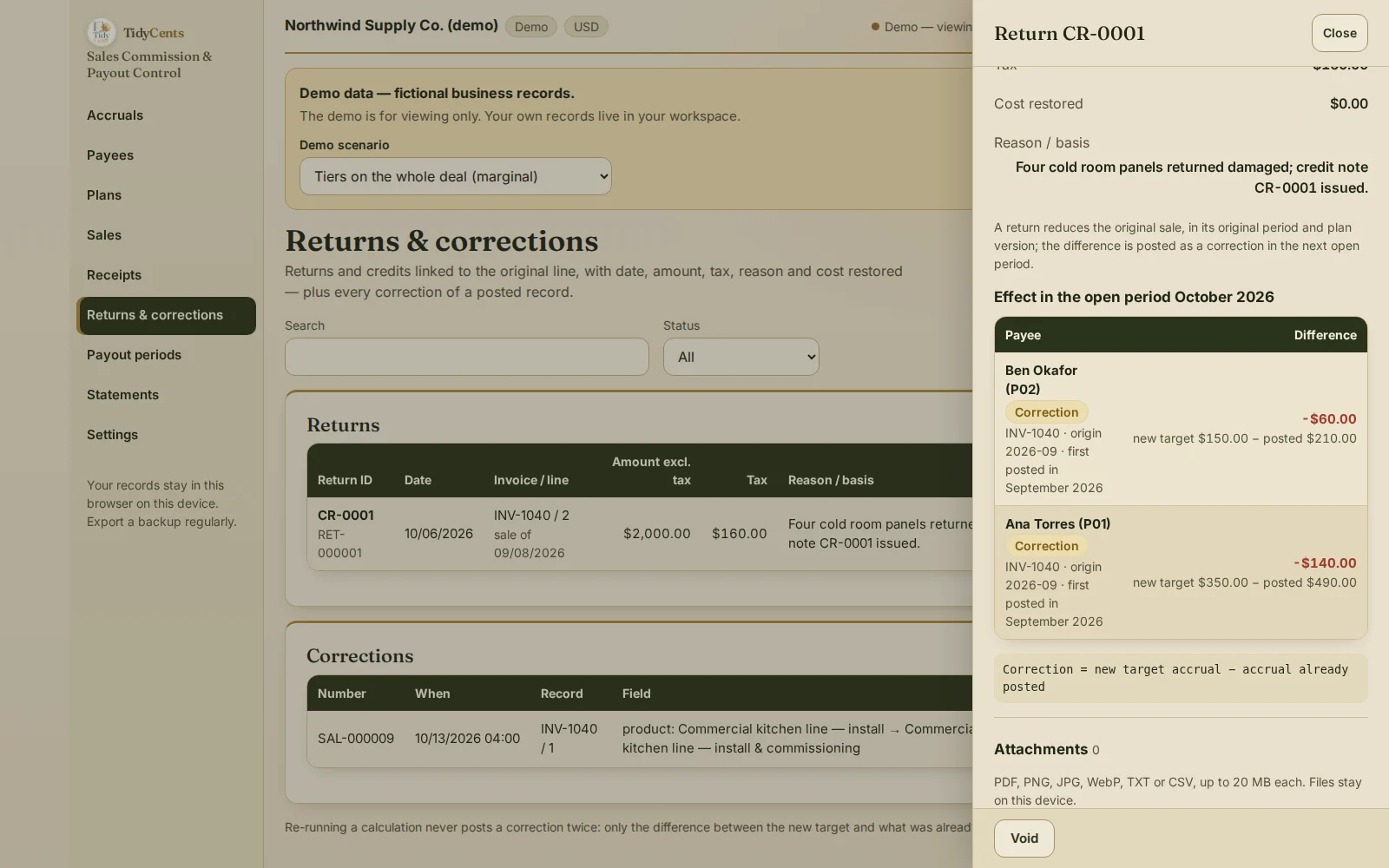
A return after the period was paid. In the demo, the $12,000 deal from September was approved with $490 and $210. On October 6 the customer returns four damaged panels worth $2,000 before tax. The September base becomes $10,000, so the new target is $500: $350 and $150.
| Seller | Posted in September | New target | Correction in October |
|---|---|---|---|
| Seller A (70%) | $490 | $350 | −$140 |
| Seller B (30%) | $210 | $150 | −$60 |
The second seller had already been paid $330 against $270 payable on the calculation date, so the statement shows a balance of −$60. The tool never takes it from pay automatically; how it is settled is a decision for you and your plan.
Step by step: calculate commission and clawbacks
- Write the plan as a dated version: base (net sales, collected revenue or gross profit), method, tiers and accumulation period.
- Decide the scope for split deals: whole deal or each seller's own base.
- Record each invoice line without tax, with sellers and shares that add up to 100%.
- Allocate payments to invoice lines and tax when commission is paid on collected revenue.
- Link every return to the original line, period and plan version.
- Post the difference between the new target and the amount already posted in the next open period.
- Keep earned, payable and paid apart, and record actual payments separately from exports.
- Give each seller a statement that shows the base, tiers, rounding and share.
Common mistakes
- Mixing marginal and retroactive tiers. On a $12,000 deal the difference is $500.
- Paying commission on tax. Only the net amount is a commission base.
- Rewriting a closed period. The original record and the correction should both stay visible.
- Clawing back twice. A second run must post only what has not been posted yet.
- Deducting a negative balance from pay by default. That depends on your agreement and the law where you operate.
- Counting an export as a payment. A payroll file is not money paid.
When a tool helps
A spreadsheet can multiply a rate. It rarely keeps plan versions, splits deals with an explicit scope, allocates partial payments to tax and lines, links returns to the original period and posts a correction only once. Sales Commission & Payout Control does, and every payout opens its calculation. It applies the plan you enter; it does not decide wage entitlement, payroll taxes or whether a deduction is permitted. Exact arithmetic, no AI guesses. To check hours and pay before payroll, see Shift-to-Pay Control.
Open the demo with the deal above — every screen, no sign-up — then enter your own plan, sales and returns.
Related guides: check timesheets before payroll, the true cost of a return and how to collect overdue invoices.
FAQ
How is a commission clawback calculated?
Recalculate the commission of the original period with the return included, then subtract what was already posted. In the example, $500 − $700 = −$200, split −$140 and −$60.
What is the difference between marginal and retroactive tiers?
Marginal tiers pay each rate only on the part of the base inside that tier. Retroactive tiers pay the highest rate reached on the whole base. On $12,000 with 5% to $10,000 and 10% above, that is $700 against $1,200.
Should a split deal reach the tiers as one deal or per seller?
Either can be right; the plan must say which. On the example deal, tiers on the whole deal give $490 and $210, tiers per seller give $420 and $180.
Do I pay commission on sales tax?
Not when the base is net sales or collected net revenue. A $550 payment on a $1,100 invoice that includes $100 tax carries a net base of $500.
This is decision support, not legal, tax or payroll advice.
Tools mentioned in this guide
 Interactive tool
Sales Commission & Payout Control
Calculate commissions from sales, collected payments and returns, with a clear explanation of every payout.

