
The true cost of a return — and when to exchange
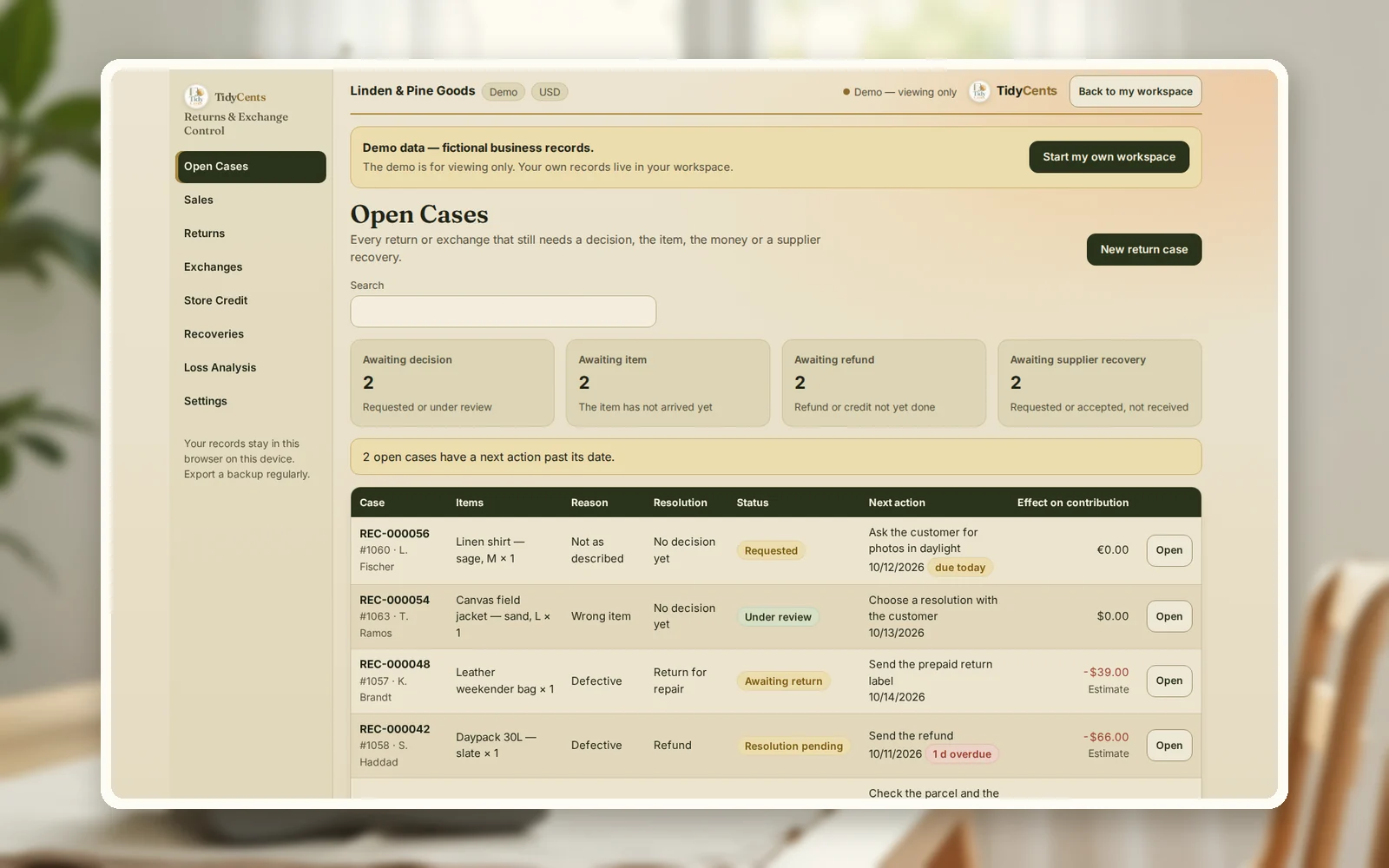
The true cost of a return is the refund, plus the costs of the original order you never get back (outbound shipping and payment fees), plus the return label and handling, minus the value of the item that goes back on the shelf. In the example below, a $100 jacket sale that made $50 of contribution ends at −$20 after a size return: a $70 swing on one order, even though the jacket itself is resold. The same calculation shows that, on another order, an exchange keeps $32 where a refund or store credit ends at −$20.
Why returns cost more than they look
When a customer sends something back, the refund is the visible part. The rest is quieter:
- Original costs stay spent. The outbound shipping and the payment or marketplace fees on the sale are usually not returned to you.
- New costs appear. A return label, inspection, cleaning and repackaging all take money or time.
- The item may not be worth full cost. Back to stock at cost, sold as damaged, or written off — each gives a different number.
- Store credit is not free. It keeps the money in the business, but it is a promise you still have to deliver on.
A shop that only counts refunds sees its return problem at half size.
The formula
For one return case:
- Original contribution = net sale − cost of goods − direct costs of the order (outbound shipping, fees).
- Return impact = − refund (net of tax) − store credit (net equivalent) + exchange supplement − replacement cost of goods − extra costs (return label, handling, replacement shipping) + value of the returned item put back to stock + recoveries confirmed from carriers or suppliers.
- Contribution after the return = original contribution + return impact.
- Returned item value is capped at its original cost: a returned jacket cannot be worth more to you than you paid for it.
Use only what has actually happened for the real result; use estimates to compare options before you decide.
A worked example
The numbers are the demo of Returns & Exchange Control: a fictional small shop selling clothing, bags and ceramics online, at markets and on a marketplace.
A size return, refunded. Order #1042: one canvas jacket for $100, cost $40, outbound shipping $6 and fees $4. Contribution: $50. The customer needed another size and asked for a refund:
| Step | Amount |
|---|---|
| Refund | −$100 |
| Return label | −$8 |
| Inspection and repackaging | −$2 |
| Jacket back to stock at cost | +$40 |
| Return impact | −$70 |
| Contribution after the return | −$20 |
The jacket went back on the shelf, yet the order now loses money: the original $10 of shipping and fees are spent, the return added $10, and the margin is gone.
The same item, three decisions. Order #1063 is the same jacket in another size, also $100 with $50 of contribution; the customer received the wrong item and the case is under review. The comparison uses the same estimates for every option — return label $8, handling $2, item back to stock at $40 — plus, for an exchange into a dearer model, a $20 supplement, $60 cost of the new item and $8 to ship it:
| Decision | Effect on contribution | Result | Cash now |
|---|---|---|---|
| Refund | −$70 | −$20 | −$110 |
| Store credit of $100 | −$70 | −$20 | −$10 (plus $100 still owed as credit) |
| Exchange with supplement | −$18 | $32 | +$2 |
| Replacement without return | −$68 | −$18 | −$8 |
The tool does not recommend an option; it shows them side by side. Here the exchange keeps most of the margin because the item comes back to stock and the customer pays a supplement.
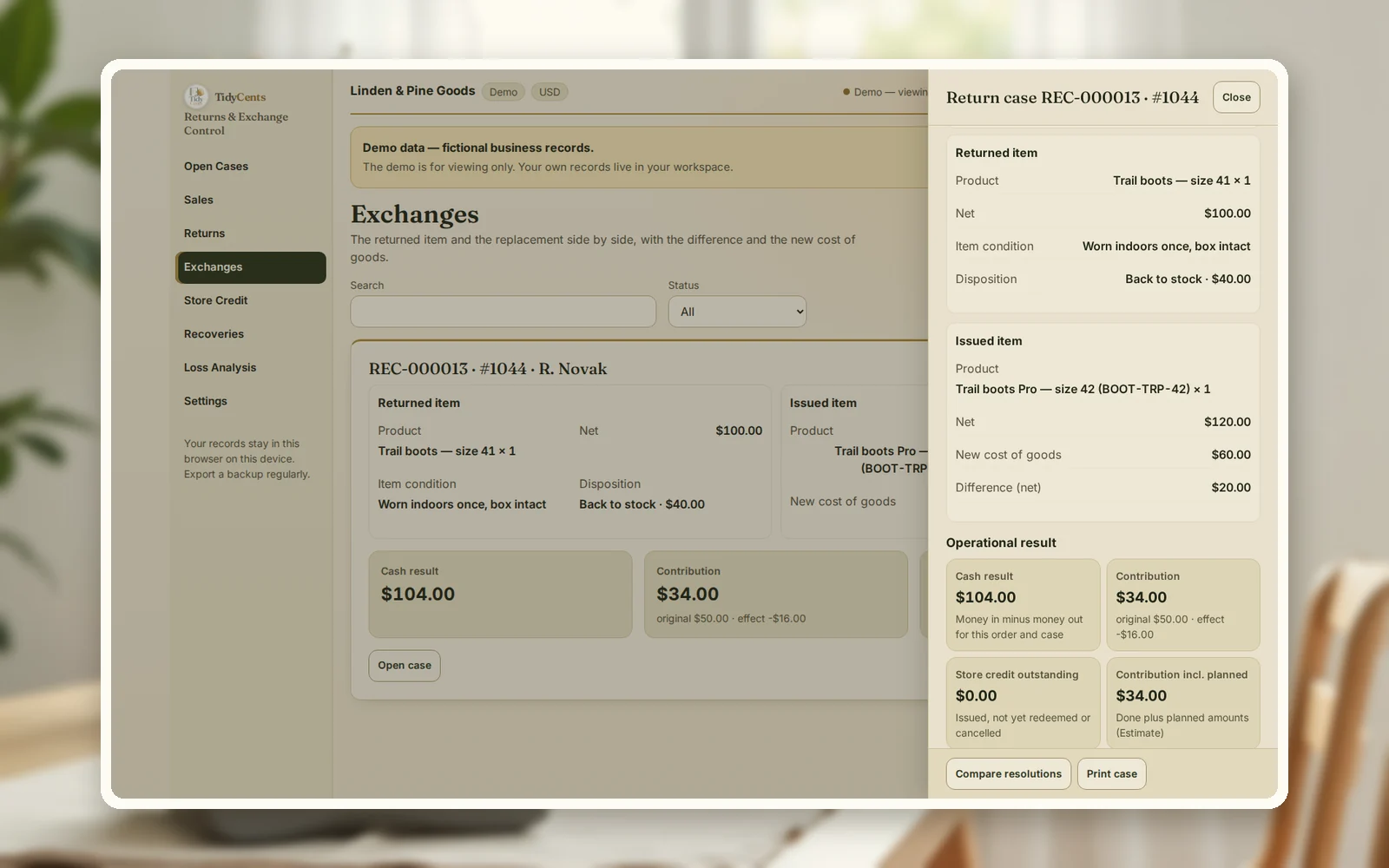
An exchange that happened. Order #1044, trail boots in the wrong size, became an exchange into the Pro model at $120: a $20 supplement, $60 cost of the new pair, $16 of shipping both ways, and the returned pair back to stock at $40. Contribution moved from $50 to $34 — smaller, but positive.
Two less obvious cases. A mug set broken in transit was replaced without asking for the broken mugs back — shipping broken ceramics costs more than it recovers — leaving $2 of contribution, with a $40 claim filed with the carrier that counts only once it is accepted. A scarf returned for store credit of $60 ended at −$8.60, and $30 of that credit is still outstanding: money the shop owes in goods.
Step by step: work out the cost of each return
- Start from the original order: net sale, cost of goods, outbound shipping and fees.
- Record the reason — wrong size, defective, damaged in transit, not as described, changed mind — so patterns become visible.
- Estimate each option before deciding: refund, store credit, exchange, replacement, repair or rejection.
- Decide whether the item must come back. For low-value or broken goods, a return can cost more than it recovers.
- Record what actually happens: refunds, labels, handling, what went back to stock and at what value.
- Claim what you can from carriers or suppliers, and count it only when accepted.
- Review losses by reason, product and supplier each month, and fix the cause — size guides, photos, packaging.
Common mistakes
- Counting only the refund. The lost shipping, fees, label and handling are where the money goes.
- Valuing the returned item at its price. It is worth at most what it cost you, and less if damaged.
- Treating store credit as revenue kept. It is a debt to the customer until it is spent or expires.
- Asking for every item back. Return shipping on a cheap or broken item can exceed its value.
- Forgetting recoveries. A carrier claim or supplier warranty can cover part of the loss — if someone files it.
- Looking at returns one by one. The cause shows only when you group losses by reason, product and supplier.
When a tool helps
A spreadsheet can list refunds. What it rarely does is follow each case from request to close, compare resolutions with the same inputs, track store credit balances and expiry, chase carrier and supplier claims, and group losses by reason. Returns & Exchange Control does that on top of your sales records, with the original tax rate on each refund and the returned item value capped at its cost. Exact decimal arithmetic, no AI guesses. To see what each marketplace order really leaves after fees and shipping before any return, try Marketplace Profit & Price.
Open the demo with the shop above — every screen, no sign-up — then add your own sales and return cases.
Open Returns & Exchange ControlAll sales and daily operations tools
Related guides: real profit per marketplace order, how to respond to a chargeback and is a win-back offer worth it.
FAQ
How much does a return cost a small business?
It depends on the order, but the parts are always the same: the refund, the original shipping and fees you do not get back, the return label, handling, and the value of the item if it cannot be resold at cost. In the example, a $100 jacket with $50 of contribution ended at −$20 after a refunded return.
Is store credit better than a refund?
For cash, usually yes: the money stays in the business. For profit, not by itself — the credit is still owed, and when it is spent the goods leave at their cost. In the example, a $100 store credit and a $100 refund both end at −$20 of contribution.
When should I offer an exchange?
When the customer still wants the product and the returned item can go back to stock. An exchange keeps the sale; a supplement for a dearer item can cover the extra shipping. It is not automatically better — compare it with the same estimates as the other options.
Should I always ask for the item back?
No. If return shipping and handling cost more than the item is worth to you — broken ceramics, low-value goods — a replacement or refund without return can cost less. Keep photos or other evidence for the decision.
Can I recover part of the cost?
Sometimes: from the carrier for transit damage, or from the supplier for defects under warranty. Count a recovery only when it has been accepted or received, not when you file it.
This is decision support, not legal, tax or consumer-rights advice.


