
Real profit per marketplace order, after every fee
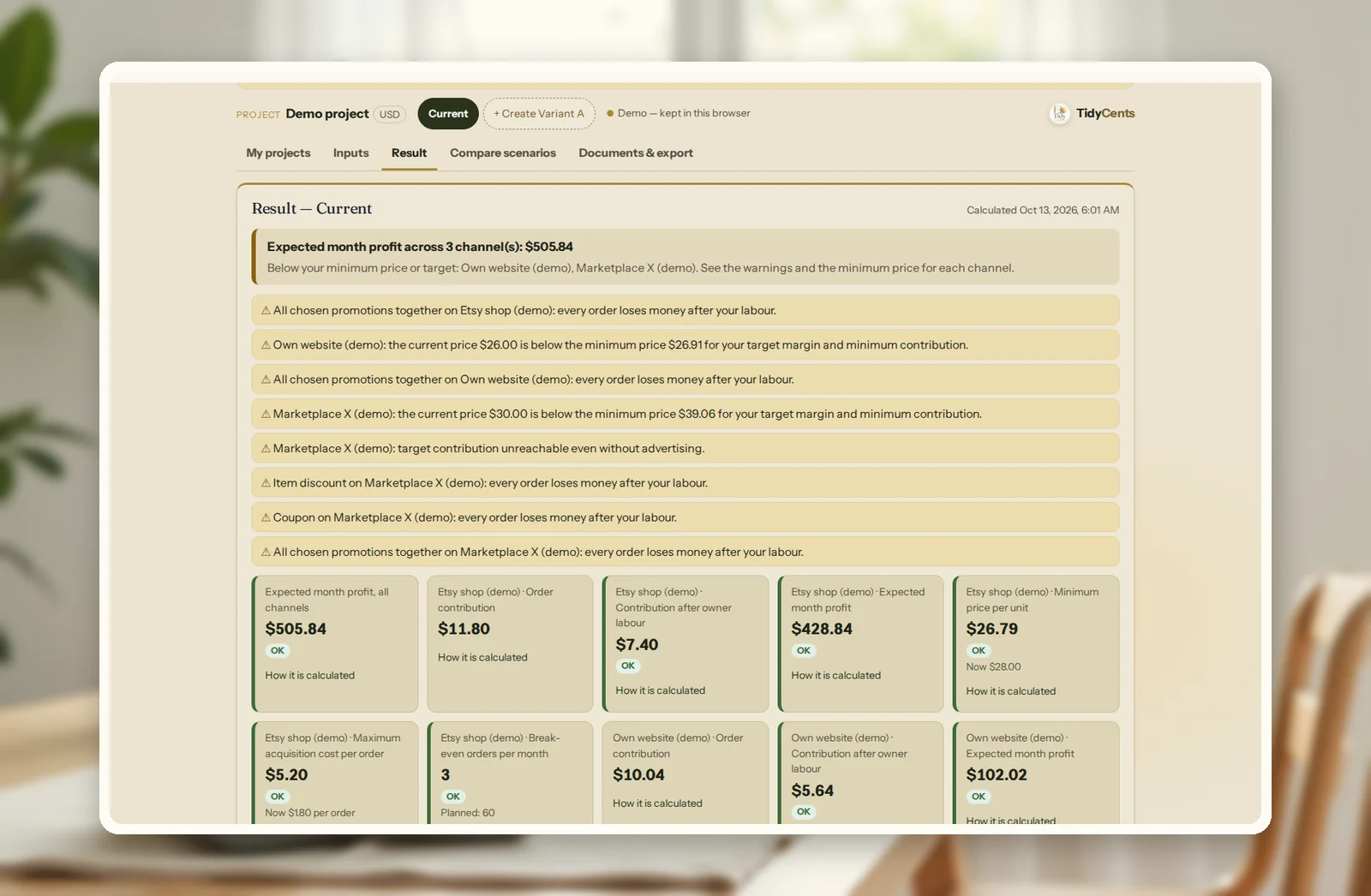
Your real profit per marketplace order is what is left from the price and the shipping the buyer pays after the channel's fees, the cost of the goods, packaging, your shipping cost, advertising, the expected cost of returns and your own time. The same product can leave very different amounts in different channels — and a channel with a higher price can leave the least. In the example below, one candle sold at $28 in a handmade marketplace shop leaves $7.40 per order after labour; on the seller's own website at $26, $5.64; and on a large marketplace at $30, just $0.75 — and that channel loses $25.02 a month after its fixed costs.
Why the price is not the profit
A sale shows the price. Several costs only appear later, and some depend on the price itself:
- Percentage fees grow with the order. A transaction fee on item and shipping, plus a payment fee on the total with tax, adds up quickly.
- Shipping rarely matches. What the buyer pays and what the label costs you are different numbers.
- Advertising is a cost per order. Spend divided by the orders it brings.
- Returns cost more than the refund. Return shipping, handling, value loss and fees you do not get back.
- Your time is a cost. Twelve minutes of packing at your hourly rate is real money.
- Fixed monthly fees need enough orders. A subscription or store plan is paid whether you sell or not.
The formula
- Order value = item price + shipping the buyer pays (tax collected for the state is not yours).
- Fees = each fixed fee + each percentage × its base (item, item and shipping, or total with tax).
- Contribution per order = order value − fees − goods − packaging − other costs − your shipping − ads − expected return cost.
- Profit per order after labour = contribution − your labour per order.
- Margin = profit after labour ÷ order value without tax.
- Break-even orders a month = channel fixed costs ÷ profit per order after labour, rounded up.
- Minimum price = the lowest price at which profit after labour meets both your minimum amount and your target margin.
A worked example
The numbers are the demo of Marketplace Profit & Price: a fictional soy candle sold in three channels with demo fee rates — not any platform's current fees. The candle costs €5.80 from a supplier ($6.32 at 1.09), packaging $1.35, other costs $0.40, and 12 minutes of packing at $22 an hour, so $4.40 of labour per order. The seller wants each order to leave at least $4 and a 20% margin after labour, with 4% of orders returned and half of returns resold.
| Channel | Price + buyer shipping | Fees | Profit per order after labour | Margin | Orders a month | Month after fixed costs |
|---|---|---|---|---|---|---|
| Handmade marketplace shop | $28 + $4.95 | $3.65 | $7.40 | 22.5% | 60 | $428.84 |
| Own website | $26 + $5.50 | $1.21 | $5.64 | 17.9% | 25 | $102.02 |
| Large marketplace | $30, free shipping | $4.50 | $0.75 | 2.5% | 20 | −$25.02 |
The handmade shop charges a $0.20 listing fee, 6.5% on item and shipping ($2.14) and 3% plus $0.25 for payment processing on the total with 7% tax ($1.31). After everything, the order leaves $7.40. Its $15 monthly fee is covered by 3 orders.
The own website has low fees — 2.9% plus $0.30 — but $4.50 of ads per order. The margin is 17.9%, below the 20% target, so the tool sets a minimum price of $26.91, just above the current $26.
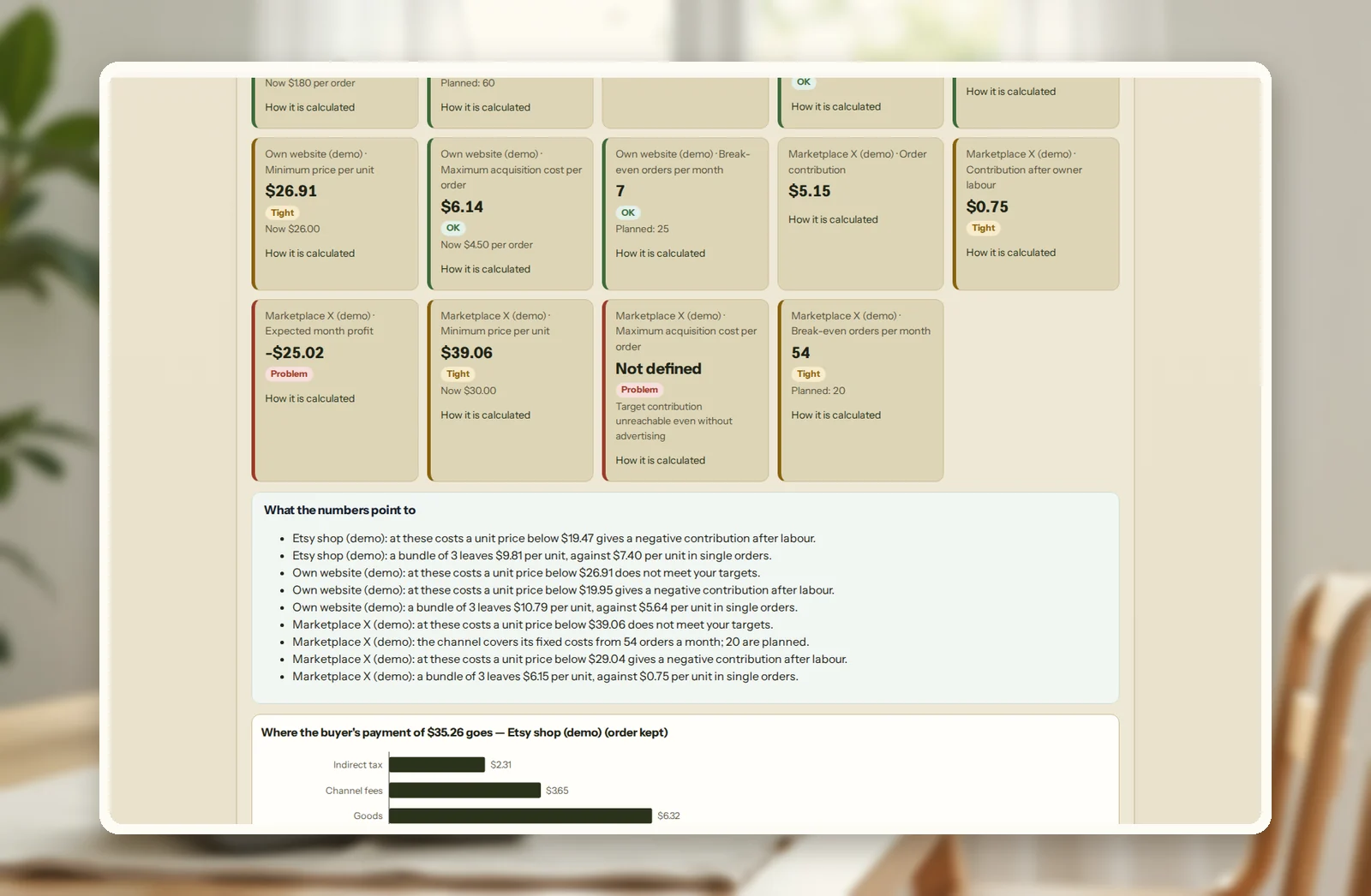
The large marketplace looks strongest on price, but the seller pays $7.20 to ship, a 15% referral fee on prices from $15, $2.50 of ads, and returns twice as often (8%). Each order leaves $0.75, so the $40 monthly fee needs 54 orders — 20 are planned. Below $29.04 every order loses money after labour; reaching the targets would take $39.06.
What a return really costs. On the handmade shop, a returned order that can be resold still costs $16.09, including $6 of return shipping and $1.50 of handling, because the original label and part of the fees are not refunded. A return that must be written off costs $19.41.
Promotions, checked before you run them. On the handmade shop:
| Promotion | Profit per order after labour | Orders a month for the same total |
|---|---|---|
| None | $7.40 | 60 |
| 15% discount | $3.76 | 119 |
| Free shipping | $2.91 | 153 |
| $3 coupon | $4.80 | 93 |
| All three together | −$3.33 | — |
A 15% discount needs almost twice as many orders to earn the same; all three together lose money on every order.
Bundles. A bundle of 3 candles for $72 leaves $9.81 per candle on the handmade shop against $7.40 in single orders, and $10.79 per candle on the own website against $5.64. On the large marketplace, the bundle lifts $0.75 to $6.15 per candle.
Step by step: work out profit per order
- Write down the unit cost in your currency, plus packaging, other per-order costs and your minutes per order.
- List each channel's fees with their base — item, item and shipping, or total with tax — and any price bands.
- Add what the buyer pays for shipping and what you pay, plus ads per order and the channel's monthly fixed costs.
- Set your return assumptions: share returned, share resold, return shipping, handling and value loss.
- Read the profit per order after labour, the margin and the break-even orders for each channel.
- Set a minimum amount and a target margin, and check the minimum price per channel.
- Test promotions and bundles before you run them, with the orders needed to stay level.
- Decide where to push volume, where to raise prices and where to stop selling.
Common mistakes
- Comparing channels by price. Compare by what each order leaves after everything.
- Using the fee headline rate only. Fees on shipping and on tax-inclusive totals add up.
- Forgetting your own time. A channel that only pays for goods and fees is paying you nothing.
- Running a discount without the order count. Check how many more orders it needs.
- Stacking promotions. Each may be fine alone and loss-making together.
- Ignoring returns by channel. A higher return share can wipe out a thin margin.
When a tool helps
A spreadsheet can subtract a fee. It rarely handles fees on different bases, price bands, tax on top, partly refunded fees on returns, resale and write-off cases, labour, fixed monthly costs, promotions and bundles for several channels at once — and solves the minimum price exactly. Marketplace Profit & Price does. Exact decimal arithmetic, no AI guesses. For selling the same product to shops in bulk, see the Wholesale Offer Builder.
Open the demo with the candle above — every screen, no sign-up — then enter your own product and channels.
Open Marketplace Profit & PriceAll costs, pricing and profit tools
Related guides: the true cost of a return, are my ads profitable and how to calculate wholesale price.
FAQ
How do I calculate profit per order on a marketplace?
Start from the item price plus the shipping the buyer pays, then subtract every fee, the goods, packaging, your shipping cost, ads per order, the expected cost of returns and your labour. In the example, a $28 candle leaves $7.40 per order on one channel and $0.75 on another.
Which marketplace fees are easy to miss?
Fees charged on shipping as well as the item, payment fees on the total including tax, fixed per-listing fees, fees that are only partly refunded on returns, and monthly plan or subscription costs.
What is the minimum price I should charge?
The lowest price at which each order still leaves your minimum amount and your target margin after all costs and labour. In the example, it is $26.79 on one channel, $26.91 on another and $39.06 on the third.
Is a discount or free shipping worth it?
Only if it brings enough extra orders. In the example, a 15% discount needs 119 orders a month instead of 60 to earn the same, and free shipping needs 153.
Do bundles make more money per unit?
Often, because fixed costs per order are shared. In the example, a bundle of 3 for $72 leaves $9.81 per candle against $7.40 in single orders.
This is decision support, not tax or legal advice.
Tools mentioned in this guide
 Interactive tool
Marketplace Profit & Price
See what one order really leaves you in each sales channel after fees, shipping, returns, advertising and your own time — and the lowest price and highest ad cost each channel can carry.

