
How to calculate wholesale price for a whole order
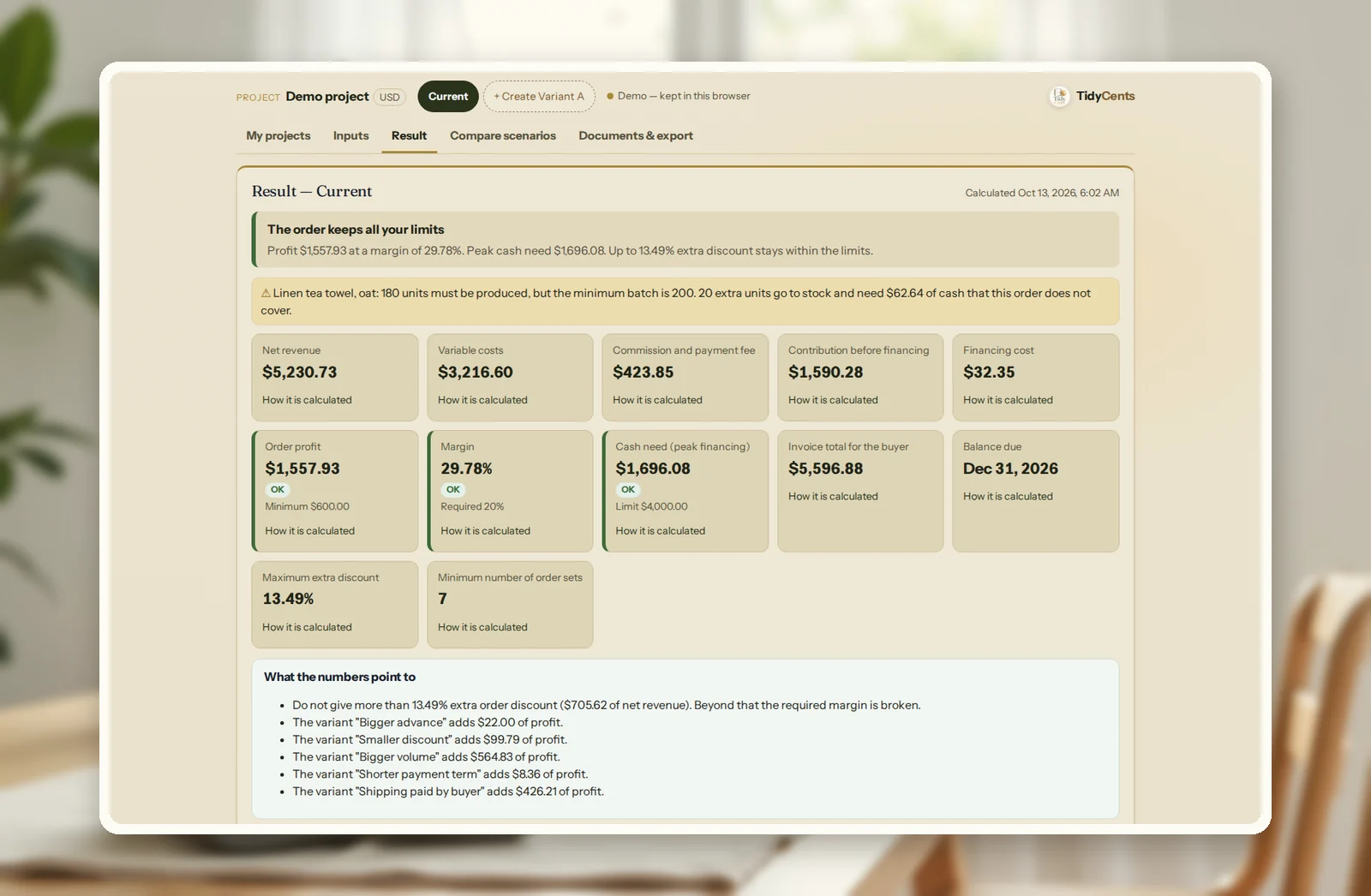
To calculate a wholesale price, start from what each unit costs you, then check the whole order: unit prices and discounts, minus goods, packaging, shipping and preparation, minus sales commission and payment fees, minus the cost of waiting for the money — and compare what is left with the margin and profit you need. A common rule of thumb is half of the retail price, but whether that works depends on the order. In the example below, a maker sells mugs, tea towels and candles to a shop at about half of retail. The order leaves $1,557.93 of profit, a 29.8% margin — and the maker has to carry up to $1,696.08 of cash for 66 days before the shop pays.
Why a per-unit price is not enough
A wholesale order has costs that do not belong to any single unit:
- Order costs are fixed. Packing, freight and preparation cost the same for a small order as for a larger one, up to a point.
- Discounts stack. A line discount plus an order discount adds up quickly.
- Commission and payment fees come off the top. A sales agent's share and the card or transfer fee reduce every invoice.
- Payment terms cost money. Paying for production now and getting paid in 45 days means borrowing or tying up cash.
- Minimum batches create extra stock. Making 180 units in batches of 200 leaves 20 on the shelf.
- Small orders can lose money. The fixed costs need enough units to spread over.
The formula
- Net revenue = units × wholesale price − line discounts − order discount (tax added on top is not yours).
- Variable costs = goods + packaging + shipping + preparation.
- Fees = commission on net revenue + payment fee on the invoice total.
- Contribution = net revenue − variable costs − fees.
- Financing cost = cash you are short each day × annual rate ÷ 365, from when you pay for goods until the customer pays.
- Order profit = contribution − financing cost; margin = profit ÷ net revenue.
- Minimum quantity = (fixed order costs + minimum profit) ÷ contribution per unit, rounded up to packs.
A worked example
The numbers are the demo of Wholesale Offer Builder: a fictional maker quoting a home-goods shop. The maker wants at least a 20% margin and $600 of profit per order, and can borrow up to $4,000 at 12% a year.
The products.
| Product | Cost | Retail | Wholesale | Ordered |
|---|---|---|---|---|
| Stoneware mug | $4.10 | $18 | $9 | 240 |
| Linen tea towel (bought in euros) | €2.90 ($3.13 at 1.08) | $14 | $6.50, 5% line discount | 300 |
| Soy candle | $5.40 | $24 | $11.50 | 120 |
The order. With a further 3% order discount, 660 units bring $5,230.73 of net revenue, plus 7% tax added on top for a total of $5,596.88.
- Goods: $2,571.60.
- Packaging $85, shipping $420 and preparation $140: $645 of order costs.
- A 5% sales commission ($261.54) and a 2.9% payment fee on the total ($162.31): $423.85.
- Contribution: $1,590.28.
- Financing at 12% while waiting for payment: $32.35.
- Profit: $1,557.93, a 29.8% margin — above both targets.
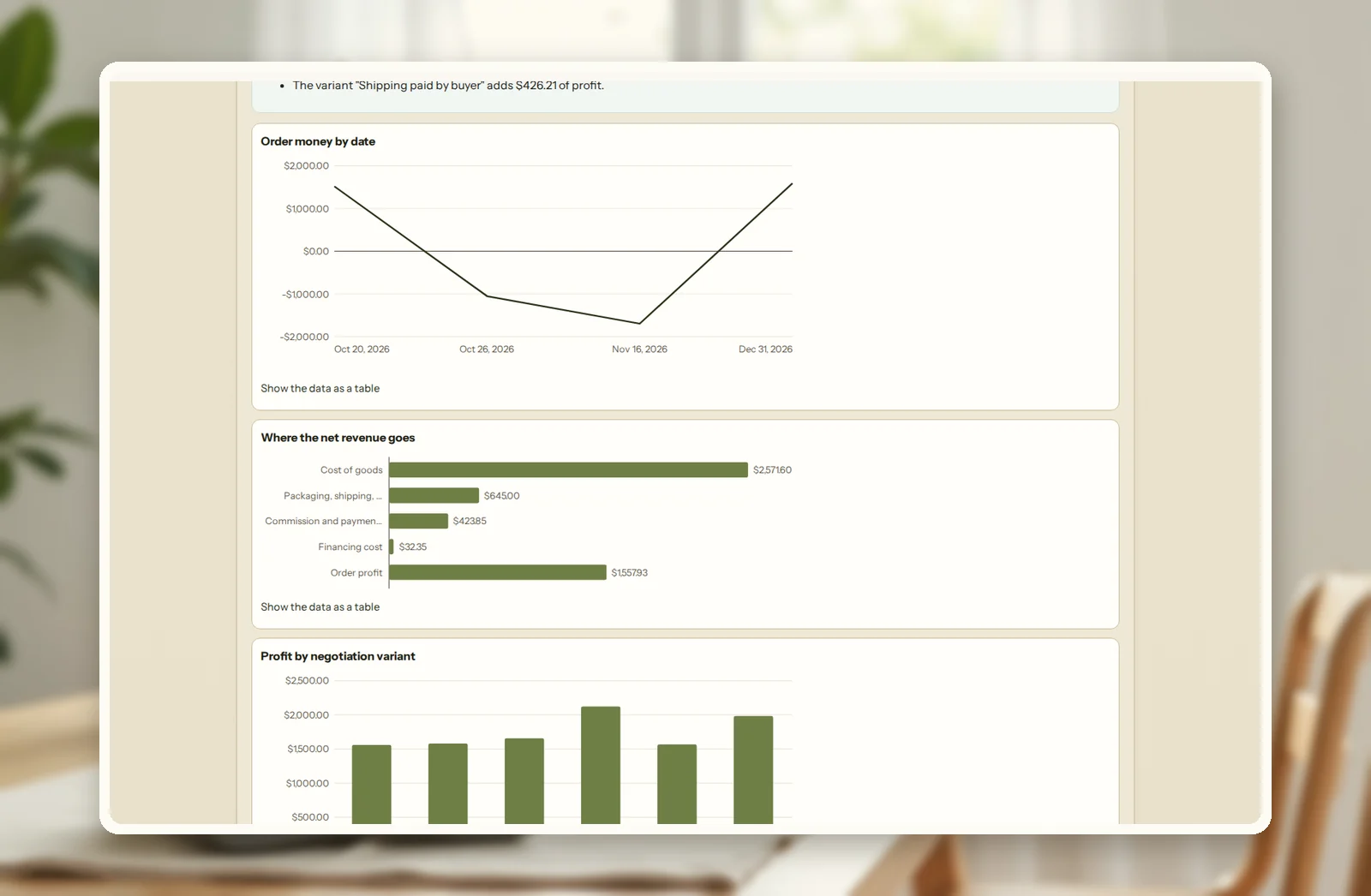
The cash gap. The shop pays a 30% advance ($1,679.06). The maker then pays $2,571.60 for production, and $645 of order costs at shipment, so the account is short by up to $1,696.08 until the balance of $3,917.81 arrives 45 days after shipping — 66 days of borrowed money in all.
Supply. All 240 mugs come from stock. Of the 300 tea towels, 120 are in stock; the other 180 are made in a minimum batch of 200, leaving 20 extra worth $62.64. The 120 candles are made to order and are ready a week before shipping.
Minimum order per product. To reach $600 of profit on its own, an order of just one product needs at least 318 mugs, 530 tea towels or 258 candles.
How far you can bend. The tool calculates that an extra discount of up to 13.49% ($705.62) would still keep the margin at 20% — the margin, not the profit, is the binding limit.
Small sampler sets. A starter set of 24 mugs, 30 tea towels and 12 candles sold once loses $433.30, because the $645 of order costs do not shrink; 7 sets in one order make $894.19.
Negotiation variants.
| Variant | Profit | Cash you carry |
|---|---|---|
| As quoted | $1,557.93 | $1,696.08 |
| 50% advance | $1,579.93 | $682.39 |
| 1% order discount instead of 3% | $1,657.72 | $1,664.72 |
| 25% more units | $2,122.76 | $1,965.80 |
| 30-day terms instead of 45 | $1,566.29 | $1,696.08 |
| Buyer pays shipping | $1,984.14 | $1,276.08 |
A bigger advance halves the money you have to carry; asking the buyer to pay shipping adds $426.21 of profit.
Step by step: price a wholesale order
- Write down unit cost for each product, including the currency you buy in.
- Set wholesale prices and any quantity tiers, and compare them with retail.
- Build the order with quantities, line discounts and an order discount.
- Add order costs: packaging, freight and preparation.
- Add commission and payment fees on the right base.
- Set payment terms: advance, production date, shipping date and days to pay.
- Check profit, margin and the cash gap against your limits.
- Test variants — a bigger advance, shorter terms, buyer-paid shipping, more units — before you send the offer.
Common mistakes
- Using half of retail without checking costs. It may not cover order costs on a small order.
- Forgetting freight and preparation. They are paid once per order, whatever its size.
- Agreeing long terms without counting the cash. 45 days can mean borrowing to fund production.
- Selling sampler sets one at a time. Fixed order costs can turn them into losses.
- Discounting past your floor. Know how much you can give before you start.
- Ignoring minimum batches. Extra units tie up cash until they sell.
When a tool helps
A spreadsheet can multiply units by a price. It rarely handles tiers, line and order discounts, tax on top, currency, order costs, commission and fee bases, minimum batches, stock, a dated cash calendar with financing, minimum quantities, the maximum concession and negotiation variants together. Wholesale Offer Builder does, and prints the offer for the buyer. Exact decimal arithmetic, no AI guesses. To price single orders on marketplaces and your own site, see Marketplace Profit & Price.
Open the demo with the order above — every screen, no sign-up — then build your own wholesale offer.
Open Wholesale Offer BuilderAll costs, pricing and profit tools
Related guides: how to set a customer credit limit, real profit per marketplace order and small-batch production planning.
FAQ
How do I calculate a wholesale price?
Start from unit cost and set a price per unit, then check the whole order: net revenue minus goods, order costs, commission, payment fees and the cost of waiting for payment. In the example, prices at about half of retail leave $1,557.93 of profit on a $5,230.73 order.
Is wholesale price always half of retail?
It is a common starting point, not a rule. In the example, the mug sells at $9 against $18 retail, but whether that works depends on order costs, discounts, fees and payment terms.
What is a good wholesale margin?
The one you set as your minimum, after all costs. The demo uses at least 20% and $600 of profit per order; the quoted order reaches 29.8%.
How do I set a minimum wholesale order?
Divide fixed order costs plus the profit you want by the contribution per unit, and round up to whole packs. In the example, an order of mugs alone needs at least 318 to reach $600 of profit.
Should I offer payment terms to wholesale buyers?
Only after you count the cash you will carry. In the example, 45-day terms mean up to $1,696.08 short for 66 days; a 50% advance would cut that to $682.39.
This is decision support, not tax or legal advice.
Tools mentioned in this guide
 Interactive tool
Wholesale Offer Builder
Build a wholesale offer from your own costs and see its profit, the financing it needs, the minimum order and the largest discount you can still give.

