
How to set a customer credit limit and a safe deposit
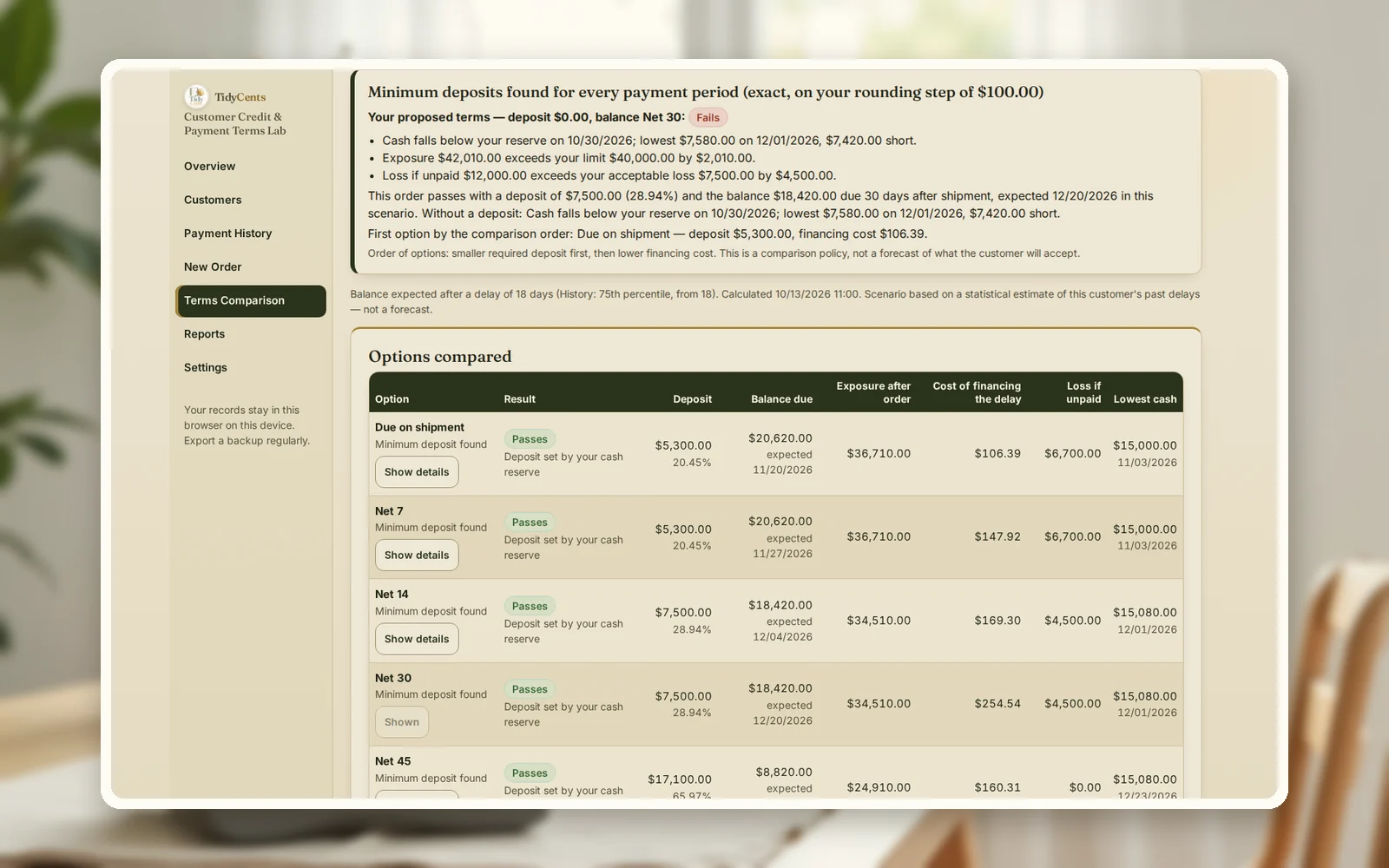
Set the credit limit before the order, not after it: decide the most this customer may owe you at once and the most you can afford to lose if they never pay. Then test every order against three things — the limit, the acceptable loss and your cash reserve on every day until the money arrives. If the order fails any of them, the answer is not "no", it is a deposit or shorter terms large enough to pass all three. In the example below, Net 30 with no deposit fails all three tests; Net 30 with a $7,500 deposit passes.
Late payment is common enough to plan for. The EU Payment Observatory reports that more than half of companies had late-payment difficulties in 2024, and that longer payment terms go with longer actual payment periods in 87% of the cases it analysed.
Why "they are a good customer" is not a credit decision
Terms are a loan. When you ship on Net 30 you pay the materials, the wages and the tax now, and the customer pays later — sometimes much later. Three different things can go wrong, and each has its own number:
- Exposure grows. Every open invoice adds to what the customer owes you. A long, friendly relationship is exactly how exposure creeps past what you would ever agree to in one go.
- The loss you can absorb is smaller than the invoice. If they do not pay, you lose the cash you already spent plus the cost of chasing, minus what you can recover.
- Your cash dips before their money arrives. Payroll and rent do not wait for their payment date.
A good payment history lowers the odds of a problem; it does not change the size of the problem if it happens.
The formula
- Exposure after the order = what the customer already owes + this order's unpaid balance. It must stay ≤ the credit limit.
- Loss if unpaid = costs you pay for the order + collection cost − what you can recover − deposit. It must stay ≤ the acceptable loss.
- Cash test = today's cash + receipts − payments, day by day, with the customer's money arriving on the due date plus their usual delay. It must stay ≥ your reserve.
- Financing cost = unpaid balance × your cost of money × days waited ÷ 365.
- Smallest safe deposit = the largest of the three shortfalls (over the limit, over the loss, under the reserve), rounded up.
A worked example
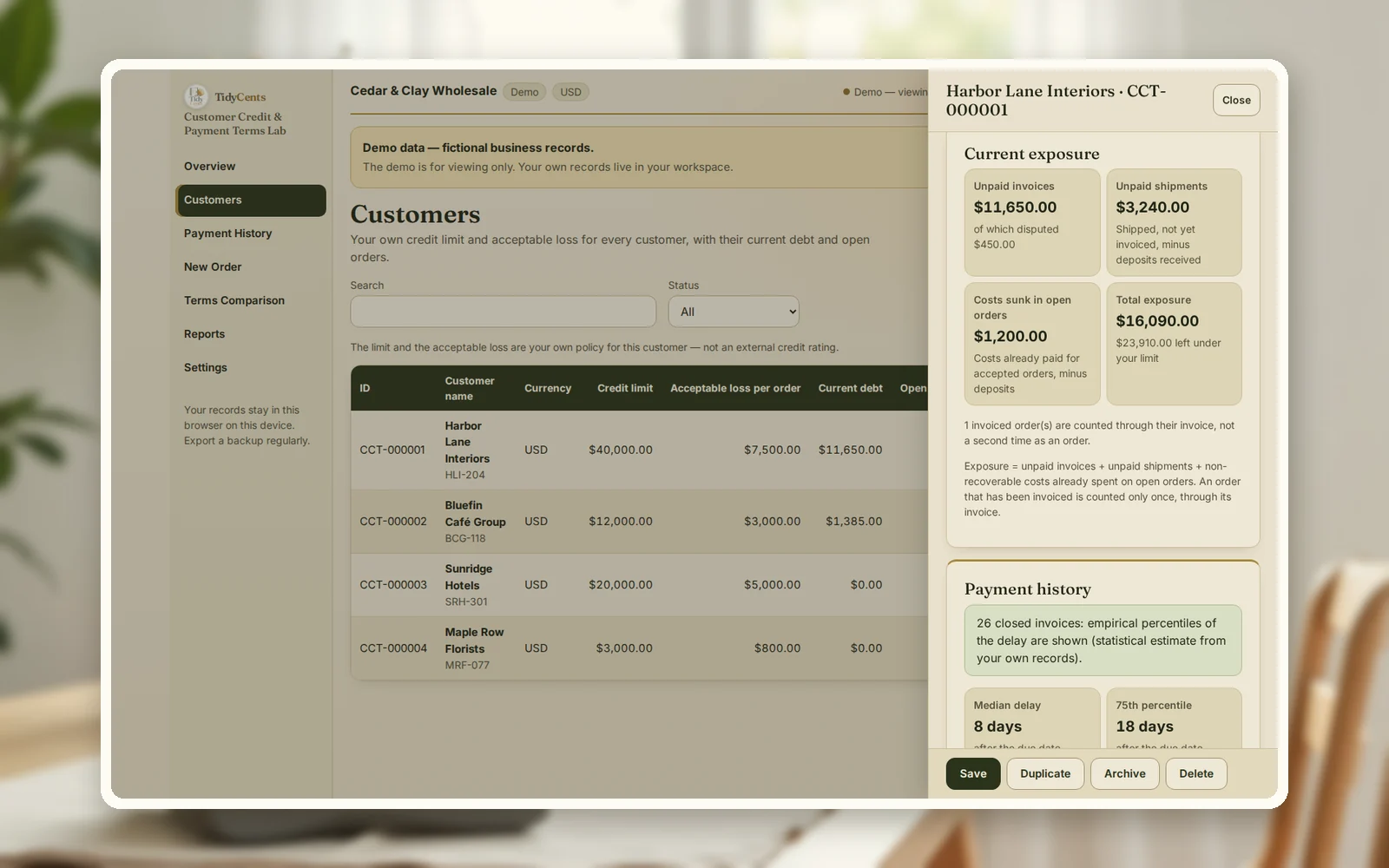
The numbers come from the demo of the Customer Credit & Payment Terms Lab: a fictional ceramics studio and its customer Harbor Lane Interiors. The studio set a $40,000 credit limit and a $7,500 acceptable loss for this customer, who already owes $16,090. The studio has $40,000 in the bank and a $15,000 reserve.
The new order: 1,200 glazed vases for $24,000 plus $1,920 tax — $25,920 in total, with a gross profit of $8,400. The studio pays $14,500 for materials before shipping and $600 after; it could recover about $4,000 of goods if things went wrong, and chasing would cost about $900. From the customer's own payment history, the lab finds that at the 75th percentile they pay 18 days after the due date. The customer asks for Net 30 without a deposit.
| Terms | Deposit | Exposure (limit $40,000) | Loss if unpaid (max $7,500) | Lowest cash (reserve $15,000) | Passes? |
|---|---|---|---|---|---|
| Net 30, no deposit | $0 | $42,010 | $12,000 | $7,580 | No — all three fail |
| Due on delivery | $5,300 (20.45%) | $36,710 | $6,700 | $15,000 | Yes |
| Net 30 | $7,500 (28.94%) | $34,510 | $4,500 | $15,080 | Yes |
| Net 45 | $17,100 (65.97%) | $24,910 | $0 | $15,080 | Yes |
Read the first row first. Net 30 without a deposit would push the customer $2,010 over the limit, put $12,000 at risk against an acceptable $7,500, and take the studio's cash below its reserve for 32 days, starting with the payroll at the end of October, with a low of $7,580. That is three separate reasons to say "not like this".
The second and third rows show what would work. Net 30 passes with a $7,500 deposit — about 29% of the invoice. The binding constraint is the cash reserve, not the credit limit: the limit alone would need only $2,010, and the loss rule $4,500. Longer terms need much more up front, because the money arrives after the December payroll and the kiln lease.
Two more figures help the negotiation. Waiting costs money: at an 11% cost of money, carrying the $18,420 balance for 48 days costs $254.54. And if the customer offers to pay 10 days early, that is worth at most $201.79 to the studio — about 1.1% of the balance — so an early-payment discount larger than that would cost more than it saves.
Step by step: set a limit and test an order
- Write down two numbers per customer: the most they may owe you at once (credit limit) and the most you could lose without real damage (acceptable loss).
- Add up what they owe today — all open invoices, minus credit notes.
- Enter the order as cash: price, tax, what you pay before and after shipping, and when.
- Use their real delay, not the contract: how late do they usually pay? A high percentile is safer than the average.
- Put the payment on your cash calendar with payroll, rent and suppliers, and find the lowest day.
- Check the three tests; if any fails, find the smallest deposit or shortest term that passes all three.
- Decide what to offer: a deposit, staged payments, shorter terms, or a smaller first order.
Common mistakes
- Setting the limit after the order. By then the conversation is about the customer, not your numbers.
- Counting the whole invoice as the risk. The loss is your spent cash plus collection cost, minus what you can recover.
- Using the contract term as the payment date. Use the customer's actual history; here it adds 18 days.
- Forgetting tax. You may owe the tax before the customer pays it to you.
- Offering an early-payment discount without pricing it. Here, more than $201.79 for 10 days would be a loss.
- Treating unknown risk as zero. If you do not know the chance of non-payment, the lab shows the loss rule instead of guessing a probability.
When a tool helps
One order against one limit fits on a notepad. Several customers with partial payments, credit notes and different delays do not. The Customer Credit & Payment Terms Lab keeps each customer's limit, acceptable loss and payment history, measures their real delay, tests every combination of deposit and terms against your cash calendar and shows which constraint binds — with "How calculated" next to each figure. Exact decimal arithmetic, no AI guesses. For a quick first check, the free payment terms calculator and deposit calculator give the one-off numbers.
Open the demo with the ceramics studio above — every screen, no sign-up — then add your own customers and orders.
Open the Customer Credit & Payment Terms LabAll decision and cash-flow tools
Related guides: how much deposit to ask for, what if my biggest client pays late and how to collect overdue invoices.
FAQ
How do I set a credit limit for a new customer with no history?
Start small and grow it with evidence. A common approach is to limit the first orders to what you could lose without damage, ask for a deposit, and raise the limit after several invoices are paid on time. Without history, use a cautious delay assumption rather than the contract term.
What is a reasonable deposit for Net 30?
There is no single percentage. The right deposit is the smallest one that keeps exposure under the limit, the loss under what you can accept and your cash above its reserve — in the example, $7,500 or about 29%. A different month, with payroll on another date, can give a different answer.
Should I offer an early-payment discount?
Only if it costs less than the money is worth to you. Value the days saved at your cost of money: here, paying 10 days early is worth at most $201.79. A discount above that pays the customer more than you gain.
Does credit insurance or a guarantor replace this check?
They can reduce what you can lose, and you can enter that as a smaller acceptable loss or a larger recoverable amount. They do not change when cash arrives, so the reserve test still applies. Check the policy terms with the provider.
What if the customer refuses a deposit?
Offer shorter terms, staged payments or a smaller first delivery, and test each one. If none passes, the order as asked is a risk you have measured and decided against — not a sale you lost by being careful.
Sources
- European Commission, EU Payment Observatory — analysis and Annual Report 2025 — more than half of companies reported late-payment difficulties in 2024; longer terms associated with longer payment periods in 87% of cases.
This is decision support, not financial, credit or legal advice.
Tools mentioned in this guide
 Interactive tool
Customer Credit & Payment Terms Lab
Test a customer’s next order against your credit limit, cash reserve and acceptable loss before agreeing to payment terms.

