
How much deposit should I ask for on a big order?

Ask for at least enough to cover the costs you pay before the customer does, minus the cash you can spare without going below your reserve. As a percentage: minimum deposit % = (costs paid before payment − free cash) ÷ order price. In the example below that is 35% — below it, a profitable order would take the business under its reserve before the customer pays a cent.
A deposit is not about trust. It is about who finances the order while it is being made, and for how long.
The formula
- Costs paid before payment — materials, subcontractors and labour you pay between accepting the order and receiving the final payment.
- Free cash — cash above your reserve that the rest of the business does not need during those weeks.
- Cash gap = costs paid before payment − free cash.
- Minimum deposit = cash gap ÷ price. If the gap is zero or negative, you do not strictly need a deposit, though you may still want one.
Two more numbers help you set the price and the terms:
- Days until paid = production days + payment terms (+ the lateness this customer usually adds).
- Price floor = direct cost + the cost of financing that cost until you are paid (direct cost × your cost of money × days ÷ 365). Below it, the order loses money once you count the money tied up in it.
Step by step
- List every cost of the order and when you pay it.
- Add up the part paid before the customer's final payment.
- Take your free cash for the same weeks — cash above your reserve, after the rest of the business's bills.
- Compute the gap and divide by the price. Round up, not down.
- Add a margin if the customer has paid late before, or if production could run over.
- Check the price floor so the deposit is not hiding an order that does not pay.
A worked example
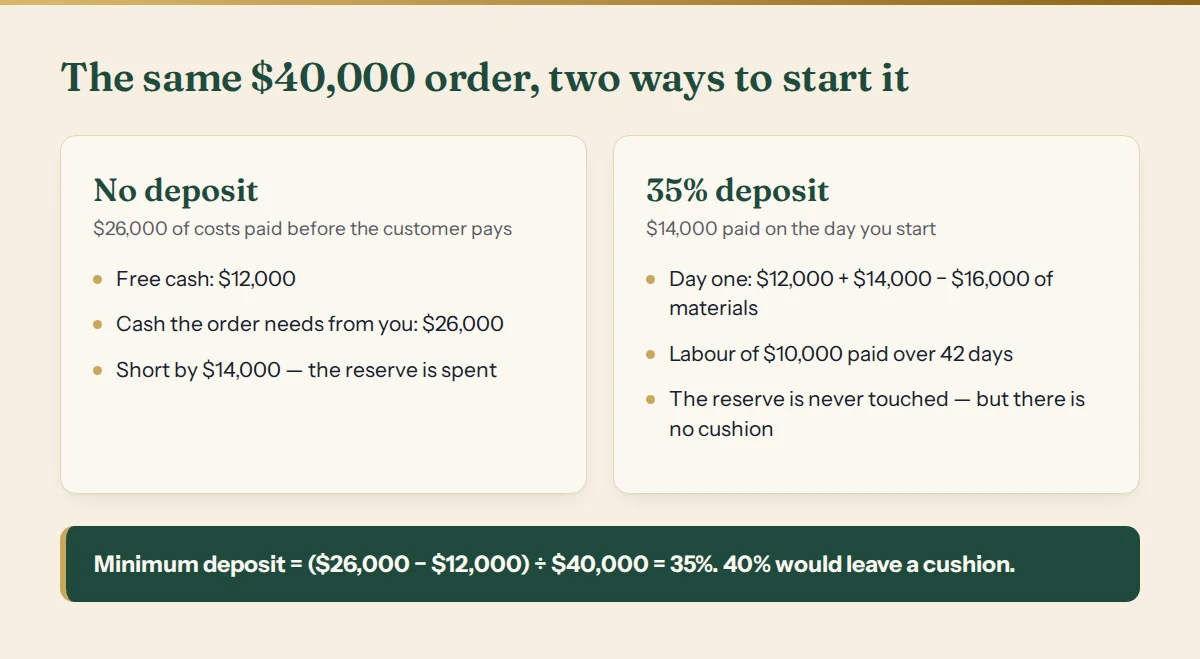
A furniture workshop is offered a $40,000 order. It costs $26,000 to make: $16,000 of materials bought up front and $10,000 of labour over the 42 days of production. The customer wants Net 30 after delivery, so the workshop is paid 72 days after it starts. It has $12,000 of free cash above its reserve.
- Cash gap: $26,000 − $12,000 = $14,000.
- Minimum deposit: $14,000 ÷ $40,000 = 35%, or $14,000.
With a 35% deposit, the workshop's cash above reserve goes to $10,000 on day one ($12,000 + $14,000 − $16,000), falls to zero as labour is paid, and stays at zero until the customer pays. It works — but only just. A 40% deposit would cover the materials outright and leave a cushion; so would billing a second stage payment at delivery.
Price check: the $26,000 of cost is tied up for 72 days. At a 12% cost of money that costs $615.46, so the price floor is $26,615.46. At $40,000 the order earns $14,000 before overheads and clears the floor easily; the deposit protects the cash, not the profit. If the customer pays 15 days late on the $26,000 balance, the extra wait costs another $128.22 — small in money, large in risk, because the workshop has no cushion left by then.
How to ask for it
- Tie it to materials. "The deposit covers the timber and hardware we order this week" is a reason customers accept.
- Offer stages instead of one large sum: for example deposit, a payment at a production milestone, balance on delivery.
- Put it in the quote, not in a follow-up. A deposit that appears after the price was agreed feels like a new condition.
- Trade, don't concede. If the customer wants a smaller deposit, ask for shorter payment terms or a higher price.
Common mistakes
- Using a round number from habit. Fifty per cent is too much for some orders and not enough for others.
- Forgetting that the rest of the business still has bills. Free cash is what is left after them, not the bank balance.
- Ignoring the payment terms. The same order with Net 60 instead of Net 30 needs the same deposit — but a longer cushion.
- Starting work before the deposit clears.
- Confusing profit with cash. A very profitable order can still break the reserve in week three.
FAQ
What percentage deposit is normal?
It varies by trade and by country, and between custom work and stock items. The useful question is not what is normal but what your cash needs; use the formula, then compare it with what your customers are used to.
Is a deposit refundable?
That depends on your contract and the law where you trade. State in writing what happens to the deposit if the customer cancels, and check the consumer rules if you sell to individuals.
What if the customer refuses any deposit?
Then shorten the gap another way: stage payments, a shorter payment term, supplier credit on materials, or a price that pays for the financing. If none is possible, the order may simply be too large for your current cash.
Does the deposit count as revenue?
For cash planning it is cash in; for accounting it is usually treated as an advance until the work is delivered. Ask your accountant how to record it.
Quick check first: the free deposit calculator finds the smallest deposit that keeps your cash above its reserve on one order, with every other percentage beside it.
Check your own numbers
The Business Decision X-Ray has a deal checker that runs a proposed order through your whole business day by day and returns the minimum safe deposit, the longest safe payment terms and the price floor before you sign. Open demo of every section, no sign-up; then from $40 a month.
The price floor above uses the same formula as our free price floor calculator. This is decision support, not financial, tax or legal advice.

