
What if my biggest client pays late? Net 30 to Net 60

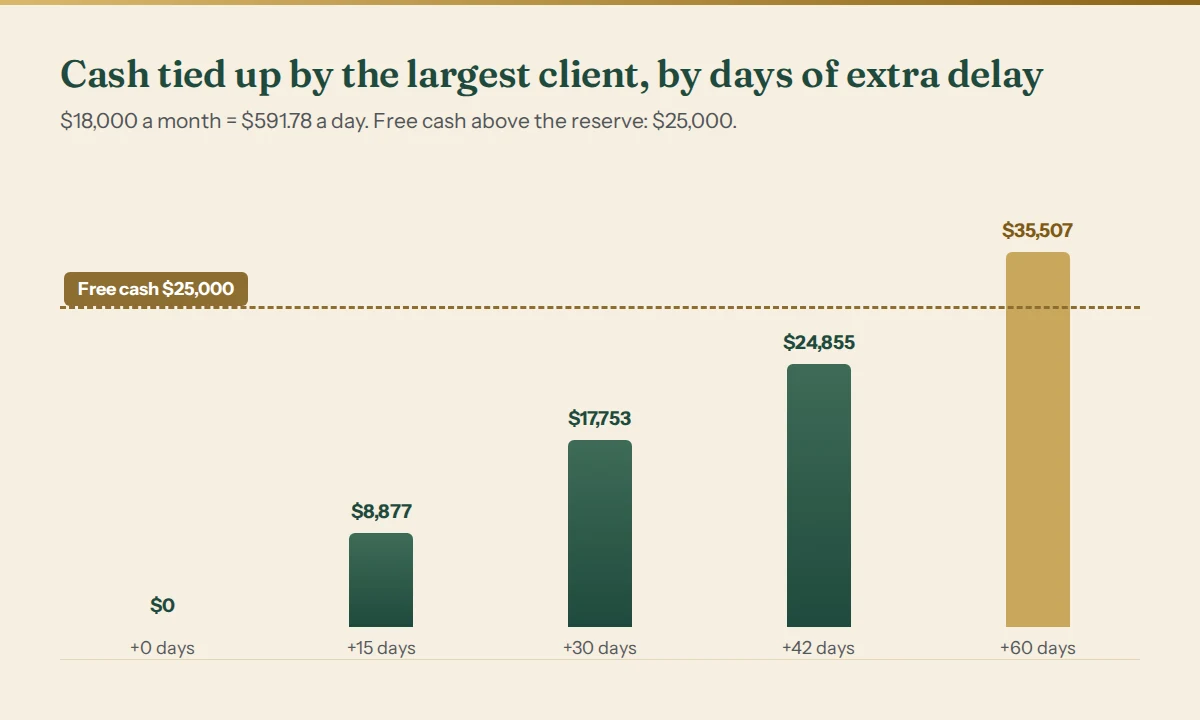
When a client moves from Net 30 to Net 60, you do not lose the money — but one extra month of that client's billing is suddenly tied up, and it stays tied up for as long as the new terms last. The size of the hole is simple: daily billing to that client × the extra days. If the hole is bigger than your cash above your reserve, the reserve breaks; in the example below that happens after 42 extra days.
That is why a "small" change in terms from a large client can hurt more than losing a small client altogether.
The formula
- Daily billing = the client's monthly billing × 12 ÷ 365.
- Cash hole = daily billing × extra days of delay.
- Days you can absorb = cash above your reserve ÷ daily billing.
- Cost of waiting = amount × your cost of money × days ÷ 365. This is what the delay costs you in interest, or in interest you would have saved.
The hole opens once, while the first longer-term invoices are outstanding, and then stays at that size. It closes only when terms go back or the client leaves.
Step by step
- Take the client's average monthly billing from the last three to six months.
- Turn it into daily billing (× 12 ÷ 365).
- Multiply by the extra days the new terms or the lateness add.
- Compare with your cash above your reserve. If the hole is larger, you need to act before the terms start, not after.
- Price the delay at your cost of money, to know what you are giving away.
- Decide the order of your response: collect what is overdue first, then negotiate deposits, milestones or a shorter term.
A worked example
A small engineering firm bills $60,000 a month. Its largest client accounts for 30% of that — $18,000 a month. The firm has $40,000 in the bank and keeps a $15,000 reserve, so $25,000 is free.
Daily billing to that client is $18,000 × 12 ÷ 365 = $591.78 a day.
| Client pays | Extra days | Cash tied up | Fits in $25,000? |
|---|---|---|---|
| Net 30 (today) | 0 | $0 | Yes |
| Net 60 | 30 | $17,753.42 | Yes |
| Net 90 | 60 | $35,506.85 | No |
The firm can absorb 42 extra days — $25,000 ÷ $591.78. Net 60 fits, with about $7,000 to spare. Net 90, or Net 60 paid two weeks late, breaks the reserve.
What it costs: at a 12% cost of money, waiting an extra 30 days on one month's $18,000 costs $177.53 — about 0.99% of the invoice. Over a year of Net 60 the permanently tied-up month costs roughly $2,160. That is the number to bring to the negotiation: a client who wants twice the time is asking for a discount of about one per cent, whether they say so or not.
What to do first
- Collect what is already overdue — ask for the oldest, largest invoice first; it frees the most cash per phone call.
- Ask for a deposit or milestone billing on new work, so less is outstanding at any time.
- Offer a trade: longer terms in exchange for a higher price or a deposit, since the delay has a cost you can name.
- Line up backup funding before you need it — a facility agreed while the numbers look good is easier to get.
- Stop new work at the old price if the terms change and none of the above is possible.
Common mistakes
- Thinking it is a one-month problem. The hole stays open for as long as the new terms last.
- Looking at profit, not cash. Net 60 does not change your profit at all, which is why it slips through.
- Ignoring lateness on top of terms. A client who pays Net 60 ten days late is really on Net 70.
- Treating all invoices as equal. Chase in order of cash impact, not in date order.
- Agreeing to terms in the meeting. Size the hole first; it takes five minutes.
FAQ
Can I charge interest on late payments?
In many countries you can, and some have statutory late-payment rules for business-to-business invoices. The details differ by jurisdiction and by contract, so check the law that applies to you and put the terms in writing before the work starts.
What is a normal payment term?
It varies by industry and country; 30 days is common, and large companies often ask for longer. What matters for you is not what is normal but whether your cash can carry it — which is the calculation above.
Should I use invoice financing?
It can bridge the hole, at a price. Compare its all-in cost with the cost of waiting you calculated, and with simply asking for a deposit.
How do I know which invoice to chase first?
The one whose delay would push your lowest balance down the most — usually the largest one due soonest from the client with the worst payment history.
Quick check first: the free payment terms calculator prices a move from Net 30 to Net 60 or 90 — the one-off cash gap, its yearly cost and the longest terms your cash can carry.
Check your own numbers
The Business Decision X-Ray runs the payment-delay test on every customer and invoice: what Net 30, 60 and 90 do to your lowest balance, how many days of delay you can absorb, which invoice to chase first, and the deposit that closes the gap. Open demo of every section, no sign-up; then from $40 a month.
The cost of waiting above uses the same formula as our free late-payment cost calculator. This is decision support, not financial or legal advice.

