
How to collect overdue invoices without losing the client
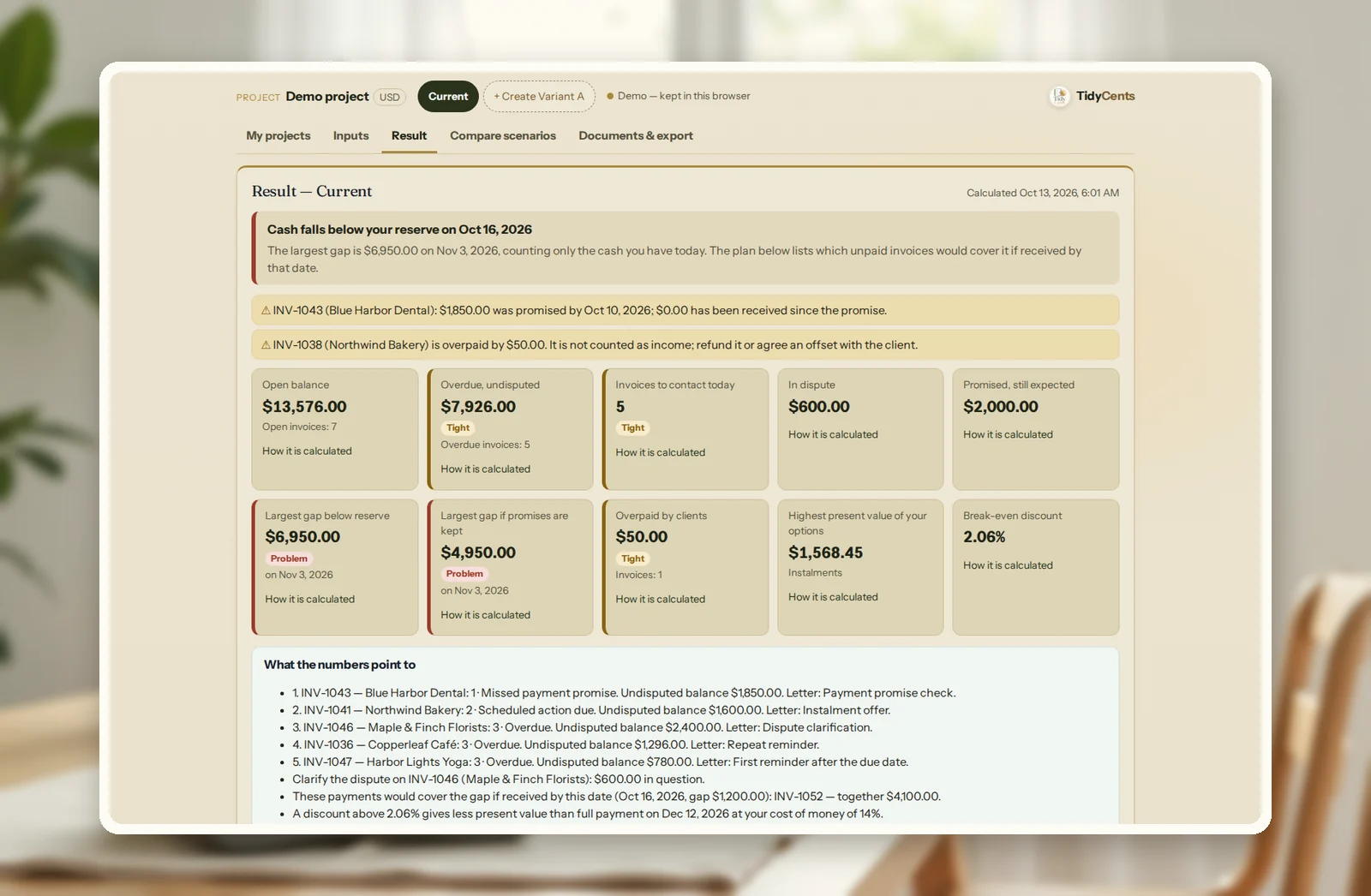
To collect overdue invoices, first know exactly what is owed and what is disputed, then chase in an order set by your next bills — broken payment promises first, then the oldest undisputed balances — and offer a discount or instalments only when you know what each option costs you. Polite, specific and regular follow-up gets most invoices paid; vague reminders sent to everyone at once do not. In the example below, a small studio has $13,576 open across 7 invoices, $600 of it disputed, and rent in 3 days already takes cash below its reserve. The tool shows which invoices would cover each gap and that, for one slow client, two instalments are worth more than a 5% discount for paying now.
Why overdue invoices hurt more than they look
An overdue invoice is not only late income. It is money you have already spent — on time, materials and wages — that is now funding your client's business instead of yours:
- Bills do not wait. Rent and payroll leave on fixed dates, whatever your clients do.
- The older it gets, the harder it is to collect. A 10-day-late invoice is a reminder; a 95-day-late one is a project.
- Disputes freeze everything. If part of an invoice is questioned, many clients stop paying all of it.
- Broken promises are signals. A client who misses a promised date needs a different message from one who simply forgot.
- Discounts and payment plans have a price. Taking 95% now can be worse than 100% in two instalments.
The formula
- Open balance = invoice amount − credit notes − payments received.
- Undisputed balance = open balance − the amount the client questions.
- Days overdue = today − due date; group balances into not overdue, 1–30, 31–60, 61–90 and over 90 days.
- Cash path = cash today − each bill on its date (+ promised payments, as a second line).
- Gap = minimum reserve − cash on that date, whenever cash falls below the reserve.
- Present value of an offer = each payment ÷ (1 + cost of money × days ÷ 365), minus any cost of setting it up.
A worked example
The numbers are the demo of Invoice Recovery Desk: a fictional design studio with nine invoices, four ledger entries and four upcoming bills.
What is open. Of the 9 invoices, 7 are still open for $13,576 in total — one is in euros (€1,200 at 1.08, so $1,296). One invoice is fully paid, and one client paid $650 on a $600 invoice: $50 to return or apply to the next invoice. The florist questions $600 of a $3,200 invoice after a $200 credit note, so $2,400 of it is undisputed and can be chased now.
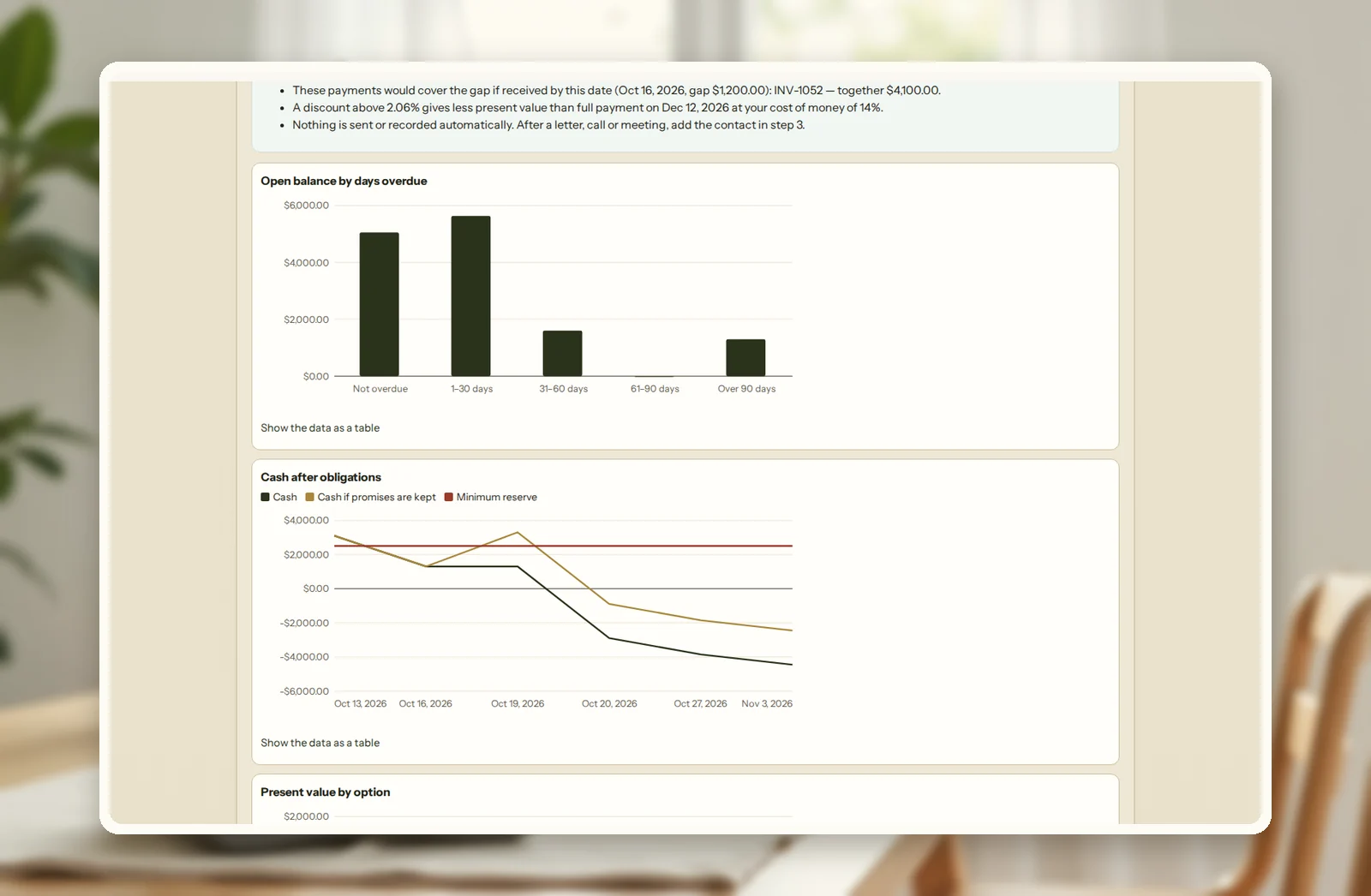
| Days overdue | Invoices | Open balance |
|---|---|---|
| Not overdue | 2 | $5,050 |
| 1–30 days | 3 | $5,630 (incl. $600 disputed) |
| 31–60 days | 1 | $1,600 |
| 61–90 days | 0 | $0 |
| Over 90 days | 1 | $1,296 |
Overdue and undisputed: $7,926 across 5 invoices.
Who to chase first. The queue for today:
- A dental office promised the full $1,850 and the date passed 3 days ago with nothing received — a promise check, not a generic reminder.
- A bakery paid $800 of $2,400 and is 45 days late on the remaining $1,600; the planned call is already overdue.
- The florist's dispute — send the clarification and ask for the undisputed $2,400 now.
- A café's euro invoice, 95 days late — they asked for a copy, so send the copy with a reminder.
- A yoga studio, 8 days late on $780 — a first friendly reminder.
- A logistics client, $4,100 due today, promised $2,000 in 6 days — no chase yet, just watch the date.
- A bike shop, $950 due in 5 days — a courtesy note before the due date.
What the cash path says. The studio has $3,100 and wants to keep $2,500 as a reserve. Rent of $1,800 in 3 days drops cash to $1,300 — $1,200 below the reserve. Payroll of $4,200 four days later takes it to −$2,900, or −$900 if the logistics client keeps its promise. After a $950 supplier bill and a $600 card statement, the gap against the reserve reaches $6,950 ($4,950 with the promise kept). The tool names which open invoices would close each gap: the $4,100 invoice covers the rent gap; by payroll it takes that one plus the florist's to cover $5,400.
Discount, instalments or wait? The bakery owes $1,600. With money costing the studio 14% a year, the three options are:
| Option | Receipts | Present value |
|---|---|---|
| Full payment in 60 days | $1,600 | $1,565.91 |
| 5% discount, paid in 2 days | $1,520 | $1,518.91 |
| Two instalments of $800 (14 and 44 days), $15 to set up | $1,585 net | $1,568.45 |
Instalments are worth the most. Any discount above 2.06% gives less than waiting for full payment.
Step by step: collect overdue invoices
- List every open invoice with its due date, payments and credit notes, so the balance is exact before you write.
- Separate the disputed amount and ask for the undisputed part straight away.
- Put your bills on a calendar with your cash and minimum reserve, to see when a late invoice starts to hurt.
- Chase broken promises first, then the largest overdue amounts that close your next gap.
- Match the message to the situation: courtesy note before the due date, first reminder, firmer repeat, promise check, dispute clarification or payment-plan offer.
- Log every contact with the date, channel, owner, result and next step.
- Price any discount or payment plan against your cost of money before you offer it.
- Return overpayments or apply them to the next invoice, and record the reason.
Common mistakes
- Sending the same reminder to everyone. A client who broke a promise and one who forgot need different words.
- Chasing a disputed invoice as if it were not disputed. Answer the question and ask for the rest.
- Waiting until the bill is due. By then, even a payment today arrives too late.
- Offering a discount by reflex. Check the break-even first.
- Not recording promises. A promise without a date and an amount cannot be checked.
- Forgetting the client's overpayment. It is their money, and it is a reason to call.
When a tool helps
A spreadsheet can list invoices. It rarely matches payments and credit notes, separates disputes, ranks today's work, shows your cash against the reserve day by day, writes the right letter for each case and compares payment options in present value. Invoice Recovery Desk does, and nothing is sent automatically — you send the letters and log the contacts. Exact decimal arithmetic, no AI guesses. To decide how much credit to give a client before the next order, see the Customer Credit & Payment Terms Lab.
Open the demo with the studio above — every screen, no sign-up — then add your own open invoices and bills.
Open Invoice Recovery DeskAll taxes, accounts and invoices tools
Related guides: what if my biggest client pays late, how to set a customer credit limit and how to stress test your cash flow.
FAQ
How do I politely ask for an overdue payment?
State the invoice number, amount, due date and how to pay, and ask for a payment date. Keep it short and factual. Send a courtesy note before the due date, a first reminder soon after it, and a firmer follow-up if there is no reply.
Which overdue invoices should I chase first?
Start with missed payment promises, then the overdue, undisputed balances that would close your next cash gap — not simply the oldest. In the example, the rent gap is covered by one invoice, while payroll needs two.
What do I do if the client disputes part of an invoice?
Separate the disputed amount, answer the question with facts, and ask for the undisputed part now. In the example, $600 of a $3,200 invoice is questioned, so $2,400 can be collected while the rest is clarified.
Should I offer a discount for quick payment?
Only if it costs less than waiting. Compare the options in present value at your cost of money. In the example, any discount above 2.06% is worse than waiting 60 days for full payment, and two instalments beat both.
When can I charge late fees or interest?
It depends on your contract terms and the law where you and your client operate. Check both before adding fees to a reminder.
This is decision support, not legal or tax advice.
Tools mentioned in this guide
 Interactive tool
Invoice Recovery Desk
A daily plan for unpaid invoices: who to contact today, which letter to send, and which payments would close your cash gap.

