
How to stress test your small business cash flow
A cash-flow stress test asks one question three ways: how far can sales fall, how far can costs rise, and how much later can customers pay before your cash drops below the level you refuse to go under? Test each shock alone to find its breakpoint, then combine them, because real trouble rarely arrives one shock at a time. The example below survives each shock on its own and still breaks its reserve in month six when all three arrive together.
You need four numbers to start: monthly revenue, gross margin, monthly obligations and cash above your reserve.
The four numbers
- Gross profit = revenue × gross margin. What is left of sales after direct costs.
- Obligations = the monthly costs that do not move with sales: rent, payroll, loan payments, owner pay, tax set-aside.
- Surplus = gross profit − obligations. Your monthly cushion.
- Free cash = cash in the bank − your reserve.
The three shocks and their formulas
1. Sales fall. The permanent drop you can take without losing money is surplus ÷ gross profit. If you only need to survive a slump of n months, you can also spend free cash: (surplus + free cash ÷ n) ÷ gross profit.
2. Costs rise. The rise in obligations you can absorb without losing money is surplus ÷ obligations.
3. Customers pay later. A delay ties up daily sales × extra days of cash at once — daily sales = monthly sales × 12 ÷ 365. If only some customers slow down, use their share of sales.
All three together. Apply the lower sales and the higher costs to get the new monthly result, subtract the delay hole from free cash, and divide what is left by the monthly loss. That is how many months you have.
A worked example
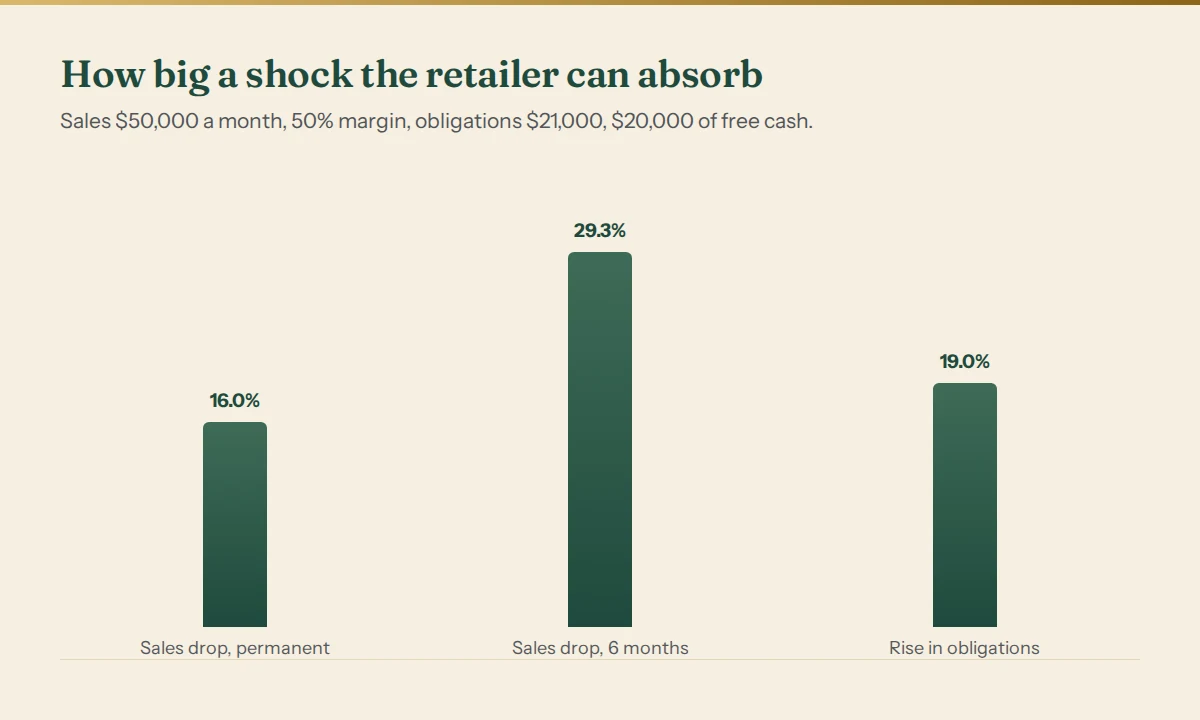
A small online retailer sells $50,000 a month at a 50% gross margin, so gross profit is $25,000. Its obligations are $21,000, which leaves a $4,000 surplus. It has $20,000 of cash above its reserve.
Break-even sales are $21,000 ÷ 0.50 = $42,000; the retailer's sales can fall 16% before they reach that line.
| Shock | Breakpoint | Meaning |
|---|---|---|
| Sales fall, permanently | 16.0% | Any larger drop loses money every month |
| Sales fall for 6 months | 29.3% | Survivable once, by spending the free cash |
| Obligations rise | 19.0% | Any larger rise loses money every month |
All three at once. Sales fall 15%, obligations rise 12%, and customers who make up 40% of sales start paying 15 days later:
- Sales $42,500, gross profit $21,250.
- Obligations $23,520.
- Monthly result: a loss of $2,270.
- Delay hole: $42,500 × 40% × 12 ÷ 365 × 15 = $8,383.56, so free cash drops to $11,616.44 at once.
- $11,616.44 ÷ $2,270 = 5.1 months: the reserve breaks during month six.
Each shock on its own was inside the breakpoints above. Together, they give the owner about five months to react — which is the real output of a stress test: not a verdict, but a deadline.
What to write down
For each scenario, record four things:
- What breaks first — the reserve, payroll, a loan payment.
- When — the month, or better, the date.
- By how much — the size of the shortfall.
- The smallest change that fixes it — a price rise, a cost cut, a deposit, a shorter payment term.
The fourth line is the one people skip, and the only one you can act on.
Rising costs are not a hypothetical: in the Federal Reserve's 2025 Small Business Credit Survey of 6,525 US employer firms, rising costs of goods, services and wages was the most commonly reported financial challenge of the prior 12 months (Fed Small Business, 2026 Report on Employer Firms).
Common mistakes
- Stressing revenue instead of gross profit. A 20% sales drop does not cut profit by 20% of revenue; it cuts gross profit.
- Testing one shock at a time only. Slow sales and slow payers usually arrive together.
- Forgetting the one-time hole that a payment delay opens.
- Using an average month. Run the test on your weakest month, or on a month with a quarterly tax payment in it.
- Stopping at "we'd survive". Always write down the date and the fix.
FAQ
How often should I stress test?
Quarterly is a sensible rhythm, and again whenever something large changes: a new hire, a new loan, a big customer arriving or leaving.
What shock sizes should I use?
Use sizes you have seen: your worst month of the last two years, the largest price rise from a supplier, the latest a big customer has ever paid. Then add one scenario that is worse than anything you have seen.
Is this the same as a cash-flow forecast?
A forecast shows your expected path; a stress test shows how far from that path you can be pushed before something breaks. You need the forecast first, since the stress test starts from it.
Do I need accounting software for this?
No. The four numbers above come from your bank balance and last month's figures. Software helps with the day-by-day version, where payroll dates and payment terms decide exactly when the balance dips.
Quick checks first: the free sales drop calculator, cash runway calculator and customer concentration calculator each answer one of these questions from a few monthly numbers.
Check your own numbers
The Business Decision X-Ray runs nine tests day by day on your real schedule of payroll, bills, tax and customer terms, draws the survival heatmap of every combination of lower sales and slower payers, and ends with a dated NOW / NEXT / MONITOR plan. Open demo of every section, no sign-up; then from $40 a month.
The break-even line above uses the same formula as our free break-even calculator. This is decision support, not financial, tax or legal advice.

