
Small-batch production planning for makers
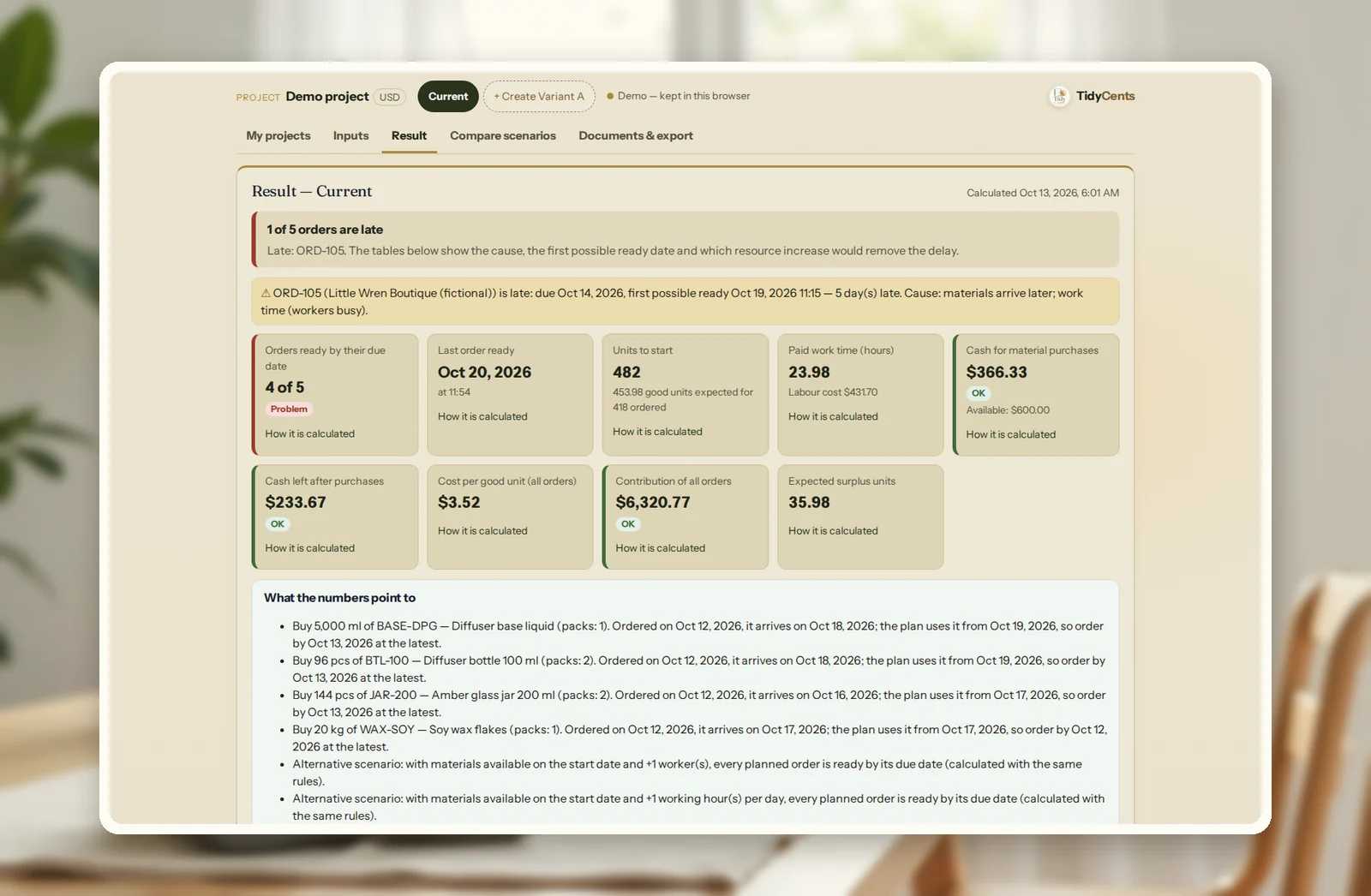
Small-batch production planning means turning your open orders into batches, then into hours and materials, and checking the result against your working days, your equipment and what is actually on the shelf — before you promise a delivery date. The order that ends up late is rarely the biggest one; it is the one whose materials arrive last or that waits behind another order. In the example below, one maker has five orders for candles, wax melts and diffusers. The plan shows that 4 of the 5 orders are ready on time, that a boutique's diffusers will be 5 days late because bottles and base liquid are short, and that buying the missing materials costs $366.33 — within a $600 budget.
Why small-batch plans slip
Most makers plan from the order quantity. Production happens in batches:
- Defects need extra starts. Making 150 wax melts with an 8% defect rate means starting more than 150.
- Batches have a fixed size. If a mould holds 40, you cannot pour 4 extra; you pour a full batch.
- Setup and waiting time are real. Melting, cleaning and curing take time whether you make 2 units or 24.
- Equipment is shared. Two products that need the same pot cannot be made at once.
- Suppliers sell in packs with minimums. You may need 24 bottles and be forced to buy 96.
- One order's stock is another order's shortage. The order made first takes the materials on the shelf.
The formula
- Units to start = order quantity ÷ (1 − defect rate), rounded up.
- Batches = units to start ÷ batch size, rounded up (and the last batch is full if partial batches are not possible).
- Labour minutes = batches × setup minutes + units × minutes per unit.
- Ready time = when the last batch's work ends + any waiting time such as curing.
- Material need = units × quantity per unit + batches × quantity per batch.
- Purchase = need − usable stock, rounded up to packs and to the supplier's minimum order.
- Cost per good unit = (labour + materials + packaging + batch costs) ÷ expected good units.
A worked example
The numbers are the demo of Maker Batch & Order Planner: a fictional maker who works alone, 7 hours a day at $18 an hour, with a craft fair closing one weekday and an extra 4-hour shift on Saturday.
The orders. A gift shop wants 120 fig candles, a market 150 packs of wax melts, a hotel 60 reed diffusers, a florist 48 candles (still tentative) and a boutique 40 diffusers. 418 units in total.
From units to batches. Candles are made in batches of 24, with 30 minutes of setup, 3 minutes per candle, 24 hours of curing and a 5% defect rate: the 120-candle order needs 127 starts in 6 batches. Wax melts are poured in moulds of 40 that cannot be part-filled; 150 packs with an 8% defect rate need 164 starts, but full moulds mean 5 batches and 200 units — 36 more starts than needed and about 34 surplus packs. Across all orders: 482 starts in 19 batches.
When each order is ready.
| Order | Units | Batches | Ready vs due date |
|---|---|---|---|
| Hotel, diffusers | 60 | 3 | 7 days early |
| Gift shop, candles | 120 | 6 | 9 days early |
| Boutique, diffusers | 40 | 2 | 5 days late |
| Market, wax melts | 150 | 5 | on the due date |
| Florist, candles (tentative) | 48 | 3 | 1 day early |
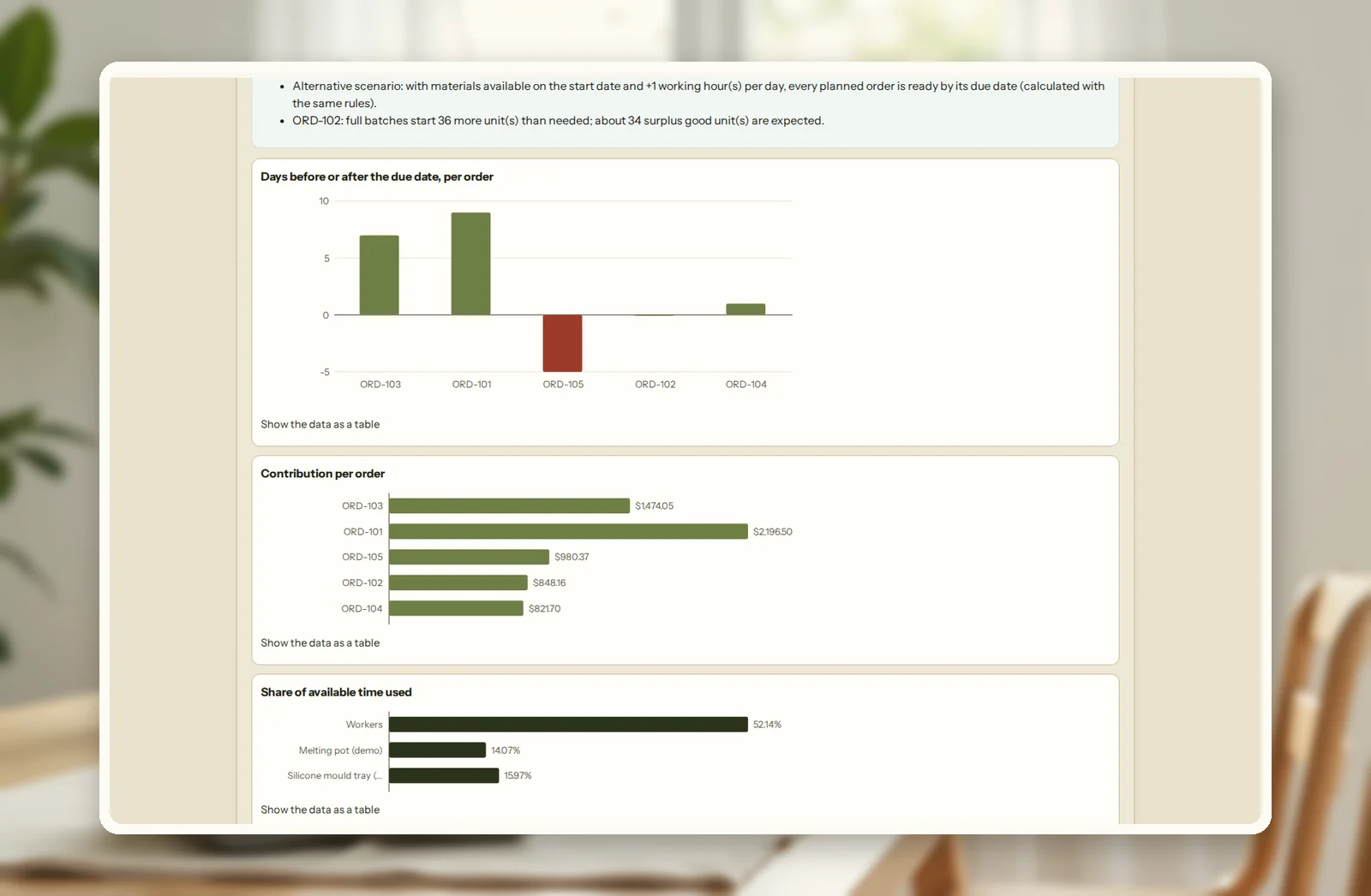
Why the boutique is late. The hotel order has the top priority, so it is made first and uses 62 of the 80 diffuser bottles on the shelf. The boutique then needs 24 more bottles and 360 ml more base liquid — and both suppliers take 6 days to deliver. The work itself is not the bottleneck: the maker uses 52% of the available time.
What fixes it. The tool tests alternatives with the same rules. Materials in hand on day one, alone, still leave one order late; so does one extra worker or one extra hour a day. Materials in hand plus either one extra worker or 1 extra hour a day gets every order out on time.
What to buy. Four purchases, each rounded up to packs and minimums:
| Material | Short | Buy | Cash |
|---|---|---|---|
| Diffuser base liquid | 360 ml | 5,000 ml (1 pack) | $60.00 |
| Diffuser bottles (in euros) | 24 | 96 (supplier minimum) | $81.91 |
| Glass jars (in euros) | 28 | 144 (supplier minimum) | $96.42 |
| Soy wax | 9.54 kg | 20 kg (minimum) | $128.00 |
Total: $366.33, leaving $233.67 of the $600 budget. The wax has the tightest timing: with a 5-day lead time it must be ordered on the first day of the plan.
The money. Costs for all five orders — labour $431.70, materials $1,155.13, packaging $165.60 and batch costs $10.80 — come to $1,763.23 against $8,084 of sales, a contribution of $6,320.77. A candle in the gift-shop order costs $5.22 per good unit against a price of $24.
Batch size. For candles, batches of 30 instead of 24 mean 7 batches instead of 9, a cost of $5.11 per good candle instead of $5.26, and the last candle order ready 2 days sooner. Batches of 12 push the cost to $5.82 and make a second order late.
Step by step: plan a small batch run
- List open orders with quantity, due date, price, advance and whether each is confirmed.
- Describe each product: batch size, setup and per-unit minutes, waiting time, equipment and defect rate.
- Write the recipe — materials per unit and per batch.
- Enter stock, pack sizes, minimum orders and lead times for every material.
- Set your working days and hours, including closures and extra shifts.
- Order the queue by priority and due date, and see which order takes which stock.
- Check every late order's reason: materials, work time or equipment.
- Test the fixes — more hours, another pair of hands, earlier materials, a different batch size — and place purchase orders by their latest date.
Common mistakes
- Planning from order quantity instead of starts. Defects and full batches add units.
- Ignoring curing and drying time. The work can end on Tuesday and the product still not ship until Wednesday.
- Counting stock twice. Stock used by the first order is not available to the next.
- Ordering the shortage, not the pack. Minimum orders can cost more than the shortage suggests.
- Treating tentative orders as certain. Plan with and without them.
- Choosing batch size by habit. A bigger batch can lower cost and bring the last order forward.
When a tool helps
A spreadsheet can multiply a recipe by a quantity. It rarely schedules batches across days, shared equipment and waiting time, assigns stock order by order, rounds purchases to packs and minimums, and tests alternatives with the same rules. Maker Batch & Order Planner does, and prints a production sheet, a purchase list and a delivery note per customer. Exact decimal arithmetic, no AI guesses. For goods you buy in and resell rather than make, see the Stock Purchase Planner.
Open the demo with the five orders above — every screen, no sign-up — then plan your own batches.
Open Maker Batch & Order PlannerAll sales and daily operations tools
Related guides: how to calculate a reorder point, how to calculate wholesale price and the cost of poor quality.
FAQ
How do I plan production for small batches?
Turn each order into units to start, then batches, labour minutes and materials. Place the batches on your working days in order of priority and due date, and check each order's ready time and material availability against its due date.
How many units should I start if some will be defective?
Divide the order quantity by one minus the defect rate and round up. In the example, 120 candles at a 5% defect rate need 127 starts.
How do I choose a batch size?
Compare cost per good unit, surplus and ready dates for a few sizes. In the example, candle batches of 30 lower the cost per good candle from $5.26 to $5.11 and bring the last candle order 2 days forward.
What if a supplier's minimum order is much larger than what I need?
Price the whole minimum, not the shortage, and note the leftover. In the example, 24 bottles short means buying 96; the 72 left over stay in stock for the next run.
How do I know which order will be late?
Schedule all orders with the same rules and look at each order's ready date against its due date, along with the reason — materials, work time or equipment.
This is decision support, not tax or legal advice.
Tools mentioned in this guide
 Interactive tool
Maker Batch & Order Planner
Turn customer orders into batches, material purchases and a dated production calendar, and see which orders will be late, why, and what extra capacity would put them back on time.

