
How to calculate a reorder point (with safety stock)
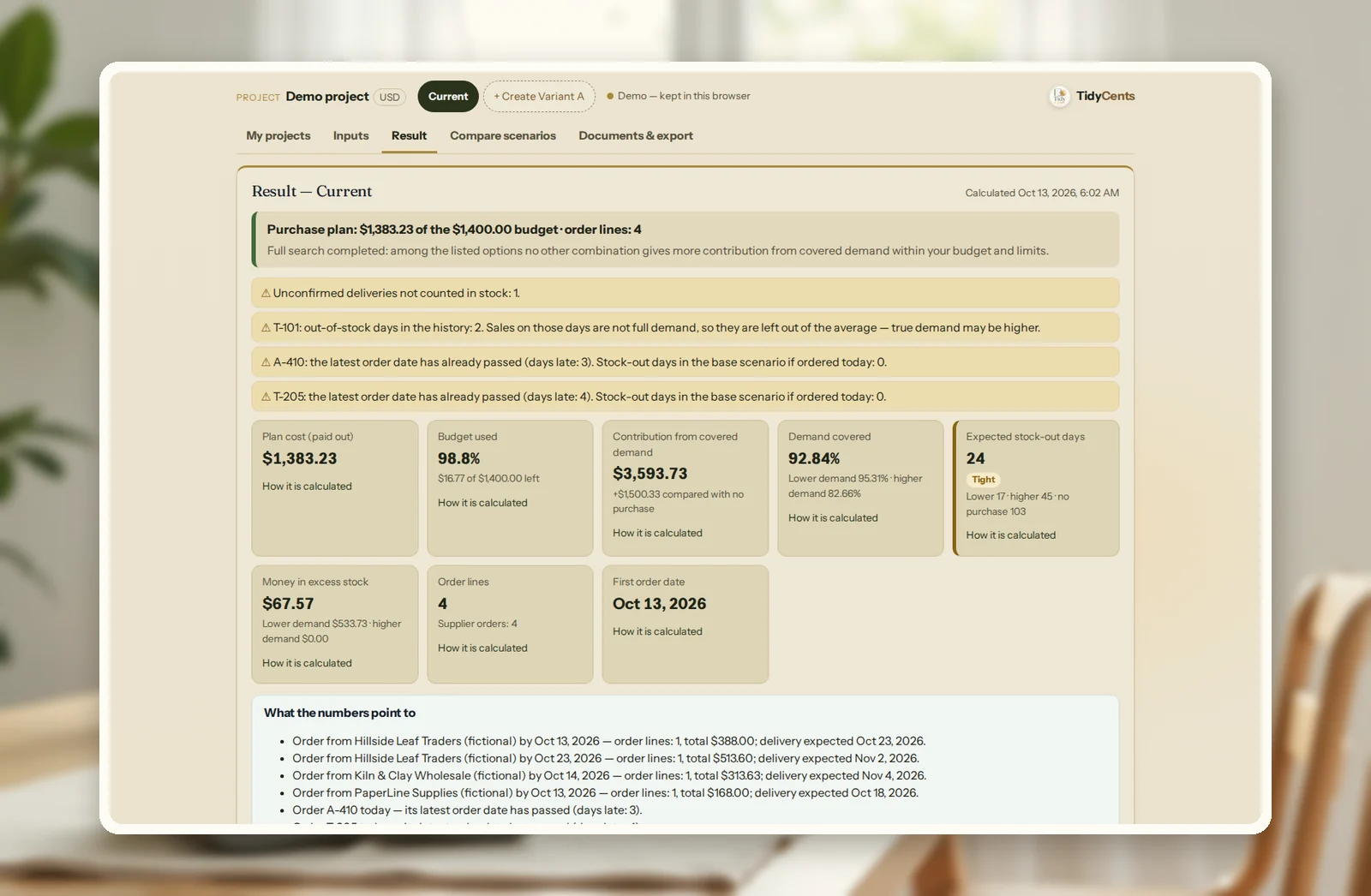
The reorder point is the stock level at which you must place a new order so it arrives before you run out: average daily demand × the supplier's lead time in days, plus safety stock for the days when sales run higher or deliveries run late. When available stock — on hand, minus what is already promised to customers — falls to that level, you order. In the example below, a tea shop sells 5.64 tins of sencha a day, its supplier takes 10 days, and it keeps 5 days of safety stock: the reorder point is 84.6 tins. With 142 tins available, the order goes out in about 10 days.
Why stock runs out even when you watch it
Most small shops reorder when the shelf looks low. The problems are predictable:
- Lead time is forgotten. A supplier that needs three weeks means ordering three weeks of sales before you need them.
- Demand is read from bad days. Days when the product was out of stock show low sales that were not low demand.
- One-off spikes inflate the average. A single market day can make every day look busier than it is.
- Reserved stock is counted as free. Units promised to a customer are not available to sell.
- Packs and minimums change the order. You may need 123 units and have to buy 132.
- The budget runs out before the list does. Something has to wait, and it should be the product that costs least to miss.
The formula
- Available stock = on hand − reserved for customers (+ confirmed incoming, if it arrives in time).
- Average daily demand = units sold ÷ days counted, leaving out stock-out days and one-off events.
- Safety stock = average daily demand × safety days.
- Reorder point = average daily demand × lead time in days + safety stock.
- Days until you must order = (available stock − reorder point) ÷ average daily demand.
- Order quantity = demand over the planning period + safety stock − available stock − confirmed incoming, rounded up to packs and minimum order.
- Price breaks = compare the extra units against the lower unit price.
A worked example
The numbers are the demo of Stock Purchase Planner: a fictional tea shop planning 42 days ahead with 5 days of safety stock, three suppliers and a purchase budget of $1,400.
Demand from real sales. The shop has four weeks of daily sales for sencha. 2 days were stock-out days and 1 was a one-off market stall, so they are left out: 25 normal days sold 141 tins, an average of 5.64 a day.
The reorder point. With a 10-day lead time and 5 safety days:
- safety stock = 5.64 × 5 = 28.2 tins;
- reorder point = 5.64 × 10 + 28.2 = 84.6 tins;
- available stock = 150 on hand − 8 reserved = 142 tins;
- days until the order must go out ≈ (142 − 84.6) ÷ 5.64 ≈ 10 days.
The order. Over the planning period the shop needs 123.08 more tins. The supplier sells cases of 12, so the order is 11 cases — 132 tins — which also reaches the 120-tin price break: $3.55 a tin instead of $3.80, $468.60 in total.
Every product, one plan.
| Product | Lead time | Reorder point | Order | When | Cost |
|---|---|---|---|---|---|
| Ceramic teapots (in euros) | 21 days | 34.05 | 36 (9 packs of 4) | now | $373.25 |
| Paper tea filters | 5 days | 40 | 140 (7 packs of 20) | day 3 | $147.00 |
| Matcha | 10 days | 18 | 12 (supplier minimum) | day 5 | $103.20 |
| Sencha green tea | 10 days | 84.6 | 132 (11 cases of 12) | day 10 | $468.60 |
| Breakfast black tea | 10 days | 52.5 | 20 (supplier minimum) | day 21 | $98.00 |
The teapots are already below their reorder point — only 28 are available against 34.05 — because the supplier needs 21 days, so that order goes out first.
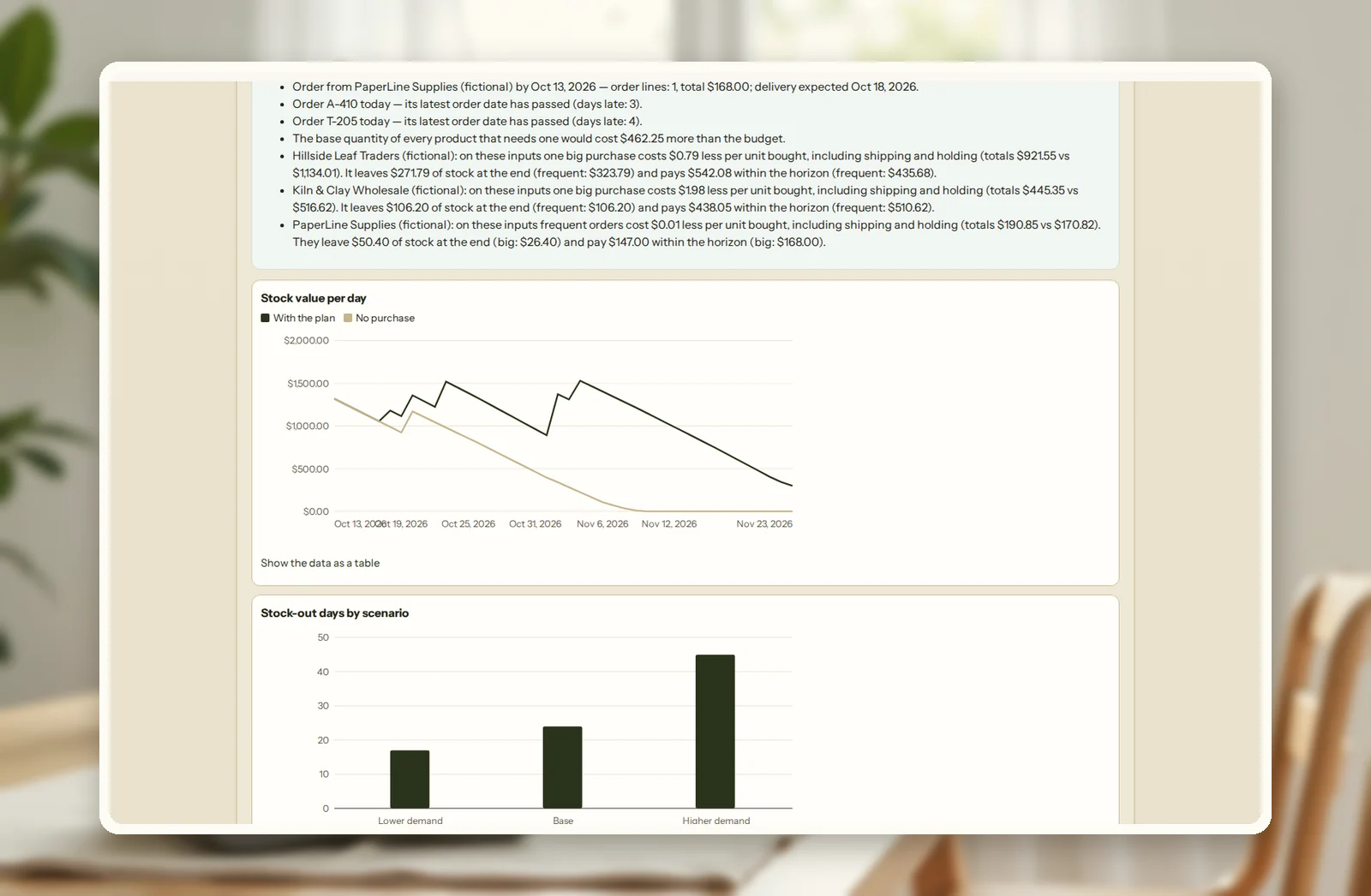
The budget decides what waits. Goods and $199.80 of shipping come to $1,389.85, leaving $10.15 of the $1,400. To stay within it, matcha gets only the supplier minimum of 12 tins instead of the 32.4 it needs, and runs out for about 12 days. The tool shows that covering every product fully would take $294.25 more.
With and without the plan. Buying nothing would mean 89 stock-out days across the five products over the 42 days. With the plan, it is 13, and the expected contribution rises from $2,276.60 to $3,737.43.
Paying for it. Prepayments are spread out: 30% at order to the tea supplier with the rest in 30 days, 50% at order to the teapot maker with the balance on delivery, and 14 days for the filters.
Step by step: calculate your reorder points
- Count available stock: on hand minus reserved, plus confirmed deliveries.
- Work out average daily demand from real sales, leaving out stock-out days and one-off events.
- Write down each supplier's lead time — from order to goods on the shelf.
- Choose safety days based on how much sales and deliveries vary.
- Calculate the reorder point and the days until you must order.
- Round the order up to packs and minimums, and check price breaks.
- Fit the orders into your budget, deciding which product can wait.
- Plan the payments — prepayments, balances and currency — before you order.
Common mistakes
- Using lead time from the supplier's website. Use the time it actually takes to reach your shelf.
- Averaging days with no stock. They hide real demand.
- Ignoring reserved units. They are sold already.
- One safety stock for every product. A three-week supplier needs more cover than a five-day one.
- Buying the cheapest price break by habit. Extra units tie up cash and can expire.
- Ordering everything on the same day. Spread orders by each product's own reorder date.
When a tool helps
A spreadsheet can multiply demand by lead time. It rarely cleans the sales history, handles reserved and incoming stock, rounds to packs and minimums, compares price breaks and suppliers, fits everything into a budget, schedules prepayments and shows low and high demand scenarios at once. Stock Purchase Planner does. Exact decimal arithmetic, no AI guesses. If you make the products yourself, see the Maker Batch & Order Planner.
Open the demo with the tea shop above — every screen, no sign-up — then enter your own stock and suppliers.
Open Stock Purchase PlannerAll sales and daily operations tools
Related guides: small-batch production planning, how to calculate landed cost and three-way match for small businesses.
FAQ
What is the reorder point formula?
Reorder point = average daily demand × lead time in days + safety stock. In the example, 5.64 tins a day × 10 days + 28.2 tins of safety stock gives a reorder point of 84.6 tins.
How do I calculate safety stock?
A simple approach is average daily demand × a number of safety days that reflects how much sales and delivery times vary. In the example, 5 safety days at 5.64 tins a day is 28.2 tins.
How much should I order?
Enough to cover demand until the next order arrives, plus safety stock, minus what you have and what is already on its way — then rounded up to packs and minimums. In the example, a need of 123.08 tins becomes an order of 132.
Should I count stock that is reserved for customers?
No. Reserved units are already sold. Subtract them from stock on hand before you compare with the reorder point.
What if my budget does not cover everything?
Decide which product can wait with the least lost profit, and see how much more budget full cover would take. In the example, $294.25 more would cover every product's full need.
This is decision support, not tax or legal advice.
Tools mentioned in this guide
 Interactive tool
Stock Purchase Planner
Decide what to reorder, how much and by which date, and split a limited purchase budget across products so the stock you can afford covers the most valuable demand.

