
How to calculate landed cost per usable unit
Landed cost per usable unit = (goods price + freight + insurance + duties + brokerage and bank fees + financing cost) ÷ units you can actually sell or use. Divide by usable units, not ordered units: if 14% of a delivery is broken or out of spec, the good units carry the cost of the bad ones. That single change often reverses a supplier ranking — in the example below, the quote with the lowest price per jar has the highest cost per usable jar.
Rising input costs are a real pressure. In the Federal Reserve's 2026 survey of employer firms, 48% of businesses bought at least some inputs from abroad, and 84% of those said the cost of those inputs had gone up.
Why the quoted price misleads
A supplier quote is the start of the cost, not the cost. Between the price on the quote and a unit on your shelf sit:
- Freight and insurance — often a fixed amount per shipment, so it depends on how much you order at once.
- Duties, brokerage and bank fees — percentages of a value that may include freight.
- Exchange rate — a quote in another currency moves with the rate until you pay.
- Yield — the share of units that arrive usable. Breakage, defects and out-of-spec items are cost you pay for and cannot sell.
- Payment terms — a deposit paid weeks before delivery ties up cash, and that has a cost of money.
Two suppliers with the same unit price can therefore have very different landed costs — and a lower price can come with a higher real cost.
The formula
- Goods cost = packs × pack price (with tier or volume pricing), converted to your currency at the rate you will actually pay.
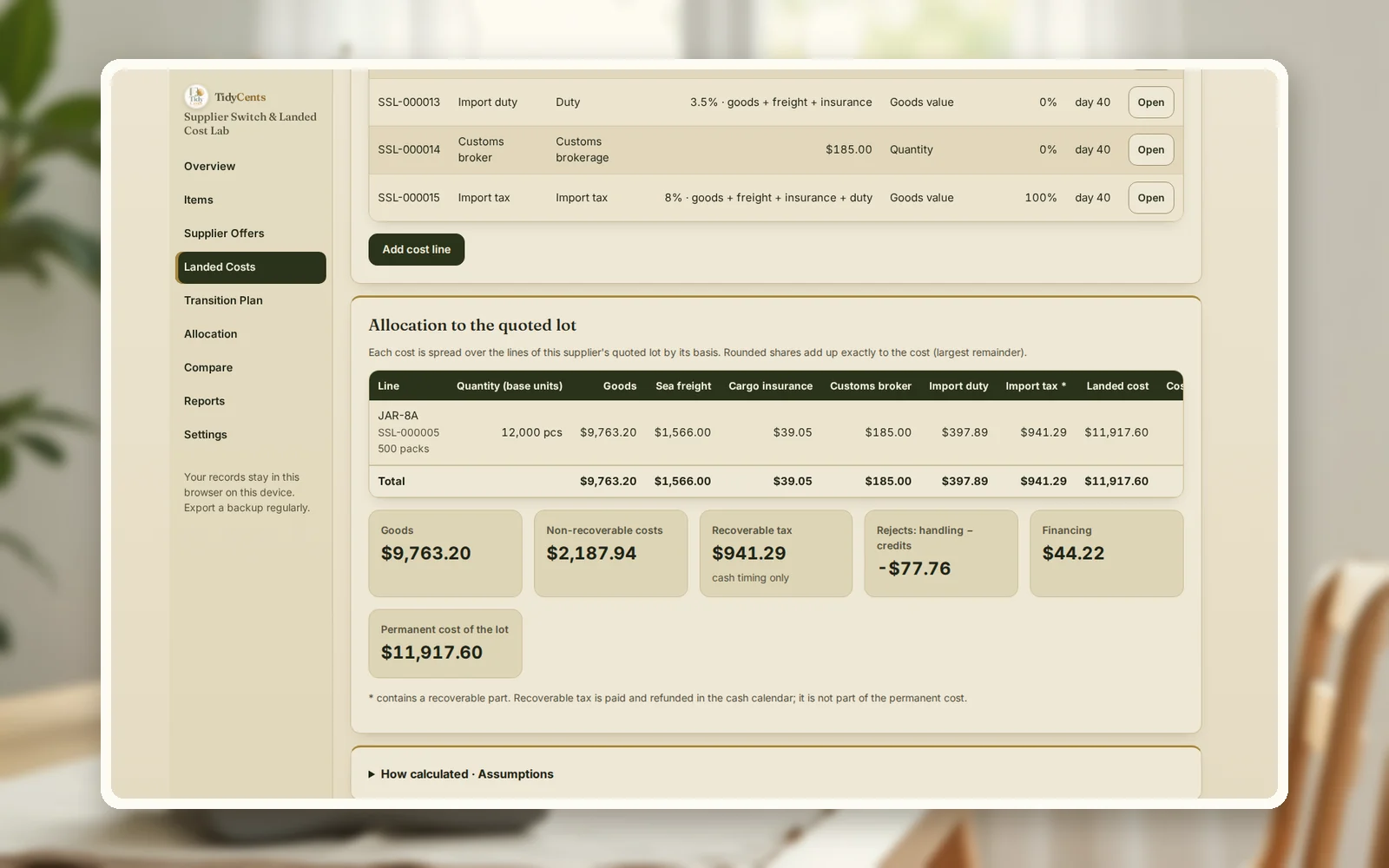
- Shipment costs = freight + insurance + duties + brokerage + other fees, allocated across the lines of the shipment by weight, value or quantity.
- Financing cost = cash paid early (deposits) × your cost of money × days until you can use the goods ÷ 365.
- Landed cost = goods cost + allocated shipment costs + financing cost.
- Usable units = units ordered × yield.
- Landed cost per usable unit = landed cost ÷ usable units.
A worked example
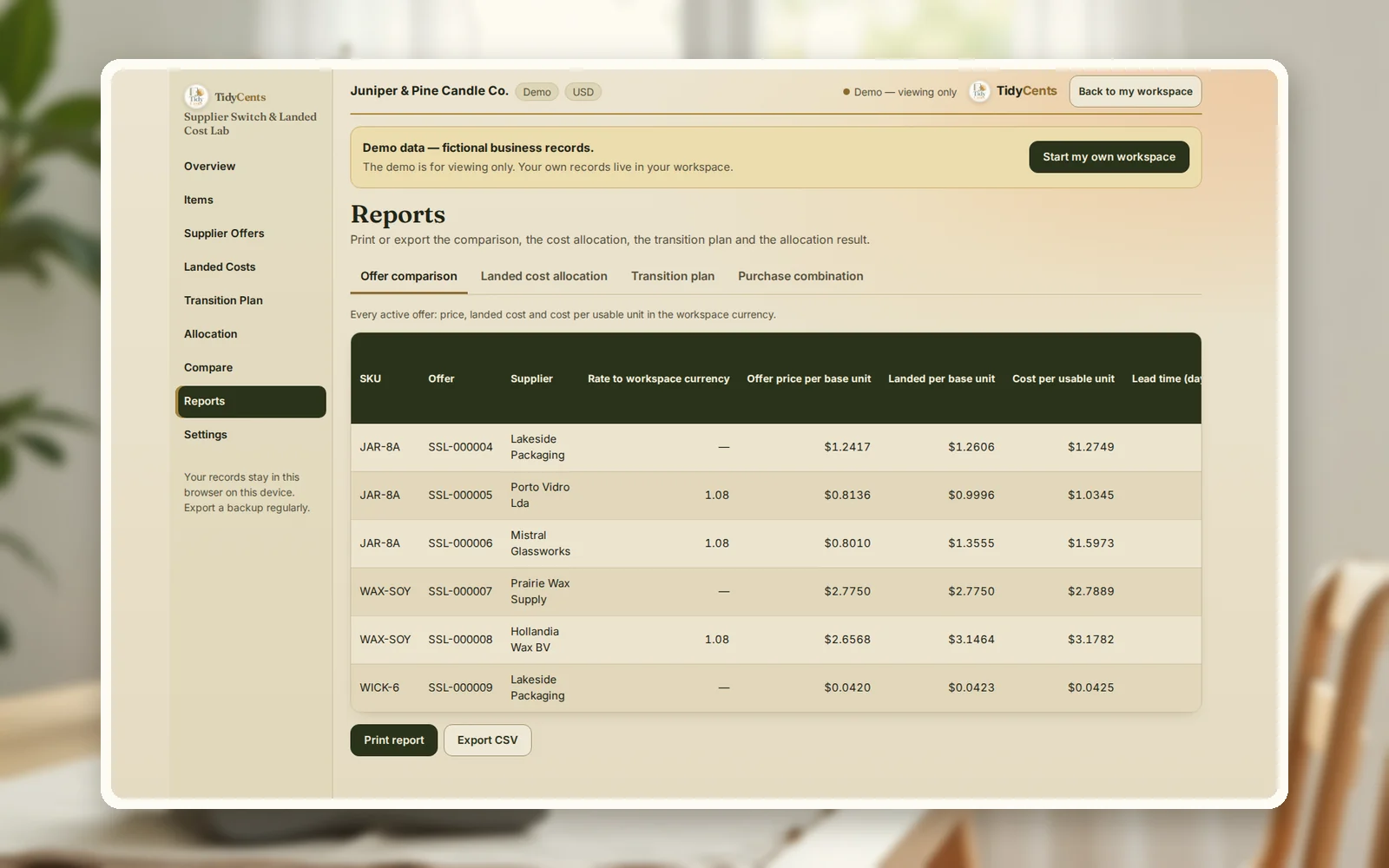
The numbers come from the demo of the Supplier Switch & Landed Cost Lab: a fictional candle maker comparing three quotes for an 8 oz amber glass jar, with a 9% cost of money.
- Lakeside Packaging (local): $14.90 per box of 12 at 200 boxes or more, 400 boxes, 99% usable, delivered in 9 days, $95 local delivery.
- Porto Vidro (Portugal): €18.40 per pack of 24, €17.60 above 300 packs, 500 packs, 96% usable, 30% deposit, sea freight of €1,450, 39 days lead time.
- Mistral Glassworks (abroad): €8.90 per box of 12, 600 boxes, only 86% usable, 50% deposit, freight and fees on top, 55 days lead time.
| Supplier | Price per jar | Landed cost per jar | Cost per usable jar |
|---|---|---|---|
| Lakeside Packaging | $1.2417 | $1.2606 | $1.2749 |
| Porto Vidro | $0.8136 | $0.9996 | $1.0345 |
| Mistral Glassworks | $0.8010 | $1.3555 | $1.5973 |
Mistral is the price trap. It has the lowest price per jar, but after freight, fees, financing and 14% unusable jars, each good jar costs about $1.60 — the most expensive of the three. Porto Vidro is the lowest real cost, about $0.24 per usable jar cheaper than the local supplier.
Is switching worth it?
A lower unit cost is not the same as a profitable switch. Moving the jars from Lakeside to Porto Vidro over 12 months has one-off costs — samples, testing, tooling, training, holding a 3,000-jar buffer and exiting the old supplier — of $3,332.65, and the lab tests three cases:
| Case | Net savings over 12 months | Jars not covered |
|---|---|---|
| Base | $633.63 | 0 |
| New supplier 90 days late | $118.10 | 200 |
| Yield falls to 90% | −$326.14 | 0 |
In the base case the switch pays back only in September of next year and needs $20,017.11 of cash along the way. The savings disappear if the euro rises above 1.1207 dollars (the quote assumes 1.08), or if the new jars cost more than $1.0729 per usable unit. So the honest answer is: cheaper per jar, but a thin and fragile gain — worth it only if the yield and lead time hold, or if the switch is done for reasons beyond this one item.
Step by step: compare suppliers by landed cost
- Define the unit you use (one jar, one kilo) and convert every quote to it, including pack sizes.
- Enter each quote as written: currency, price tiers, minimum order, pack size, deposit and payment days.
- Add every shipment cost and spread it over the lines by weight, value or quantity.
- Apply the yield you expect from each supplier — from your own receiving records if you have them.
- Price the financing: deposits paid before delivery at your cost of money.
- Compare cost per usable unit, not price.
- Before switching, test the transition: one-off costs, buffer stock, late delivery and lower yield.
Common mistakes
- Dividing by ordered units. Rejected units are cost without revenue.
- Ignoring the exchange rate. A 10% move in the rate can erase the saving.
- Allocating freight evenly. Heavy items should carry more of a weight-based freight bill.
- Forgetting the deposit. Cash paid two months early has a cost.
- Counting the saving but not the switch. Samples, tooling and buffer stock come first; savings come later.
- Assuming the new supplier is on time. A late first delivery means emergency buying at the old price.
When a tool helps
One quote, one currency, one shipment fits in a spreadsheet. Several suppliers, currencies, tiers, shared freight and a transition plan do not. The Supplier Switch & Landed Cost Lab allocates shipment costs line by line, converts currencies, applies yield and financing, flags price traps and tests a switch in base, late-delivery and low-yield cases — with "How calculated" next to every figure. Exact decimal arithmetic, no AI guesses. For a quick look at what a price rise does to your margin, the free cost increase calculator helps.
Open the demo with the candle maker above — every screen, no sign-up — then enter your own quotes.
Open the Supplier Switch & Landed Cost LabAll cost, pricing and profit tools
Related guides: three-way match for small businesses, how to calculate a reorder point and the cost of poor quality.
FAQ
What is included in landed cost?
Everything you pay to get a usable unit into your business: goods price, freight, insurance, duties, customs brokerage, bank and payment fees, handling, inspection and the cost of money for deposits. Recoverable taxes, such as VAT you can reclaim, are usually left out — check what applies to you.
How do I allocate freight across several products?
Use the driver that matches the bill: weight for freight charged by weight, value for insurance and value-based duties, quantity for per-unit handling. Allocating everything by quantity makes light, cheap items look more expensive than they are.
Why divide by usable units?
Because rejected units cost money but earn nothing. If 86 of 100 units are usable, each good unit carries the cost of all 100 — about 16% more than the price suggests.
When is switching suppliers worth it?
When the savings over your planning period exceed the one-off cost of switching, the cash you need along the way is available, and the gain survives a late first delivery, a lower yield and a move in the exchange rate.
Do I need to know duty rates?
Yes, for imported goods, and they depend on the product's tariff classification and origin. Enter the rate from your customs broker or official tariff database; the lab calculates with it but does not decide it.
Sources
- Federal Reserve Bank of Cleveland, press release on the 2026 Small Business Credit Survey — 48% of firms sourced inputs abroad; 84% of those reported higher input costs.
This is decision support, not financial, tax or customs advice.
Tools mentioned in this guide
 Interactive tool
Supplier Switch & Landed Cost Lab
Compare supplier offers by the cost of delivered usable goods, then check whether switching suppliers is worth the cash and disruption.

