
How to respond to a chargeback, step by step
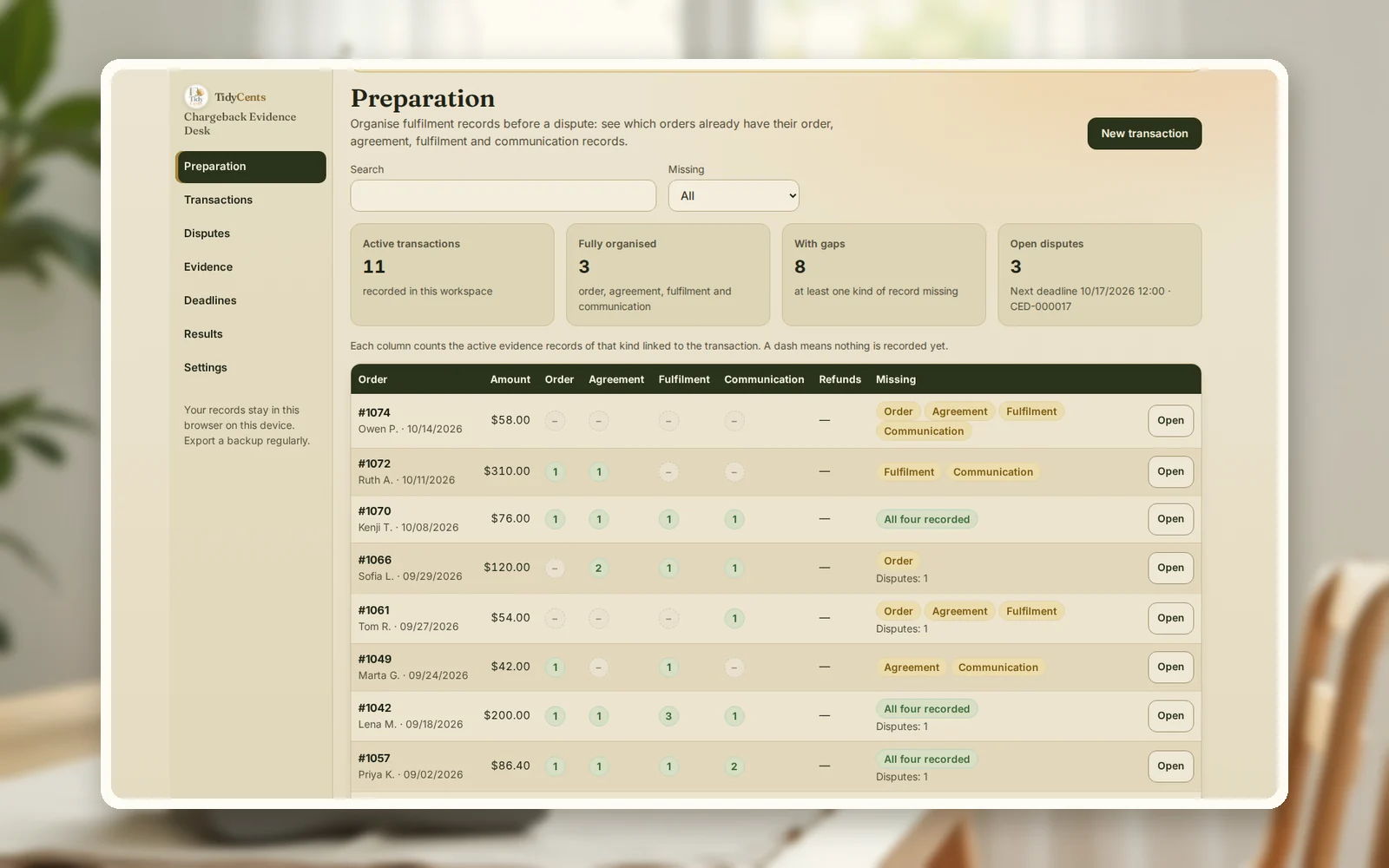
To respond to a chargeback, first decide whether it is worth answering — the amount you can recover against the time it takes — then collect the evidence that fits the dispute reason, put it in date order, check it for contradictions and submit it before the processor's deadline. If the customer is right, accept or refund instead. In the example below, a small ceramics shop answers an "item not received" dispute on a $200 order with a carrier delivery photo and a full timeline — and submits it one minute after the deadline. On another case, a refund entered twice turns into a lost dispute and $79.50 gone.
Why chargebacks are lost even when the shop is right
Most lost disputes are not about who was right. They are about the answer:
- Missed deadlines. The window is short and set by the processor; a response one minute late may not be considered.
- Evidence that does not match the reason. Delivery proof does not answer "not as described"; product photos do not answer "not received".
- No timeline. A reviewer sees ten attachments and no story.
- Contradictions. A ship date before the order date, a refund recorded twice, two different files with the same name.
- Fighting what should be refunded. If a refund was promised and not sent, the dispute is the customer's reminder.
Decide first: is it worth answering?
Before collecting anything, compare what you can win with what it costs:
- What you can recover = disputed amount + any dispute fee that is returned if you win.
- Response cost = extra fees for responding + your hours × the value of an hour.
- Break-even chance = response cost ÷ what you can recover. If your honest estimate of winning is below this, answering costs more than it is likely to return.
- A fee that will not come back either way is already lost; leave it out of the decision.
This is arithmetic, not a forecast. The chance of winning is your judgement, not a number the tool supplies.
A worked example
The numbers are the demo of Chargeback Evidence Desk: a fictional ceramics shop with seven disputes across subscriptions, shipped orders and a class booking.
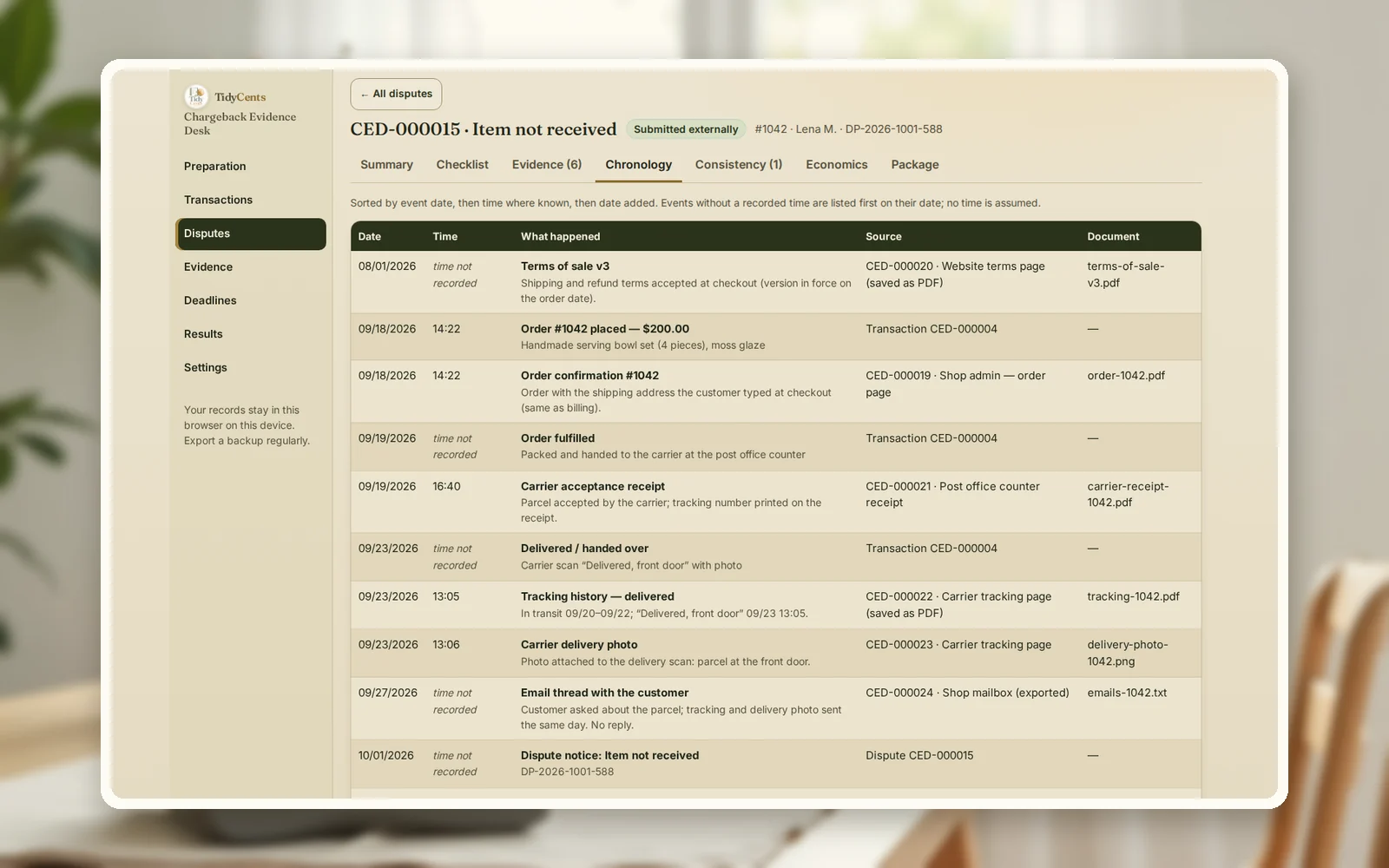
"Item not received" on a $200 order. Order #1042, a serving bowl set, was placed on 18 September. The customer says it never arrived. The shop's evidence, by date:
| Date | Event | Evidence |
|---|---|---|
| 1 August | Terms of sale v3 in force | Terms page saved as PDF |
| 18 September | Order placed, shipping address typed by the customer | Order confirmation |
| 19 September | Parcel accepted by the carrier | Post office receipt with tracking number |
| 23 September | Delivered, front door, 13:05 | Tracking history and the carrier's delivery photo |
| 27 September | Customer asked; tracking and photo sent the same day | E-mail thread, no reply |
| 1 October | Dispute opened | Processor notice |
All five checklist sections for this reason are covered. The economics are clear: $200 plus a $15 fee returned on success makes $215 to recover; one hour at $30 is the response cost, so the break-even chance is about 14%. Answering makes sense.
The catch: the response was submitted on 15 October at 17:01, and the deadline was 17:00. The desk flags it as submitted after the deadline. The evidence was good; the timing was not.
A cracked plate, with warnings to fix first. Order #1057, $86.40, arrived with one plate cracked. The shop has the listing as shown at the time of sale, its own photo of both plates intact before packing, and the customer's photo. Before submitting, the desk shows four problems: the fulfilment date (30 August) is before the order date (2 September), one evidence file belongs to another order, two different files are both named photo-1.png, and the "resolution offered" section is empty although a replacement was offered. The $15 fee here is not returned either way, so it stays out of the decision: 1.5 hours at $30 is a $45 response cost against $86.40, a break-even chance of about 52%.
A dispute that should not have been fought. Order #1038, $64.50, was charged twice; the duplicate had already been refunded on 2 September. But the refund was entered twice in the records, so refunds of $129 showed against a $64.50 order. The dispute was lost: $64.50 plus a $15 fee, $79.50 in total.
Two quick decisions. A $29 subscription dispute was won with the terms, the sign-up consent, the billing dates and the cancellation e-mail six days after the charge — the money and the fee came back. A $54 "refund not received" case is still open: the refund was promised on 6 October and never sent. The right answer there is to issue it, not to argue.
Step by step: answer a chargeback
- Record the dispute: reason, amount, fee, whether the fee is returned on success, and the exact deadline with the time.
- Decide whether to answer with the amount, the fee and your time — or refund, or accept.
- Collect evidence that matches the reason: delivery proof for "not received", the listing and photos for "not as described", terms and consent for subscriptions.
- Add dates and times to every item, and let them form a timeline.
- Check for contradictions: dates, refund amounts, files from other orders, duplicate file names.
- Write a short summary that points to each piece of evidence.
- Build the package within the processor's file limits, and submit well before the deadline.
- Record the outcome and the actual amounts returned, so your results are real numbers.
Common mistakes
- Starting on the last day. Put the deadline, with the time, where you see it every morning.
- Sending everything you have. Send what answers the reason, in order.
- Ignoring your own records. A wrong refund entry can lose a case you should win.
- Storing full card numbers. Keep only the last four digits; never store card numbers, security codes or passwords.
- Fighting a promised refund. Refund it and record it instead.
- Counting a non-refundable fee as part of the decision. It is lost either way.
When a tool helps
One dispute a year fits in an e-mail folder. Several a month — each with its own reason, deadline, fee and files — need a system. Chargeback Evidence Desk keeps transactions, disputes and evidence together, shows a checklist for each dispute reason, builds the timeline, flags contradictions and late submissions, checks the package against file limits, does the break-even arithmetic and records actual results. Exact decimal arithmetic, no AI guesses. Many disputes start as returns; Returns & Exchange Control helps settle them before they become chargebacks.
Open the demo with the ceramics shop above — every screen, no sign-up — then add your own transactions and disputes.
Open Chargeback Evidence DeskAll decisions and cash-flow risk tools
Related guides: the true cost of a return, how to reconcile card payouts with bank deposits and real profit per marketplace order.
FAQ
Should I fight every chargeback?
No. Compare what you can recover — the amount plus any fee returned on success — with the time and fees it takes to answer. If the customer is right, or a refund is already owed, refund or accept instead.
What evidence do I need for an "item not received" dispute?
The order with the shipping address, proof the carrier accepted the parcel, tracking to delivery, any delivery photo or signature, and your messages with the customer. In the example, a delivery photo and a same-day reply cover all five checklist sections.
How long do I have to respond?
The deadline is set by your payment processor and shown on the dispute notice. Record it with the exact time, and submit well before it — in the example, a response one minute late was flagged.
What is friendly fraud?
A dispute filed by a customer who did receive what they paid for — sometimes by mistake, sometimes not. Clear terms, delivery proof and a record of your messages are what answer it.
Can I win a chargeback for a cancelled subscription?
Sometimes, if the terms, the customer's consent, the billing dates and the cancellation date show the charge followed the terms. In the example, the customer cancelled six days after the billing date, and the shop won.
Do I lose the dispute fee if I win?
It depends on the processor; some return it, some do not. Record which applies to each case: a fee that is not returned is lost whatever you decide.
This is decision support, not legal or payments advice.


