
Why do the same problems keep coming back in my business?
The same problems come back because they are produced by a mechanism, not by a bad week or a bad person. A task with no clear owner will drift every time. A mistake that is admitted but never traced to its cause will happen again. Fixing the symptom — finishing the task yourself, calling another meeting — resets the clock, and the mechanism produces the problem again a few weeks later.
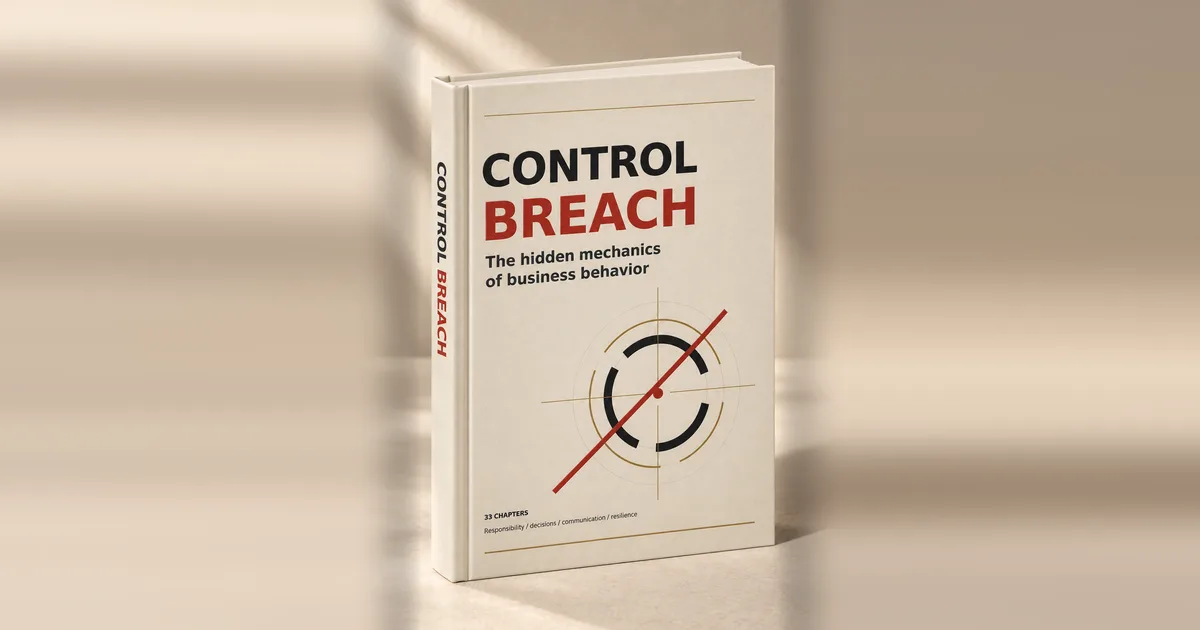
That is the idea behind CONTROL BREACH, a business book we wrote from practice: every chapter started as a real problem in a real company that had to be solved with real people, deadlines and money at stake. This article covers seven of the questions owners and managers ask most often, what is usually happening underneath, and the first thing worth checking. The full methods are in the book; three of its chapters are free to read.
Why does everyone seem busy, yet the same problems keep happening?
Being busy and being in control are two different states. A team can work hard all week while the same handful of issues — a late delivery, a missed handover, a customer who has to chase twice — repeat on schedule.
What is usually happening: effort goes into closing today's instance of the problem, and nobody is assigned to the process that produces it. Every repeat is treated as a new event.
Where to look first: write down the last five problems that cost you time or money. If two or more of them are the same problem, you are looking at a mechanism, and a mechanism needs an owner, not more effort.
Why does nobody take ownership of tasks?
Tasks move between people — an email here, a comment there — and when something goes wrong, everyone can show they did their part. The result belonged to no one.
What is usually happening: responsibility is confused with monitoring. People report on activity ("I sent it", "I asked them") instead of answering for an outcome. The book's chapter on responsibility separates the two and shows how the confusion is built into the way tasks are assigned.
Where to look first: take one task that went wrong and ask, "Who could have stopped this, and did they know it was theirs to stop?" If the honest answer is "several people, partly", the task never had an owner.
Why do employees repeat the same mistakes?
A mistake is acknowledged in the meeting, everyone agrees it should not happen again, and next month it does.
What is usually happening: acknowledging a mistake and correcting it are different steps, and most teams stop after the first. Denial also takes quieter forms than "it wasn't me" — explaining, minimising, moving straight to the next task. The free first chapter describes ten forms of denial at work and what each one costs.
Where to look first: after the next mistake, check whether anything changed besides the apology — a step, a check, a handover. If nothing changed, the conditions that produced it are still in place.
Why do urgent requests always destroy the plan?
Every Monday there is a plan. By Wednesday it has been replaced by whatever arrived loudest.
What is usually happening: competing requests are handled in the order they arrive, not by any agreed rule, and the person under the most pressure decides. Over time the team becomes reactive — good at responding, unable to finish planned work. The difference between proactive and reactive work, and how priorities break down across several levels of management, each have their own chapter.
Where to look first: count how many of last week's planned tasks were finished. If it is under half, the problem is not workload; it is the absence of a rule for what is allowed to interrupt.
Why do people leave the same meeting with different understandings?
Everyone nodded. A week later, three people did three different things, and each is sure they did what was agreed.
What is usually happening: assumptions fill the gaps that questions should have closed, and people-pleasing stops anyone from saying "I don't understand" or "that won't work". The book calls the outcome multiple realities: one team, several versions of what was decided.
Where to look first: end the next meeting by asking each person to state, in one sentence, what they will do and by when. Differences show up in the room instead of in the results.
Why does the work fall apart when one person is away?
The process works perfectly — as long as the same two or three people are there. When one is on holiday or leaves, nothing moves.
What is usually happening: small local workarounds have turned into closed work cycles: knowledge, contacts and shortcuts that live inside a few people instead of in the process. The team looks strong and is in fact fragile. This is the subject of the free chapter 33, Team degradation, or closed work cycles.
Where to look first: list the tasks only one person can do. Each item on that list is a risk to the business, not a sign of that person's value.
Why do good decisions get made badly under pressure?
Stress, anger and fear do not only make work unpleasant; they change which option looks reasonable. Under pressure people choose what ends the discomfort fastest, which is rarely what solves the problem.
What is usually happening: decisions are being made from inside the pressure instead of from outside it. Several chapters cover stress, anger, fear, burnout and the "outside observer" method for stepping back before deciding.
Where to look first: for any decision made in a hurry this month, ask whether you would make the same call on a calm Tuesday morning. If not, the pressure made the decision, not you.
What CONTROL BREACH covers
The book has 33 chapters across five areas, each built around one recurring situation:
- Responsibility and mistakes — ownership versus monitoring, and the process of acknowledging and correcting mistakes.
- Communication and assumptions — questions, people-pleasing, subgroups and multiple realities.
- Decisions and priorities — competing requests, experience versus knowledge, proactive versus reactive work.
- Team processes — how closed work cycles form and make a business depend on specific people.
- Pressure and internal resources — stress, anger, fear, burnout and resistance to change.
You can read it in order or open the chapter that matches the problem on your desk today.
Read three chapters free
Chapters 01, 02 and 33 are open in full, with no sign-up:
- 01 — The structural impact of denial in professional environments.
- 02 — Experience and knowledge: choosing the right approach.
- 33 — Team degradation, or closed work cycles.
Open the book and read them here. The full PDF is 156 pages, a one-time purchase with instant download.
FAQ
Is this a management theory book?
No. Each chapter started as a practical problem in a real company. It describes what was happening, how to recognise it and what to do about it, rather than summarising theories.
Who is it for?
Business owners, team leaders and managers who are responsible for how work gets done — including small businesses without an HR department.
Is it legal, HR or financial advice?
No. It is professional reading and decision support. For legal, HR or financial questions specific to your situation, talk to a qualified professional.


