Hoe groot moet een noodfonds zijn? Drie maanden is de ondergrens, niet het antwoord
"Drie tot zes maanden aan uitgaven." Elk artikel zegt het, en het is het enige advies over persoonlijke financiën dat een ziekenhuisarts met een vast salaris en een seizoensdakdekker precies hetzelfde antwoord geeft.
Dat kan niet kloppen, en de reden waarom het niet klopt heeft een naam en een formule. Deze gids geeft je allebei, plus het eerlijke beeld van waar mensen werkelijk staan.
Wat mensen werkelijk hebben
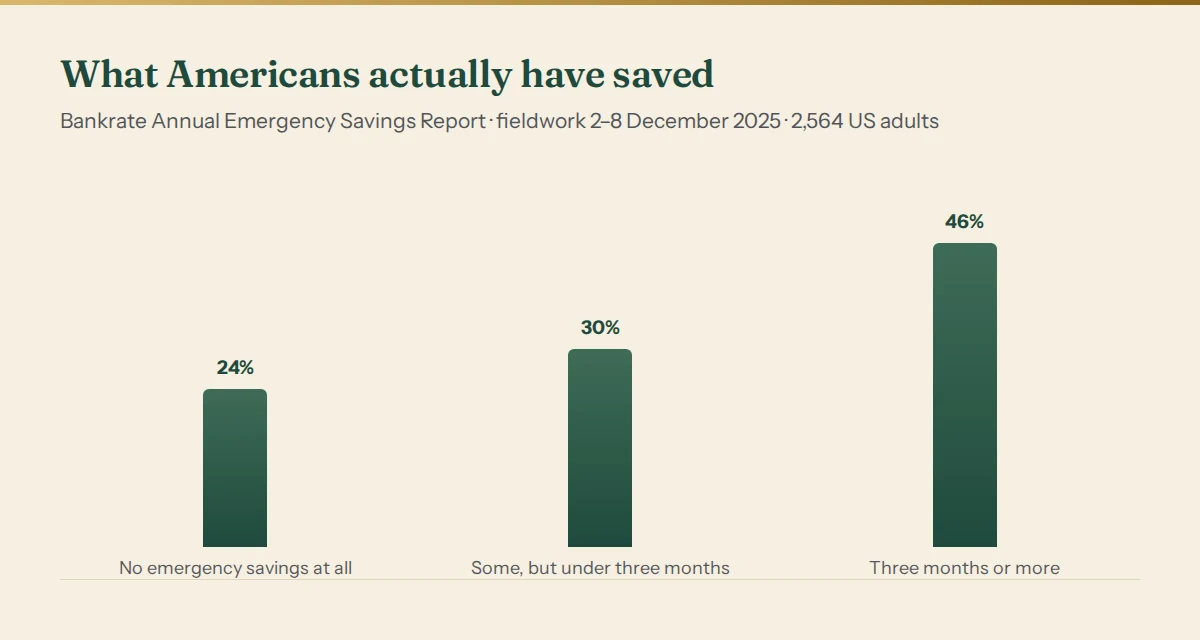
46% van de Amerikaanse volwassenen heeft minstens drie maanden aan uitgaven gespaard. 30% heeft wel iets, maar minder dan drie maanden. 24% heeft niets opzijgezet. In dezelfde peiling zei maar 47% dat ze een noodgeval van $1,000 uit spaargeld konden dekken.
Het onderzoek van de Federal Reserve vertelt bij een kleiner bedrag een vergelijkbaar verhaal: in de gegevens van 2025 zei 63% van de volwassenen dat ze een onverwachte uitgave van $400 volledig zouden dekken met contant geld, spaargeld of een creditcard die bij het volgende overzicht wordt afgelost — en 12% zei dat ze die op geen enkele manier konden betalen.
Uit die cijfers volgen twee dingen, en ze wijzen in tegengestelde richtingen. De meeste mensen zitten niet in de buurt van drie maanden, dus een groter doel kan absurd lijken. Maar de huishoudens met het minst stabiele inkomen zijn precies de huishoudens voor wie drie maanden het verst van genoeg af ligt. Middelen over die spanning heen — zo werd "drie tot zes" het standaardantwoord, en zo werd het voor bijna iedereen afzonderlijk fout.
Waarom één getal niet voor iedereen kan kloppen
Een noodfonds heeft één taak: het betaalt je vaste lasten in de maanden waarin je inkomen dat niet doet.
De grootte die je nodig hebt hangt dus van twee dingen af — hoeveel je uitgeeft, wat de standaardregel wél meeneemt, en hoeveel je inkomen schommelt, wat ze niet doet. Een salaris dat op dezelfde dag voor hetzelfde bedrag binnenkomt heeft bijna geen variantie; het fonds hoeft alleen baanverlies te overleven. Een inkomen dat in hetzelfde jaar tussen $640 en $5,120 slingert, staat aan iets heel anders bloot: niet één dramatische gebeurtenis, maar een doodgewoon slecht kwartaal.
De maat voor die slingering is de variatiecoëfficiënt:
CV = STDEV(laatste 12 maanden netto-inkomen) / AVERAGE(laatste 12 maanden netto-inkomen)
Het is een verhouding, dus het werkt op elk inkomensniveau — een freelancer met $2,000 per maand en een bureau-eigenaar met $20,000 per maand zijn direct te vergelijken. In woorden:
| CV | De vorm van je inkomen |
|---|---|
| onder 0.20 | Stabiel. Bijna een salaris. |
| 0.20 – 0.45 | Hobbelig. Normaal voor freelancewerk. |
| 0.45 – 0.75 | Beweeglijk. De buffer heeft echt werk. |
| boven 0.75 | Feest en hongersnood. Niet onderhandelbaar. |
De regel
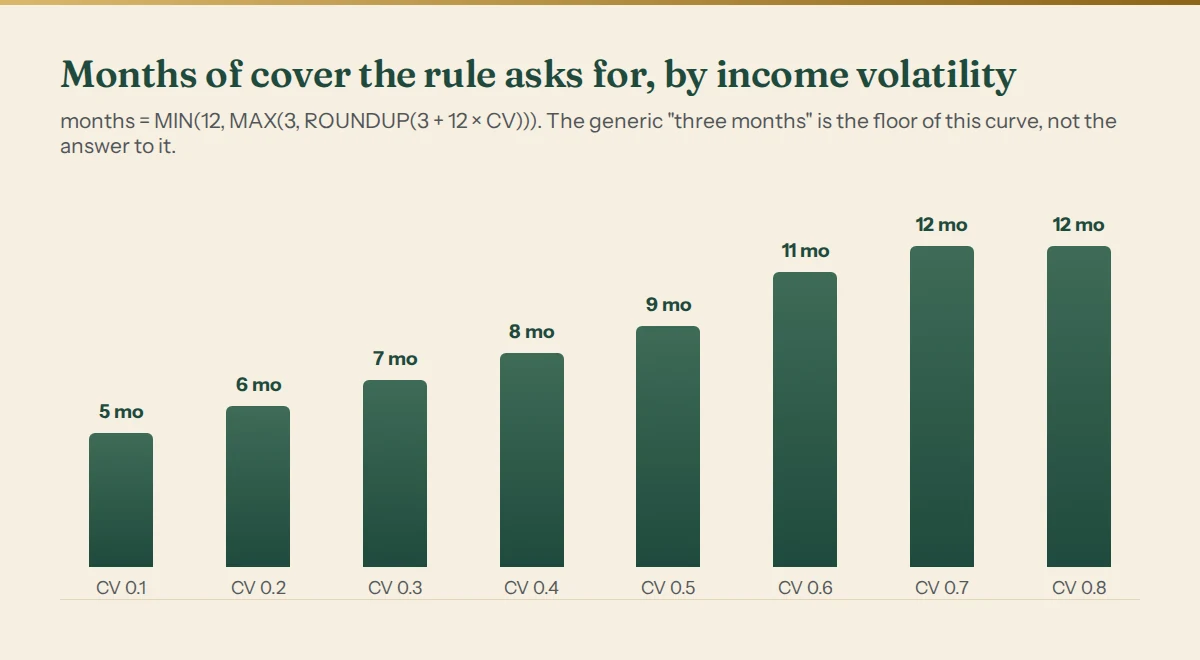
benodigde_maanden = MIN(12, MAX(3, ROUNDUP(3 + 12 × CV, 0)))
bufferdoel = benodigde_maanden × vaste_maandlasten
Drie delen, elk met een taak:
- De 3 is de basis — de dekking die je zelfs nodig hebt als je inkomen nooit schommelt, want het risico om het helemaal kwijt te raken hangt niet af van hoe gelijkmatig het is.
- De 12 × CV is het deel dat iedereen weglaat. Elke 0.1 aan beweeglijkheid voegt ongeveer 1.2 maanden toe, omdat een meer gespreid inkomen zowel diepere dalen als langere reeksen ervan oplevert; de tekorten stapelen zich op in plaats van elkaar af te wisselen.
- Het plafond op 12 houdt de regel in toom. Voorbij een jaar dekking hou je een grote som nutteloos contant geld vast, en het juiste antwoord op beweeglijkheid boven dat punt is het inkomen veranderen — niet ertegen blijven hamsteren.
Kijk wat de grafiek laat zien: op elk echt niveau van schommeling ligt het antwoord al boven drie maanden. Drie is de ondergrens van deze curve, en alleen een inkomen met letterlijk nul variantie zit erop. Als je inkomen ook maar iets beweegt, was het standaardadvies vanaf het begin te grof voor je.
Uitgewerkt voorbeeld
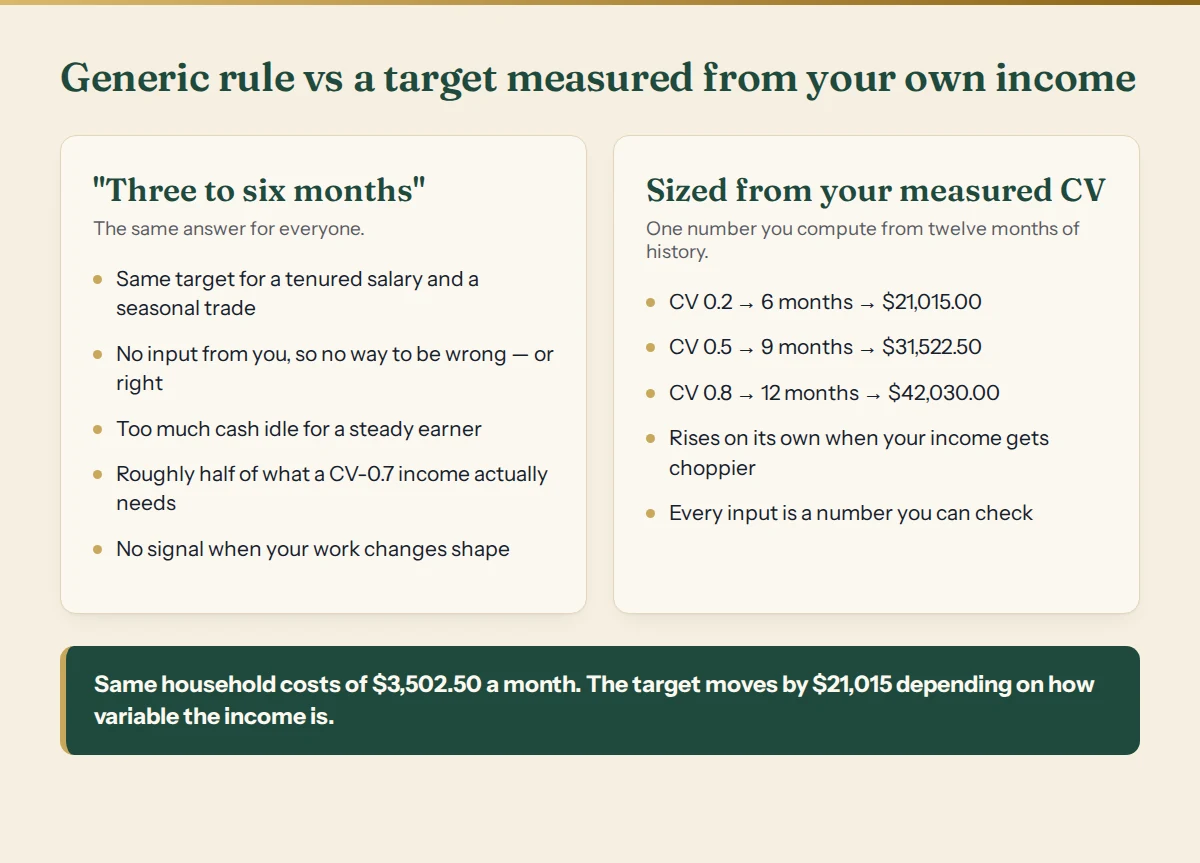
Neem een freelancer met $3,502.50 aan vaste maandlasten — het salaris dat ze zichzelf uitkeert plus haar vaste rekeningen — en twaalf maanden netto-inkomen met een CV van 0.53.
maanden = ROUNDUP(3 + 12 × 0.5273) = ROUNDUP(9.33) = 10
doel = 10 × $3,502.50 = $35,025
Tegenover het standaardadvies van drie tot zes maanden — $10,508 tot $21,015 — vraagt de gemeten regel $35,025. Dat is niet de regel die somber doet. Die freelancer had een maand die $640 opbracht tegen $3,502.50 aan lasten, een gat van $2,862.50 in één maand, en het was niet haar enige slechte. Zes maanden dekking was een reëel risico geweest om droog te vallen.
Wat telt als "vaste maandlasten"
Niet je gemiddelde uitgaven. Het getal dat je nodig hebt, is wat je binnen een maand niet kunt stopzetten:
- Telt mee: huur of hypotheek, energie en water, verzekeringen, minimale aflossingen op schulden, boodschappen, vervoer naar je werk, kinderopvang, telefoon en elk abonnement dat je in een slecht kwartaal echt zou houden.
- Telt niet mee: vrije uitgaven die je werkelijk zou schrappen, spaarstortingen anders dan de buffer zelf, en alles wat je met één telefoontje kunt pauzeren.
Wees eerlijk in beide richtingen. Het getal opblazen maakt het doel onhaalbaar en dan geef je het op; het uitkleden tot op het bot laat het fonds falen op het moment dat je het nodig hebt — het enige moment dat telt.
Er komen wanneer het doel onmogelijk lijkt
$35,025 is een getal waarbij mensen het tabblad sluiten. Drie dingen maken het hanteerbaar:
- Tel in maanden, niet in dollars. "$8,000 gespaard" is geen informatie. "2.3 maanden speelruimte" wel — en het stijgt op een manier die je voelt. Speelruimte is gewoon
saldo ÷ vaste_lasten. - De eerste maand dekking is meer waard dan de tiende. Van 0 naar 1 maand gaan haalt de hele categorie noodgevallen weg die nu op een creditcard tegen 22% belanden. Van 9 naar 10 levert veel minder op. Zet de inspanning vooraan en laat de latere maanden desnoods jaren duren.
- Vul hem uit het overschot, niet uit discipline. Als je inkomen schommelt, komen de goede maanden de buffer vullen. Keer jezelf een vast salaris uit, laat de rest staan, en het fonds vult zichzelf zonder dat een maand als opoffering voelt — de percentielmethode bepaalt dat vaste bedrag.
Controleer het elk kwartaal opnieuw
CV is geen constante. Een grote klant verliezen, een vast contract erbij krijgen of van losse projecten naar contractwerk overstappen verandert de vorm van je inkomen, en het doel moet meebewegen. Reken de standaardafwijking en het gemiddelde elk kwartaal opnieuw uit over twaalf voortschrijdende maanden; als het bufferdoel omhoogging, vertelt het mechanisme je iets echts over je risico — het is geen rekenfout.
De korte versie
Drie tot zes maanden is een invuloefening voor een som die niemand je laat maken. Meet je eigen schommeling, tel er 1.2 maanden dekking bij op voor elke 0.1 ervan, zet het plafond op een jaar en tel wat je hebt in maanden in plaats van dollars. Het getal dat eruit komt is specifiek van jou — en je kunt precies zeggen waarom het is wat het is.
Bronnen: Bankrate Annual Emergency Savings Report (veldwerk 2–8 december 2025, n = 2,564 Amerikaanse volwassenen); Federal Reserve, Report on the Economic Well-Being of U.S. Households in 2025.