Life after Mint: what the budgeting apps cost in September 2026, and what happens to your data
We sell a budgeting file. It is one paragraph at the bottom of this page, it costs money once, and for a lot of people reading this it is the wrong answer — it has no bank connection and no sync. Everything above that paragraph is checked against the companies' own pages, with the date we checked, so you can use it and buy nothing from us.
Every price below was read off the seller's own page on 6 September 2026. Prices change; the dates are there so you can tell how stale this has gone.
What actually happened to Mint?
Intuit bought Mint in 2009 for $170 million. In November 2023 it announced the app was closing and told users to move to Credit Karma, which it had bought in 2020. The first date given was 31 December 2023; it was moved to 23 March 2024.
Mint had 3.6 million active users in 2021 — the figure Bloomberg reported and Engadget repeated when Intuit confirmed the shutdown. No newer number was published, so that is the size of the problem as far as anyone outside Intuit can say.
What did not make the trip was the budget. Credit Karma's own announcement of 31 October 2023 says: "we know the most active Minters use Mint to monitor their cash flow and track their spending, and not only does Credit Karma offer these capabilities, but we're able to take things even further." Cash flow and spending. Not budgets. For your history, the same release points you at a help article on "how to download your Mint data" — that part was yours to do, before the lights went out.
Is Credit Karma a budgeting app now?
Go to mint.intuit.com today and it still answers. The page says "Mint has been reimagined on Credit Karma" and lists what made the trip: linking accounts from more than 17,000 institutions, reviewing transactions, tracking spending by category, monthly insights, net worth.
Read the list again. There is no budget in it.
It is worth knowing how the free replacement is paid for, because Credit Karma says so plainly: "When you're approved for a product we recommend, we typically make a small commission for helping make the connection." Recommendations are the product.
That model has been tested by a regulator. In 2022 the FTC took action against Credit Karma, alleging it told people they were "pre-approved" and had "90% odds" of approval for card offers they ultimately did not qualify for. Credit Karma agreed to an order to stop making the claims and to pay $3 million. In October 2024 the FTC sent more than $2.5 million to 50,994 people who had filed a valid claim.
What do the replacements cost right now?
| App | Per month | Per year | Free tier | Trial |
|---|---|---|---|---|
| YNAB | $14.99 | $109 ($9.08/mo) | none | 34 days |
| Monarch Core | $14.99 | $99.99 ($8.33/mo) | none | 7 days |
| Monarch Plus | — | $199.99 ($16.67/mo) | none | 7 days |
| Copilot | $13 | $95 ($7.92/mo) | none | 1 month |
| EveryDollar Premium | $17.99 | $79.99 ($6.67/mo) | yes | 14 days |
| PocketGuard Premium | $12.99 | $74.99 ($6.25/mo) | not shown | 7 days |
| Quicken Simplifi | annual billing only | $3.99/mo first year, then $6.99/mo | none | none stated |
| Rocket Money Premium | you choose, usually $7–$14 | not published | yes | 7 days |
| Rocket Money Premium+ | $15 | not published | — | 7 days |
| Goodbudget Premium | $10 | $80 | yes | — |
Four notes the table cannot hold.
Simplifi is annual-only, and the first-year price is an offer. Quicken's page states the introductory rate applies to the first year for orders placed direct by 4 October 2026; after that it renews at the then-current price. At the listed regular rate that is $83.88 a year, against $47.88 for year one.
Rocket Money will not print a number. Its help centre says Premium is a sliding scale: "You choose what to pay." Its own learning-centre article of 19 January 2026 puts the usual range at $7 to $14 a month and Premium+ at $15. Separately, its bill negotiation service charges a success fee of 35–60% of your first year's savings — you pick the percentage, and pay nothing if nothing is saved.
YNAB gives college students a free year. Its pricing page offers enrolled students a 365-day free trial on proof of enrolment, and one subscription can be shared with up to six people.
PocketGuard sells a lifetime licence — $149.99 once, listed alongside the subscriptions.
Did the prices actually go up, or does it just feel that way?
Of the six we could check against archived copies of their own pricing pages, two went up and four did not.
- YNAB: $99 to $109 a year. The archived copy of the pricing page from 1 August 2024 shows "$99 paid annually". The copy from 1 October 2024 shows "$109". The monthly price stayed at $14.99 through both.
- Quicken Simplifi: $3.99 to $6.99 a month, billed annually. The archived copy from 29 March 2024 gives $3.99 as the standard rate with promotions below it. Today $3.99 is the promotion and $6.99 is the standard. Per year that is $47.88 to $83.88 — up 75%.
- Monarch: unchanged at $99.99, archived April 2024 and live today. What changed is above it: a $199.99 Plus tier that did not exist then.
- Copilot: unchanged at $95 a year, archived December 2023 and live today.
- EveryDollar: unchanged at $79.99 and $17.99, archived April 2024.
- PocketGuard: unchanged at $74.99 and $12.99, archived April 2024.
So the story is not a general price surge. The thing that disappeared was Mint's actual offer: a full-featured budgeting app, connected to your banks, for nothing.
Which ones are still free, and what pays for them?
- EveryDollar has a free version you can keep for as long as you like. It is manual: bank connections are a Premium feature.
- Rocket Money has a free tier with subscription tracking, budgeting and bill reminders. It is owned by Rocket Companies, the mortgage lender, which bought Truebill for $1.275 billion in cash in December 2021 and renamed it.
- Goodbudget has a plan it calls Free Forever: 10 regular envelopes plus 10 more, 1 account, 2 devices, 1 year of history. Bank sync lives in Premium.
- Actual Budget is open source and free, on the condition that you run it — self-hosted or on a hosting service you pay separately.
- Credit Karma is free and paid for by commissions, as above.
- YNAB, Monarch, Copilot, Simplifi and PocketGuard have no permanent free tier. Copilot's FAQ says it outright: "There's no permanent free tier."
Who actually receives my bank login?
Almost none of these companies connect to your bank themselves. They rent that from an aggregator, and the aggregator is who your credentials really go to.
- YNAB — Plaid and MX. Its security page, updated 24 August 2026, says the connection is read-only and "your bank credentials go to them, not us, and we never store them".
- Monarch — Plaid, Finicity, MX or Spinwheel, named in its privacy policy effective 10 August 2026: "At no point will we receive your login information to any of your financial accounts."
- Copilot — Plaid mainly, plus Mastercard, MX and Akoya for institutions Plaid does not cover, and direct links to Apple, Capital One, Public and Coinbase (help centre, 6 May 2026).
- EveryDollar — Mastercard Connect and Plaid, per Ramsey's own FAQ.
- PocketGuard — Finicity, Plaid, Salt Edge and Apple Wallet, per its security page.
- Rocket Money — Plaid. Its help article of 11 April 2024: "we never store your bank login information."
- Quicken Simplifi — an unnamed "aggregation partner", and this one is different. Its help article of 23 April 2026 says: "Your login credentials are encrypted and securely stored by our aggregation partner", which "securely logs in to your bank on your behalf — typically once a day and outside of business hours."
That last one is not a scandal; it is an older way of connecting, and Quicken documents it clearly. But it is a real difference. YNAB, Monarch, Copilot and Rocket Money each state in as many words that your bank password never reaches them and is not stored. Simplifi states that it is stored, by a partner it does not name, and used to log in on your behalf every night. EveryDollar and PocketGuard name their providers but do not make the no-storage claim either way.
One more thing worth knowing about the plumbing: Finicity has been a Mastercard company since 19 November 2020. When Copilot's help page lists "Mastercard" as a data provider, that is what it means.
Do these apps sell my data?
Every paid app on this list says no, in its own words.
- YNAB: "YNAB doesn't sell your financial data or anything you enter in the app. We make money from subscriptions, not data."
- Monarch: "We will never sell your financial data."
- Copilot: "Copilot Money does not sell user's financial data and does not show ads."
Two of them then add a caveat that is easy to miss and, to their credit, they print it themselves. YNAB: "We do use targeted advertising to reach new users, which some state privacy laws count as a 'sale' or 'share,' so you can opt out." Monarch's policy says references to selling and sharing "are only used as they relate to certain online advertising activities related to our use of Cookies", and that disclosures to advertising partners "may constitute a 'selling' or 'sharing' under applicable U.S. State Privacy Law".
Read that as it is meant: your transactions are not for sale, and the marketing cookies on the website are a different question with a legal answer you may not like. Monarch's policy also names OpenAI among the vendors powering parts of the service.
The aggregation layer has a harder history than the apps do. On 20 July 2022 a federal judge approved a $58 million settlement in Cottle v. Plaid, brought by users who said Plaid had harvested and sold financial data obtained through bank login screens designed to look like their bank's. Payments worked out at about $13.50 per person, and the order required Plaid to delete certain transaction data, minimise what it collects and add disclosures. Plaid's own statement, published when the settlement became public: "Plaid does not, and never has, sold data... While we disagree with the claims, we believe the settlement that the parties were able to achieve is the best path forward."
For the apps themselves: searching on 6 September 2026 turned up no regulatory action and no reported breach at YNAB, Monarch, Copilot, EveryDollar, PocketGuard, Quicken Simplifi or Rocket Money. That is not the same as proving nothing happened, and we are not going to dress it up as one. It is what a day of looking found.
What happens to my data when the app shuts down?
This is the question Mint users learned the answer to, and there is a fresher example.
Moneyhub, a UK budgeting and net worth app, told users in 2025 that the app would be decommissioned in August 2026, and that "in line with our terms and conditions, all personal data will be securely deleted from Moneyhub systems once the app is closed." It later announced that a partner, WPS Advisory, would take over the app instead — but only for people who opted in: "Users will be offered the chance to export data before accounts and data are permanently deleted."
Its own help centre puts the ending plainly: the app "will be officially sunsetted and no longer available from the 31st of July", and "if no action is taken by the 31st of July, all remaining accounts and associated data will be automatically deleted in full accordance with GDPR rules."
Note that the date moved — August 2026 in the statement quoted by the press, 31 July in the help article, which does not name the year. Mint's date moved too, in the other direction. That is the practical lesson from both, and it costs nothing to act on: the export button is the feature. Use it on a schedule, not when you see the notice.
Why do people actually leave?
We cannot measure forum sentiment honestly, and we are not going to invent quotes. But you can read the objections off the sellers' own pages, because a sales page answers the thing people say.
Monarch's pricing page opens with the heading "Why pay for a personal finance app?" and four arguments underneath it. YNAB's pricing FAQ answers "Is my data safe with YNAB?" by starting "There's a saying that if you're not paying for the product, YOU'RE the product." PocketGuard sells a lifetime licence next to its subscriptions. Rocket Money lets you set your own price. Those four pages tell you what people object to: cost, subscriptions, and not knowing who is being served.
Where users were quoted in print, the complaints are ordinary. In a March 2025 report on the Moneyhub closure, one Reddit user was quoted saying: "I could go spreadsheet I suppose, but having things automatically update is nice." Another wanted "a wealth tracker without any budgeting". Nobody in that piece was arguing about features. They were annoyed at having to move again.
What can I do with no subscription and no bank login?
More than the app marketing suggests, as long as you accept the trade: you type things in.
- Run the numbers without any app. The budget calculator splits an income into needs, wants and savings; the savings goal calculator works out the monthly amount that actually reaches a date; the debt payoff calculator compares snowball against avalanche on your real balances; the emergency fund calculator sizes the buffer. All free, no sign-up, nothing stored.
- Build the sheet yourself. How to make a budget spreadsheet is the eight-step build, formula by formula. It costs an evening and then it is yours, with no renewal date.
- Use a free tier deliberately. Goodbudget's free plan and EveryDollar's free version both work without a bank connection. So does Actual Budget, if running your own software appeals.
- Use paper. There are free sample pages — a monthly budget, an expense log, a bill tracker — that need no device at all.
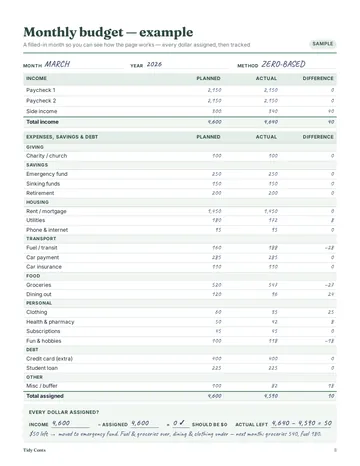
- Pick a method first. Zero-based budgeting and sinking funds are what the paid apps are mostly selling you a nicer interface to. The method is free.
One practical note about the typing, since it is the whole objection. Nearly every bank will export a statement as CSV from its own website, usually under statements or transactions, and that file is the same data an aggregator would fetch for you — a month at a time, on your terms, with no third party holding a credential. It takes a couple of minutes a month. Whether that is worth $74.99 to $199.99 a year is the actual question, and it is a different answer for someone with two accounts than for a couple running six.
Our own file, and what it does not do
The Tidy Cents Budget App is one .html file you save and open in a browser. It shows what is safe to spend today after the bills due before payday, tracks plan against actual, bills, goals and reports, in eight languages, and it costs one payment with no renewal. Here is what it does not do, in plain terms: it does not connect to your bank — every entry is typed or pasted from CSV; it does not sync your phone with your laptop — they are separate copies and you move a backup file between them; it has no account, no server and no support for automatic categorisation, because there is no network code in it at all. If automatic import is the reason you used Mint, one of the subscriptions above will suit you better, and this page is a fair place to choose one.
What this page cannot tell you
Prices move, tiers get renamed, and a policy can change the week after we read it — every claim here carries the date we checked it, and the links go to the pages themselves so you can see today's version. This is a US-focused list; several of these apps do not support banks outside the US and Canada. And none of it is financial advice: which app suits you depends on whether you will actually open it, which no comparison table can predict.
Sources. YNAB pricing and YNAB security, updated 24 August 2026 · Monarch pricing and Monarch privacy policy, effective 10 August 2026 · Copilot pricing section and Copilot FAQ and "How do you get my financial data?", 6 May 2026 · EveryDollar, Ramsey Solutions · PocketGuard pricing and security · Quicken Simplifi and "How does Quicken Simplifi connect to my bank?", 23 April 2026 · Rocket Money help, "How much does Rocket Money cost?", 27 July 2026, Rocket Money learning centre, 19 January 2026 and "Is Rocket Money secure?", 11 April 2024 · Goodbudget sign-up plans and changes to plan offerings, August 2024 · Actual Budget · Rocket Companies to acquire Truebill, December 2021 · Mastercard completes Finicity acquisition, 19 November 2020 · Engadget on the Mint shutdown · Wikipedia, Intuit Mint — shutdown dates and references · mint.intuit.com as it stands today · Credit Karma, "Intuit Credit Karma welcomes all Minters", 31 October 2023 and how Credit Karma works · FTC, refunds to consumers deceived by Credit Karma "pre-approved" offers, 31 October 2024 · Courthouse News, judge approves $58 million Plaid settlement, 20 July 2022 and Plaid's own statement · Moneyhub, "Continuing service of the Moneyhub app", Moneyhub help centre on the app closure and Yahoo News UK, 10 March 2025 · price history from the Internet Archive's copies of the YNAB, Simplifi, Monarch, Copilot, EveryDollar and PocketGuard pricing pages. All pages read on 6 September 2026.