Sinking funds: the budgeting habit that ends "unexpected" expenses
Ask someone why their budget failed last year and you will usually get a list: the car needed tyres, the boiler went, Christmas happened, the insurance renewed, the cat needed an operation.
Four of those five were entirely predictable. One of them happens on exactly the same date every single year.
A sinking fund is the fix. It is money set aside monthly for a known, non-monthly expense, so that when the expense arrives it is paid for rather than absorbed. The name comes from corporate finance, where a company sets aside money over time to retire a bond — same idea, smaller numbers.
The habit is not complicated. What makes it work is being honest about how many of these you actually have.
Sinking fund or emergency fund?
They get conflated constantly, and keeping them separate is what makes both of them work.
| Sinking fund | Emergency fund | |
|---|---|---|
| For | Known expense, unknown or known date | Genuinely unforeseeable events |
| Examples | Insurance renewal, Christmas, new tyres | Job loss, urgent medical, storm damage |
| Target | The cost of the thing | Three to six months of essential spending |
| When it empties | That is what it was for | Something has gone wrong |
| Rebuilt | Automatically, monthly | Deliberately, as a priority |
If you spend your emergency fund on Christmas, you do not have an emergency fund. That is the whole reason for the distinction.
The 12 categories most people forget
Not the obvious ones. These are the ones that turn up in "why was last month so bad" post-mortems:
- Car insurance — if you pay annually or twice-yearly to avoid the instalment surcharge, that is a large bill twice removed from your monthly budget.
- Car maintenance, tyres and registration — a service, an annual road tax or registration, and one set of tyres roughly every three years. Not the same fund as fuel.
- Home maintenance and repairs — the boiler, the roof, the washing machine. A common rule of thumb is 1-2% of the property's value per year; it is a rough guide rather than a researched figure, but it is a much better starting number than zero.
- Property tax, service charges and annual local bills — usually the biggest single one on this list for homeowners.
- Medical and dental — the deductible, the dentist, glasses, contact lenses, the prescription that is not covered.
- Pets — annual vaccinations and the vet bill nobody plans for. Insurance moves this cost but does not remove the excess.
- Christmas and December — gifts, food, travel, and the general 30% inflation that happens to a household in December.
- Other people's occasions — birthdays, weddings, christenings, leaving gifts. Individually small, collectively a real annual number, and completely invisible in a monthly budget.
- Annual subscriptions and renewals — cloud storage, domain names, antivirus, Prime, professional memberships. These renew silently and are almost never in anyone's bill list.
- Technology replacement — a phone every three years, a laptop every five, appliances whenever they decide. Predictable in aggregate, never in timing.
- Travel — not the holiday you are planning, which you probably already budget, but the flights for the wedding abroad and the trip home at Christmas.
- Professional and admin costs — tax preparation, licences, union dues, school fees, uniform and equipment lists.
You will not have all twelve. A renter with no car and no pets might have four. A homeowner with two cars, a dog and children could have all twelve and then some.
Calculating each one
The formula is arithmetic, not finance:
Monthly amount = (target amount − already saved) ÷ months until it is due
For a fund that repeats every year and has no urgent deadline, that reduces to annual cost ÷ 12.
Here is a fully worked steady-state example for a household with a home, a car, a pet and travel plans:
| Fund | Annual cost | Per month |
|---|---|---|
| Property tax | $2,400 | $200.00 |
| Home maintenance | $1,800 | $150.00 |
| Travel | $1,500 | $125.00 |
| Car insurance | $1,240 | $103.33 |
| Car maintenance, tyres, registration | $900 | $75.00 |
| Christmas and gifts | $850 | $70.83 |
| Medical and dental | $600 | $50.00 |
| Technology replacement | $600 | $50.00 |
| Pet | $480 | $40.00 |
| Clothing | $480 | $40.00 |
| Professional and tax prep | $300 | $25.00 |
| Annual subscriptions | $260 | $21.67 |
| Total | $11,410 | $950.83 |
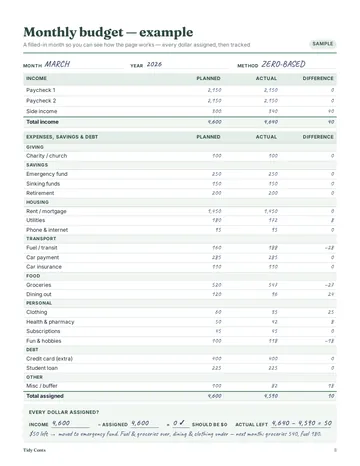
That number is the point of the exercise. This household spends $950 a month on things it does not think of as monthly expenses. If those twelve lines are not in the budget, then the budget is understating real costs by nearly a thousand dollars a month, and every quarter will contain a "bad month" that is not actually bad — it is just when the arithmetic caught up.
Seeing the total is uncomfortable and also the most useful thing sinking funds do. You are not adding a new cost. You are writing down one you were already paying.
The year-one problem, and how to get through it
There is a catch nobody mentions. In the first year you are funding these from a standing start, and the months-until-due are short.
Suppose you start on 1 September with nothing saved:
| Fund | Target | Due | Months to go | Per month |
|---|---|---|---|---|
| Christmas and gifts | $850 | 1 Dec | 3 | $283.33 |
| Car insurance | $1,240 | 1 Mar | 6 | $206.67 |
| Car service and tyres | $900 | 1 Jun | 9 | $100.00 |
| Annual subscriptions | $260 | spread | 12 | $21.67 |
| Total | $611.67 |
The same four funds in steady state cost $270.83 a month. Year one costs 2.3 times as much, because you are simultaneously saving for this year's expenses and building the float that makes future years smooth.
Four honest ways through it:
- Start with fewer funds. Three is a real system. Twelve on day one is a spreadsheet you abandon in October.
- Start in January if the choice is available, so most funds get a full run-up.
- Accept a partial first year. $500 toward an $850 Christmas is not failure, it is $500 that did not go on a credit card at 24%.
- Use a windfall. A tax refund or a third paycheck in a 3-paycheck month is the ideal way to skip the year-one hump, because it funds the float in one go.
How to hold them in one account without losing track
The instinct is to open one savings account per fund. Do not. Twelve accounts means twelve logins, twelve transfers a month, and a system that collapses the first time you are busy.
One savings account. One ledger.
The savings account holds the money. A single table — spreadsheet or paper — records what each dollar in it is for. Some banks now offer "pots", "spaces", "vaults" or "buckets" inside one account, which is exactly this idea implemented for you; if yours does, use it.
The ledger needs five columns and one check:
| Fund | Target | Saved | Due | Per month |
|---|---|---|---|---|
| Car insurance | $1,240 | $413 | 1 Mar | $103.33 |
| Christmas | $850 | $283 | 1 Dec | $70.83 |
| … | ||||
| Total saved | $696 |
And then the check that makes the whole thing trustworthy:
Reconciliation = savings account balance − SUM(saved column)
That cell must read zero. If it does not, either a transfer did not happen or a withdrawal was not recorded, and you want to know that in ten seconds rather than in March. Put it at the top of the sheet in a large font.
In a spreadsheet, the useful formulas are:
Still needed   =MAX(0, $B2 - $C2)
Months to go   =MAX(1, (YEAR($D2)-YEAR(TODAY()))*12 + MONTH($D2)-MONTH(TODAY()))
Per month      =ROUNDUP($E2 / $F2, 2)
The MAX(1, …) matters: without it, a fund due this month divides by zero. Building the months calculation from YEAR and MONTH rather than DATEDIF keeps it identical in Excel and Google Sheets.
Four rules that keep the ledger honest
- One transfer a month, on payday, for the total. Not twelve transfers. The ledger does the splitting; the bank just holds the total.
- Record the withdrawal the same day you spend it. An unrecorded withdrawal is how a ledger silently starts lying.
- Do not raid one fund for another without editing the ledger. Borrowing from Christmas to fix the car is completely fine. Pretending you did not is what breaks it.
- Review the targets once a year. If a fund ran out, the target was too low — that is information, not failure. If a fund has sat untouched for two years, close it and move the money.
Triage, when you cannot fund them all
Almost nobody can fund the full list immediately. Order them like this:
- Anything with a penalty for missing it — insurance, tax, registration. Non-payment here costs more than the bill.
- Anything you would otherwise put on a credit card — because that fund's real return is your card's APR, which is the highest guaranteed return available to you.
- The one that hurt most last year. You already know which it is.
- Everything else, in order of how soon it is due.
And do the subtraction the other way round at least once: if the twelve funds come to $950 a month and there is $400 available, the gap is not a motivation problem. It is a signal that either the targets are aspirational, or the household's fixed costs are genuinely too high, and both of those are worth knowing precisely rather than discovering one bill at a time.
Setting it up
You need very little: a list of irregular expenses with an annual cost and a due month, a single savings account, one automatic transfer, and a ledger you can reconcile.
Our Savings Goals & Sinking Funds Tracker is that ledger with the reconciliation, the projected funding dates and a monthly calendar of what is due when — but the five columns above are genuinely the whole system, and a notebook page runs it perfectly well.
If you would rather see it on paper first, there are free printable sample pages, and if you are still working out how much of your income should be going into any of this, the 50/30/20 calculator is a reasonable place to start.
The measure of success is not the balance. It is the first year the car needs tyres in February and nothing happens — no card, no argument, no bad month. Just a transfer out of an account that was expecting it.