
Contract auto-renewal: find your last notice day
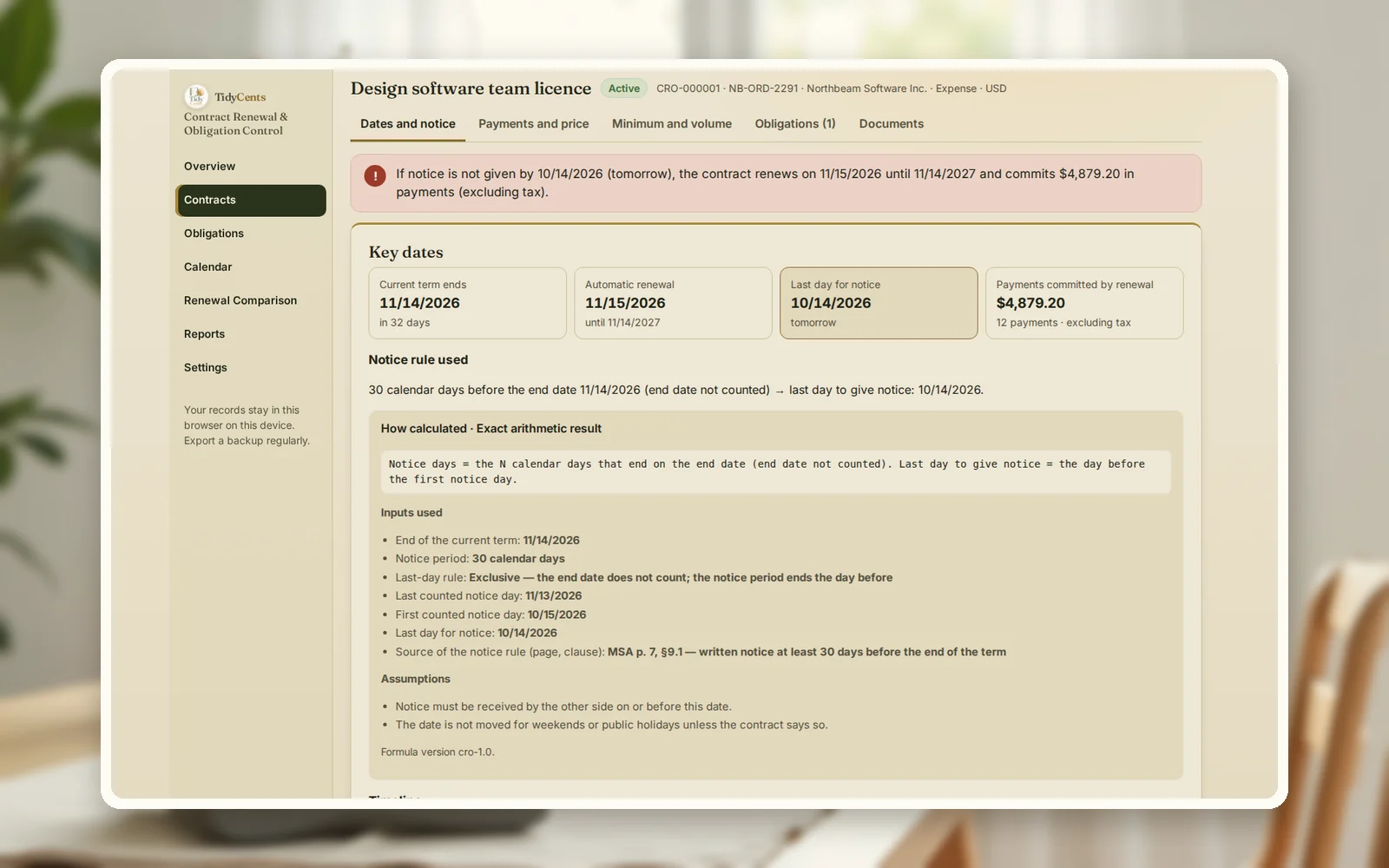
The last day to give notice is the end date of the current term minus the notice period — counted exactly as the contract defines it (calendar days, working days or months, and whether the end date itself counts). Miss it by one day and an auto-renewing contract commits you to another full term at whatever price the renewal brings. In the example below, one software licence has one day left before it renews for $4,879.20, and a lease's notice deadline falls on a Saturday.
Why notice deadlines slip
Auto-renewal clauses are written to be easy to miss. Four things make the date harder than it looks:
- The unit. "30 days", "10 working days" and "3 months" give different dates for the same end date.
- The counting rule. Some contracts count the end date as a notice day; others end the notice period the day before.
- Weekends and holidays. A deadline that falls on a Saturday usually means you act on Friday.
- The price after renewal. Fixed increases, index clauses with caps and stepped fees mean the next term costs more than the current one.
The cost of missing the date is not the monthly fee — it is the whole next term.
The formula
- Last counted notice day = end date (if the end date counts) or the day before it (if it does not).
- Calendar days: first notice day = last counted day − (notice length − 1); last day to give notice = the day before that.
- Months: last day to give notice = the same date the given number of months before the last counted day.
- Working days: count back only working days; the last day to give notice is the working day before the first counted one.
- Renewal commitment = every payment in the next term, at the price that applies after any increase.
- Index increase = change in the index × pass-through share, kept between the floor and the cap.
A worked example
The numbers are the demo of Contract Renewal & Obligation Control: a fictional design studio with seven contracts, checked on 13 October 2026.
| Contract | Term ends | Notice | Last day to give notice | What renewal commits |
|---|---|---|---|---|
| Design software licence | 14 November 2026 | 30 calendar days, end date not counted | 14 October 2026 | $4,879.20 for 12 months |
| Studio lease | 31 January 2027 | 3 months, end date counted | 31 October 2026 (a Saturday) | $30,218.76 for 12 months |
| Cloud backup storage | 30 November 2026 | 10 working days, end date not counted | 13 November 2026 | $768 for 12 months |
The software licence costs $380 a month today; the order form adds 7% at each renewal, so the next term is 12 × $406.60 = $4,879.20. The studio compares three choices before the deadline:
| Option | Next 12 months | Difference vs renewing |
|---|---|---|
| Renew as offered (+7%) | $4,879.20 | — |
| Negotiate to $360 a month | $4,320.00 | $559.20 saved |
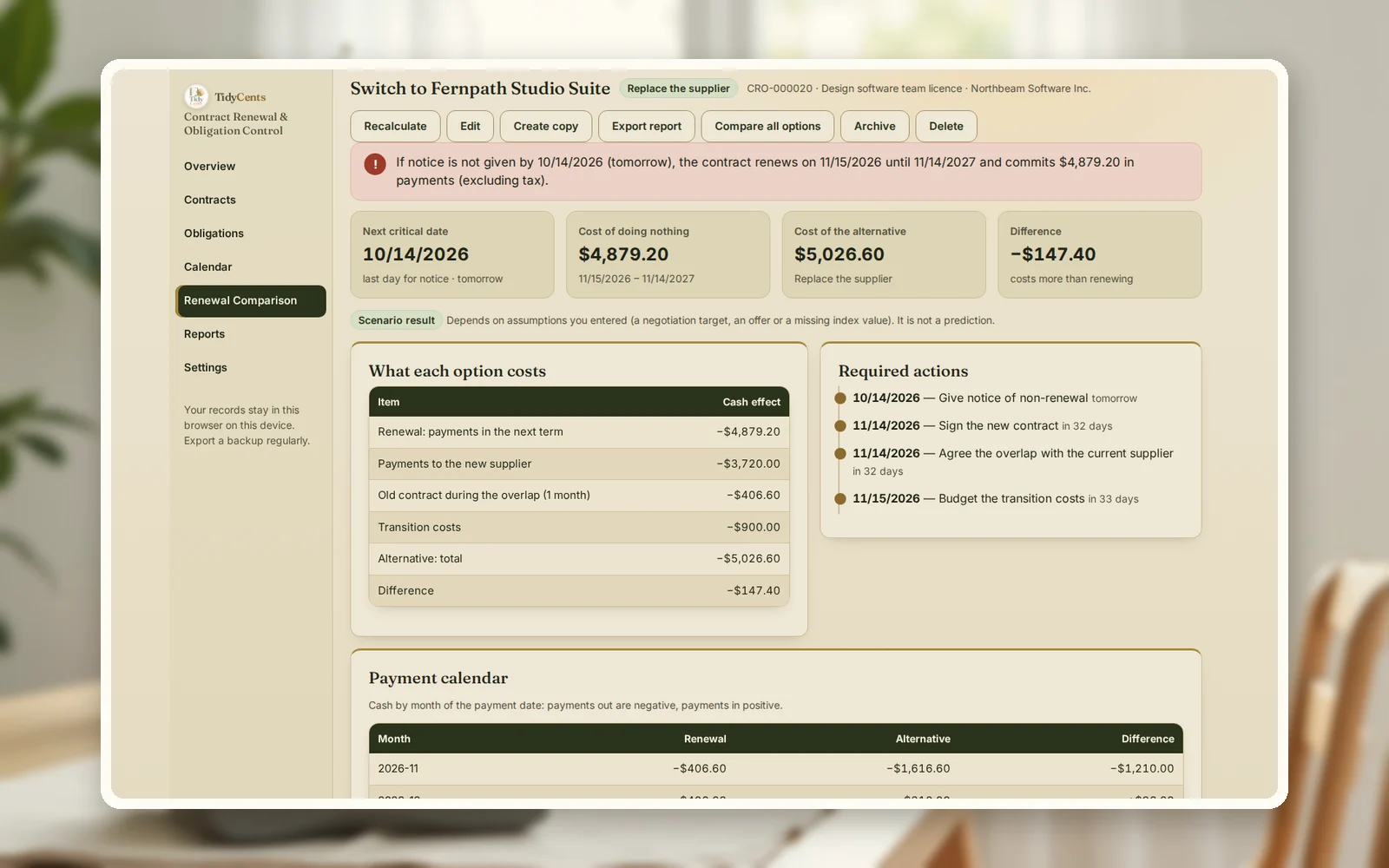
| Switch to another suite at $310 a month | $5,026.60 | $147.40 more |
The cheaper monthly price of the switch does not win in year one: $3,720 of new fees plus one overlapping month of the old licence ($406.60) and $900 of migration and training add up to more than renewing. Negotiating is the better use of the last day — but only if the notice goes out by 14 October.
The lease has a CPI clause: the index moved from 312.4 to 321.1, a rise of 2.78%, which is under the 3% cap, so the rent goes from $2,450 to $2,518.23 a month. The three-month notice period ends on the last day of the term, so the last day to give notice is 31 October — a Saturday. The studio plans to send its certified letter on Friday 30 October.
The backup contract shows why units matter: 10 working days before 30 November is 13 November, not 19 November as 10 calendar days would give.
One more check the register makes: the print supply agreement requires 40,000 sheets a year and the studio has used 31,500. The contract states no charge for a shortfall, so the lab records the 8,500-sheet gap and does not invent a cost.
Step by step: never miss a renewal date
- List every contract that renews by itself: software, rent, equipment plans, services, insurance.
- Copy the notice clause word for word with its page and section, so anyone can check it.
- Work out the last day to give notice with the right unit and counting rule; move it earlier if it falls on a non-working day.
- Price the next term with every increase the contract allows.
- Decide early: renew, renegotiate, reduce volume or replace — and compare them over the same 12 months.
- Give notice in the form the contract requires (email, letter, portal) and keep the proof.
- Set reminders 30, 14, 7 and 1 days before each deadline.
Common mistakes
- Counting from today instead of from the end date. The deadline depends on the term, not on when you noticed it.
- Ignoring the counting rule. "Before the end of the term" can mean the end date counts or not; read the clause.
- Treating working days as calendar days. Ten working days can be two weeks.
- Comparing a new supplier's monthly price only. Overlap months and migration costs come first.
- Forgetting the increase. Renewal at the old price is rarely what the contract says.
- Giving notice without proof. Keep the delivery receipt or confirmation.
When a tool helps
A spreadsheet holds dates; it does not count working days, apply caps or show what a renewal commits. Contract Renewal & Obligation Control keeps each contract with its source clause, calculates the last notice day with the rule shown, prices the next term with indexation, tracks obligations with owner and evidence, compares renewal against negotiation or replacement, and exports deadlines to your calendar. Exact decimal arithmetic, no AI guesses. It calculates from the terms you enter — it does not interpret the law or the contract for you.
Open the demo with the design studio above — every screen, no sign-up — then add your own contracts.
Open Contract Renewal & Obligation ControlAll contract and management tools
Related guides: how much to charge for usage rights, should I refinance my business debt and lease or buy equipment.
FAQ
What does "30 days' notice before the end of the term" mean?
It usually means the notice must arrive so that 30 days remain until the end of the term. Whether the end date itself is one of the 30 days depends on the wording, and the result can differ by one day — enough to miss a deadline. Record which reading you use and, if in doubt, act earlier.
What happens if I miss the notice deadline?
In most auto-renewing contracts, the agreement continues for another term on its renewal terms. Some laws limit automatic renewals for consumers or small businesses; check what applies to you with a qualified adviser.
How do I calculate a CPI rent increase with a cap?
Divide the new index by the base index, subtract 1, multiply by the pass-through share, then keep the result between the floor and the cap. Here: 321.1 ÷ 312.4 − 1 = 2.78%, under the 3% cap, so $2,450 becomes $2,518.23.
Should I always switch to the cheaper supplier?
Compare the full first year, including overlap and migration. In the example the cheaper suite costs $147.40 more in its first 12 months, while negotiating saves $559.20.
Can I export the deadlines to my calendar?
Yes — the tool exports deadlines with reminders as a calendar file you can import into most calendar apps.
This is decision support, not legal or financial advice.
Tools mentioned in this guide
 Interactive tool
Contract Renewal & Obligation Control
Track contract notice deadlines, renewal costs, price changes and obligations before another payment period becomes unavoidable.

