
Should I refinance my business debt? Compare the full cost
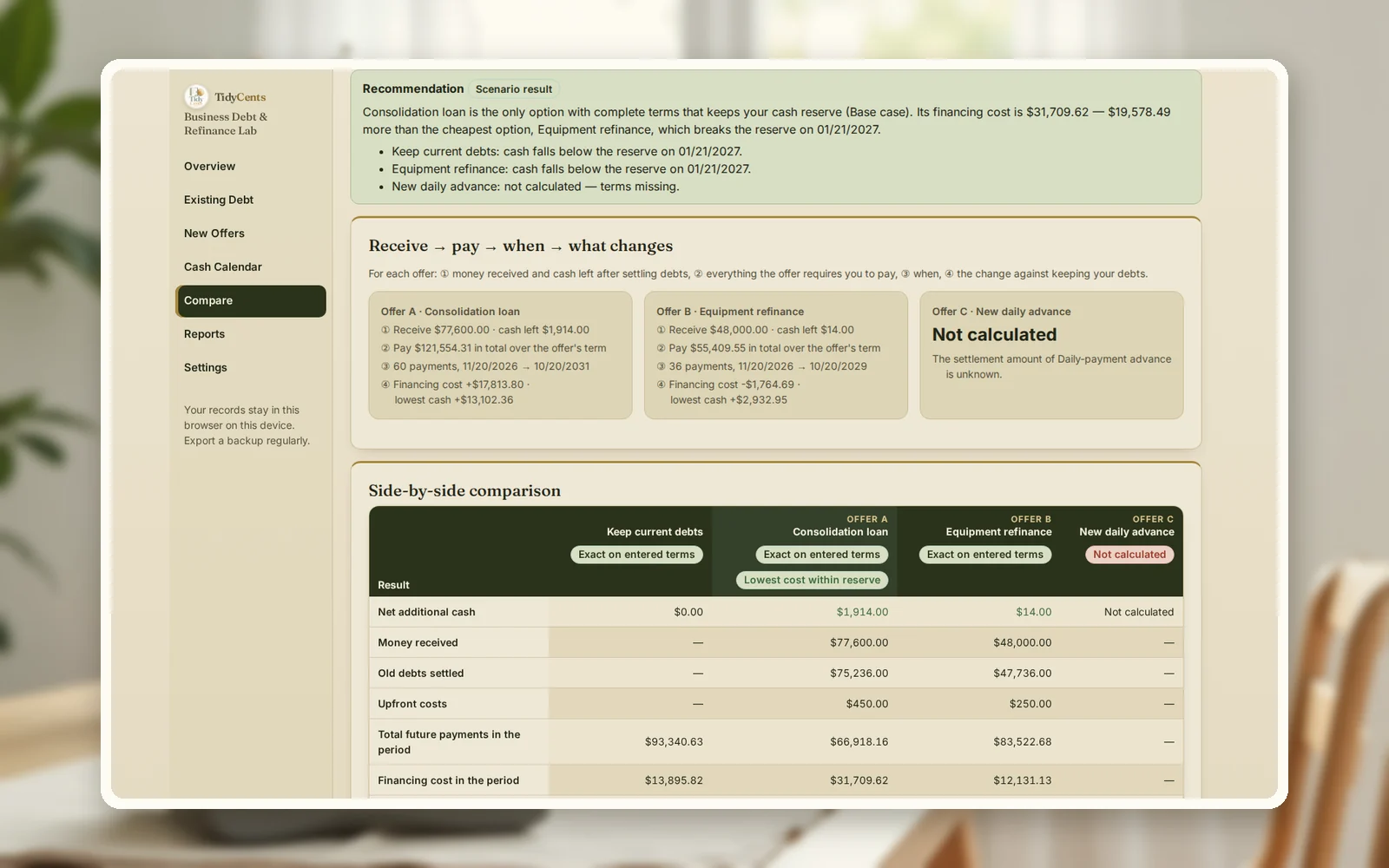
Refinance only if two things are true at once: the new deal costs less in total than keeping your current debts — counting fees, withheld amounts, early-payoff premiums and the debt still owed at the end — and your cash stays above your reserve on every day of the plan. A lower monthly payment proves neither. In the worked example below, a consolidation loan cuts the next 12 months of payments by $28,124.19 but costs $17,813.80 more over two years.
That gap is the reason so many owners are surprised after signing. In the Federal Reserve's 2026 survey of employer firms, 60% of businesses that applied to online lenders said borrowing costs were higher than they expected.
Why the monthly payment is the wrong test
A refinance changes four things at once, and the payment shows only one of them:
- What you actually receive. Fees withheld from the payout mean you borrow $80,000 but get less.
- What it takes to close the old debts. Many loans carry an early-payoff percentage; advances often settle at a quoted amount, not the balance.
- How long you pay. Stretching 30 months of payments into 60 lowers each payment and raises the total.
- When the money leaves. A daily or weekly debit hits a different day than a monthly payment, and your lowest balance moves with it.
The honest comparison puts every option — including "keep what I have" — on the same calendar, over the same period, and adds what is still owed at the end. Otherwise a long loan looks cheap simply because most of its payments fall after the date you stopped looking.
The formula
For each option, over the same period:
- Money received = loan amount − fees withheld from the payout.
- Financing cost in the period = everything paid to lenders (payments, fees, insurance, settlements, upfront costs) + debt still owed at the end − debt owed at the start − money received.
- Effective annual cost = the rate that makes all dated cash flows of the offer (money received, upfront costs, every payment) add up to zero. It is usually higher than the nominal rate because fees count.
- Cash test = opening cash + receipts − operating payments − this option's debt payments, day by day. The option passes if the balance never goes below your reserve.
The decision rule: among the options with complete terms that keep the reserve, take the one with the lowest financing cost.
A worked example
The numbers below are the demo of the Business Debt & Refinance Lab: a fictional woodworking business with $98,700 of debt across four records — a CNC router loan ($46,800 at 14.5%), an operating line of credit ($22,500), a daily-payment advance ($19,800 to repay) and an online sales advance ($9,600). It has $41,000 in the bank and wants never to go below a $20,000 reserve. The test runs over 24 months.
Three offers are on the table:
- Consolidation loan — $80,000 at 16.9% over 60 months, $2,400 withheld, $450 paid upfront, $42 a month insurance; it pays off the router loan (2% prepayment premium), the daily advance and the sales advance.
- Equipment refinance — $48,000 at 8.9% over 36 months, $250 upfront and $15 a month in fees; it pays off only the router loan.
- New daily advance — $30,000, repaying $38,400 over 160 business days.
| Keep current debts | Consolidation loan | Equipment refinance | |
|---|---|---|---|
| Payments in the next 12 months | $68,570.12 | $40,445.93 | $62,891.57 |
| Financing cost over 24 months | $13,895.82 | $31,709.62 | $12,131.13 |
| Debt still owed after 24 months | $27,255.19 | $73,405.46 | $35,322.45 |
| Lowest cash balance | $14,377.64 | $27,480.00 | $17,310.59 |
| Goes below the $20,000 reserve | Yes, for 4 days | No | Yes, for 3 days |
| Effective annual cost of the offer | — | 21.4% | 10.4% |
What the table says:
- The consolidation loan is the payment winner and the cost loser. It lowers the next 12 months by $28,124.19 but costs $17,813.80 more than keeping the current debts. Its effective annual cost is 21.4%, not the 16.9% on the offer, because the withheld $2,400, the $450 and the insurance all count. After paying $75,236 to settle three debts, only $1,914 of new cash is left.
- The equipment refinance is cheaper — $1,764.69 less than keeping the debts — but on its own it does not fix the cash problem: the balance still dips below the reserve in late January, in the week of the quarterly tax payment.
- The daily advance cannot be compared yet. The payoff amount for the existing daily advance and the insurance terms are unknown, so the lab marks it blocked rather than guessing.
So the lab recommends the consolidation loan in the base case — not because it is cheap, but because it is the one complete option that keeps the reserve. That is a real trade: about $17,800 of extra cost to avoid four days below $20,000. Before accepting it, it is worth asking whether a smaller fix — the equipment refinance plus moving one payment, or a slightly larger line — closes the same gap for less.
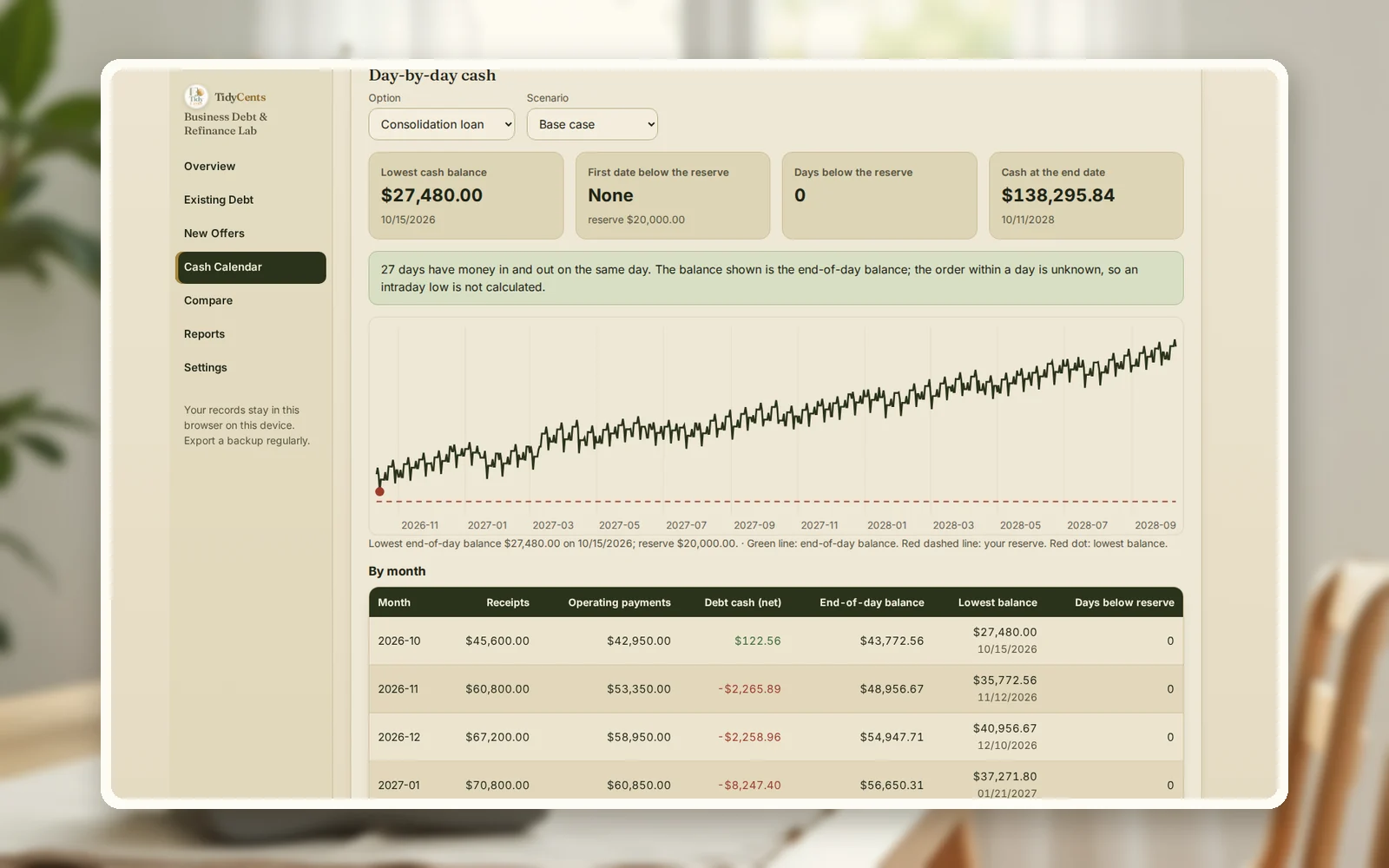
The lab also runs a stress case — receipts 10 days late and 8% lower. In this demo every option goes below the reserve in that case, which is useful information on its own: no refinance makes this business safe if sales slip, so the reserve itself needs attention.
Step by step: compare refinance offers yourself
- List every current debt with balance, rate, payment frequency, remaining payments and the early-payoff rule (percentage, fixed fee or written quote).
- Enter each offer exactly as written: amount, fees withheld, upfront costs, rate, term, payment frequency, insurance and which debts it settles.
- Compute money received and the payoff amount of each debt it replaces. If the net new cash is close to zero, you are paying fees to rearrange debt.
- Put your real cash flow on a calendar: receipts, payroll, rent, suppliers, taxes. Monthly totals hide the day the balance is lowest.
- Run every option, including "keep", over the same period, and add the debt still owed at the end.
- Discard options that break your reserve, then pick the lowest financing cost among the rest.
- Repeat with a stress case (late and lower receipts) before you sign.
Common mistakes
- Comparing monthly payments. A longer term always wins that contest and often loses on cost.
- Using the nominal rate. Withheld fees, upfront charges and insurance raise the effective annual cost — here from 16.9% to 21.4%.
- Forgetting the payoff premium. The router loan costs $936 more to close early than its balance.
- Stopping the comparison at today. Debt still owed at the end of the period must be counted, or a 60-month loan looks free in year one.
- Treating "unknown" as zero. An offer with missing payoff or insurance terms is not cheaper; it is incomplete.
- Ignoring the payment day. Daily debits and a quarterly tax payment in the same week are what break a reserve.
When a tool helps
On paper, one offer against one loan is manageable. With a line of credit, an advance repaid as a share of sales and two or three offers, the calendar becomes the hard part. The Business Debt & Refinance Lab keeps current debts and offers as records, tests each option against your dated receipts and payments, shows "How calculated" for every figure and refuses to rank an offer whose terms are incomplete. Exact decimal arithmetic, no AI guesses. For a quick first number, the free business loan cost calculator prices a single loan, and the 13-week cash flow calculator shows your tightest week.
Open the demo with the woodworking business above — every screen, no sign-up — then enter your own debts and offers.
Open the Business Debt & Refinance LabAll decision and cash-flow tools
Related guides: how to stress-test your cash flow, lease or buy equipment and how to set a customer credit limit.
FAQ
Is debt consolidation always more expensive?
No. It is cheaper when the new rate and fees are lower than the debts it replaces and the term is not stretched much. It becomes expensive when it replaces short, nearly finished debts with a long new loan. Compare the financing cost over the same period, not the rate alone.
What is the difference between the nominal rate and the effective annual cost?
The nominal rate is the number on the offer. The effective annual cost includes every dated cash flow — fees withheld, upfront charges, insurance and each payment — so it shows what the money really costs per year. It is a comparison figure, not a statutory APR for any country.
How do I compare a merchant cash advance with a term loan?
Turn both into dated payments. An advance repaid daily, weekly or as a share of sales has a schedule even if it has no stated rate; once both are on the same calendar, the financing cost and the effective annual cost can be compared directly.
Should I refinance to lower my payments if cash is tight?
Sometimes that is the right call — the example above does exactly that. But know the price: here, about $17,800 more over two years. Check smaller fixes first, and make sure the new plan still passes a stress case.
Does refinancing affect my credit?
It can, through new applications and changed balances, and the rules differ by country and lender. Ask the lender or a qualified adviser; this guide covers the cash and cost calculation only.
Sources
- Federal Reserve Banks, 2026 Report on Employer Firms, Small Business Credit Survey — borrowing costs at online lenders higher than expected (60% of applicants).
- Federal Reserve Bank of Cleveland, survey press release, 3 March 2026.
This is decision support, not financial, tax or legal advice.
Tools mentioned in this guide
 Interactive tool
Business Debt & Refinance Lab
Compare business loans and refinancing offers by their full cost, payment dates and the cash they leave your business.

