
Lease or buy equipment? Compare the lifetime cost
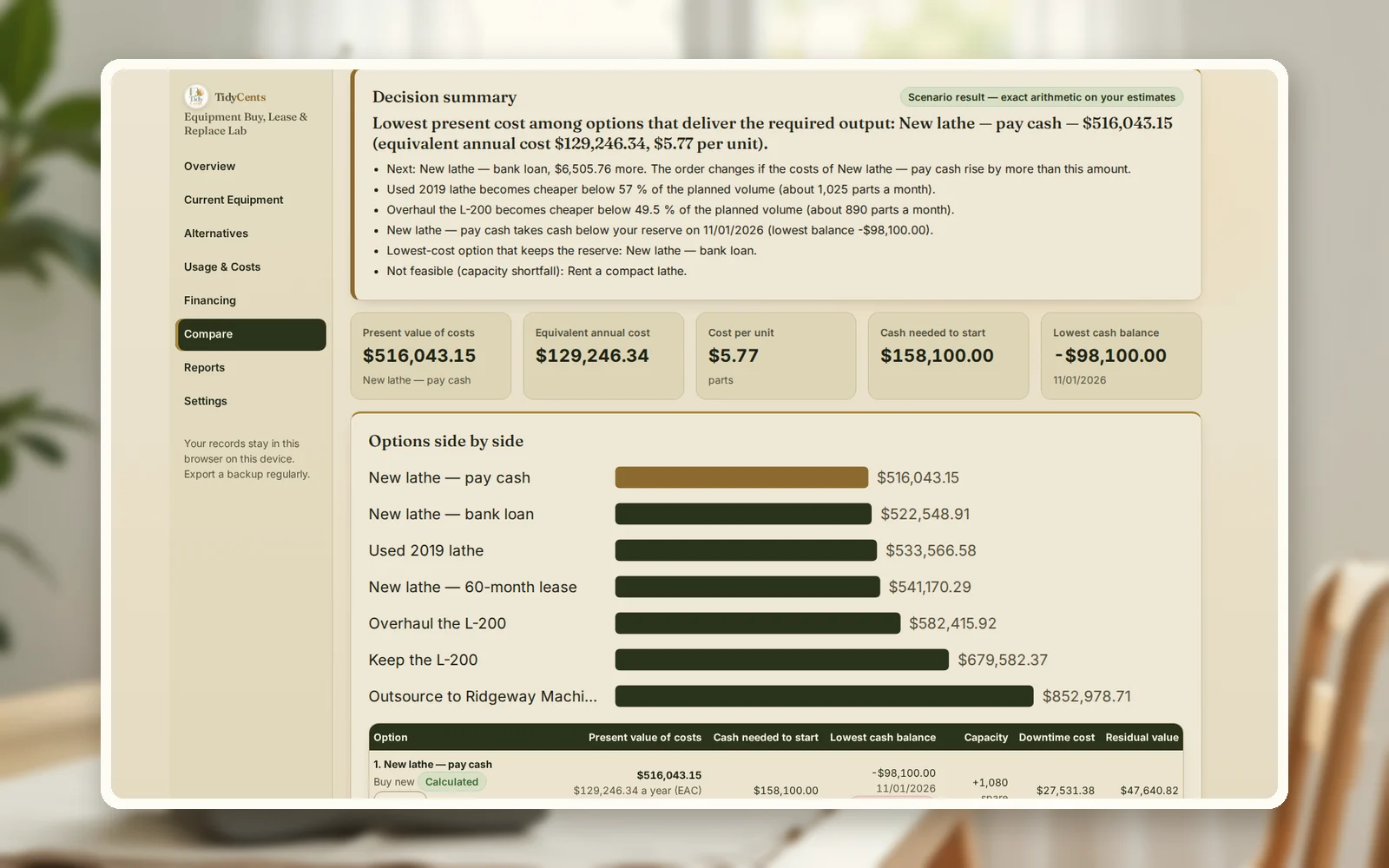
Compare every option over the same period and the same output, then decide in two steps: first by lifetime cost (purchase or payments, running costs, downtime and resale value, discounted to today), then by cash — does the option keep your bank balance above your reserve? The cheapest option on paper is often the one you cannot pay for. In the worked example below, buying a new machine outright is the cheapest over five years, but it would take the business $98,100 below zero on day one; the same machine on a bank loan costs $6,505.76 more and never touches the reserve.
The purchase price is usually not what decides it. Labour, downtime and maintenance over five years can be several times larger — and they differ between a slow old machine and a fast new one.
Why price-versus-payment is the wrong comparison
Most lease-or-buy calculators compare a price with a stream of payments. That misses most of the money:
- Speed changes labour cost. A machine that makes 9 parts an hour instead of 6 needs a third fewer operator hours for the same output.
- Downtime has a price. Lost hours have to be made up — with overtime, a contractor or lost orders.
- The old machine is not free. Keeping it means its maintenance, repairs, the major repair that is coming, and the value it loses while you wait.
- Resale value comes back. A machine you own is worth something at the end; a leased one is not yours.
- Cash timing differs. Cash purchase, loan, lease and rental put the same machine on very different cash paths.
What you paid for the old machine years ago does not belong in the comparison at all. Only what it is worth today and what it will cost from now on.
The formula
- Lifetime cost = all cash out for this option over the period (purchase or payments, installation, energy, labour, maintenance, repairs, consumables, downtime) − resale value at the end.
- Present value (PV) = each month's cost discounted at your rate: cost ÷ (1 + rate)^(months ÷ 12).
- Equivalent annual cost = PV converted into an even yearly amount — the fair way to compare options with different lives.
- Cost per unit = lifetime cost ÷ units produced.
- Cash test = opening cash + margin from production − this option's payments, month by month, against your reserve.
The decision rule: the lowest PV wins only if its cash path stays above your reserve; otherwise take the lowest PV among the options that do.
A worked example
The numbers are the demo of the Equipment Buy, Lease & Replace Lab: a fictional machine shop with an old CNC lathe making 1,800 parts a month for two regular customers. It has $60,000 in the bank and wants to keep a $25,000 reserve. The old lathe makes 6 parts an hour, needs about $1,550 a month in maintenance and repairs, and its spindle bearings are due for a $24,000 repair next summer. It would sell today for $18,000.
The lab compares eight options over 5 years at an 8% discount rate:
| Option | PV of 5-year cost | Equivalent annual cost | Cost per part | Lowest cash balance |
|---|---|---|---|---|
| Keep the old lathe | $679,582.37 | $170,205.79 | $7.60 | $47,724.72 |
| Overhaul it ($21,000) | $582,415.92 | $145,869.83 | $6.52 | $38,200.00 |
| New lathe, pay cash ($165,000) | $516,043.15 | $129,246.34 | $5.77 | −$98,100.00 |
| New lathe, bank loan | $522,548.91 | $130,875.75 | $5.85 | $36,150.00 |
| New lathe, 60-month lease | $541,170.29 | $135,539.59 | $6.06 | $64,100.00 |
| Used 2019 lathe ($78,000) | $533,566.58 | $133,635.19 | $5.97 | −$9,600.00 |
| Outsource the parts | $852,978.71 | $213,634.02 | $9.55 | — |
A rented compact lathe was also tested and marked infeasible: at 5 parts an hour it cannot make 1,800 parts a month.
What the table says:
- Keeping the old lathe is the most expensive way to own a lathe. Slow output means more labour hours, and downtime alone is worth $75,360.96 in present value.
- Buying new for cash has the lowest lifetime cost — but it needs more cash than the business has. The lab flags it and moves on.
- The bank loan is the cash-safe choice. The same new machine, $30,000 down at 9.5% over 60 months, costs $6,505.76 more in present value and keeps the lowest balance at $36,150.
- The lease keeps the most cash ($64,100 at its lowest) but costs $18,621.38 more than the loan over five years. That is the price of flexibility — worth paying only if you value it.
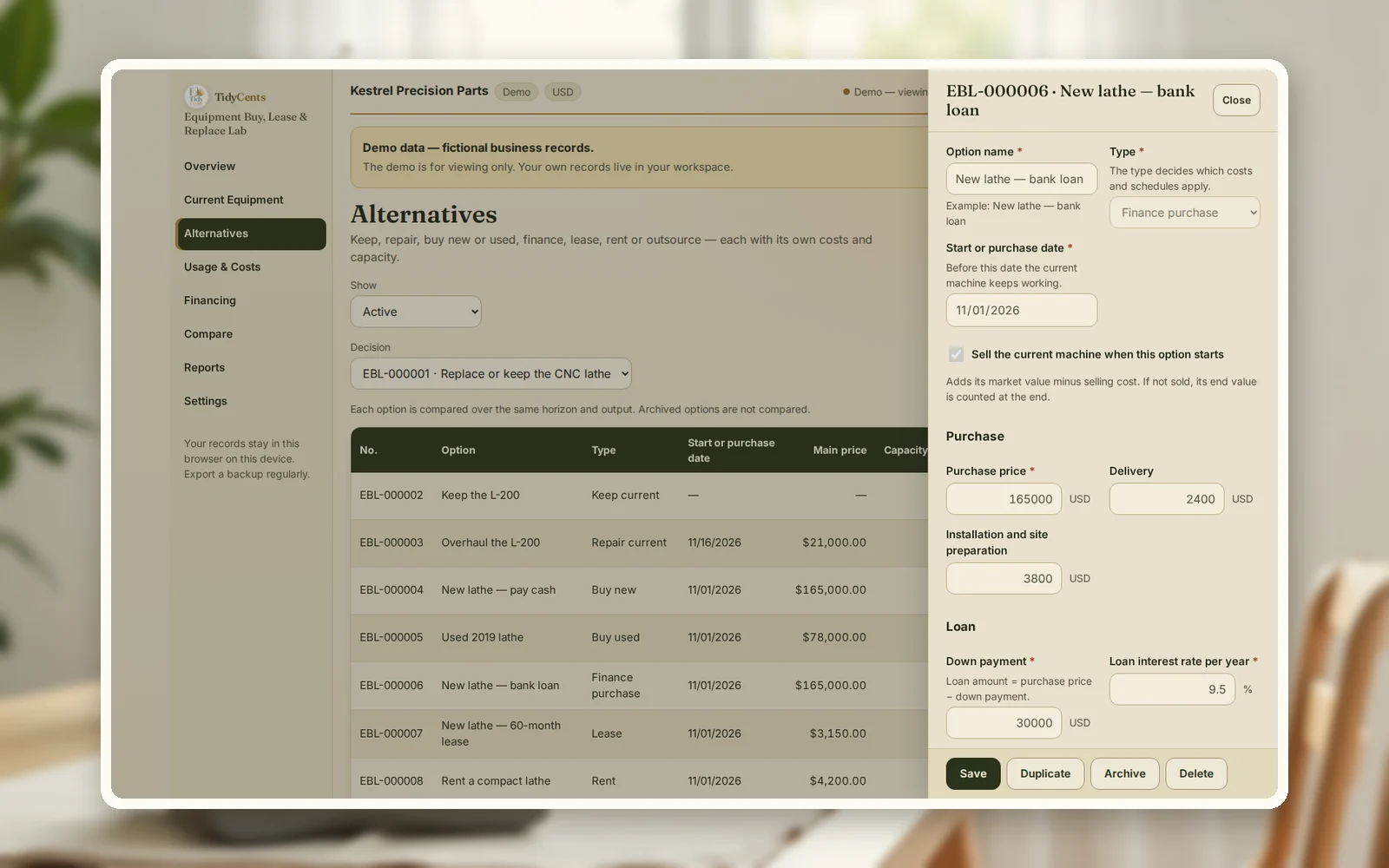
The lab also tells you where the answer would change. The used lathe becomes cheaper than a new one if volume falls below 1,025 parts a month; the overhaul beats a new lathe below 890 parts a month. If your order book is uncertain, those break points matter more than the ranking.
Step by step: lease, buy or keep
- Fix the output you need each month and the period you are deciding for (often the life of the new machine).
- Describe the current machine as it is today: market value, running costs, downtime and any repair you know is coming. Leave out what you paid for it.
- Enter each alternative as written in its quote: price or payments, delivery, installation, training, speed, running costs and resale value.
- Count labour and downtime, not just the price. They are usually the largest numbers.
- Discount to today at a rate that reflects your cost of money, and compare by equivalent annual cost or cost per unit.
- Run the cash test month by month against your reserve.
- Check the break points: how much would volume have to change to flip the answer?
Common mistakes
- Counting the old machine's purchase price. It is gone either way; only today's value and future costs matter.
- Ignoring speed. A faster machine saves labour on every unit.
- Leaving out downtime. Lost hours cost overtime, contractors or orders.
- Forgetting resale value. An owned machine is worth something at the end.
- Comparing a lease payment with a loan payment. Compare lifetime cost and cash path instead.
- Picking the cheapest option you cannot fund. A plan that breaks your reserve is not cheaper, it is unpaid.
When a tool helps
One price against one lease is easy. Eight options with different speeds, downtime, financing and resale values are not. The Equipment Buy, Lease & Replace Lab puts keep, repair, buy new or used, finance, lease, rent and outsource on one timeline, counts the purchase price once, tests capacity and cash, and shows the break points — with every input and assumption in the report. Exact decimal arithmetic, no AI guesses. For financing alone, the free business loan cost calculator prices a single loan.
Open the demo with the machine shop above — every screen, no sign-up — then describe your own machine and quotes.
Open the Equipment Buy, Lease & Replace LabAll decision and cash-flow tools
Related guides: should I refinance my business debt, can I afford to hire an employee and the cost of poor quality.
FAQ
Is it better to lease or buy equipment?
Neither in general. Buying usually has the lower lifetime cost when you keep the machine long enough and have the cash or a cheap loan; leasing keeps more cash and moves maintenance risk, at a price. Compare both over the same period and output, and check your cash.
When should I replace a machine instead of repairing it?
When the repaired machine's lifetime cost per unit — including its slower speed, downtime and coming repairs — is higher than a replacement's, and you can fund the replacement. In the example, an overhaul is better than keeping the old lathe as it is, but a new lathe is cheaper still.
What discount rate should I use?
Your cost of money: the rate on the loan you would use, or the return you could earn on the cash. Test a higher and a lower rate too; if the ranking flips, the decision is close.
Does tax change the answer?
It can, because depreciation and lease payments are treated differently in different countries. The lab can include tax cash flows you enter, but it does not calculate tax for you; check the rules with a qualified adviser.
What if my volume is uncertain?
Look at the break points: in the example, below 1,025 parts a month the used machine beats a new one, and below 890 the overhaul does too. If your realistic range crosses a break point, choose the option that is cheapest across that range, not at one number.
This is decision support, not financial, tax or legal advice.
Tools mentioned in this guide
 Interactive tool
Equipment Buy, Lease & Replace Lab
Compare keeping, repairing, buying, leasing, renting or outsourcing equipment by lifetime cost, capacity and cash requirements.

