
How much revenue from one client is too much?

One client is too much when losing them would take your cash below your reserve before you could replace the work. That limit depends on your margin, your monthly surplus and your free cash, so it is different for every business. For the business below it is about 26% of revenue — its largest client is at 35%, so it is over the line even though the relationship is going well.
Percentages alone can mislead: the real risk is liquidity — how fast the cash runs out — not the share of the sales report.
Why 10% is a reference, not a rule
You will often see 10% quoted. It comes from accounting: US public companies must disclose any single customer that brings in 10% or more of revenue (ASC 280-10-50-42, summarised by Deloitte). It is a disclosure threshold for investors, not a safety limit for a small business. Many healthy small firms have a client above 10%; the question is whether they could survive its loss.
The formula
- Client gross profit = the client's monthly revenue × your gross margin. This is what you actually lose if they leave.
- Monthly result after the loss = your current surplus − client gross profit.
- Months of cash = free cash ÷ the monthly loss (if there is a loss).
- The limit: the largest client gross profit you can lose for n months is surplus + free cash ÷ n, where n is how long it would take you to replace the work. Divide by your margin and by total revenue to turn it into a share.
Add one more line: what the client owes you today. If a client leaves on bad terms, the open invoices may be paid late or not at all.
Step by step
- Rank clients by revenue over the last six to twelve months.
- Convert the top client's revenue to gross profit.
- Subtract it from your monthly surplus to see the monthly result without them.
- Divide free cash by the loss to get the months you would have.
- Estimate honestly how long replacement would take — the sales cycle, not the hope.
- Compute the limit and compare it with the client's share today.
- Repeat for the second and third client. Two clients at 25% can be a bigger risk together than one at 35%.
A worked example
A software consultancy bills $40,000 a month at a 55% gross margin — $22,000 of gross profit. Obligations are $19,000, so the surplus is $3,000. It has $16,000 of cash above its reserve.
Its biggest client accounts for 35% of revenue: $14,000 a month, or $7,700 of gross profit.
- If the client leaves and pays what it owes: the monthly result becomes a loss of $4,700, and $16,000 lasts 3.4 months.
- If the client leaves without paying the last month's $14,000: free cash falls to $2,000 straight away — less than half of one month's loss.
- The limit, if replacing the work takes 6 months: $3,000 + $16,000 ÷ 6 = $5,666.67 of gross profit a month, which is 25.8% of revenue at this margin.
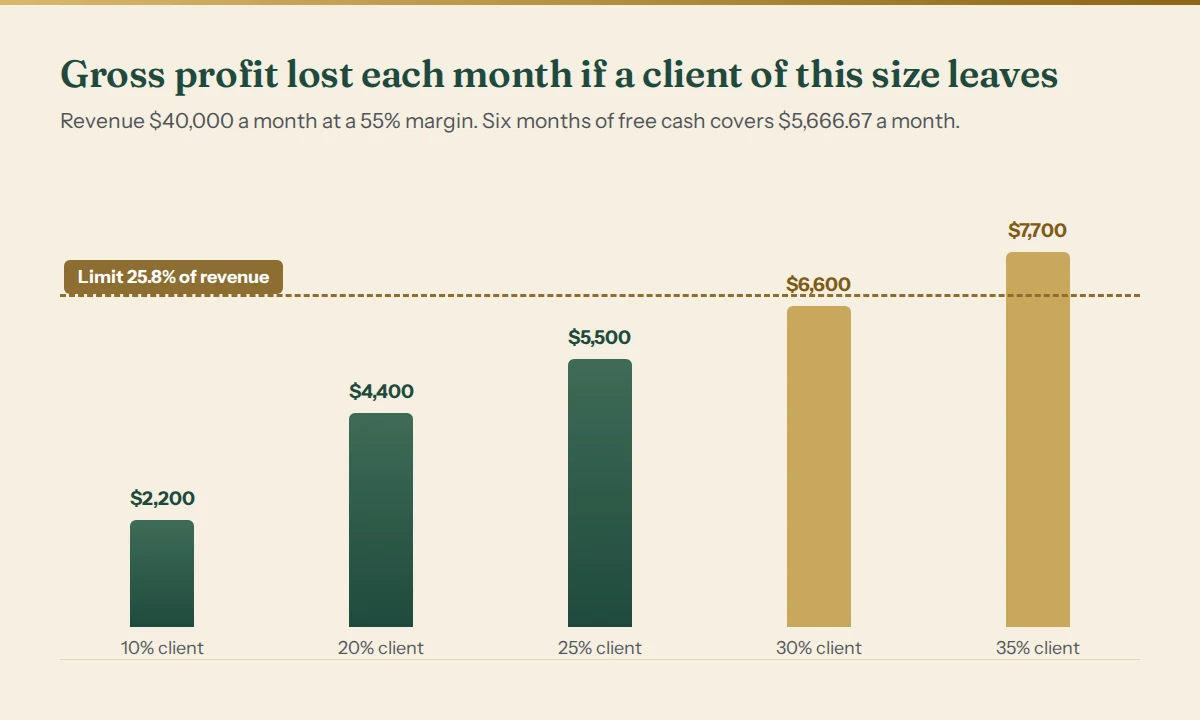
The consultancy does not need to drop its best client. It needs to know that at 35% it has about three months, and to act on that: a deposit or shorter terms on that client's work, a notice period in the contract, and new clients before the old one leaves, not after.
Ways to reduce the risk
- Put a notice period in the contract, so a departure gives you months instead of days.
- Keep what the client owes you small: shorter terms, milestone billing, deposits.
- Raise your margin on the rest of the work, which raises the surplus and the limit.
- Build free cash while the client is paying well — every $1,000 raises the limit for the whole replacement period.
- Grow the second and third clients deliberately; spread matters more than any one percentage.
Common mistakes
- Measuring share of revenue instead of cash impact. A client with low margin and quick payment is less dangerous than its share suggests; one with high margin and slow payment is more.
- Forgetting the open invoices, which are at their most fragile exactly when the relationship ends.
- Assuming a quick replacement. New clients take as long to win as your sales cycle, however urgent the gap.
- Looking only at the top client. Two or three large ones together can control your cash.
FAQ
Is 20% from one client too much?
It can be fine or dangerous: run the formula with your margin, surplus and free cash. A business with a thin surplus and little cash can be in trouble at 15%; one with a large cushion can carry 40%.
Does customer concentration affect the value of my business?
Buyers and lenders usually look at it, because it makes future revenue less certain. How much it matters depends on the buyer and the contract terms, so treat any single percentage you read as a rough guide.
What if the big client is a long-term contract?
A signed contract with a notice period changes the replacement time, not the arithmetic. Use the notice period as n in the formula and the risk may drop well below the limit.
How do I talk to the client about deposits or shorter terms?
Frame it as planning, not distrust: tie deposits to the costs of their work, and offer something in return, such as priority scheduling.
Quick check first: the free customer concentration calculator shows each customer's share, your concentration index and what losing each one does to monthly profit and runway.
Check your own numbers
The Business Decision X-Ray runs the customer-dependency test on every client: revenue share against liquidity-risk share, which client could break payroll if they left or paid 30 days late, and what to do about it first. Open demo of every section, no sign-up; then from $40 a month.
This is decision support, not financial, legal or valuation advice.

