Missed a quarterly estimated tax payment? What it actually costs (US, 2026)
Everything below is United States federal tax, for tax year 2026. The third instalment of the year is due on Tuesday 15 September 2026, which is why this piece exists now: if a June payment went missing, the weeks before that date are when fixing it is still cheap. State estimated tax runs on its own rules and its own penalties, and none of it is covered here.
The numbers are worth being precise about, because this is one of the most common penalties the IRS charges. In fiscal year 2025 it assessed 15.73 million estimated-tax penalties on individual, estate and trust returns, totalling $12,060,514,000 — an average of $766.49 each (IRS Data Book FY2025, Table 4-2).
What happens if you miss a quarterly estimated tax payment?
Interest-style arithmetic starts running, and nothing else happens. The charge is the missed amount × days late × an annual rate — currently 7% — divided by 365; there is no flat fine, no late form, and no letter demanding anything in September.
That is the whole mechanism. Form 2210's instructions put it in one line: "The penalty is figured for the number of days that each underpayment remains unpaid." The rate is set each quarter under section 6621 as the federal short-term rate plus 3 points. For 2026 it has been 7% in the first quarter, 6% in the second, 7% from 1 July (Rev. Rul. 2026-10), and the IRS has just confirmed 7% again for October to December.
Two consequences follow directly. First, a missed payment is not a catastrophe — on ordinary freelancer numbers it is tens of dollars, not hundreds, if you act inside the same quarter. Second, there is no date on which the cost arrives all at once, so there is also no date on which it stops getting worse. It is a meter.
How much does a missed payment cost in dollars?
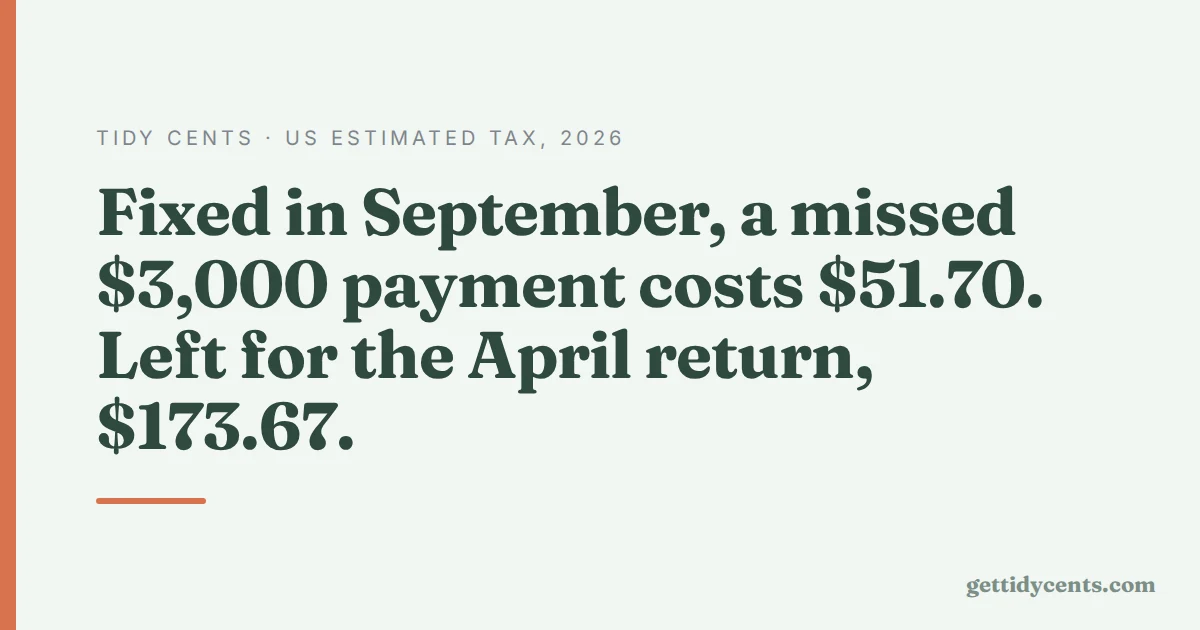
A $3,000 instalment that was due on 15 June 2026 costs $51.70 to clear on 15 September — 92 days late, 1.72% of the amount. Left until the return is filed on 15 April 2027, the same miss costs $173.67.
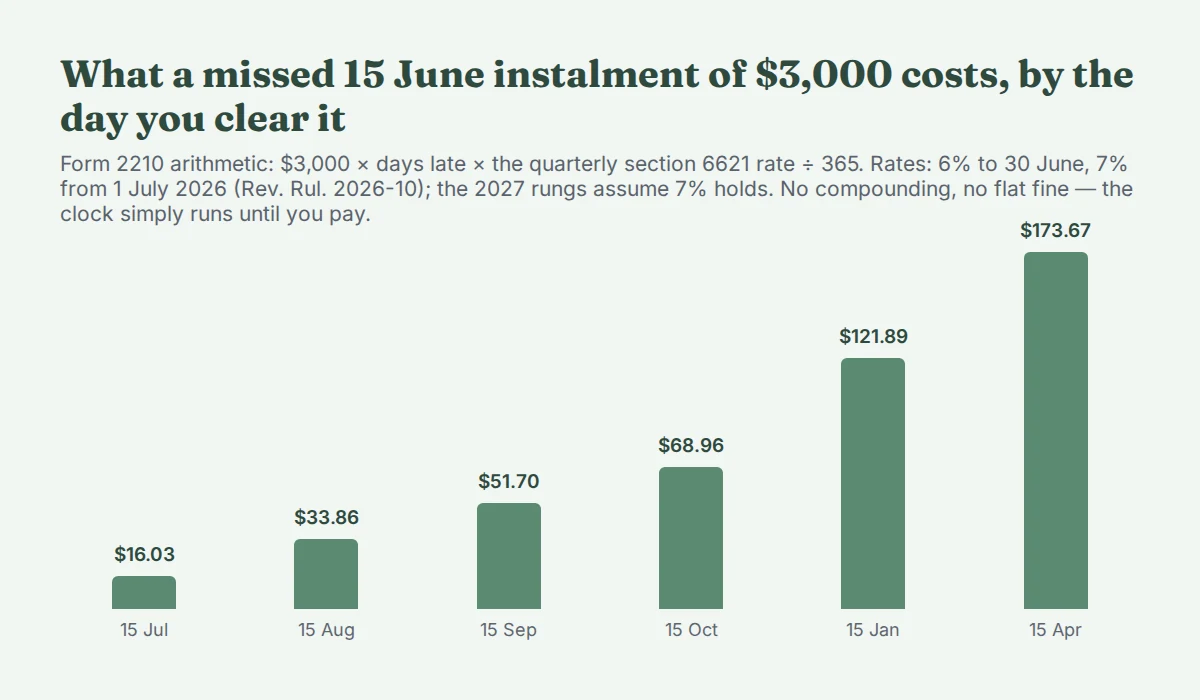
| You clear it on | Days late | Penalty |
|---|---|---|
| 15 July 2026 | 30 | $16.03 |
| 15 August 2026 | 61 | $33.86 |
| 15 September 2026 | 92 | $51.70 |
| 15 October 2026 | 122 | $68.96 |
| 15 January 2027 | 214 | $121.89 |
| 15 April 2027 | 304 | $173.67 |
Every one of those rows is on our free underpayment penalty calculator, which runs this same day-count arithmetic on your own instalments — what each should have been, what you actually paid and when, and the date you can clear the rest — and shows what one more day costs.
Every month of waiting adds roughly $17–18 on this amount; at 7% the meter on $3,000 runs at about 58 cents a day. Scale is linear — a $6,000 miss costs exactly twice each figure, a $1,500 miss half. The two 2027 rows assume the rate stays at 7%, where it has stood for three of 2026's four quarters; the actual 2027 rates are announced quarter by quarter. And the meter has a hard stop: the penalty on a missed instalment runs to the date you pay or to the return's due date, whichever comes first.
The averages above say most people let it run: $766.49 across 15.73 million assessments is what "deal with it at filing time" costs in practice.
Should you wait for 15 September, or pay now?
Pay now. The clock stops on the day the payment arrives, not on the next quarterly date — waiting for 15 September to fix a June miss buys nothing and costs 58 cents a day on our example.
Two separate things are due in September, and they do not merge. The late June instalment stops its own meter the day it lands. The September instalment — which covers income from 1 June to 31 August — is its own payment with its own due date, and missing it starts a second meter. Clear the old one today, pay the new one by the 15th.
There is no form to attach and nothing to declare when paying late; the reckoning happens once, on Form 2210 with the annual return. You do not even have to compute the penalty yourself — the IRS will happily do it and bill you — but the arithmetic above is exactly what the bill will say.
How much must be paid in to stop the penalty for good?
Enough to be on track for the required annual payment: the smaller of 90% of your 2026 tax or 100% of your 2025 tax — 110% if your 2025 adjusted gross income was over $150,000. Hit a quarter of that number at each date and no instalment is ever "missed", whatever your final bill turns out to be.
Worked through for a single freelancer expecting $60,000 of net profit in 2026 — federal tax $12,037, computed with the same verified engine that ships as our tax workbook — whose 2025 return showed $9,000 of tax on an $80,000 AGI:
- 90% of this year: $10,833
- 100% of last year: $9,000
- Required annual payment: the smaller — $9,000, so four instalments of $2,250
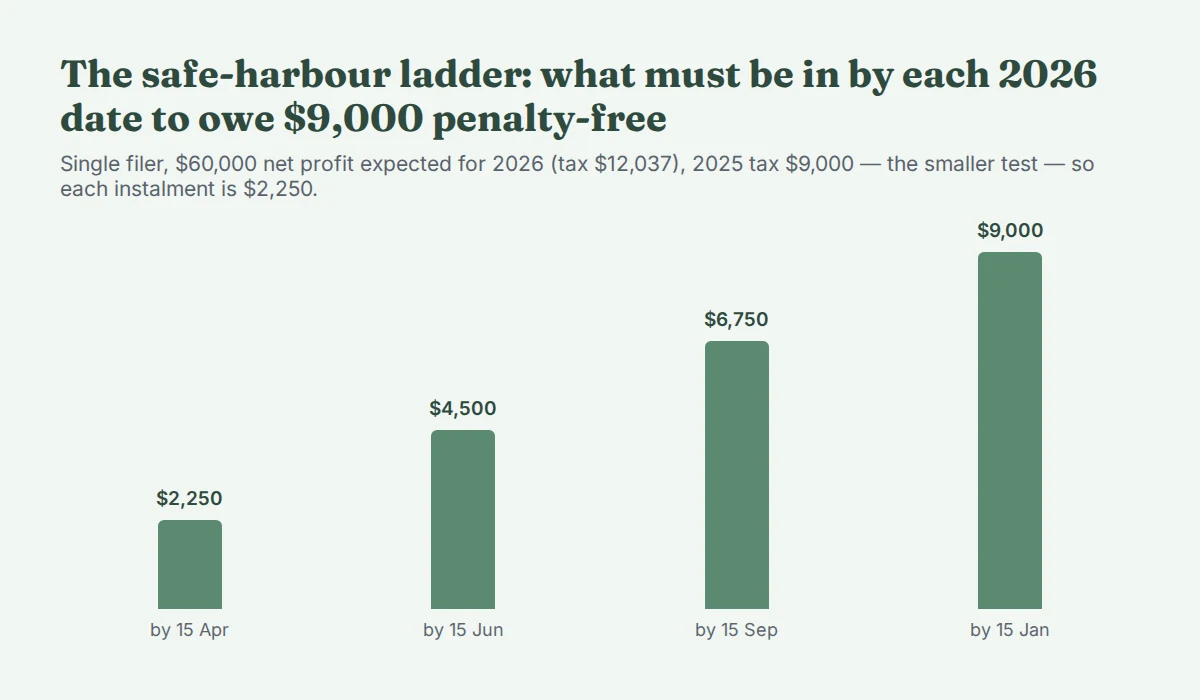
By 15 September, $6,750 of the $9,000 should be in. If June was missed, the practical move in early September is one payment that brings the year's total to that figure — the old meter stops the day it arrives, and the year is back inside the safe harbour.
The 110% version works the same way but is not a punishment tariff: the rule always takes the smaller test. A filer with $30,000 of 2025 tax on a $200,000 AGI compares 110% of prior — $33,000 — with 90% of current, and if this year is leaner (our $10,833 again), pays four instalments of $2,708 off the current-year test instead. High earners after a bad year are not chained to last year's number.
Two exits close the question entirely. If your total tax minus withholding comes to under $1,000, no estimated payments were required at all. And if your 2025 return covered a full twelve months and showed zero tax, the same is true regardless of what 2026 brings.
If you would rather not do any of this by hand, our free quarterly tax calculator computes the 2026 liability, both safe-harbour tests and the instalment schedule from your own numbers, in the browser, with no sign-up.
What if your income was uneven — did you even miss it?
If most of your 2026 money arrived after 31 May, the June instalment you "missed" may be far smaller than a quarter of the annual figure — possibly a few hundred dollars — because Form 2210 Schedule AI recomputes each instalment from the income actually earned by each period. For genuinely lumpy years this is not a loophole; it is the method the form itself offers.
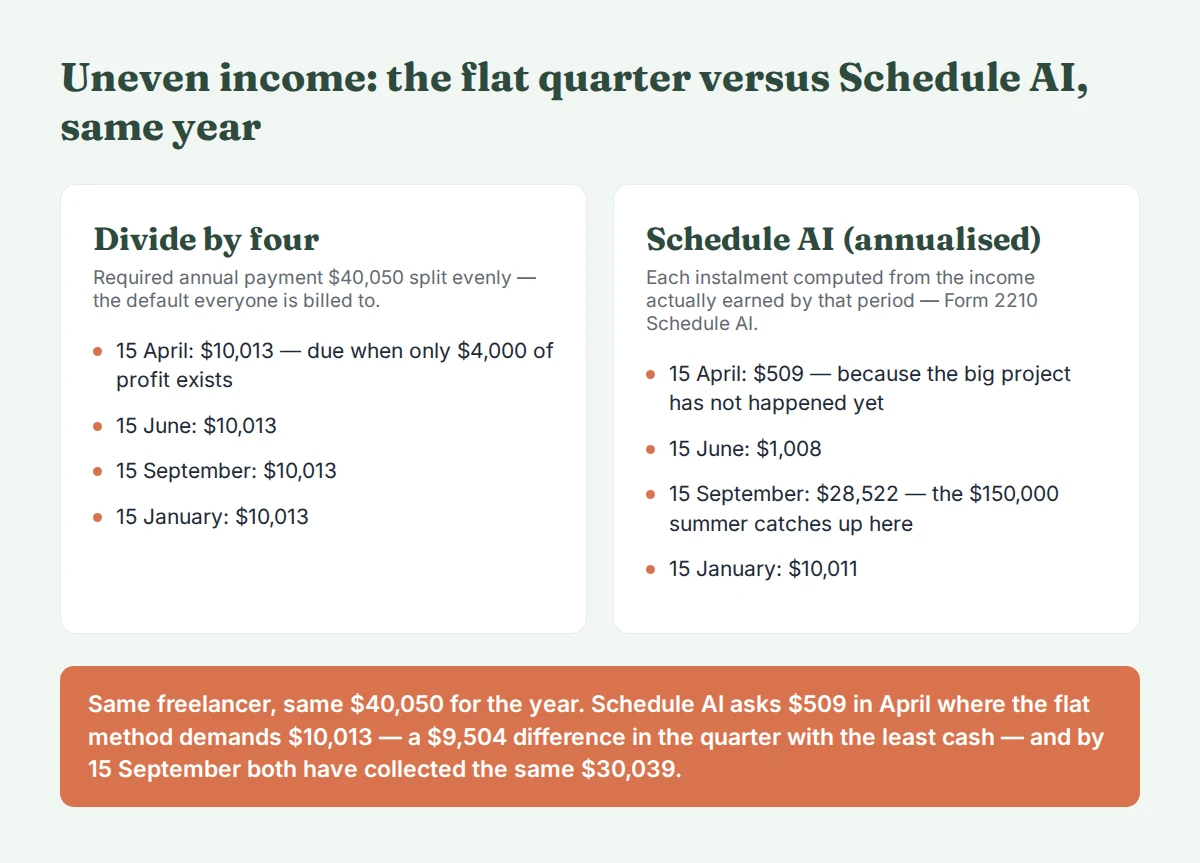
The engine's headline example: a freelancer with almost nothing until June and a $150,000 project in July–August. Divide-by-four demands $10,013 at every date, including an April in which only $4,000 of profit existed. Schedule AI's instalments are $509, $1,008, $28,522 and $10,011 — the same $40,050 over the year, timed to when the money actually arrived. By 15 September both methods have collected the identical $30,039 in this example; the $9,504 difference sits entirely in the spring, in the quarter with the least cash.
The catch is symmetrical: the September instalment under Schedule AI is larger than flat when the summer was big, and the method must be elected by filing Schedule AI with the return, period by period, with the bookkeeping to support it. Our tax workbook carries the full Schedule AI computation across all four periods; the set-aside article covers how much of each payment to reserve in the first place.
Can withholding rescue a missed June payment in December?
Yes — this is the one genuinely retroactive fix. The Form 2210 instructions: "For withheld federal income tax and excess social security or tier 1 RRTA, you are considered to have paid one-fourth of these amounts on each payment due date unless you can show otherwise."
Estimated payments count on the day they arrive; withholding is deemed spread evenly across all four dates, whenever it actually happened. A freelancer with a W-2 job on the side — or a spouse with one, on a joint return — can raise withholding for the last months of 2026, and a quarter of the extra is treated as having been paid on 15 April, before the miss existed. The same applies to withholding on a year-end bonus. It is the only way to put money on the April date after the April date has gone.
Late estimated payments can never do this: they stop the meter for the future but never rewrite the past. If there is no W-2 anywhere in the household, this door is closed, and paying quickly is the whole toolkit.
When is the penalty simply not charged?
Under $1,000 owed after withholding, a zero-tax prior year, or a granted Form 2210 waiver — otherwise the arithmetic above applies mechanically. The waiver boxes on the form cover casualty, disaster and certain retirement or disability cases, and they are requests, not entitlements.
It is also worth naming what does not trigger the penalty: owing a large balance in April is fine, by itself, as long as the safe-harbour tests were met along the way. The penalty polices the timing of payments, not the size of the final bill. That distinction — send the safe-harbour amount, hold the real liability — is the subject of the set-aside piece.
The short version
A missed quarterly payment is a meter, not a fine: at today's 7% it costs a missed $3,000 instalment about 58 cents a day, so clearing it in September costs $51.70 where April costs $173.67. Pay the moment you notice; bring the year's total up to the safe-harbour line while you are at it; check whether Schedule AI means the miss was smaller than you think; and if a W-2 exists anywhere in the household, December withholding can still repair April. Every figure here is arithmetic on published rules, not advice about your return — a return with credits, capital gains or an S corporation in it has moving parts this article does not model.
Where these numbers come from. The tax figures were computed with the engine that ships as our US Self-Employed Tax Engine — US federal, tax year 2026, every constant tied to the IRS or SSA document it was read from, 22 fixtures, 210 assertions, cross-checked against PolicyEngine US — and the penalty figures apply the published section 6621 rates through Form 2210's own day-count arithmetic, independently recomputed twice before publication. Online sellers reconciling a 1099-K should start with the seller profit workbook instead, and the free sample pack shows how we build these files before you spend anything.
Sources. Rev. Rul. 2026-10, Internal Revenue Bulletin 2026-22 — 7% underpayment rate for the quarter beginning 1 July 2026 · Greenback Expat Tax Services, "IRS Raises Quarterly Interest Rates Back to 7%, Effective July 1", 27 May 2026 — the Q2 2026 rate of 6% · FingerLakes1.com, 24 August 2026 — 7% held for Q4 2026 · IRS, Instructions for Form 2210 — day-count penalty arithmetic and the withholding one-fourth rule · IRS Data Book FY2025, Table 4-2 — 15,734,656 estimated-tax penalties totalling $12.06bn · Instalment due dates per Form 1040-ES (2026), verified against the engine's payment-schedule check.