How much to set aside for tax when you are self-employed (US federal, 2026)
Everything below is United States federal tax, for tax year 2026 — the return filed in early 2027. If you are in the UK, Canada, Australia or anywhere else, the structure of the argument holds but not a single number does, and you should treat the dollar figures as somebody else's. State and city income tax is not included either, and in California, New York or Oregon that is not a rounding error.
The advice everyone gives is a band. Ramsey Solutions, updated 7 July 2026: "We recommend setting aside about 25-30% of your freelance income in a separate savings account to cover both income taxes and self-employment tax." 1-800Accountant, 20 April 2026: "Self-employed individuals typically set aside 25% to 30% of their income to address 1099 taxes each year."
It is a reasonable band. It is also wrong in a way you can point at, and the direction it is wrong in depends on facts about you that the band cannot see.
What the band gets wrong
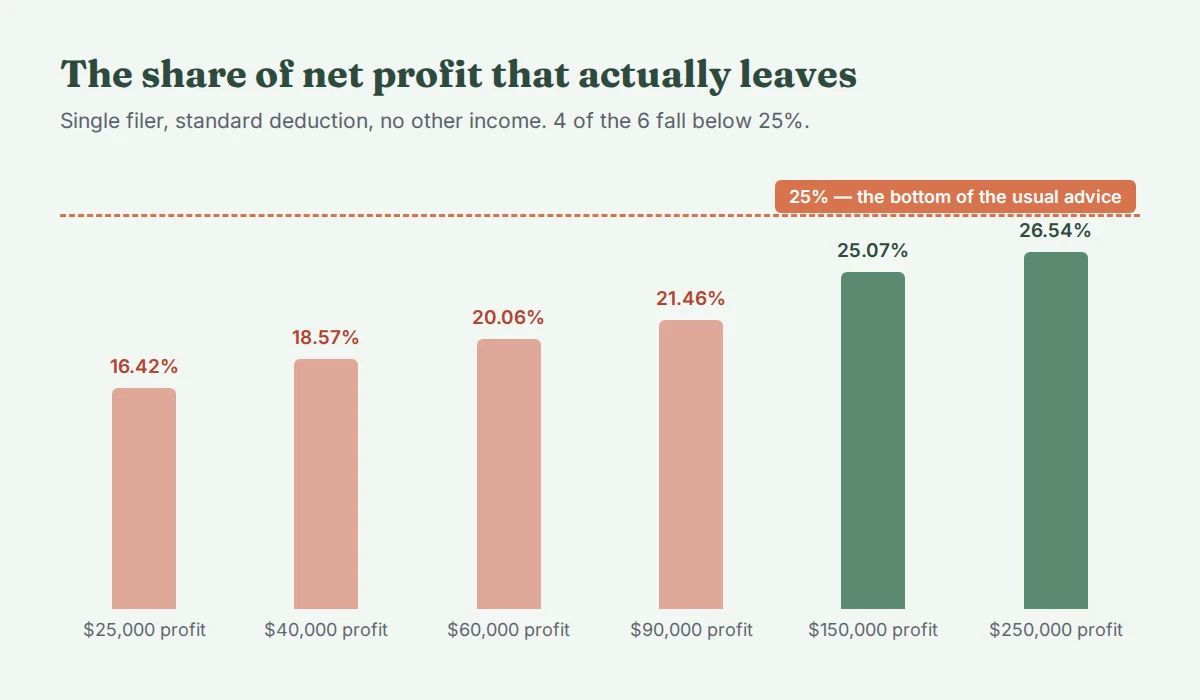
For a single sole proprietor with no other income, the share of net profit that leaves in federal tax runs from 16.42% at $25,000 of profit to 26.54% at $250,000 — a spread of 10.12 percentage points across the range where most self-employed people actually sit. Only two of those six levels reach 25% at all.
Set aside 30% at $60,000 of profit and you have parked $5,963 you never owed. At $25,000 it is $3,396; at $250,000 it is $8,640. That money is not lost, but it spends the year doing nothing in a tax account instead of paying down a card or sitting in your own emergency fund.
Now the other direction. Same profit, different household:
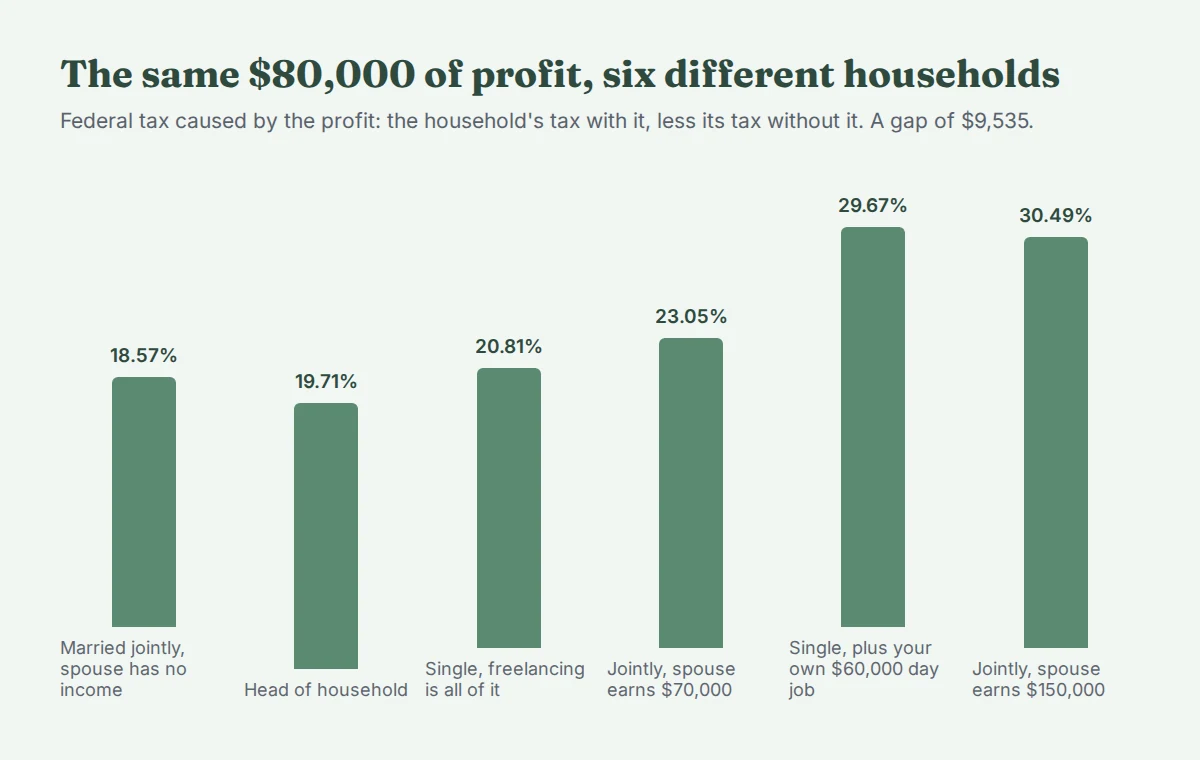
| Household | Tax on the $80,000 | Share |
|---|---|---|
| Married jointly, spouse has no income | $14,854 | 18.57% |
| Head of household | $15,769 | 19.71% |
| Single, freelancing is all of it | $16,648 | 20.81% |
| Jointly, spouse earns $70,000 | $18,441 | 23.05% |
| Single, plus your own $60,000 day job | $23,739 | 29.67% |
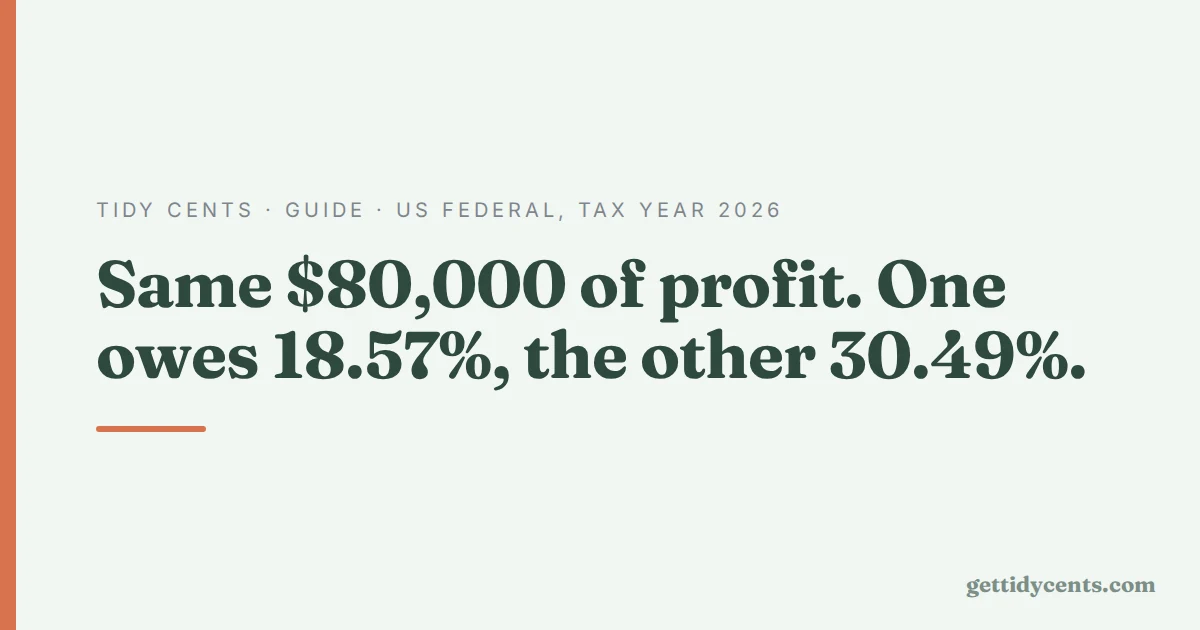
| Jointly, spouse earns $150,000 | $24,389 | 30.49% |
Every one of those six pays exactly the same $11,304 of self-employment tax, because Schedule SE is a per-person form that never looks at the rest of the household. Everything else moves. The gap between the top and bottom row is $9,535 on the same $80,000 — 11.92 percentage points — and none of it is explained by how much you earned or how well you tracked expenses.
That is the case against the band. It is too high for a solo filer at modest profit and too low for someone whose partner earns well or who freelances on top of a salaried job.
Where the number actually comes from
Four things decide it, and they interact.
One. Self-employment tax is charged on 92.35% of profit, not on all of it. The rate is 15.3% — 12.4% for Social Security and 2.9% for Medicare — but Schedule SE applies it to net earnings, which are 92.35% of net profit. So the effective rate on profit is 14.13%, not 15.3%. Below $400 of net earnings there is no self-employment tax at all.
Two. The Social Security half stops. For 2026 the wage base is $184,500. Because the cap applies to net earnings rather than to profit, it starts to bite at $199,783.43 of net profit. Above that, only the 2.9% Medicare part continues, and the share of profit going to tax falls.
Three. Two deductions run before income tax. Half the self-employment tax comes off income. Then the standard deduction — $16,100 single, $32,200 married filing jointly, $24,150 head of household — comes off as well.
Four. The section 199A deduction takes 20% off the top. For a sole proprietor it is the smaller of 20% of qualified business income and 20% of taxable income before the deduction. In the worked example below those two come out at $11,152 and $7,932, and it is the taxable-income limit that binds — which is the usual outcome at modest profits, and the reason the deduction is worth less than "20% off" sounds.
Here is all four on $60,000 of net profit, single, standard deduction, nothing else:
| Line | Amount |
|---|---|
| Net profit (Schedule C, line 31) | $60,000 |
| Net earnings, 92.35% of it (Schedule SE, line 4a) | $55,410 |
| Social Security, 12.4% | $6,871 |
| Medicare, 2.9% | $1,607 |
| Self-employment tax | $8,478 |
| Less the deductible half | −$4,239 |
| Adjusted gross income | $55,761 |
| Less the standard deduction | −$16,100 |
| Taxable income before section 199A | $39,661 |
| Less the section 199A deduction | −$7,932 |
| Taxable income | $31,729 |
| Income tax on that | $3,559 |
| Total federal tax | $12,037 |
$12,037 on $60,000 is 20.06% — about $1,003.08 a month. Note what the two deductions did: $60,000 of profit became $31,729 of taxable income, so 47.1% of the profit never reached a bracket at all. Note also that the self-employment tax is 2.38 times the income tax. For most people below six figures, the payroll-style tax is the bill and the income tax is the smaller half.
The next $10,000 is not taxed like the last one
The share of profit that leaves is one number. What the next piece of work costs is a different one, and it moves in a way that surprises people.
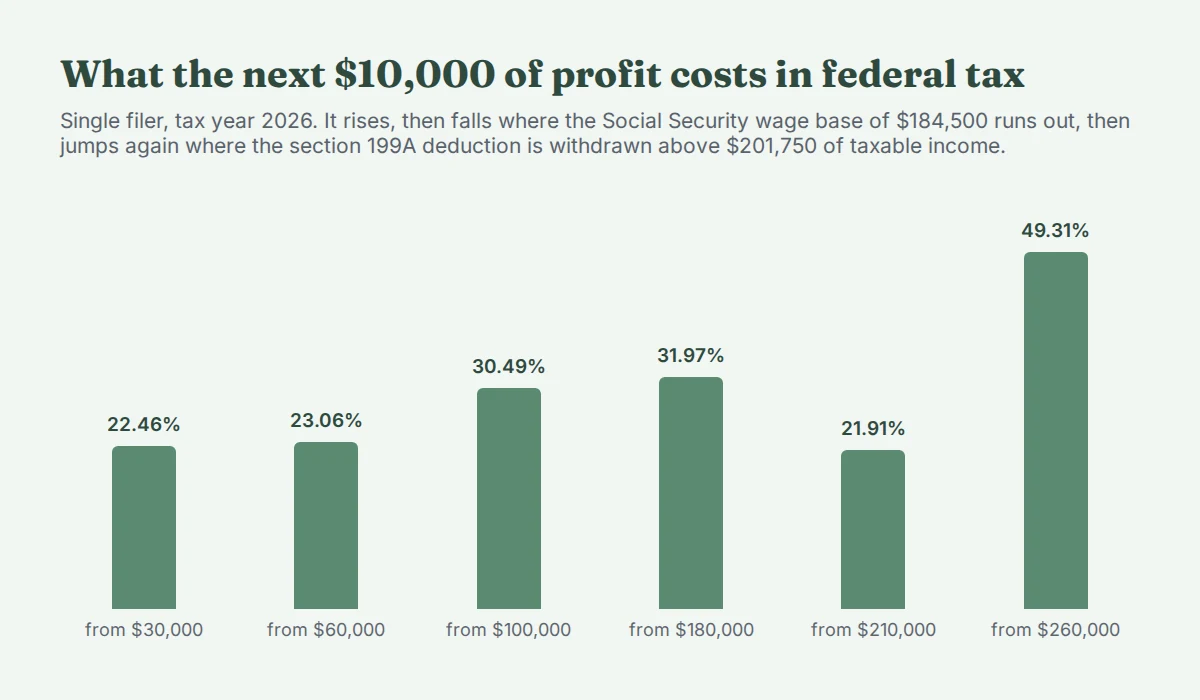
It climbs from 22.46% to 31.97%, then drops to 21.91% once the Social Security wage base is used up, then jumps to 49.31%. That last bar is not a bracket. Above $201,750 of taxable income the section 199A deduction begins to phase out for a sole proprietor with no W-2 wages and no qualified property, and it is fully gone by $276,750. Losing the deduction and paying tax on the extra income at the same time is what produces a marginal rate that no rate schedule contains.
Practically: if your profit is heading past roughly $200,000, the last chunk of the year is the expensive one, and it is the point at which paying an accountant stops being optional.
The safe harbour is a penalty rule, not a savings target
The IRS wants the money as you earn it. Its own guidance, last reviewed 28 June 2026: "Individuals, including sole proprietors, partners, and S corporation shareholders, generally have to make estimated tax payments if they expect to owe tax of $1,000 or more when their return is filed."
For tax year 2026 the four instalments are due 15 April 2026, 15 June 2026, 15 September 2026 and 15 January 2027. What stops the underpayment penalty is the required annual payment: the smaller of 90% of this year's tax, or 100% of last year's (110% if last year's adjusted gross income was over $150,000).
That smaller-of is where people come unstuck, because in a good year the prior-year test is much the cheaper one — and paying it is not the same as being ready.
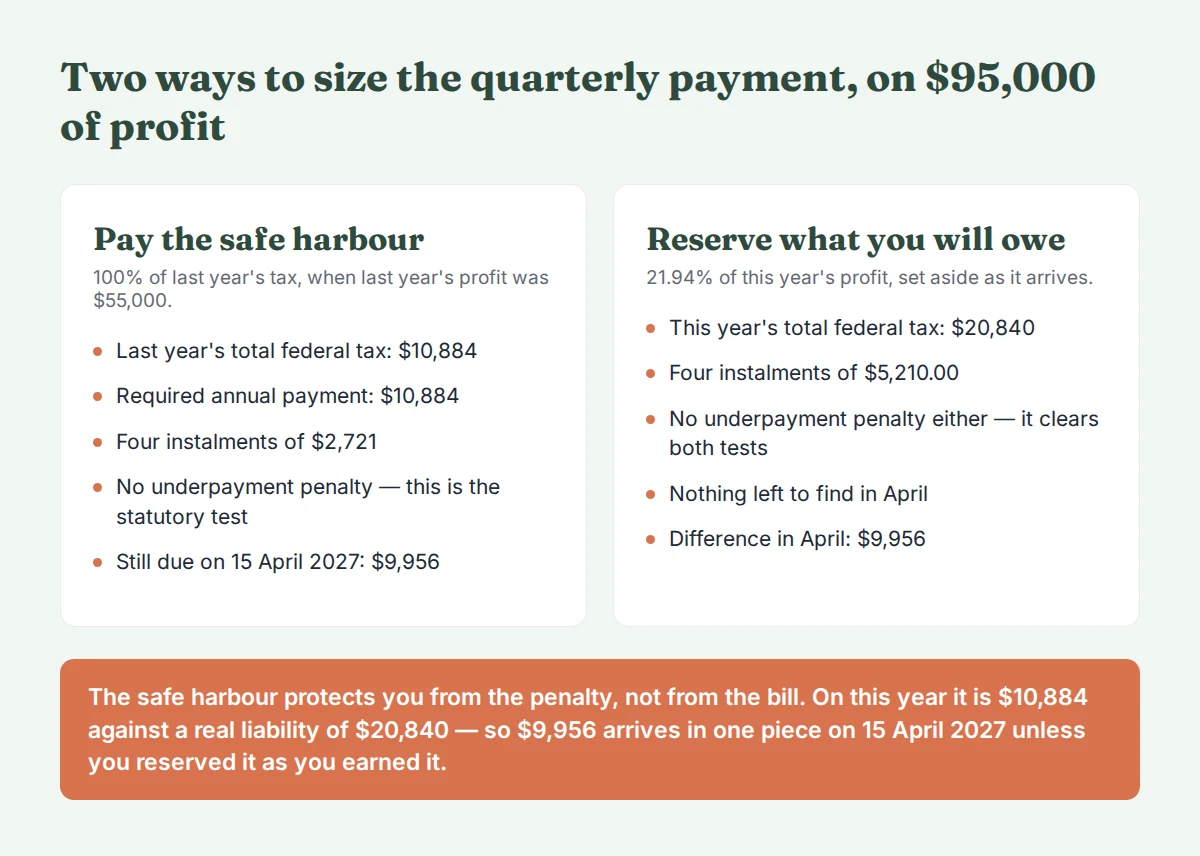
Last year's profit of $55,000 produced $10,884 of federal tax. This year's $95,000 produces $20,840, which is 21.94% of profit. The two tests are 90% of this year — $18,756 — and 100% of last year — $10,884 — and the rule takes the smaller. So $10,884, four instalments of $2,721, is a complete defence against the underpayment penalty.
It also leaves $9,956 due in a single piece on 15 April 2027.
Reserve the real 21.94% instead and the instalments are $5,210, the penalty is equally avoided, and April is a formality. Use the safe harbour to decide what you send; use the real liability to decide what you hold. They are two different questions and the safe harbour only answers the first.
What happens to people who guess
In fiscal year 2025 the IRS assessed 15,734,656 estimated-tax penalties on individual, estate and trust income tax returns, totalling $12,060,514,000 — an average of $766.49 each. Against the 162.8 million individual and 3.2 million estate and trust returns filed that year, that is 9.48 penalties for every hundred returns: about one in ten.
Those are administrative counts of every return the IRS processed, not survey estimates, so there is no margin of error to allow for. Form 1040-ES filings rose from 12,076,801 in fiscal 2024 to 13,315,355 in fiscal 2025 — up 10.26% in a year. The population underneath them is large: BLS put unincorporated self-employed employment at 9,735,000 in July 2026, though that one is a seasonally adjusted estimate from a monthly household survey rather than a count.
None of that is an argument for over-reserving. It is an argument for reserving the right amount on a schedule, which is a different discipline from reserving a large amount whenever you remember.
Running it
- Work out net profit, not revenue. Income minus deductible business expenses. Every percentage in this article is a share of that number, and applying 25% to gross revenue is a different and much worse mistake than any discussed here.
- Compute the actual liability once, in the first quarter, using your best estimate of the year. Then divide by four. If your income is lumpy, the annualised income instalment method lets you pay in proportion to when you earned rather than in four equal parts.
- Check the prior-year safe harbour as a floor, not a target. Send at least the required annual payment; hold the real liability.
- Move the money on the day it arrives, not at quarter end. A percentage of every payment received, into an account you do not spend from. Our free savings goal calculator will turn an annual figure into a per-week transfer, and the budget calculator will show you whether it fits.
- Recompute at the end of each quarter. Profit that is 40% ahead of plan changes the number, and in the phase-out ranges above it changes it sharply.
- Add your state. Everything here is federal. A state with a 5% flat rate adds something close to five points to every share above — close, not exact, because most states start from their own definition of taxable income and few of them recognise the section 199A deduction.
- In January, write down what it actually was. Your own effective rate from last year's return is a better starting point than any band, and it is the number the prior-year safe harbour uses anyway.
If your income arrives in unpredictable lumps, the set-aside sits on top of a bigger problem, and budgeting on an irregular income is the piece to read first. Holding the reserve as its own sinking fund rather than as a vague surplus is what stops it being spent.
The honest limits
- This is not tax advice. It is arithmetic from published 2026 rules, and your return may contain things this article does not model — credits, capital gains, itemised deductions, an S corporation election, more than one business, a loss carried forward.
- Federal only. No state or city income tax, no Net Investment Income Tax, no Additional Medicare Tax except where the ladder crosses its threshold.
- The examples assume the standard deduction and no employees. W-2 wages paid by the business change the section 199A calculation materially above the threshold.
- A percentage is a planning device, not a payment. Two people with the same profit and different households owe amounts $9,535 apart. Once you have your own figure, use it and retire the percentage.
The short version
The set-aside is not one number, and the difference between the right one and 25–30% is measured in thousands of dollars in both directions. For a single sole proprietor with nothing else going on, the real share of profit is roughly 16% at $25,000, 20% at $60,000, 25% at $150,000. Add a well-paid spouse or a day job of your own and it goes past 30%. Work out your own, divide by four, and move the money on the day each invoice is paid.
Where these numbers come from. Every tax figure in this article was computed with the same engine that ships as our US Self-Employed Tax Engine — US federal, tax year 2026, 30 constants each tied to the IRS or SSA document it was read from, 22 fixtures, 210 assertions, cross-checked against PolicyEngine US. The charts and the prose are generated from one run of it, so they cannot disagree. The workbook takes your own profit, filing status and household and produces the quarterly figure directly, including the annualised instalment method for a lumpy year. If you would rather see how we build these before spending anything, there is a free sample pack.
Sources. Ramsey Solutions, "What Are Freelance Taxes?", updated 7 July 2026 · 1-800Accountant, "How Much Should You Set Aside for 1099 Taxes?", 20 April 2026 · IRS, "Estimated taxes", last reviewed 28 June 2026 · IRS Data Book FY2025, Table 4-2, civil penalties assessed and Table 1-2, returns filed, published 5 June 2026 (IR-2026-74) · BLS via FRED, series LNS12027714, Employment Level — Self-Employed, Unincorporated, July 2026, released 7 August 2026.