Your solo 401(k) limit is not 25% of your profit (US, 2026)
Everything below is United States federal tax, for tax year 2026, and it is about a one-participant plan — a solo 401(k) for a sole proprietor or single-member LLC with no employees. State rules, S corporations and partnerships work differently and are not covered.
How much can a self-employed person contribute to a solo 401(k)?
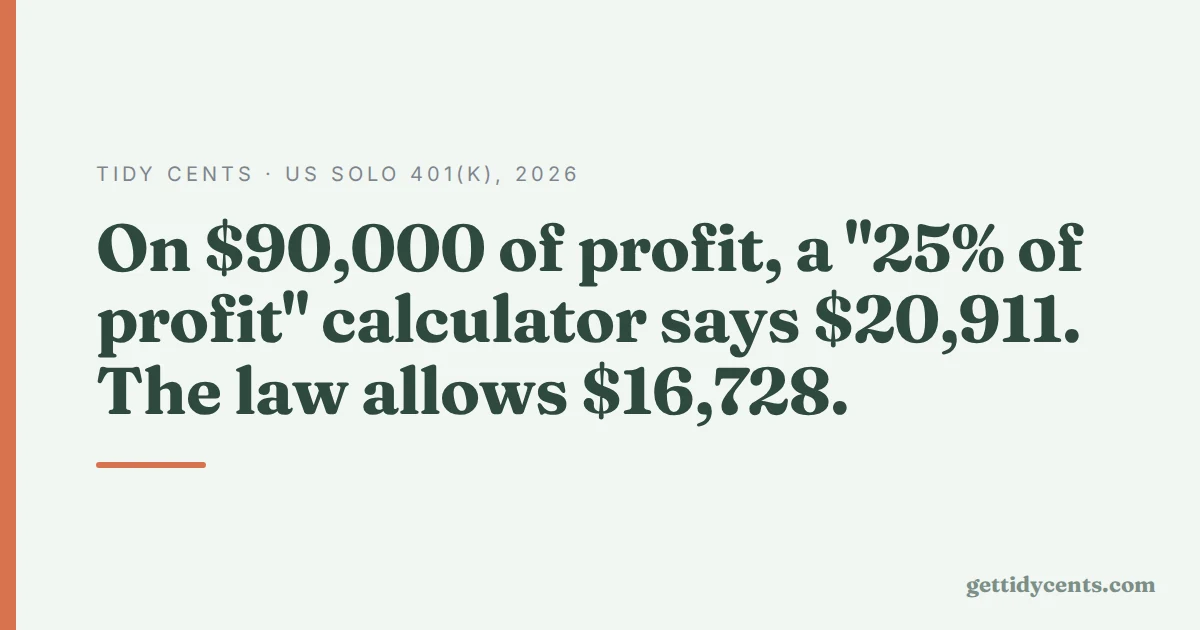
On $90,000 of net profit the limit for someone under 50 is $41,228: $24,500 as your own elective deferral plus $16,728 from the business. The business share is 20% of your net earnings, not 25% of your profit — two separate reductions happen before the percentage is applied.
Almost every free calculator gets the second one wrong, and it is not a rounding error. Applying 25% straight to net earnings gives $20,911. That is $4,183 too high, and it is money that would have to come back out of the account.
Why is the business contribution not 25% of my profit?
Because the contribution is part of the pay it is measured against. If you pay yourself 25% of what is left after paying yourself, the equation feeds itself. IRS Publication 560 solves this not with iteration but by reducing the rate: a plan that calls for 25% of compensation gives the owner
0.25 ÷ (1 + 0.25) = 0.20
of net earnings. Publication 560 puts it plainly: "you determine the deduction for contributions to your own SEP IRA indirectly by reducing the contribution rate called for in your plan." The same rate table applies to the profit-sharing side of a solo 401(k).
The overstatement is not random. It is always exactly a quarter of the correct amount, at every level of profit:

What exactly are "net earnings from self-employment"?
Your net profit minus the deductible half of your self-employment tax. On $90,000 of profit that is $90,000 − $6,358 = $83,642, and the 20% is applied to that, not to the $90,000 you started with.
This is the reduction people skip most often, because it happens on a different form. Schedule SE charges self-employment tax on 92.35% of your profit; line 13 of that form is half of the tax, and it comes off your income before the retirement calculation begins. A calculator that starts from your Schedule C profit and never asks about self-employment tax cannot have done this.
The two reductions in order, against the shortcut:

What are the ceilings, and which one actually stops you?
There are three, and they bind in different places:
| Ceiling | 2026 amount | What it caps |
|---|---|---|
| Elective deferral, §402(g) | $24,500 | Your own contribution, across all employers |
| Annual additions, §415(c) | $72,000 | Deferral plus business contribution |
| Compensation, §401(a)(17) | $360,000 | The pay a plan may count |
At $90,000 of profit none of them is what stops you — the business share is. At $400,000 of profit the picture inverts: the annual additions ceiling binds at $72,000, and it is the business contribution that gets cut back to fit, because your deferral of $24,500 may already have been made month by month and cannot be taken back.
The compensation cap almost never bites on a one-participant plan: by the time your earnings reach it, the §415(c) ceiling has already stopped you.
I have a job and a business. Can I defer the full amount in both?
No. The elective deferral limit belongs to you, not to each plan. What you defer at a job and what you defer in your own plan share one annual limit of $24,500.
This is the most expensive thing a moonlighting freelancer can miss, because both plans will happily accept the money. If you have already used the full $24,500 at an employer, your solo 401(k) on $90,000 of profit takes $16,728 — the business side only, and nothing else.
The business profit-sharing contribution is separate and is not touched by what you did at the job. That is the part people are usually surprised by in the good direction.
Does the higher catch-up really end at 63?
Yes, and this is where calculators are wrong most visibly. SECURE 2.0 gave ages 60, 61, 62 and 63 a higher catch-up — $11,250 instead of $8,000 — and at 64 it drops back to the ordinary amount. It is a window that opens and closes, not a threshold you cross.
Written in code as "age ≥ 60", it hands a 64-year-old $3,250 they are not entitled to. Same profit, four different years of life:

Two other things about the catch-up worth knowing: it sits on top of the $72,000 annual additions ceiling rather than inside it, and it is available for the whole calendar year in which you reach the age — not from your birthday.
What this does not tell you
- Roth treatment inside the plan, and the rule requiring high earners to make catch-up contributions as Roth, are not modelled. They change how the money is taxed, not how much of it you may put in.
- The day you hire someone, a solo 401(k) stops being a one-participant plan and this arithmetic no longer applies.
- S corporations and partnerships pay their owners differently. Where compensation is a W-2 salary, the reduced rate does not apply at all — the plan's 25% is really 25%.
- Deadlines for opening and funding the plan, and Form 5500-EZ, are a calendar question, not a limit question.
- State taxes are not modelled anywhere on this page.
Work it out on your own numbers
The solo 401(k) contribution calculator does everything above on your figures and shows each step separately — half of self-employment tax, net earnings, the business share at the reduced rate, your deferral, the ceiling that binds and the catch-up for your age. It also prints, side by side, what a "25% of profit" calculator would have told you.
Every constant on it carries its IRS source and the date it was checked: the 2026 limits come from Notice 2025-67, the rate rule and the definition of net earnings from Publication 560. The arithmetic that ships to your browser is held against an independent model over 1,155 scenarios before it goes out, and the self-employment tax underneath it is the same verified engine behind our quarterly estimated tax calculator.
If what you actually need is the whole year — what you owe, not just what you may save — the US Self-Employed Tax Engine works out self-employment tax, income tax, the section 199A deduction and each quarterly payment, with every constant sourced the same way.