
How to audit shipping invoices for dimensional weight errors
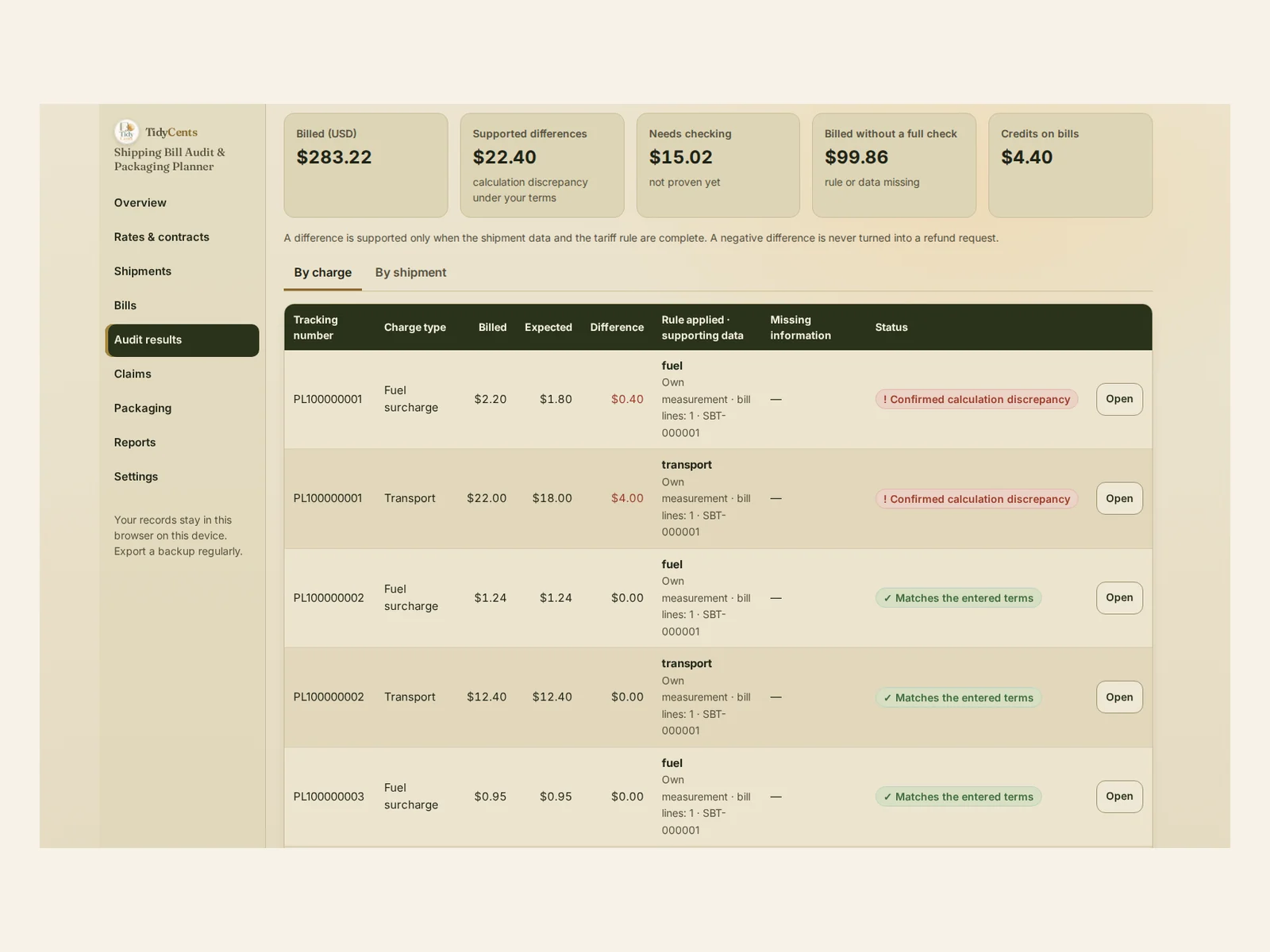
To audit a shipping invoice, recalculate every charge from the shipment facts and your own contract terms — rounding, dimensional divisor, rate table, then discounts and surcharges in the order the contract states — and compare the result with each bill line. Call a difference supported only when the measurements and the rule are complete; anything that depends on an unknown fact is a question, not a claim. In the example below, a small ceramics shop is billed $283.22 for 12 shipments: $22.40 is a supported difference, $15.02 still needs checking, and one parcel billed at 20 lb should have been rated at 15 lb.
Why shipping bills need checking
Parcel charges are built from several inputs, and each one can go wrong without anyone noticing:
- Dimensional weight. Carriers charge by size when a box is light for its volume, so one measuring error changes the price.
- Rounding. Sides and weight are rounded up in steps set by the contract, before the divisor is applied.
- Surcharges. Residential delivery or additional handling may be added for conditions that never applied.
- Duplicates and credits. A charge can appear twice, or be corrected later by a credit you already received.
- Packaging. A box that is too large raises every bill, month after month.
The formula
- Dimensional weight = length × width × height ÷ divisor, rounded up as your contract says.
- Billable weight = the higher of actual weight and dimensional weight.
- Transport charge = the rate-table row for that zone and billable weight.
- Expected charge = transport − discounts + surcharges that apply + fuel, in the order the contract sets.
- Supported difference = billed − credits − corrections − expected, when every input is known.
A worked example
The numbers come from the demo of Shipping Bill Audit & Packaging Planner: a fictional ceramics shop with 12 shipments on 2 bills, rated with a training contract.
The overview. Of the 12 shipments, 5 match the contract, 1 was already corrected by a credit, 2 have a confirmed calculation discrepancy, 3 need their source data checked and 1 has no tariff rule yet. The money stays in separate boxes: $22.40 supported, $15.02 not proven yet, $4.40 claimed and $4.40 recovered.
One parcel, step by step. The box measures 20 × 10 × 10 in and weighs 5 lb.
| Step | Result |
|---|---|
| Volume | 2,000 in³ |
| Divided by 139 | 14.3885 lb |
| Dimensional weight, rounded up | 15 lb |
| Billable weight, higher of 5 and 15 | 15 lb |
| Transport, zone 5, up to 15 lb | $18.00 |
| Fuel, 10% of transport | $1.80 |
| Expected total | $19.80 |
The bill shows transport at $22.00 and fuel at $2.20, $24.20 in total. The supported difference is $4.00 + $0.40 = $4.40. Residential and additional-handling surcharges were not added because those conditions were not confirmed. The second confirmed shipment makes up the other $18.00 of supported differences.
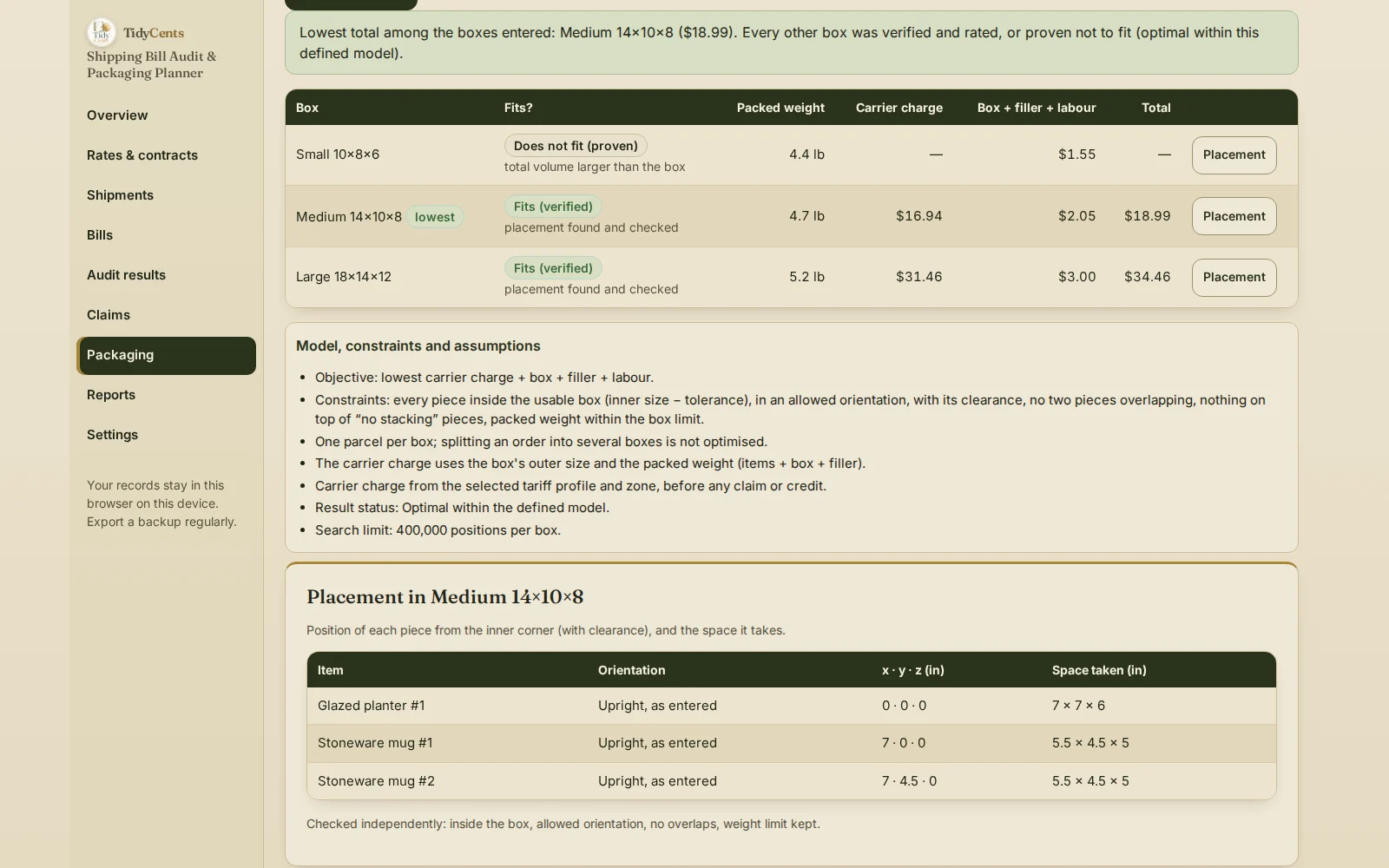
Which box should the next order use? An order of one glazed planter and two stoneware mugs is replayed with three boxes:
| Box | Fits? | Carrier charge | Box, filler and labour | Total |
|---|---|---|---|---|
| Small 10×8×6 | No — the items' total volume is larger than the box | — | $1.55 | — |
| Medium 14×10×8 | Yes, placement checked | $16.94 | $2.05 | $18.99 |
| Large 18×14×12 | Yes, placement checked | $31.46 | $3.00 | $34.46 |
The medium box costs $15.47 less than the large one for this order. The tool places each item in an allowed orientation and checks the placement; volume alone is never treated as proof that items fit.
Step by step: audit a shipping invoice
- Copy your contract rules: rounding of sides and weight, divisor, rate table by zone, discounts, minimums, surcharges and fuel, in their order.
- Measure and weigh your boxes as packed, and keep the record.
- Import the bill lines with tracking number, charge type and amount.
- Recalculate each charge and compare it line by line.
- Mark unknown facts as unknown, such as whether an address was residential.
- Look for duplicates, reversals and credits before calling anything an overcharge.
- Prepare the claim with the calculation and note the claim deadline; you submit it to the carrier.
- Record what was actually credited, separately from what you claimed.
- Test smaller boxes for the orders that cost the most.
Common mistakes
- Comparing against a published rate instead of your contract. Only your own terms prove a difference.
- Forgetting to round up. Sides and weight are often rounded before the divisor.
- Counting a credit twice. A charge already corrected is not still open.
- Claiming on a guess. A surcharge that depends on an unknown fact needs checking first.
- Treating claimed money as recovered. The carrier decides; only the credit is money back.
- Picking boxes by volume. Items that add up to less volume may still not fit.
When a tool helps
A spreadsheet can multiply sides. It rarely applies your contract's rounding, rate table and surcharge order line by line, matches duplicates and credits, keeps supported, open, claimed and recovered money apart, and replays orders in boxes that are checked to fit. Shipping Bill Audit & Packaging Planner does, and every audit line opens to its calculation. The rates are the ones you enter; the tool has no live carrier connection, and a refund is decided by the carrier. Exact decimal arithmetic, no AI guesses. To compare suppliers including freight and duties, see Supplier Switch & Landed Cost Lab.
Open the demo with the ceramics shop above — every screen, no sign-up — then enter your own contract rules and bills.
Related guides: how to calculate landed cost, the true cost of a return and three-way match for a small business.
FAQ
How is dimensional weight calculated?
Multiply length, width and height after rounding, divide by the divisor in your contract and round up. In the example, 20 × 10 × 10 in gives 2,000 in³; divided by 139 that is 14.3885, rounded up to 15 lb.
What is billable weight?
The higher of the actual weight and the dimensional weight. A 5 lb box with a dimensional weight of 15 lb is rated at 15 lb.
Which differences can I claim from a carrier?
Those you can rebuild from complete shipment data and your contract terms. A charge that depends on an unknown fact, or one already corrected by a credit, is not a supported difference. Whether a claim is accepted is up to the carrier.
How do I choose a cheaper shipping box?
Compare the carrier charge plus the cost of the box, filler and packing time for each box the items really fit in. In the example, the medium box totals $18.99 and the large one $34.46.
This is decision support, not legal or tax advice.
Tools mentioned in this guide
 Interactive tool
Shipping Bill Audit & Packaging Planner
Check shipping bills against your shipments and contract, then see which packaging changes would prevent repeat costs.

