
How to follow up on a quote without losing the job
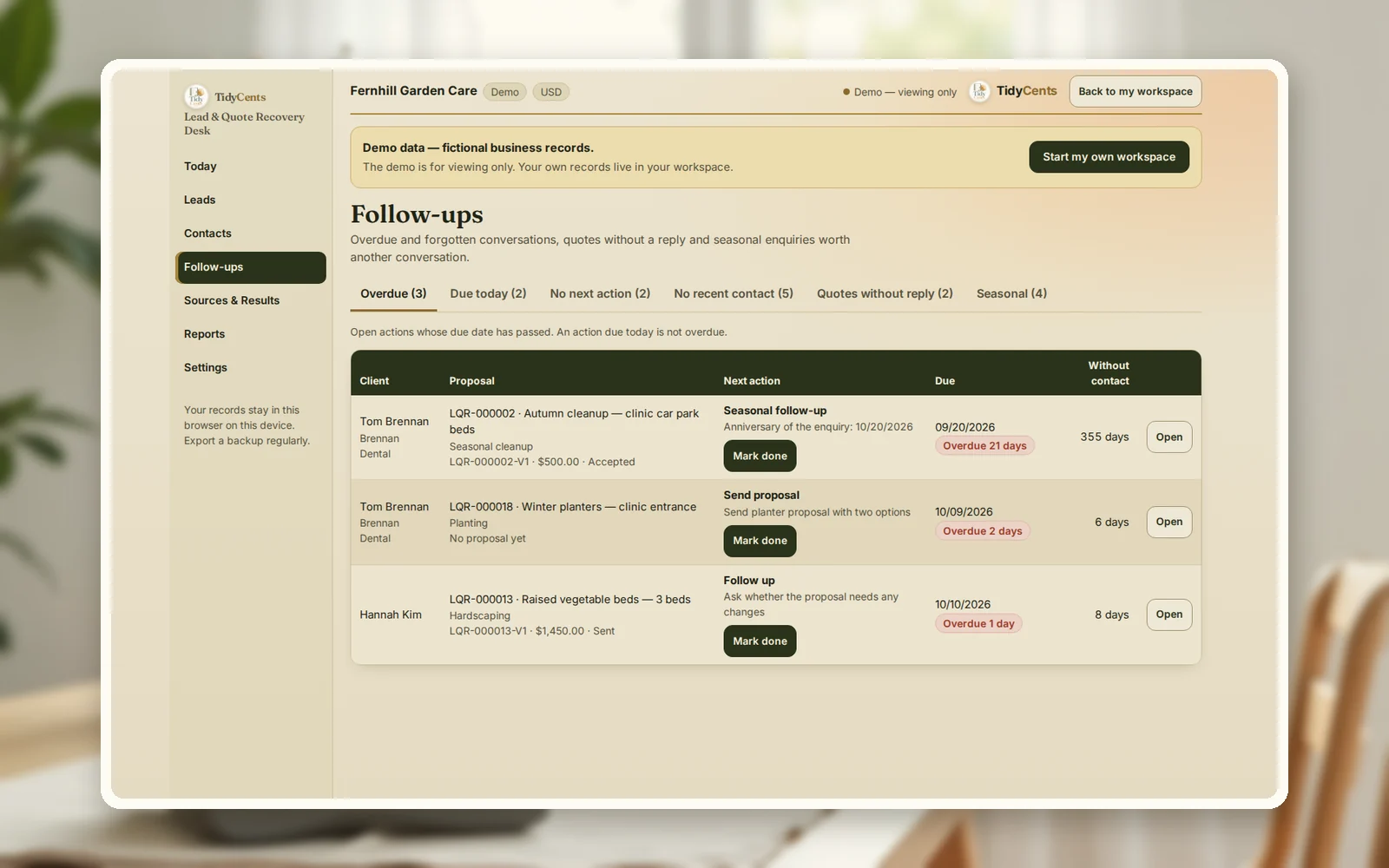
Follow up on every quote on a date you set when you send it — usually a few days after the client has had time to read it — and give every open enquiry exactly one next action with a due date. Most quotes are not refused; they are forgotten, by the client and by you. In the example below, a small garden business has $3,850 of quotes waiting for a reply — nearly as much as the $4,000 it won from twelve closed enquiries — and one $900 quote was lost to "no response" after a single send.
Why quotes go quiet
A quote that gets no answer is rarely a firm "no". The common reasons are ordinary:
- The client is comparing and has not decided yet.
- Something in the quote does not fit — scope, timing or price — and they do not want to negotiate.
- They forgot. Your email is under thirty others.
- You forgot. Without a date on the next step, the follow-up never happens.
The fix is not a more persuasive email. It is a simple rule: no open enquiry without a next action, and no quote without a follow-up date.
The numbers to watch
- Win rate = won ÷ (won + lost) × 100. Open enquiries are left out until they close.
- Sales cycle = days from enquiry to won or lost, averaged over closed enquiries.
- Quote awaiting reply = a sent quote with no contact since it was sent, older than your follow-up days.
- Contribution by source = revenue − direct cost of won jobs, grouped by where the enquiry came from.
- Source return = contribution ÷ marketing spend for that source. No spend entered means "not calculated", not "infinite".
A worked example
The numbers come from the demo of the Lead & Quote Recovery Desk: a fictional garden-care business with 20 enquiries.
What closed. 12 enquiries are closed: 8 won and 4 lost, a 66.7% win rate, with an average of 12.7 days from enquiry to decision. The won jobs brought $4,000 of revenue and $2,400 of contribution. The four losses each had a different reason — price, timing, another provider and no response.
What is still open. Three quotes are waiting for an answer:
| Quote | Value | Sent | Next action |
|---|---|---|---|
| Back garden redesign, version 2 | $1,640 | 1 October | Call for the decision on version 2 |
| Raised vegetable beds | $1,450 | 3 October | Ask whether the proposal needs changes |
| Wildflower meadow strip | $760 | 25 September | Follow up — no contact since sending |
Together that is $3,850. The redesign also shows why quote versions matter: version 1 at $1,850 became version 2 at $1,640 after the client dropped the gravel path. Keeping both, with the reason, means nobody quotes the old price by mistake.
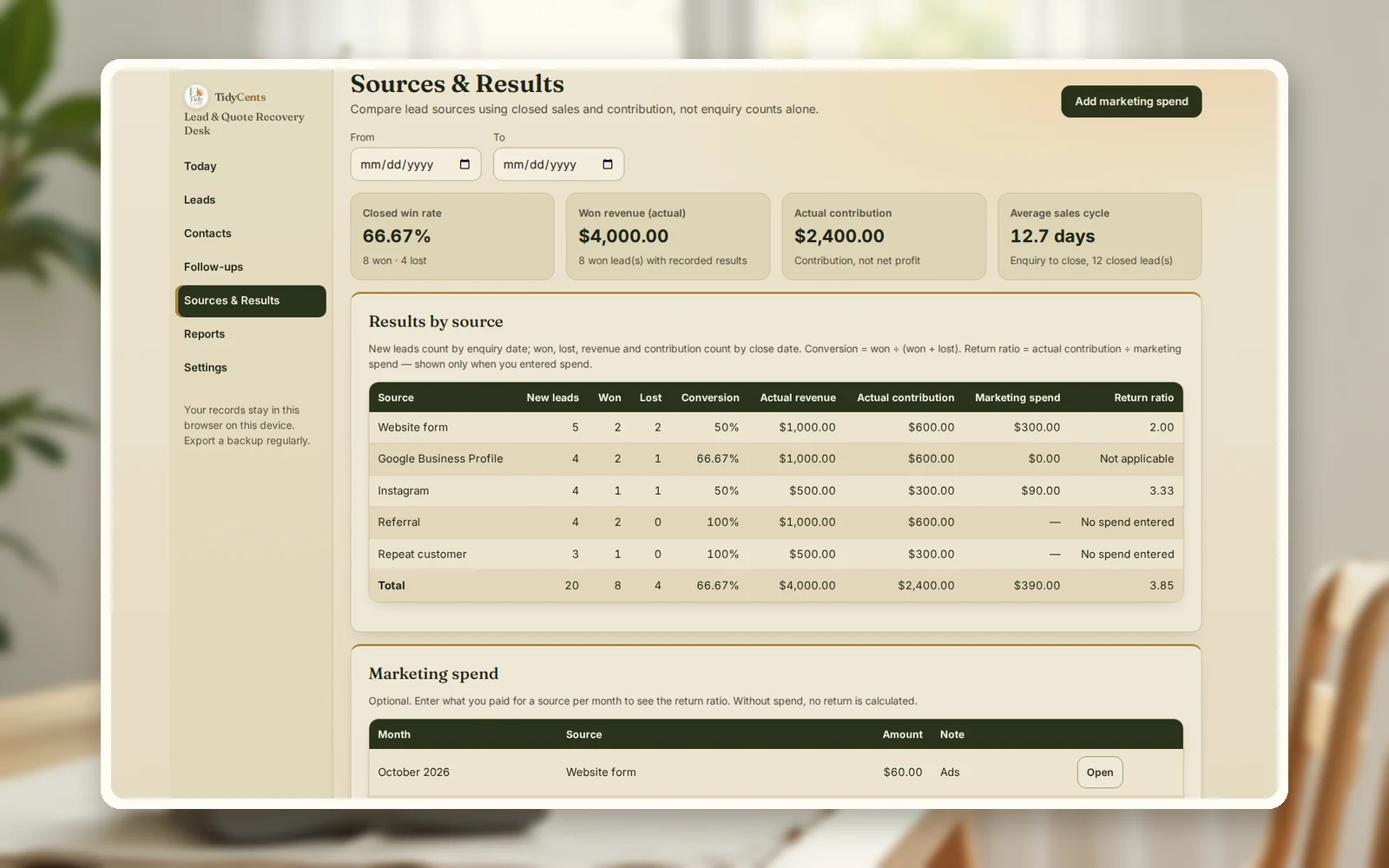
Where the good enquiries come from. Comparing sources by closed sales and contribution, not by enquiry count:
| Source | Won / lost | Contribution | Marketing spend | Contribution per $1 spent |
|---|---|---|---|---|
| Website form | 2 / 2 | $600 | $300 | $2.00 |
| 1 / 1 | $300 | $90 | $3.33 | |
| Google Business Profile | 2 / 1 | $600 | $0 | not applicable |
| Referral | 2 / 0 | $600 | none entered | not calculated |
The website form brings the most enquiries, but it also produced the $4,200 patio quote lost on price and the $900 design consultation lost to no response. Referrals close every time. That is a reason to ask happy clients for referrals — and to follow up website enquiries faster.
Seasonal work comes back. Last October's autumn cleanup for a clinic created a reminder for 20 September this year: a month before the anniversary of the enquiry, with a ready message template — a repeat job found without any advertising.
Step by step: a follow-up system that works
- Log every enquiry with source, service, date and an estimated value.
- Give each one a next action and a due date — call, visit, send quote, follow up. Never leave one without.
- Send the quote and set the follow-up date at the same time — a few working days later is common.
- Keep quote versions with the reason for each change.
- Follow up once with a question, not a push: "Does the proposal fit, or should I change something?"
- Close the loop. Mark the enquiry won or lost with a reason, even when the answer is silence.
- Review sources monthly by contribution, and set seasonal reminders for repeat work.
Common mistakes
- Sending a quote with no follow-up date. It will depend on memory.
- Following up with "just checking in". Ask a question the client can answer in one line.
- Leaving lost enquiries open. They distort your win rate and your pipeline.
- Judging sources by enquiry count. Count contribution from closed work.
- Overwriting old quotes. Keep versions so the client and you see the same numbers.
- Forgetting seasonal clients. Last year's work is next year's easiest sale.
When a tool helps
A spreadsheet can list enquiries. Keeping one next action per enquiry, versions per quote, overdue follow-ups, seasonal reminders and source results in one place is what slips. The Lead & Quote Recovery Desk shows today's actions, flags quotes awaiting a reply, keeps every version, prepares follow-up drafts you send yourself, and compares sources by closed sales and contribution — without a subscription CRM. Exact decimal arithmetic, no AI guesses. To make sure each quote is priced right in the first place, see the Freelance Quote & Scope.
Open the demo with the garden business above — every screen, no sign-up — then add your own enquiries.
Open the Lead & Quote Recovery DeskAll sales and daily operations tools
Related guides: how to calculate a freelance rate, how to price a contractor job and are my ads profitable.
FAQ
How long should I wait before following up on a quote?
Long enough for the client to read and compare, short enough that they still remember you — many small businesses use two to five working days. More important than the exact number is setting the date when you send the quote.
How many times should I follow up?
Once or twice with a clear question is usually enough; after that, ask whether you should close the enquiry. A clear "not now" is useful: it frees your diary and gives you a reason to record.
What should a quote follow-up say?
Name the quote, offer a specific choice and make it easy to answer: "Would you like version 2 as it is, or should I adjust the planting?" Avoid pressure; ask what would help them decide.
Should I lower my price if they do not reply?
Not as a first step. Silence is usually about timing or scope, not price. Ask; if price is the reason, change the scope rather than cutting the margin.
Do I need a CRM?
Not for a small business that needs one list of enquiries, next actions and quotes. What matters is that every enquiry has a next step with a date and every closed one has a reason.
This is decision support, not legal or marketing advice.
Tools mentioned in this guide
 Interactive tool
Lead & Quote Recovery Desk
Stop losing enquiries between the first message and the final decision.

