
How to price a contractor job without losing margin
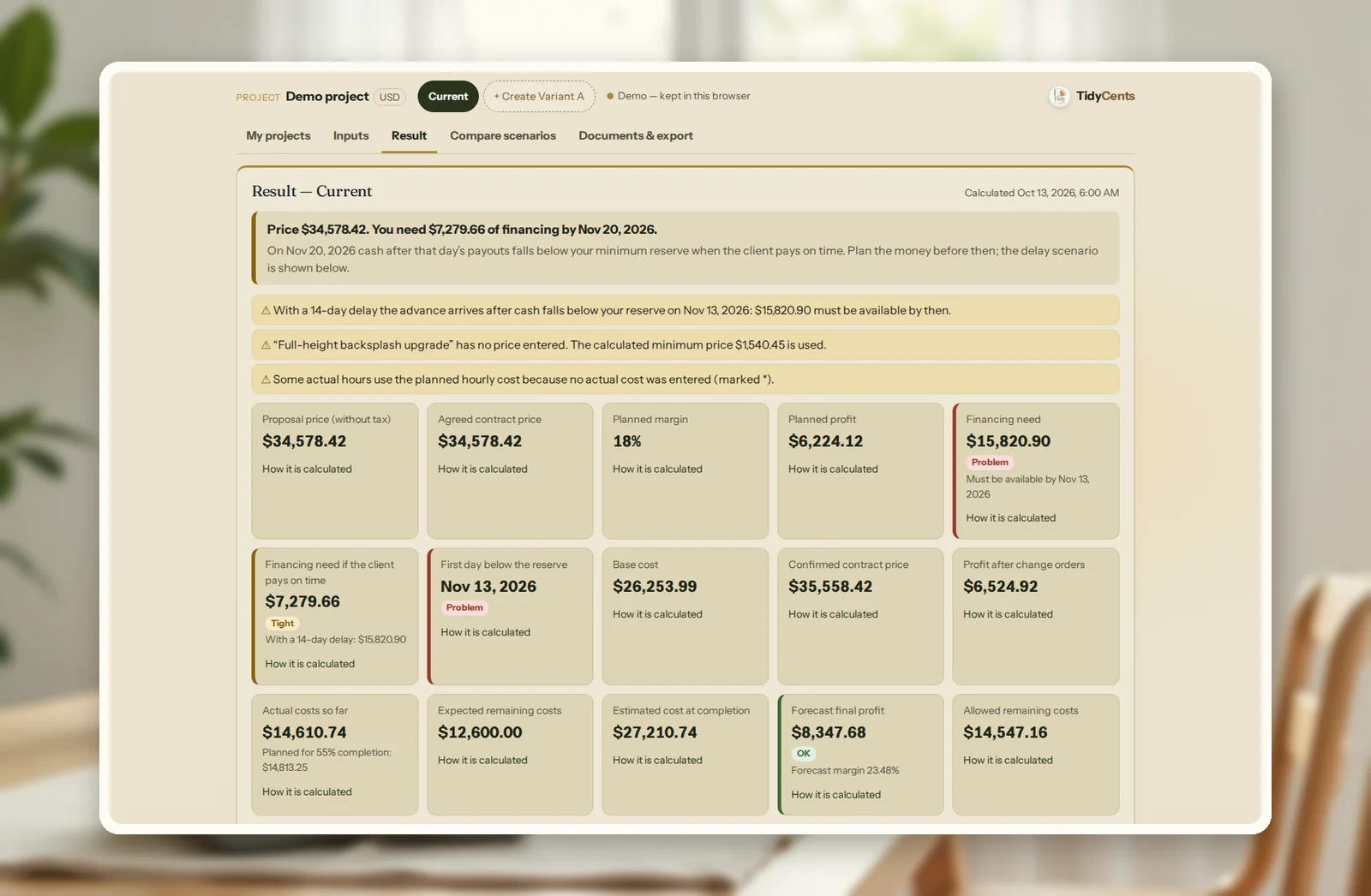
To price a contractor job, add up every cost the job will cause — materials with waste and full packs, labour hours at your cost rate, subcontractors, transport, equipment and the job's share of overheads — add a reserve for what you cannot see yet, and then set the price so the margin you need is left after all of it. Margin is a share of the price, not a percentage added to cost. Then check the cash: when you pay suppliers and crews, and when the client pays you. In the example below, a kitchen renovation priced at $34,578.42 keeps an 18% margin on paper — but still needs $7,279.66 of extra cash before the first stage payment arrives.
Why contractor bids lose money
Most underpriced jobs are not one big mistake. They are several small ones:
- Waste and pack sizes ignored. 180 ft² of tile becomes 198 ft² with waste, and 204 ft² once you buy full boxes.
- Markup confused with margin. Adding 18% to cost leaves about 15% of the price as profit, not 18%.
- Overheads left out. The van, the office and the permit are real costs of this job.
- No reserve. Something always turns up behind the old cabinets.
- Change orders priced on the spot. Extra work quoted at cost, or not at all.
- Cash ignored. A profitable job can still run you out of money in week three.
The formula
- Materials = quantity × (1 + waste) rounded up to whole packs × price, plus tax you cannot recover.
- Labour = hours × your cost rate per hour (what the hour costs you, not what you bill).
- Direct costs = materials + labour + subcontractors + transport + equipment.
- Job overheads = fixed items (permit, site admin) + a share of company costs (for example, a percentage of direct costs).
- Reserve = a percentage of direct costs plus overheads, for the unknowns.
- Price = (direct costs + overheads + reserve) ÷ (1 − required margin).
- Change-order minimum = (extra cost + reserve) ÷ (1 − margin), the least that keeps the job's margin.
A worked example
The numbers are the demo of Contractor Bid & Job Control: a fictional kitchen renovation from 2 November to 18 December, with an 18% required margin, an 8% reserve and 8% tax on purchases that the contractor cannot recover.
The cost build-up.
| Section | Amount |
|---|---|
| Materials (tile, adhesive, cabinets, quartz worktop) | $11,514.18 |
| Labour, 160 hours at $46–$52 | $7,888.00 |
| Subcontractors (electrician, plumber) | $4,250.00 |
| Transport and equipment rental | $691.20 |
| Job overheads (permit $450 and 6% share of office and van) | $1,910.60 |
| Reserve, 8% | $2,100.32 |
| Total cost before margin | $28,354.30 |
| Price at 18% margin | $34,578.42 |
| Planned profit | $6,224.12 |
The price is $28,354.30 ÷ 0.82. Adding 18% to cost instead would have given about $33,458 — roughly $1,120 less, and a margin of only about 15%.
The cash timeline. The client pays a 20% advance of $6,915.68 at the start, then 35%, 25% and 20% at three stages, with 5% of each stage payment held back until 22 January. The contractor starts with $3,500 of its own and wants at least $1,500 in the bank at all times. Suppliers and crews are paid before the stage payments arrive, so even with on-time payments cash falls below that floor from 20 November; the low point is on 27 November. The job needs $7,279.66 of extra cash by 20 November — an overdraft, a bigger advance or later supplier terms. If the client pays 14 days late, the need grows to $15,820.90, from 13 November.
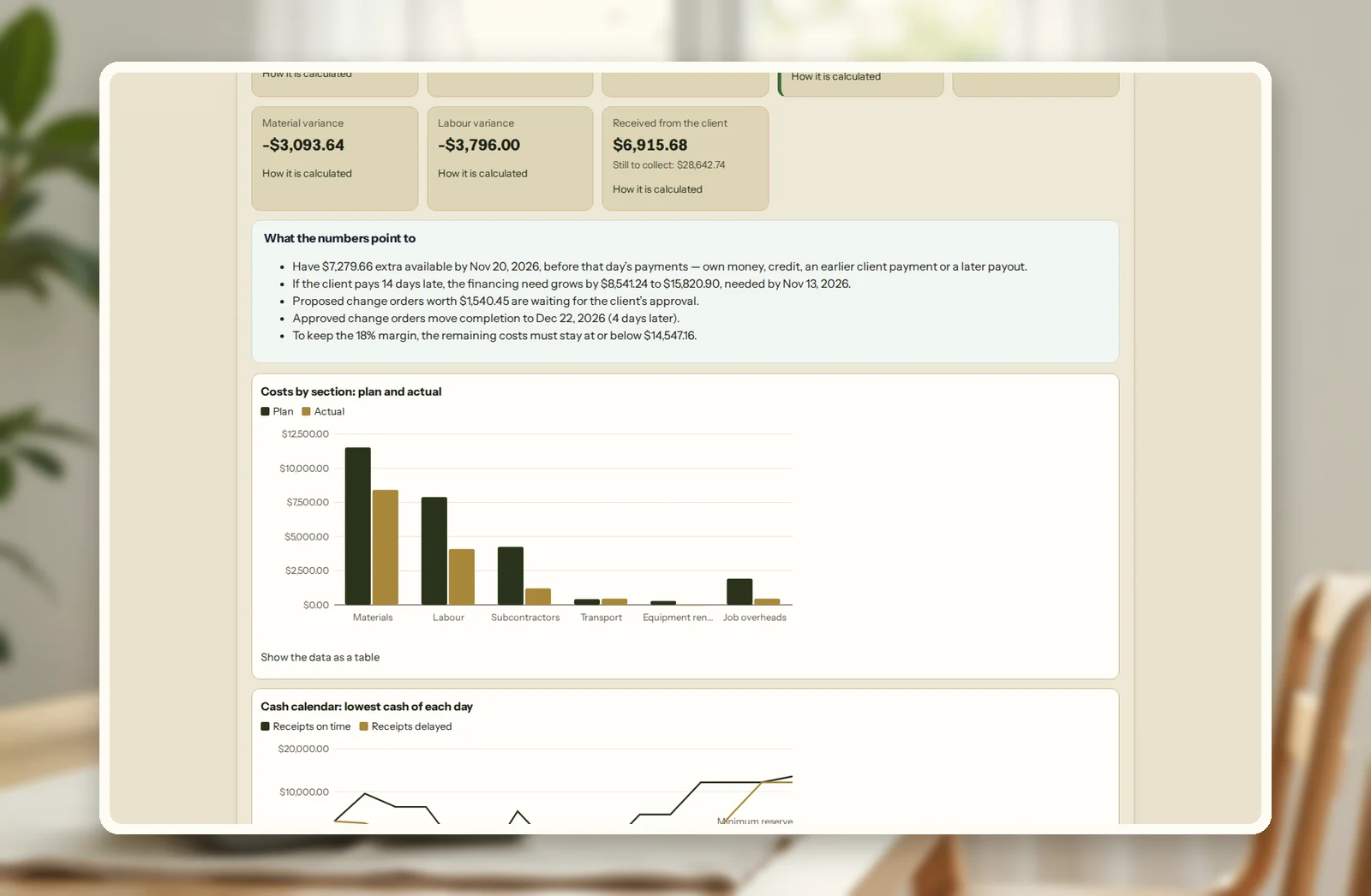
Change orders priced from cost. Under-cabinet LED lighting needs $367.20 of materials and 6 hours of labour: $679.20 of cost. The minimum price that keeps the job's margin is $894.56; it was agreed at $980. A full-height backsplash would cost $1,169.60, so the minimum to quote is $1,540.45.
Halfway check. At 55% complete, $14,610.74 has been spent. Demolition took 46 hours against 40 planned, and the cabinets cost $7,149.60 against $6,912. To keep the 18% margin, the remaining costs must stay at or below $14,547.16.
Step by step: price a contractor job
- Write the scope and the exclusions so both sides know what the price covers.
- List materials with waste and pack sizes, and the tax you cannot recover.
- Estimate labour hours by stage at your real cost rate.
- Add subcontractors, transport, equipment and the job's overheads.
- Add a reserve that matches how much is unknown.
- Set the price from the margin you need, not a markup on cost.
- Build the payment schedule — advance, stages, retention — and check the cash day by day.
- Price every change order from its cost before the work starts, and track actual costs against the plan.
Common mistakes
- Using markup when you mean margin. 18% on cost is not 18% of the price.
- Pricing tile by the square foot you need. You buy full boxes, plus waste.
- Using your billing rate as labour cost. Use what the hour costs you.
- Leaving out the permit, the van and the office. They are job costs too.
- Accepting a payment schedule without a cash check. Profit on paper does not pay suppliers.
- Starting extra work without a priced change order. Agree the price and the new deadline first.
When a tool helps
A spreadsheet can add up a bid. It rarely handles waste and packs, unrecoverable tax, margin instead of markup, a reserve, a stage-payment schedule with retention, a day-by-day cash check with a late-payment scenario, change orders and a halfway check against actual costs in one place. Contractor Bid & Job Control does, and prints the proposal for the client. Exact decimal arithmetic, no AI guesses. If a job is already running late, the Project Delay & Recovery Cost Lab compares the cost of catching up.
Open the demo with the kitchen renovation above — every screen, no sign-up — then price your own job.
Open Contractor Bid & Job ControlAll sales and daily operations tools
Related guides: how to follow up on a quote, recovering a late project and how to calculate a freelance rate.
FAQ
What is the difference between markup and margin?
Markup is added to cost; margin is the share of the price left as profit. A cost of $82 with an 18% markup sells for about $96.76, a margin of about 15%. To keep 18% of the price, divide the cost by 0.82: $100.
How much reserve should I add to a bid?
Enough for what you cannot see yet. Renovation work behind walls usually needs more than new construction. The demo uses 8% of direct costs plus overheads.
How do I price waste on materials?
Add a waste percentage to the quantity, then round up to the pack size you can buy. In the example, 180 ft² of tile with 10% waste is 198 ft², bought as 17 boxes of 12 ft²: 204 ft².
Should I ask for an advance?
It depends on the job and the client, but check the cash first. In the example, a 20% advance still leaves a gap of $7,279.66 before the first stage payment, because the cabinets are paid before the client pays.
How do I price a change order?
From its cost — materials, hours and any extra overhead — divided by (1 − your margin), plus the reserve you use for the job. Agree the price and any new deadline before you start the extra work.
This is decision support, not legal, tax or financing advice.
Tools mentioned in this guide
 Interactive tool
Contractor Bid & Job Control
Price a job from real quantities and costs, see the day your cash runs short before you sign, and keep change orders and actual costs tied to the profit of the same job.

