
Recovering a late project: what does catching up cost?
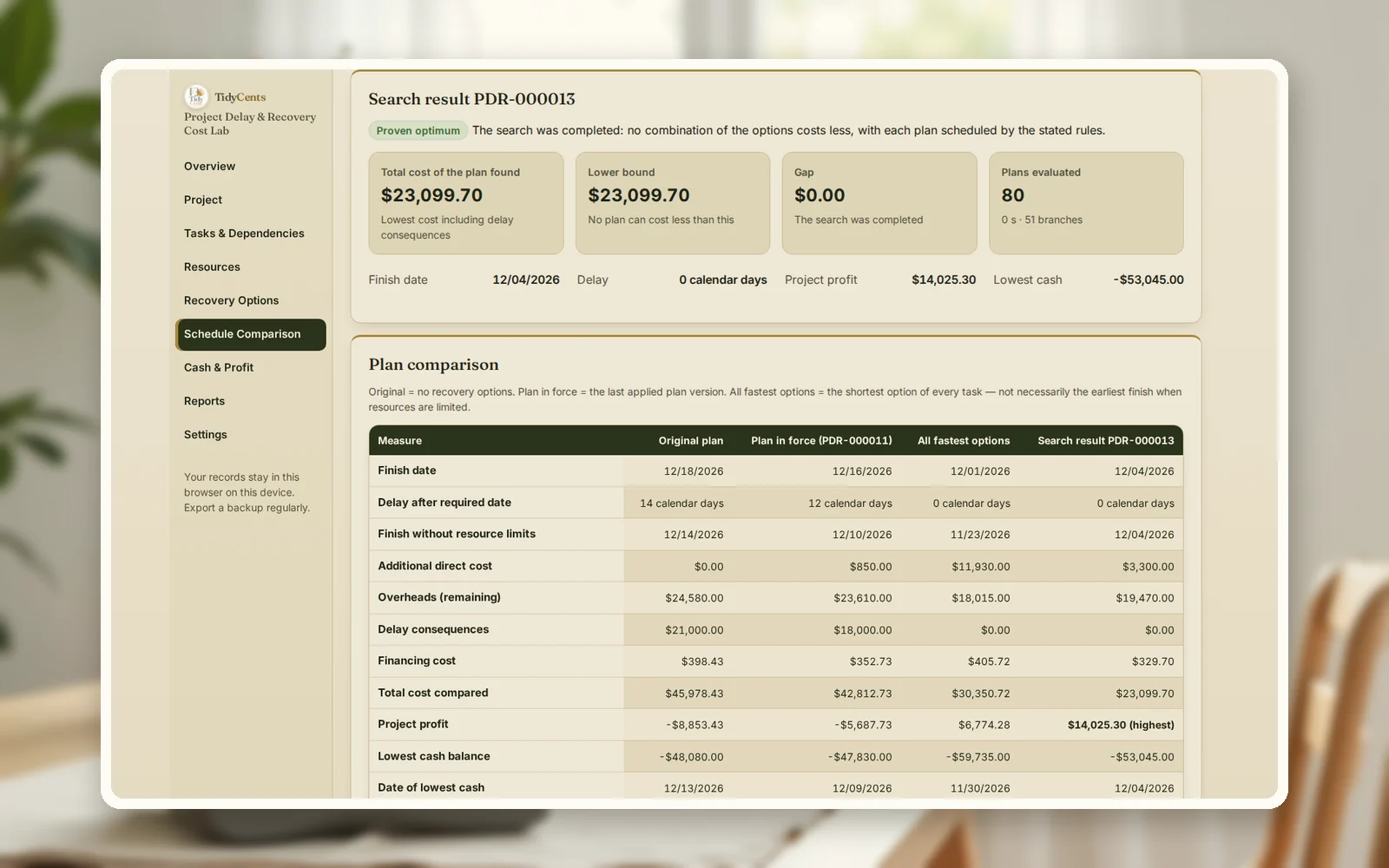
Catching up is worth it only where a day saved on the critical path costs less than a day late — late penalties, extra overhead and financing included. Speeding up a task that is not on the critical path costs money and moves nothing. And the task that caused the delay is often not the cheapest one to speed up. In the example below, the cheapest on-time plan leaves the delayed HVAC delivery alone and turns a −$8,853.43 project into a $14,025.30 profit.
Why "add more people" is not a plan
When a project slips, the instinct is to throw overtime and subcontractors at it. Three things decide whether that pays:
- The critical path. Only tasks with zero float push the finish date. Accelerating anything else is pure cost.
- The price of a late day. Penalties, site overheads, equipment hire and financing all run while the project is late — that is the budget for catching up.
- Shared resources. Two tasks that need the same crew cannot both be accelerated with that crew; the plan has to respect capacity.
There is also a cash question: acceleration costs are paid now, while milestone payments arrive later.
The formula
- Total cost compared = additional direct costs of the recovery options + remaining overheads + delay consequences + financing cost.
- Delay consequences = penalty per calendar day × days after the required completion date (up to the cap) + any one-off amount for being late.
- Overheads = cost per working day × working days to the finish + cost per calendar day × calendar days to the finish.
- Project profit = contract price − costs already spent − remaining direct costs − overheads − delay consequences − financing cost.
- Decision rule: among the plans that meet the date you need, take the one with the lowest total cost compared — and check that the cash path is fundable.
A worked example
The numbers are the demo of the Project Delay & Recovery Cost Lab: a fictional interior fit-out of a clinic for $214,000, due on 4 December. The contract carries a late penalty of $1,500 per day, capped at $30,000. A delivery notice for the HVAC units pushes the plan's finish to 18 December — 14 days late, or $21,000 of penalties.
The lab knows 13 tasks with their links, crews and calendars, and nine possible accelerations — air-freighting the HVAC units, a second drywall crew, drywall overtime, subcontracted painting, starting painting while taping continues, a flooring subcontractor, a second sign installer, electrician overtime and pre-assembled casework. It searches the combinations and compares them:
| Plan | Finish | Days late | Total cost compared | Project profit |
|---|---|---|---|---|
| Do nothing (HVAC late) | 18 December | 14 | $45,978.43 | −$8,853.43 |
| Drywall overtime only | 16 December | 12 | $42,812.73 | −$5,687.73 |
| Cheapest plan that finishes on time | 4 December | 0 | $23,099.70 | $14,025.30 |
| Finish nine days early (25 November) | 25 November | 0 | $27,463.05 | $9,661.95 |
The cheapest on-time plan uses three options: start painting while taping continues ($600), a flooring subcontractor ($6,200) and pre-assembled casework from the supplier ($3,400). It does not air-freight the HVAC units: that $3,900 option only pays if you want to finish earlier still. The search ran to a proven optimum — no combination of the entered options meets 4 December for less.
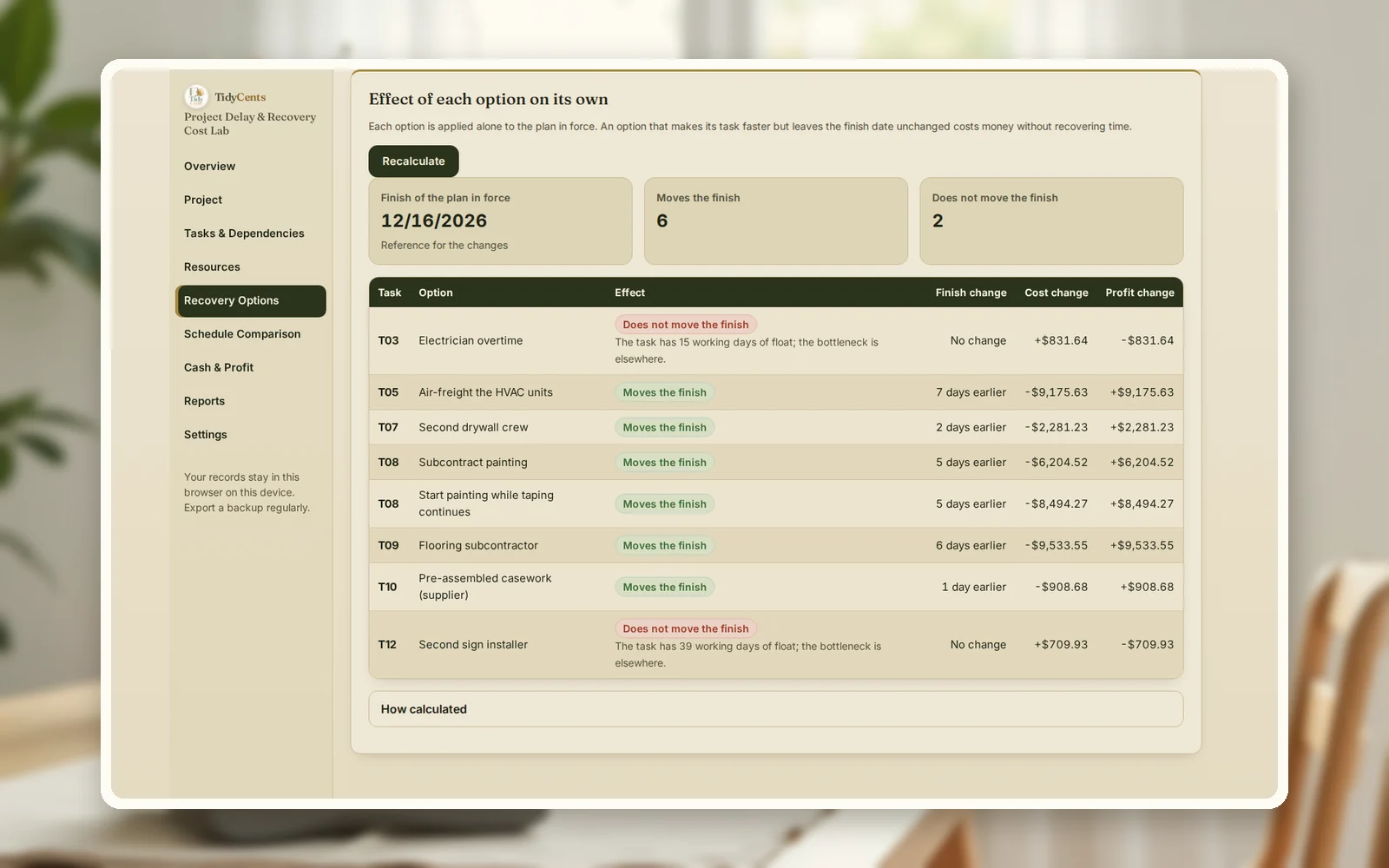
Two lessons are in the table. Drywall overtime alone saves two days and $3,165.70 of cost, but leaves the project 12 days late and still loss-making — a partial fix that feels like action. And finishing even earlier costs $4,363.35 more than finishing on time, with nothing in the contract to reward it.
Cash is the other check. Costs leave when tasks start; milestone payments arrive after the work and the payment term. The lowest cash balance is −$48,080 if nothing is done and −$53,045 in the on-time plan. Recovery is clearly worth it on profit, but it needs about $5,000 more short-term funding — something to arrange before committing the subcontractors.
Step by step: build a recovery plan
- Update the schedule to today: actual starts and finishes, remaining durations, the new delivery dates.
- Find the critical path and float. Only zero-float tasks move the finish.
- Price a late day: penalty, overheads per working and calendar day, financing.
- List realistic options per task: overtime, another crew, subcontracting, resequencing, faster delivery — each with its new duration and extra cost.
- Check resources: no crew booked above its capacity.
- Compare plans by total cost compared and profit, not by days saved.
- Check the cash path and arrange funding before you sign the extra work.
Common mistakes
- Accelerating the task that caused the delay by reflex. Another task may buy the same days cheaper.
- Crashing non-critical tasks. They have float; the finish date does not move.
- Counting only the penalty. Overheads and financing run every late day too.
- Ignoring resource clashes. A plan that needs the same crew in two places at once will slip again.
- Finishing earlier than needed. Unless the contract rewards it, it is cost without return.
- Forgetting the cash dip. Acceleration is paid before the milestones that fund it.
When a tool helps
On a small job you can reason through two or three options. With a dozen tasks, links, calendars, shared crews and nine possible accelerations, the combinations multiply quickly. The Project Delay & Recovery Cost Lab rebuilds the critical path, levels resources, searches the combinations with a time limit and an honest status (optimal, feasible, incomplete search), and shows cost, profit and the lowest cash balance for each plan. Exact decimal arithmetic, no AI guesses. For the contract side of a late job, see the Contractor Bid & Job Control.
Open the demo with the clinic fit-out above — every screen, no sign-up — then load your own schedule.
Open the Project Delay & Recovery Cost LabAll sales and daily operations tools
Related guides: how to price a contractor job, how to stress-test your cash flow and contract auto-renewal notice periods.
FAQ
What is project crashing?
Shortening the schedule by adding resources or money to critical-path tasks — overtime, extra crews, subcontractors or faster delivery. It pays only up to the point where a day saved costs less than a day late.
How do I find the critical path?
List each remaining task with its duration and the tasks it depends on, then calculate the earliest and latest start of each. Tasks whose earliest and latest start are the same have zero float; together they form the critical path.
Should I accelerate or accept the penalty?
Compare the total cost of each plan, including penalties, overheads and financing. Here, accepting the delay means a loss of $8,853.43; the cheapest on-time plan makes $14,025.30.
What if the search cannot finish?
On large plans the number of combinations can be huge. The lab stops at the time limit and says so: "feasible" or "incomplete search", never "cheapest possible" unless it proved it.
Does this replace a scheduling program?
No. It is a decision tool for one question — which recovery is worth paying for. Keep your detailed schedule where it is, and use the lab to price the options.
This is decision support, not financial, legal or contractual advice.
Tools mentioned in this guide
 Interactive tool
Project Delay & Recovery Cost Lab
Compare the cost of recovering a delayed project with extra resources, outsourcing and faster delivery—before paying for the wrong acceleration.

