
How to calculate your freelance rate and price a project
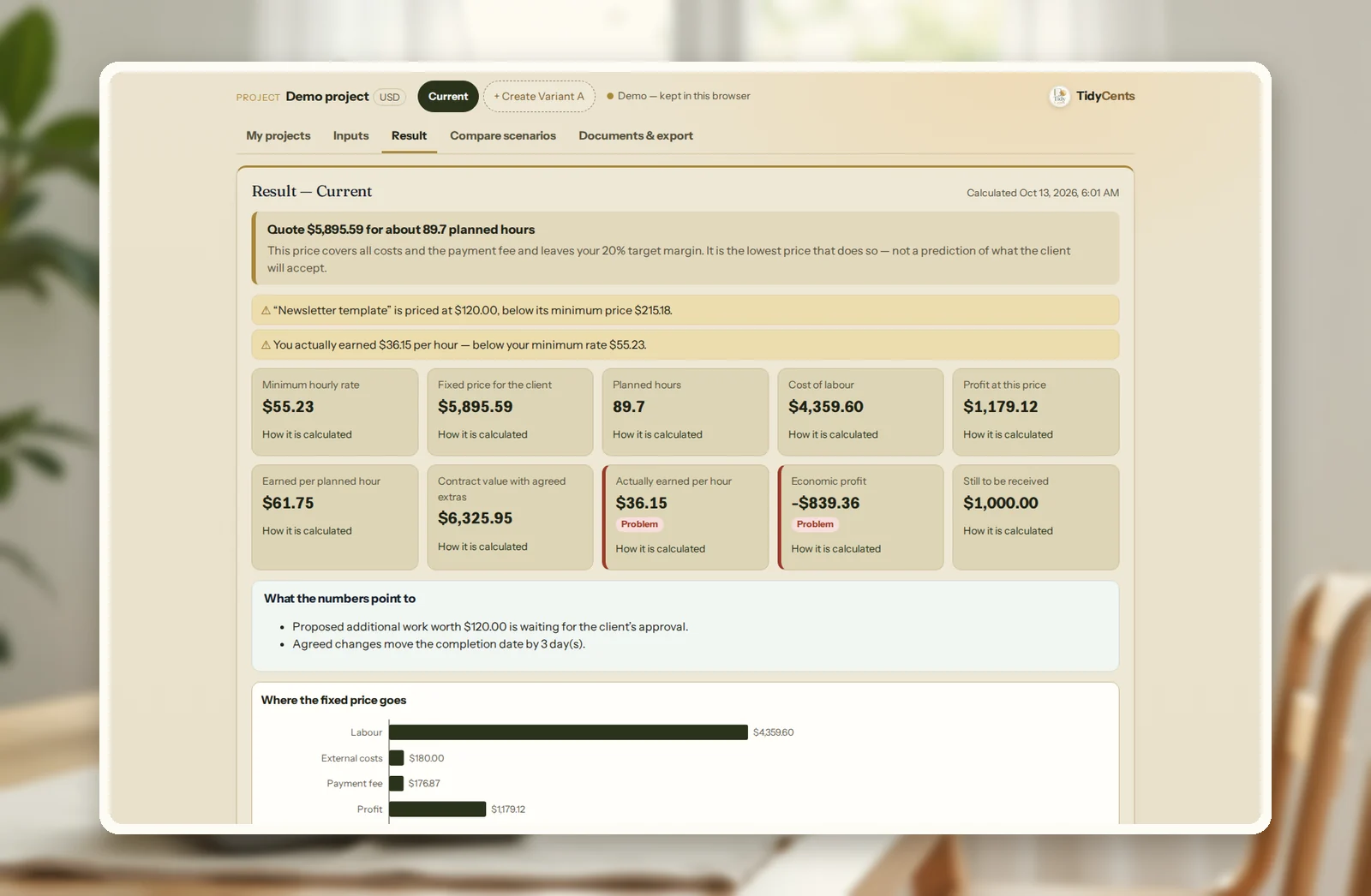
Your minimum freelance rate is what you need each month — income, business costs and a buffer — divided by the hours you can actually sell, after days off and the time that never gets billed, and grossed up for payment fees. Price below it and you are paying to work. Then price each project from its scope: hours per stage, revision rounds, a reserve, outside costs and the margin you want. In the example below, a designer who needs $5,250 a month can sell 98 hours, so her floor is $55.23 an hour — and a website redesign priced at $5,895.59 brings $61.75 per planned hour after fees and outside costs.
Why freelancers under-price
The usual mistakes are about hours, not about the rate itself:
- Counting every working hour as billable. Admin, sales and learning take real time that no client pays for.
- Forgetting business costs. Software, insurance, equipment and accounting come out of the same income.
- Ignoring payment fees. A 3% fee on every invoice comes off the top.
- Pricing the work, not the revisions. Two rounds of changes can be a day of work.
- No reserve. Estimates are optimistic; a reserve keeps the price honest.
- Saying yes to extra requests at no charge. Small additions add up to a free week.
The formula
- Monthly need = desired income + fixed business costs + profit buffer.
- Available hours = (working days − days off) × hours per day.
- Sellable hours = available hours − hours you cannot bill (admin, sales, learning).
- Minimum hourly rate = monthly need ÷ sellable hours ÷ (1 − payment fee).
- Project cost = (stage hours + revision hours) × (1 + reserve) × your rate + subcontractor hours × their rate + outside costs.
- Project price = project cost ÷ (1 − target margin − payment fee).
- Change request minimum = extra hours × the same build-up, so extra work keeps the same margin.
A worked example
The numbers are the demo of Freelance Quote & Scope: a fictional designer quoting a website redesign for a bakery.
The minimum rate. She wants $4,200 a month, has $650 of business costs and adds a $400 buffer: $5,250. She works 21 days with 2 days off at 7 hours a day — 133 hours — but 35 of those go to admin and sales, leaving 98 sellable hours. With a 3% payment fee, her minimum rate is $55.23 per hour.
The project. Four stages and two revision rounds:
| Stage | Hours | With 15% reserve | Rate | Cost |
|---|---|---|---|---|
| Discovery and sitemap | 10 | 11.5 | $55.23 | $635.13 |
| Visual design | 24 | 27.6 | $55.23 | $1,524.30 |
| Development (subcontracted) | 30 | 34.5 | $38.00 | $1,311.00 |
| Launch and handover | 6 | 6.9 | $55.23 | $381.08 |
| Revision rounds (2 × 4 hours) | 8 | 9.2 | $55.23 | $508.10 |
| Total | 78 | 89.7 | $4,359.60 |
With $180 of outside costs, the project costs $4,539.60. At a 20% target margin and the 3% fee, the price is $5,895.59: $1,179.12 of profit after the $176.87 fee, or $61.75 per planned hour after the fee and outside costs.
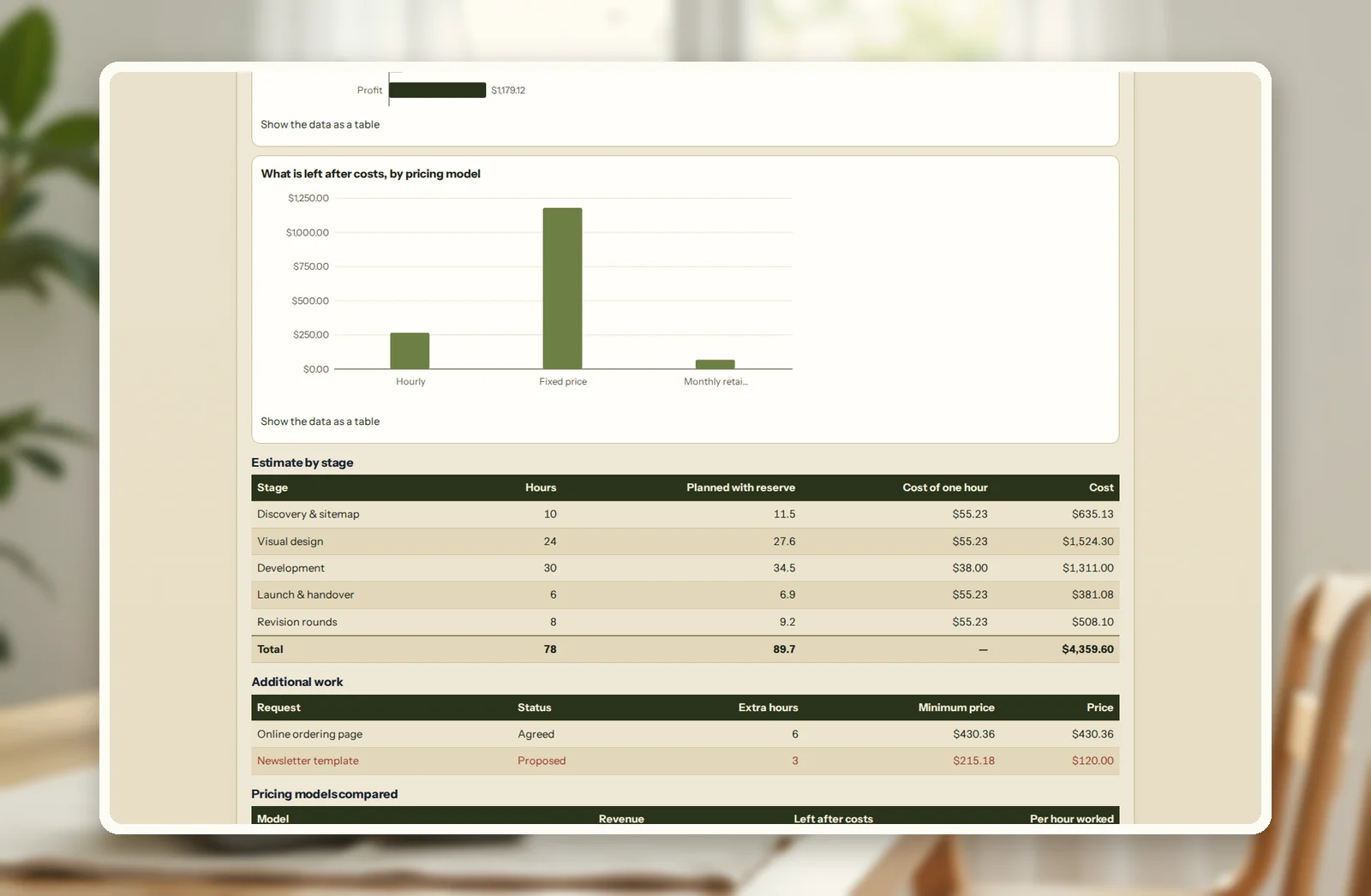
Three ways to bill the same work. Billing the same 89.7 hours at the minimum rate would bring $4,953.98 and leave $265.76 after costs — the floor, by definition. The fixed price leaves $1,179.12. A $900 monthly retainer for 15 hours, with 18 hours used and the extra billed at $65, brings $1,095, or $59.01 per hour after the fee.
Change requests. An online ordering page needs 6 extra hours; the minimum that keeps the margin is $430.36, it was agreed at that price, and the deadline moved by 3 days. A newsletter template was proposed at $120, but its 3 hours need at least $215.18 — the tool flags it as below the minimum.
Payment milestones. 40% on signing ($2,358.24), 30% when the design is approved ($1,768.68) and 30% on launch ($1,768.67).
Step by step: calculate your rate and price a project
- Write down your monthly need: income, business costs and a buffer.
- Count your sellable hours honestly, after days off and unbilled time.
- Calculate your minimum hourly rate, including payment fees.
- Break the project into stages with hours and a deliverable for each.
- Add revision rounds, a reserve, subcontractors and outside costs.
- Set the price from your target margin, and compare it with hourly and retainer billing.
- Write what is included and excluded, and how changes are handled.
- Price every change request before you start it, and track actual hours against the plan.
Common mistakes
- Dividing income by 40 hours a week. Most freelancers sell far fewer hours than they work.
- Using a market rate without checking your floor. A popular rate can still be below what you need.
- Pricing projects at your minimum rate. The minimum covers your costs; profit comes from the margin.
- Leaving revisions unlimited. Write how many rounds are included.
- Saying "small change, no problem". Quote it, even if you then decide to waive it.
- Asking for payment only at the end. A deposit and milestones keep cash coming in.
When a tool helps
A spreadsheet can divide income by hours. It rarely keeps your minimum rate, project stages, reserve, subcontractor rates, margin, payment fee, pricing models, change requests, milestones and actual hours in one place. Freelance Quote & Scope does, and prints a proposal with the scope, exclusions and change rule. Exact decimal arithmetic, no AI guesses. For brand deals with usage rights, see the Creator Deal & Rights Planner.
Open the demo with the website redesign above — every screen, no sign-up — then calculate your own rate and project.
Open Freelance Quote & ScopeAll costs, pricing and profit tools
Related guides: how much to charge for usage rights, how to follow up on a quote and how to price a contractor job.
FAQ
How do I calculate my freelance hourly rate?
Add your desired monthly income, business costs and a buffer, then divide by the hours you can actually sell in a month, and gross it up for payment fees. In the example, $5,250 ÷ 98 hours ÷ 0.97 gives $55.23.
How many billable hours does a freelancer have?
Fewer than the hours worked. Start from working days minus days off, multiply by your hours per day, and subtract the time spent on admin, sales and learning. In the example, 133 available hours become 98 sellable hours.
Should I charge hourly or a fixed price?
Compare both on the same work. Hourly pays for the time spent; a fixed price pays for the result and rewards good estimating. In the example, the same project leaves $265.76 billed hourly at the minimum rate and $1,179.12 at a fixed price with a 20% margin.
How do I handle scope creep?
Write what is included and excluded, and a rule that any change is quoted in writing before work starts. Price each change from its hours with the same margin; in the example, a 6-hour addition needs at least $430.36.
How much deposit should I ask for?
Enough to cover the first stage of work and any outside costs. The demo uses 40% on signing, 30% on design approval and 30% on launch.
This is decision support, not tax or legal advice.
Tools mentioned in this guide
 Interactive tool
Freelance Quote & Scope
Work out the lowest hourly rate your month can afford, turn a project into a fixed price that keeps your margin, and price every extra request before you say yes.

