
Rental inventory: avoid double bookings, track deposits
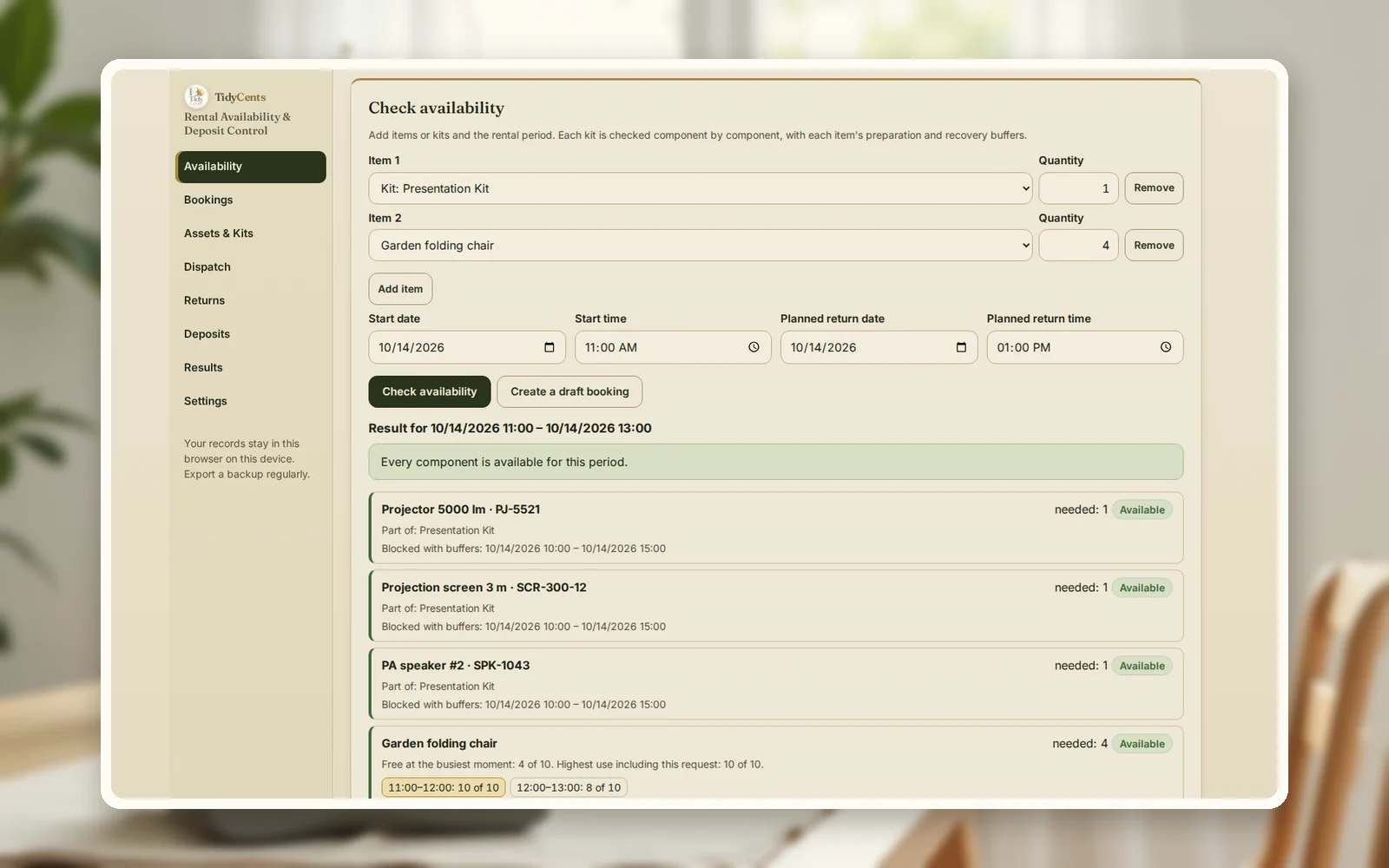
To avoid double bookings in a rental business, check every item of a booking — including each part inside a kit — against all other bookings, repairs and late returns over the full blocked time: the rental period plus your preparation time before and your return-and-cleaning time after. Then keep the deposit in its own ledger, because it is money you hold, not money you earned. In the example below, an event-rental business is about to confirm a $230 quote that looks fine — until the check shows that one speaker inside the kit is already promised to a wedding the same evening. The same business holds $1,000 of deposits that belong to its customers until the gear comes back.
Why rental availability is harder than it looks
A calendar of bookings shows when orders start and end. It does not show:
- Buffers. A chair is "free" at 18:00, but it still needs two hours to come back, be cleaned and stacked.
- Shared parts. A presentation kit and a sound kit can both include the same speaker. Two kits look free; one speaker is not.
- Pools versus single items. Ninety identical chairs can serve several orders at once; one projector cannot.
- Late returns and repairs. An item still out from the weekend, or in the workshop, blocks next week's order.
- Deposits mixed with income. A deposit spent as revenue has to be paid back from somewhere.
The rules that keep the calendar honest
- Blocked time = from (start − preparation buffer) to (end + return buffer), per item.
- Single items (serial-numbered): any overlap in blocked time is a conflict.
- Pooled items (identical units): the highest number in use at the same moment must not exceed the pool. Orders that only touch — one ends at 12:00, the next starts at 12:00 — do not overlap.
- Kits: check each component, not the kit name.
- Unavailable units: items overdue, in repair or under inspection count as taken until released.
- Deposit held = deposit received − refunded − applied to a documented damage charge. It is never rental revenue.
- Rental contribution = rental and delivery revenue + confirmed damage charges − transport, cleaning, repair, consumables and other direct costs.
A worked example
The numbers are the demo of Rental Availability & Deposit Control: a fictional event-rental business with chairs, tables, lighting, sound, projection, patio heaters and a generator, on 12 October.
A quote with a hidden conflict. A Rotary dinner on 17 October, 17:00–23:00, wants the Presentation Kit and 20 banquet chairs for $230. The projector, screen and chairs are free. But the Presentation Kit includes PA speaker #2, which is also part of the PA Sound Kit reserved for a wedding from 17 October 12:00 to 18 October 11:00. With 60 minutes of preparation and 120 minutes after, the speaker is blocked from 16:00 to 01:00. The quote cannot be confirmed as it stands — but PA speaker #3 is free that evening and can be substituted.
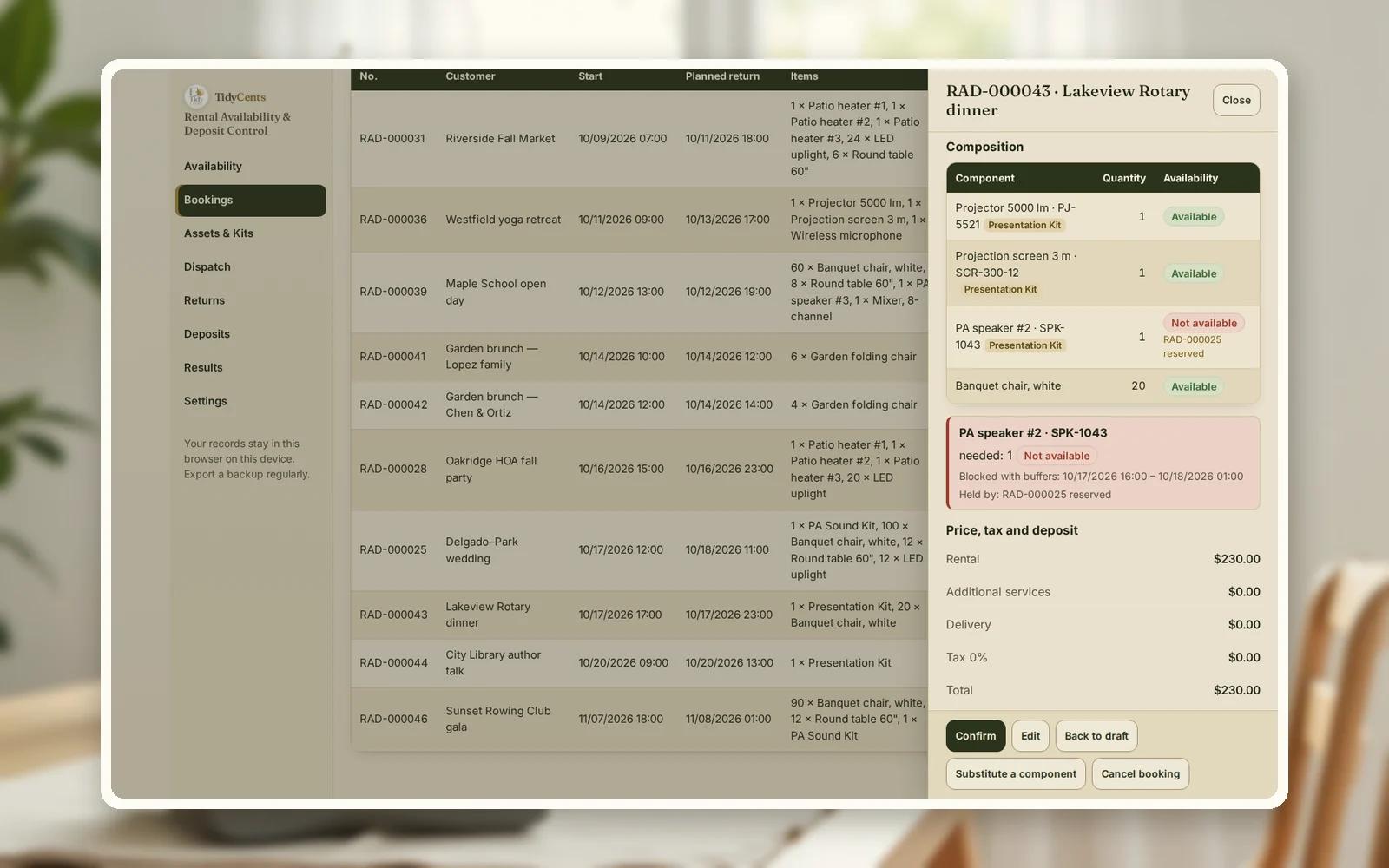
A late return that affects next week. A fall market rented 3 patio heaters and 24 LED uplights until 11 October 18:00. Heater #3 and 4 uplights have not come back yet, and one returned uplight flickers and is held for inspection. An HOA party on 16 October has booked all 3 heaters and 20 uplights. Heater #3 is now a conflict, and only 19 uplights are available instead of 20 — a reason to chase the return today, not on the morning of the party.
Two orders that touch but do not overlap. The business has 10 garden folding chairs, with no buffers. On 14 October one brunch takes 6 from 10:00 to 12:00 and another takes 4 from 12:00 to 14:00. They fit exactly: the first order ends when the second begins.
A deposit handled by the book. A wedding paid a $200 deposit. On return, the front grille of one speaker was torn, documented with photos and a $60 replacement invoice. The owner charged only the grille, agreed it with the couple by e-mail, applied $60 of the deposit and refunded $140. The booking's contribution came to $1,381: $1,342 rental, $120 delivery and the $60 damage charge, minus $141 of direct costs.
| Deposits held on 12 October | Amount |
|---|---|
| Fall market (partly returned) | $300 |
| Wedding on 17 October | $250 |
| Yoga retreat (gear out) | $200 |
| HOA party | $150 |
| School open day | $100 |
| Total held for customers | $1,000 |
Step by step: run rental availability and deposits
- List your items: single serial-numbered items and pools of identical units, with preparation and return buffers.
- Build kits from components, so a kit is checked part by part.
- Quote with a full availability check: every component, every buffer, every repair and late return.
- Confirm only when the check passes, or substitute a component and check again.
- Dispatch with a checklist and record condition, who took it and when.
- Record returns line by line: back, missing, damaged, held for inspection or repair.
- Keep deposits in their own ledger; apply part of one only against a documented, agreed damage charge, and refund the rest.
- Review contribution per booking and per item after direct costs.
Common mistakes
- Checking kit names instead of components. Two kits can share one item.
- Forgetting buffers. Back-to-back bookings without preparation time fail on the day.
- Counting late items as available. Until it is back and checked, it is not.
- Treating deposits as income. It is the customer's money until you apply or refund it.
- Keeping a deposit without paperwork. Photos, an invoice and a written agreement make a deduction fair and defensible.
- Ignoring small repairs. A flickering light held for inspection is one unit fewer in the pool.
When a tool helps
A shared calendar works for a few large items. With pools of chairs, kits that share parts, buffers, dispatch and return checklists, repairs and deposits, conflicts hide until the day. Rental Availability & Deposit Control checks every component and buffer before you confirm, shows what is out, overdue or in repair, records dispatch and returns, keeps a deposit ledger separate from revenue, and calculates contribution per booking and per item. Exact decimal arithmetic, no AI guesses. Thinking about buying more gear or leasing it? The Equipment Buy, Lease & Replace Lab compares the full cost.
Open the demo with the event-rental business above — every screen, no sign-up — then add your own items and bookings.
Open Rental Availability & Deposit ControlAll sales and daily operations tools
Related guides: lease or buy equipment, the true cost of a return and how to respond to a chargeback.
FAQ
How do I avoid double bookings for rental equipment?
Check each item, and each component of a kit, against every other booking, repair and late return over the blocked time — the rental period plus preparation before and return time after. Confirm only when every item passes.
How much buffer time should I add between rentals?
Enough to bring the item back, check it, clean it and prepare it. In the demo, banquet chairs and tables use 60 minutes before and 120 after, uplights 30 and 60, and the generator 60 and 180.
Is a security deposit revenue?
No. It is money you hold for the customer. Record it separately; only the part applied against a documented, agreed damage charge becomes revenue, and the rest is refunded.
How do I handle damage to a rented item?
Record the damage at return with photos, get the repair or replacement cost, agree the charge with the customer, apply that amount from the deposit and refund the rest. Check what local rules apply to deposits and deductions.
How do I know which items earn their keep?
Track contribution per booking after transport, cleaning, repair and consumables, and share it across items. Compare it with what each item cost to buy.
This is decision support, not legal, tax or insurance advice.
Tools mentioned in this guide
 Interactive tool
Rental Availability & Deposit Control
Know what is available, what went out and what still needs to come back.

