Why retirement planning needs cash flow, not just a final balance

A retirement projection can finish with money left while still missing a bill earlier. To understand the plan, follow the accounts, income, spending and withdrawal dates through the whole horizon.
Calculate spendable withdrawals
An account withdrawal and the money available for spending may differ. With an entered twenty-percent tax assumption and no fee, delivering $1,000 of spending cash requires a $1,250 gross withdrawal. The account falls by $1,250, $250 goes to the assumed tax and $1,000 funds spending. This is a simplified tax model, not a calculation of local law.
Test the order of returns
Consider a two-period teaching example with $100,000 and a $10,000 withdrawal at the end of each period. A twenty-percent rise followed by a twenty-percent fall leaves $78,000. Reversing those returns leaves $74,000. The return figures are the same; their order changes the capital left after withdrawals.
That is why comparing plans only on an average return can hide a relevant difference. Do not mistake this deliberately extreme example for a forecast.
Separate essential and flexible spending
A flexible rule can reduce optional spending when the modelled portfolio falls. It should not silently relabel an unpaid essential expense as a successful adjustment. Record desired spending, the amount planned under the rule and what was actually funded.
Respect locked accounts and the dates when pensions or other income begin. A valuable asset that is unavailable this month cannot pay this month's bill.
Read simulation results carefully
A simulation repeats the cash-flow model under generated return paths. Its success percentage is the share of those paths meeting a stated test. It depends on the return model, tax assumption, currency path, spending rule and horizon.
A sampling interval describes finite simulation noise. It does not establish that the model matches the real world. Use the same generated paths when comparing strategies so that differences are caused by the rules rather than different random draws.
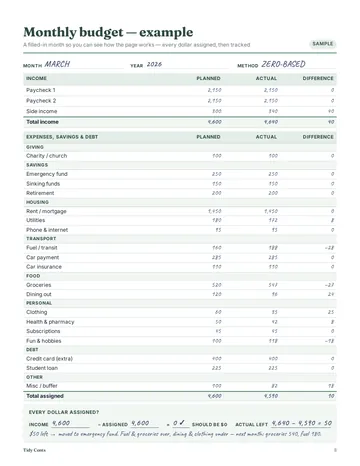
Retirement Spending & Drawdown Lab makes these assumptions and calculations visible. Start with the fictional deterministic demo, then explore reproducible simulations. For the everyday budget behind the plan, see the offline Budget App, the Savings Goals & Sinking Funds Tracker and the Net Worth & Investment Tracker.
Tools mentioned in this guide
 Interactive tool
Retirement Spending & Drawdown Lab
See how spending, withdrawal order and market sequence interact.
 New