
Salon profit per service hour: which treatments pay
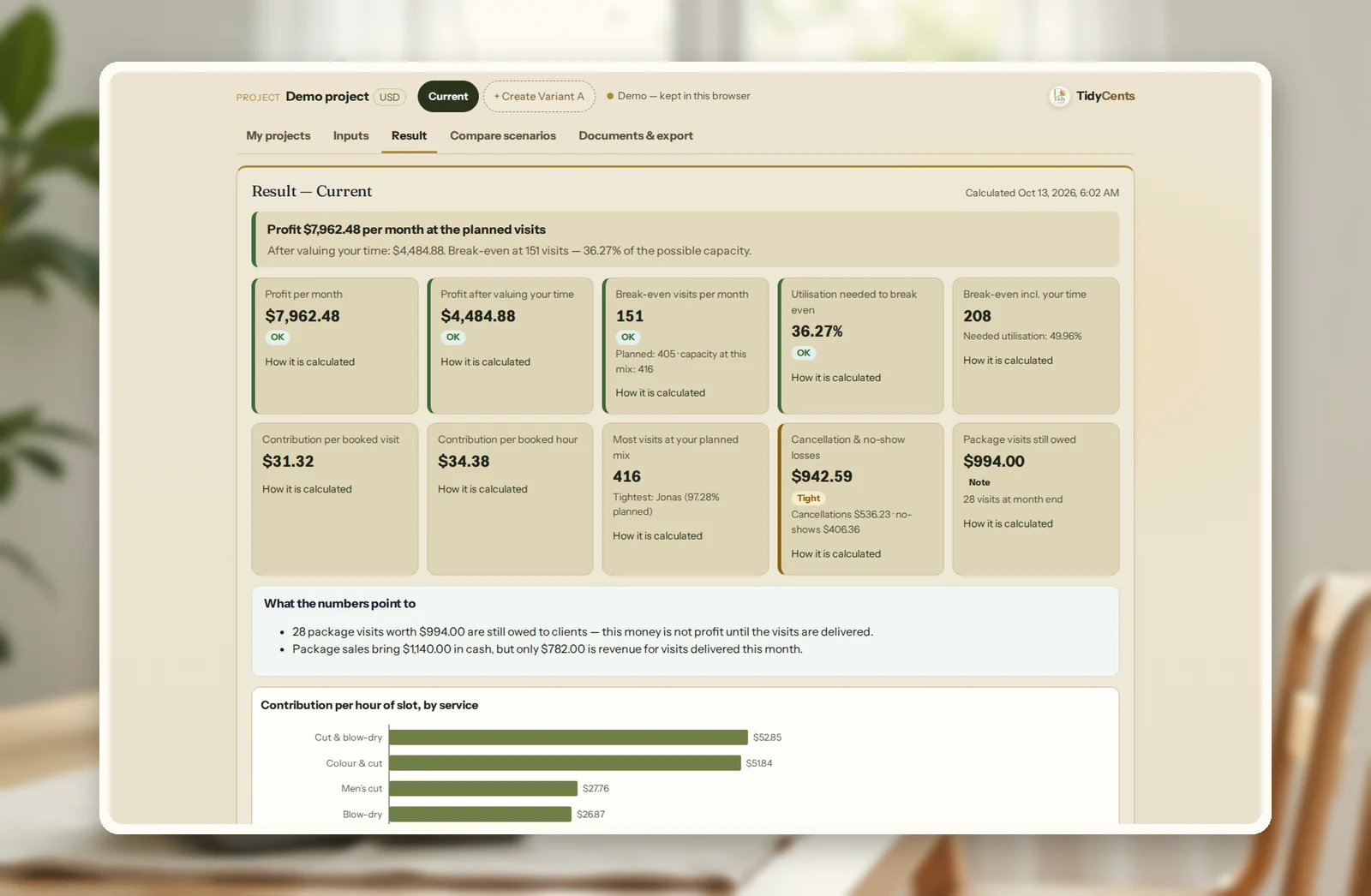
Salon profit per service hour is the price of a service, minus products, card fees and the pay that goes with it, divided by the hours it occupies — including prep and cleaning time. It is the fairest way to compare a quick cut with a long colour, because both use the same scarce resource: a person and a chair or desk. In the example below, a cut and blow-dry leaves $52.85 per hour, a men's cut only $27.76, and the stylist who does the men's cuts is booked to 97% — so he, not the chairs, sets the salon's limit.
Why price alone misleads
A price list shows what each treatment costs the client. It does not show what each hour earns:
- Slots are longer than the treatment. Ten minutes of cleaning between clients is still booked time.
- Products differ widely. Colour can use five times the product of a cut.
- Pay models change the result. Commission rises with the price; a salary does not.
- Discounts come off the top. A 10% offer reduces commission too, but not products or time.
- Cancellations and no-shows cost time. Empty slots that are not refilled still have to be paid for.
- Prepaid packages are a promise. Money taken now is visits you still owe.
The formula
- Slot = treatment minutes + prep + cleaning.
- Contribution per visit = price after discount (and tax) − products − card fees − pay tied to the service.
- Contribution per hour = contribution per visit × 60 ÷ slot minutes.
- Utilisation = booked minutes ÷ available minutes, for each person and each station.
- Bottleneck = the person or station with the highest utilisation.
- Break-even visits = fixed costs ÷ average contribution per visit.
- After owner time = contribution − the value of the owner's own hours.
A worked example
The numbers are the demo of Salon Capacity & Service Profit: a fictional hair and nail salon with two styling chairs and a nail desk. The owner values her own time at $30 an hour; one stylist is paid 40% commission; the nail technician has a $1,400 salary plus 10% commission and 8% on-costs. Card fees are 2.5% plus $0.10.
| Service | Price | Slot | Products | Staff pay | Contribution per visit | Per hour |
|---|---|---|---|---|---|---|
| Cut & blow-dry (owner) | $58 | 60 min | $3.50 | — | $52.85 | $52.85 |
| Colour & cut (owner) | $125 | 120 min | $18 | — | $103.68 | $51.84 |
| Men's cut (10% off) | $34 | 35 min | $1.20 | $12.24 | $16.20 | $27.76 |
| Blow-dry | $38 | 45 min | $1.50 | $15.20 | $20.15 | $26.87 |
| Gel manicure | $45 | 65 min | $4.80 | $4.86 | $34.02 | $31.40 |
The owner's services look strongest, but they are her hours. After valuing her time at $30 an hour, the cut and blow-dry leaves $22.85 and the colour $21.84 per hour.
The month. 405 visits bring $17,572.30 and a contribution of $12,684.48. Fixed costs — $3,210 of rent, utilities and software plus $1,512 for the nail technician's salary — come to $4,722, leaving $7,962.48, or $4,484.88 after the owner's time. The salon covers its fixed costs from 151 visits.
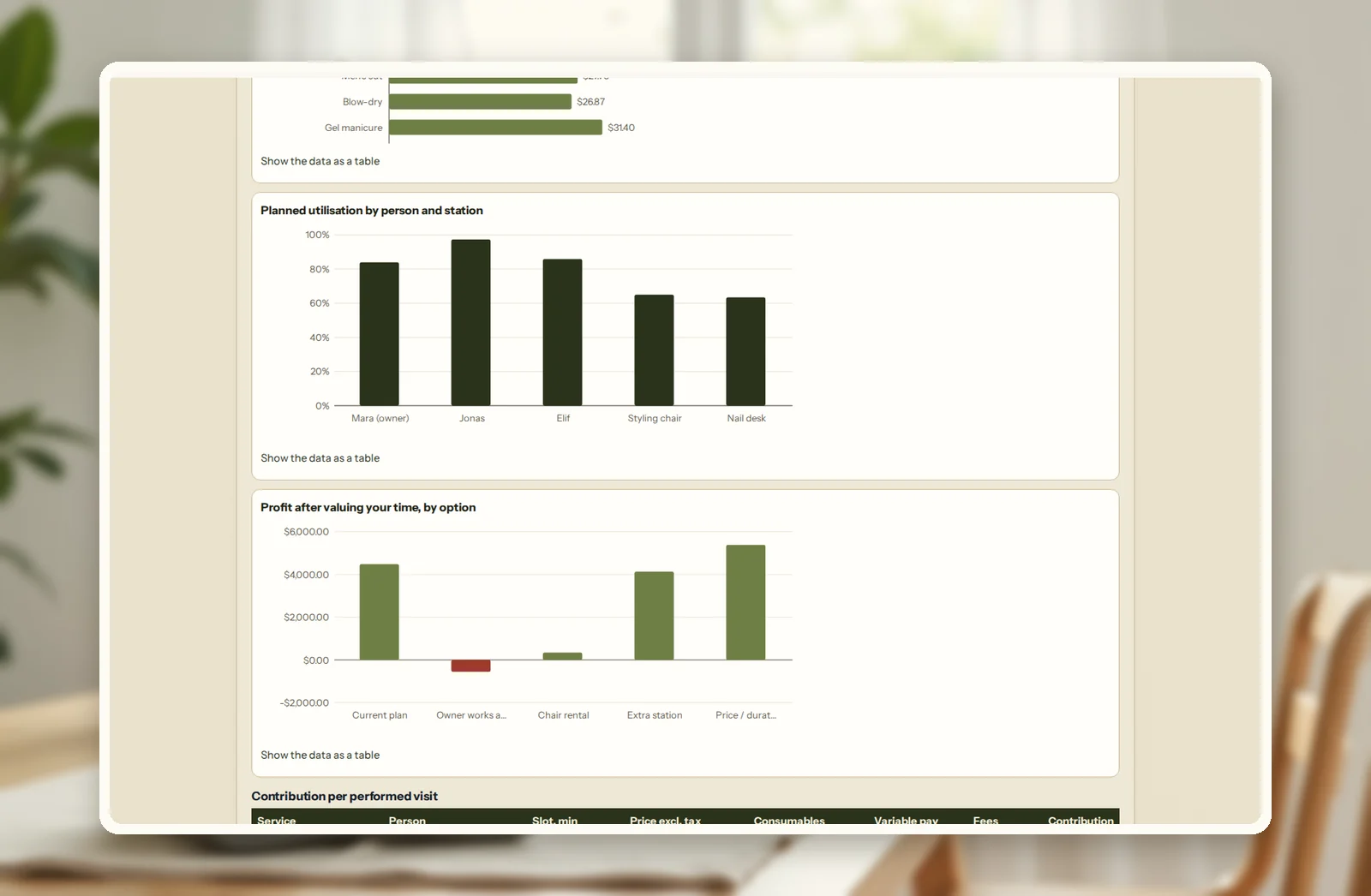
Who is full. The stylist on commission is booked to 97% of his hours, the owner to 84%, the nail technician to 86% — but the chairs only to 65% and the nail desk to 63%. At this service mix, the salon can fit 416 visits at most. Cancellations (8%, half refilled) and no-shows (4%) cost $536.23 and $406.36 a month, even with a 20% deposit kept on no-shows.
Options, checked with the same rules.
| Option | Profit after owner time |
|---|---|
| Current plan | $4,484.88 |
| Owner works alone | −$558.62 |
| Owner alone and rents one chair for $900 | $341.38 |
| Add a second nail desk for $350 | $4,134.88 |
| Prices +5% and slots 5 minutes shorter | $5,389.11 |
The extra nail desk lowers profit, because the desk is not what limits the salon. Raising prices by 5% and trimming 5 minutes from each slot lifts a men's cut from $27.76 to $34.15 an hour and a cut and blow-dry from $52.85 to $60.74.
Commission or salary? For the stylist on commission, the tool compares pay models on the same month: 40% commission costs $2,507.77 and leaves the salon $3,317.58 from his work; a $2,000 salary would leave $3,825.35; $15 an hour, $3,665.35; 45% commission, $3,026.63. These are calculations, not a recommendation — pay also affects motivation, rules and contracts.
Packages. A blow-dry card of 5 visits for $165 saves the client $25 and leaves $17.46 per visit instead of $20.15. With 18 visits still owed on cards sold, the salon carries $594 of unearned money.
Step by step: find your profit per hour
- List each service with price, discount, tax and who performs it.
- Time the full slot: treatment, prep and cleaning.
- Add products per visit and card fees.
- Enter each person's pay model: commission, salary, hourly, or a mix, with on-costs.
- Read contribution per visit and per hour for every service.
- Enter working days, opening hours, chairs and desks, and find the bottleneck.
- Add cancellations, no-shows, deposits and packages.
- Test options — prices, slot length, an extra station, chair rental — before you change anything.
Common mistakes
- Comparing services by price. Compare by contribution per hour of the scarce resource.
- Forgetting cleaning and prep time. It fills the diary as much as the treatment.
- Adding chairs when people are the limit. More furniture does not create more hours.
- Ignoring the owner's time. A salon that only pays because the owner works for free is not yet profitable.
- Treating package money as earned. It is a promise of future visits.
- Discounting the busiest person's services. Their hours are already sold.
When a tool helps
A spreadsheet can divide a price by minutes. It rarely combines different pay models, on-costs, products, card fees, deposits, cancellations, packages, staff and station capacity, and options such as chair rental in one consistent model. Salon Capacity & Service Profit does. Exact decimal arithmetic, no AI guesses. To track prepaid visits and balances client by client, see Session & Package Control.
Open the demo with the salon above — every screen, no sign-up — then enter your own services, team and diary.
Open Salon Capacity & Service ProfitAll costs, pricing and profit tools
Related guides: how to track class packages, how to calculate your freelance rate and is a win-back offer worth it.
FAQ
How do I calculate profit per service in a salon?
Take the price after any discount and tax, subtract products, card fees and the pay tied to that service, then divide by the full slot in hours. In the example, a $58 cut and blow-dry in a 60-minute slot leaves $52.85 per hour.
Which salon services are the most profitable?
The ones that leave the most per hour of your scarcest resource — usually a person, not a chair. In the example, the owner's services leave over $51 an hour, a men's cut $27.76.
Should salon staff be on commission or salary?
Compare the models on the same month of work. In the example, 40% commission leaves the salon $3,317.58 from one stylist's work, a $2,000 salary $3,825.35. Pay also affects motivation and must follow local employment rules.
How many clients does a salon need to break even?
Divide fixed costs by the average contribution per visit. In the example, $4,722 of fixed costs are covered by 151 visits a month.
Is it worth adding another chair or station?
Only if that station is the bottleneck. In the example, the stylist is booked to 97% and the chairs to 65%, so a second nail desk would lower profit.
This is decision support, not tax, legal or employment advice.
Tools mentioned in this guide
 Interactive tool
Salon Capacity & Service Profit
See what each service and each booked hour really leaves you after consumables, staff pay and fees — and how many visits your chairs and people can carry before the month breaks even.

