
How to track class packages and session credits
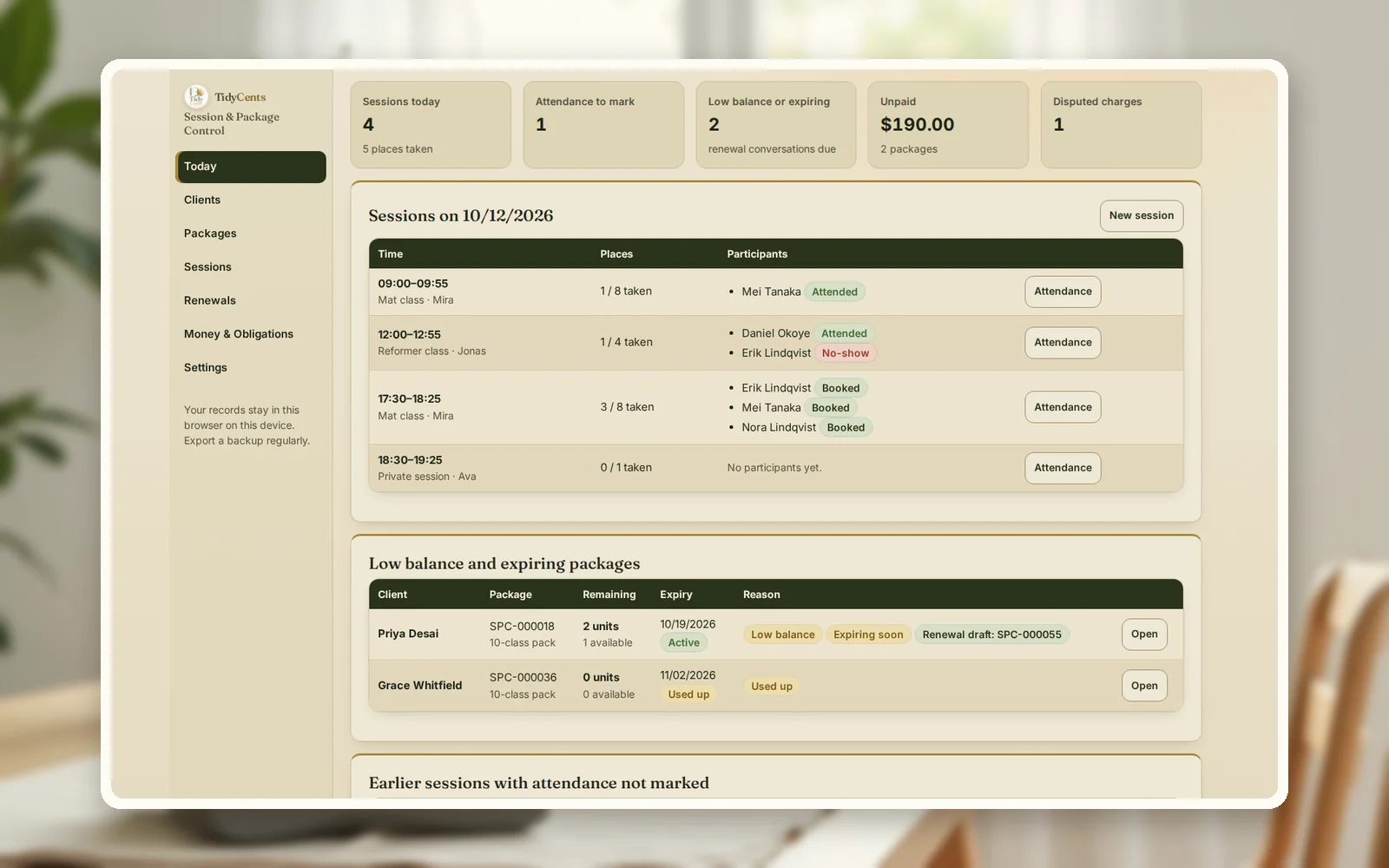
To track class packages, keep one record per package with the credits bought, every class attended or charged under your cancellation rules, any freeze that moves the expiry date, and what the client has paid. Then the remaining balance, the expiry date and the value of unused credits are always one look away. In the example below, a Pilates studio's family pack of 20 classes for $340 has 11 credits left, 2 already booked, and $140 still unpaid — while another client's pack runs low two days before it expires, which is the moment to talk about renewing.
Why class packs drift out of control
A paper punch card or a spreadsheet tab per client works until a few things happen at once:
- Late cancellations and no-shows. Is the credit used or not? Without a written rule applied the same way each time, every case is a negotiation.
- Shared packs. A family pack used by three people needs one balance, not three guesses.
- Freezes. A client travels for a week; the expiry date should move, and only by the days frozen.
- Partial payments. The pack is in use, but part of the price has not been paid.
- Expiry and renewals. Clients run out or expire without anyone mentioning it, and the next pack is never sold.
- Prepaid credits are owed service. Money received for unused classes is service you still have to deliver.
The numbers per package
- Remaining credits = credits bought + credits added − credits used − credits refunded.
- Credits used = classes attended + late cancellations and no-shows charged by your rules.
- Available to book = remaining − credits already reserved for future bookings.
- Credit value = net package price ÷ credits bought. A credit is a share of the price, not the price of a single class.
- Remaining service value = credit value × remaining credits: what you still owe in classes.
- Expiry = start date + validity, plus the days of any freeze (overlapping freezes counted once).
- Amount due = net price − payments received.
A worked example
The numbers are the demo of Session & Package Control: a fictional Pilates studio with mat classes, reformer classes and private sessions, on 12 October.
A shared family pack. One family bought a 20-class pack for $360 with a $20 discount: $340 net, so each credit is worth $17. Three family members use it.
| Line | Credits | Value |
|---|---|---|
| Bought | 20 | $340 |
| Attended | 8 | $136 |
| No-show charged by the rule | 1 | $17 |
| Remaining | 11 | $187 |
| Already booked for later classes | 2 | |
| Available to book | 9 |
The family has paid $200, so $140 is still due. Their pack's rule charges no-shows but not late cancellations, so a late cancellation on 28 September cost nothing, while a missed reformer class on 12 October cost one credit.
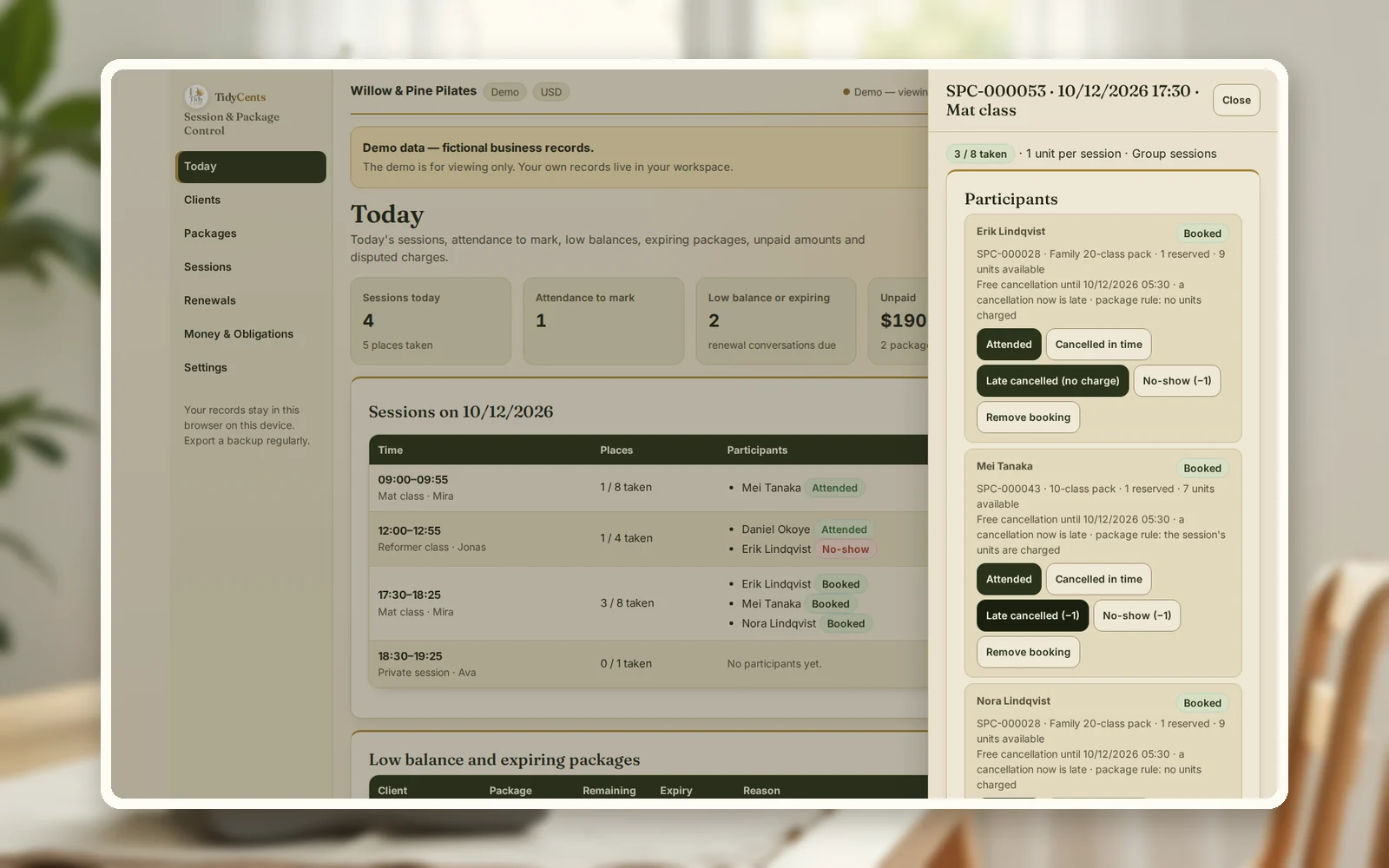
A late cancellation in dispute. A private-session pack costs $450 for 10 credits, with each 55-minute session using 2 credits — $45 per credit. On 9 October the client cancelled late under the 24-hour rule, and the rule charges the full 2 credits, worth $90. She says she phoned the day before. The booking is marked as disputed with her note, so the decision is made on facts, not memory.
A freeze that moves the expiry. A client froze his 10-class pack for a business trip from 10 to 12 October, then extended it to 14 October. The two freezes overlap on 12 October, so they count as 5 days, not 6, and the expiry moves from 9 to 14 November.
Two renewal moments. One client has 2 classes left and her pack expires on 19 October — both a low balance and an expiry within a week. Another client's 3-class intro pack expired on 30 September with 1 class unused, worth $15. Both are reasons for a conversation, not a surprise at the front desk.
Unused credits refunded by a written rule. A client moving away had 1 unused intro class; the studio refunded $15, the package's credit value, under its own written rule. Credits and cash are recorded separately, so the balance and the money both stay right.
Step by step: track class packages
- Define each package type: credits, price, validity, which classes it covers, and its late-cancel and no-show rules.
- Sell the package to a client, with participants if it is shared, and record payments as they come in.
- Book clients into sessions against a package; the system checks credits, validity and capacity.
- Mark attendance after each class: attended, cancelled in time, late cancelled or no-show.
- Apply your rules the same way every time, and record disputes with a note instead of editing history.
- Record freezes with dates and a reason; let the expiry move by the frozen days.
- Review renewals weekly: low balances, packs expiring soon, used-up packs and expired credits.
- Watch the money: amounts due, and the value of credits you still owe.
Common mistakes
- Deciding late cancellations case by case. Write the rule into the package, then apply it.
- Counting a family pack per person. One pack, one balance, several participants.
- Extending expiry by hand. Use freezes with dates so the change can be explained.
- Treating package sales as earned at once. Until the classes happen, part of the money is owed service.
- Letting packs expire silently. A reminder a week ahead is the easiest renewal you will get.
- Mixing up credits and cash in refunds. Record both separately so the balance and the money both stay right.
When a tool helps
A spreadsheet per client works for a few regulars. With group classes, private sessions, shared packs, freezes, partial payments and renewals, the balance stops being obvious. Session & Package Control keeps packages, sessions, bookings, attendance, freezes, payments and refunds together, applies each package's cancellation rules, shows today's classes and attendance to mark, flags low balances and expiring packs, and shows the value of credits you still owe. Exact decimal arithmetic, no AI guesses. To see what each service hour actually earns, see Salon Capacity & Service Profit.
Open the demo with the studio above — every screen, no sign-up — then add your own packages and clients.
Open Session & Package ControlAll sales and daily operations tools
Related guides: salon profit per service hour, is a win-back discount worth it and how to check timesheets before payroll.
FAQ
How do I track class packages without a booking system?
Keep one record per package: credits bought, each class attended or charged, freezes, payments and the expiry date. A shared view of balances and expiry dates is what matters most; the booking calendar can stay where it is.
Should a late cancellation use a credit?
That is your policy, not a calculation — but write it into the package and apply it the same way every time. In the example, the family pack charges no-shows but not late cancellations, while the 10-class pack and private sessions charge both.
How do I handle freezes?
Record the dates and the reason, and move the expiry by the number of days frozen. If freezes overlap, count the shared days once.
What is the value of an unused class credit?
The net package price divided by the credits bought. In the example, a $340 family pack of 20 credits gives $17 per credit; 11 remaining credits are $187 of service still owed.
When should I remind clients to renew?
When the balance is low or the expiry is close — the demo uses 2 credits and 7 days. A short message with the remaining credits and expiry date is usually enough.
This is decision support, not legal, tax or accounting advice.


