
Free to read: contents, introduction, chapters 01 and 02
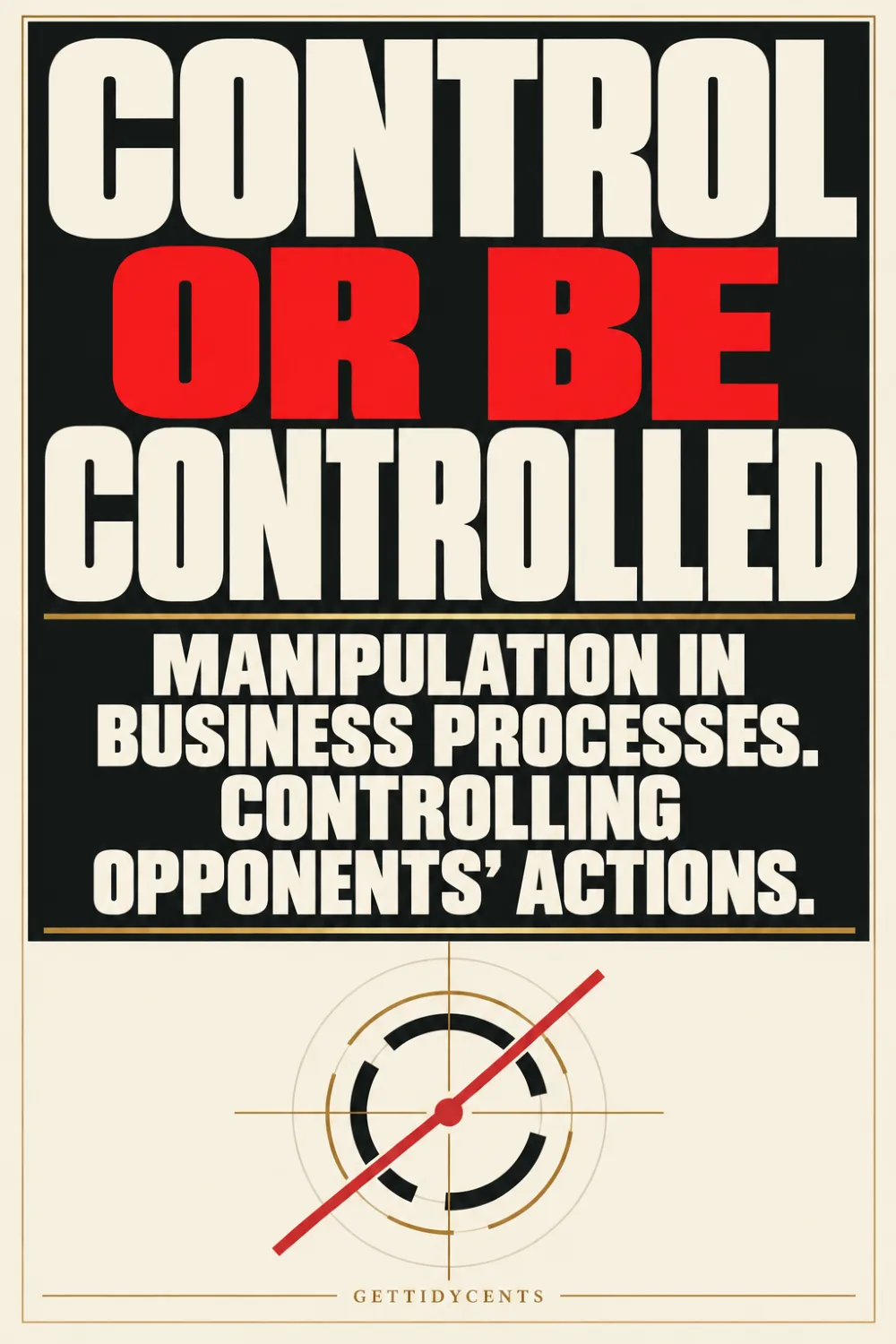
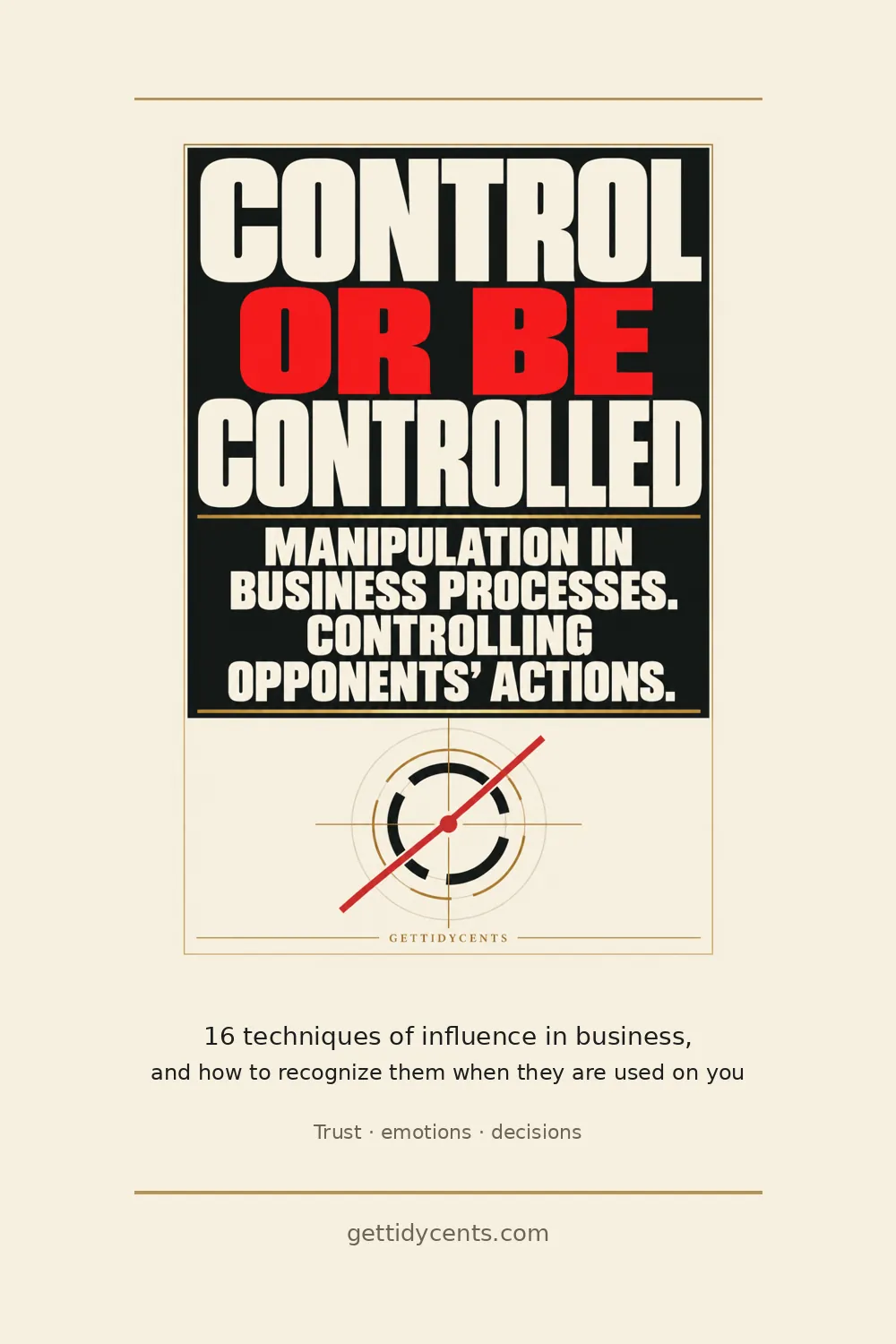
CONTROL OR BE CONTROLLED · 40 pages · 16 chapters · English · PDF
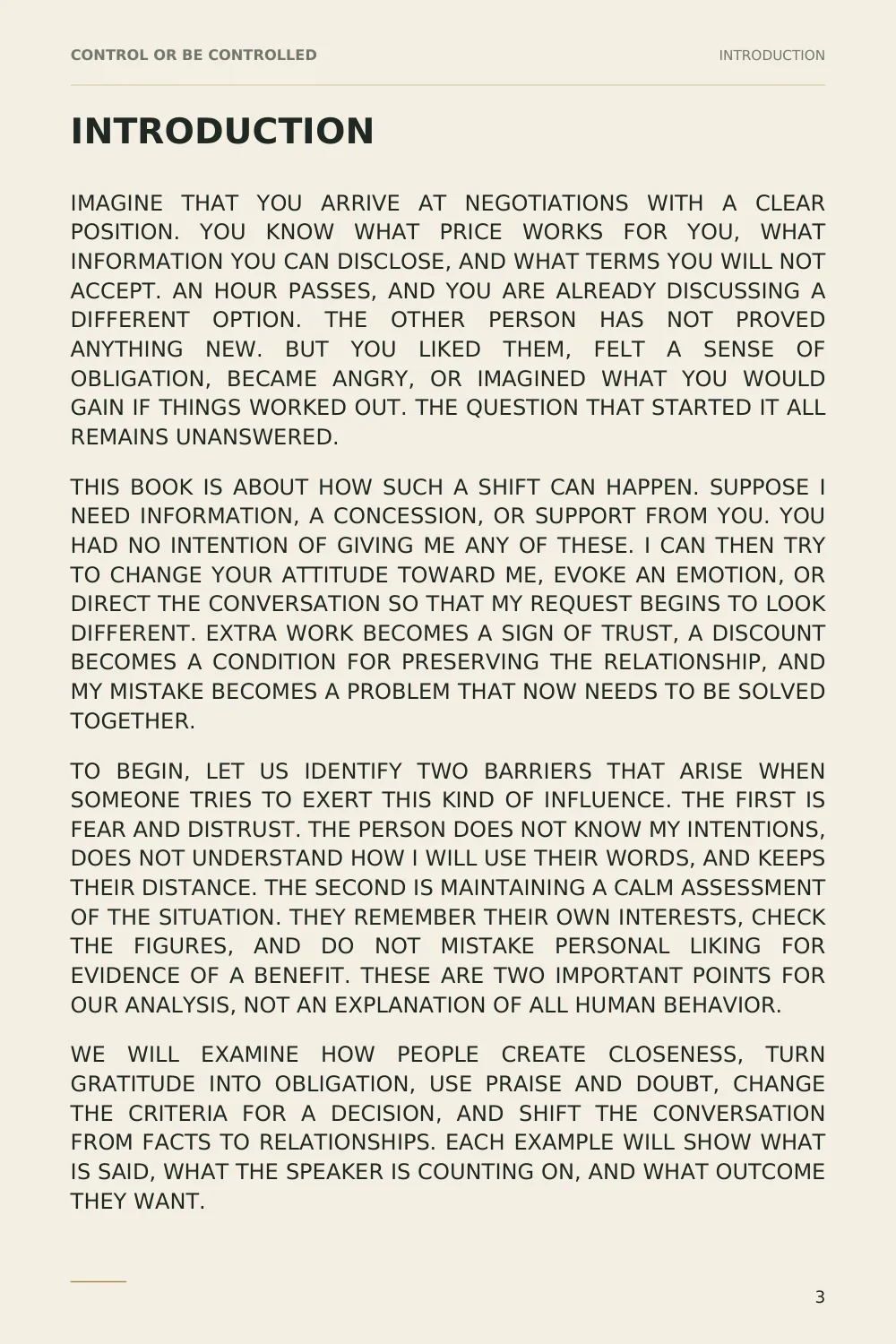
You came with a clear position.
Why are you now discussing a different deal?
You arrive at a negotiation knowing your price, your limits and what you will not accept. An hour later you are discussing a different option. Nobody proved anything new. You liked the other person, felt you owed them something, got angry, or pictured what you would gain if it all worked out — and the question you came with was never answered.
CONTROL OR BE CONTROLLED takes this shift apart. Sixteen chapters, sixteen techniques: how closeness is prepared in advance, how gratitude becomes an obligation, how praise, doubt and a shared enemy are used, how the criteria for a decision quietly change, and how a conversation moves from facts to relationships. Each chapter shows what is said, what the speaker is counting on, what result they want — and how to recognize it when it is used on you.
The scenes are model business situations: suppliers and clients, managers and employees, partners and negotiators. The book does not teach you to see a trap in every friendly word. It helps you notice the moment one question was swapped for another, so you can return to the terms calmly — without turning the meeting into an argument.
The situations it addresses
Recognize any of these?
| What happens in the meeting | What the book examines |
|---|---|
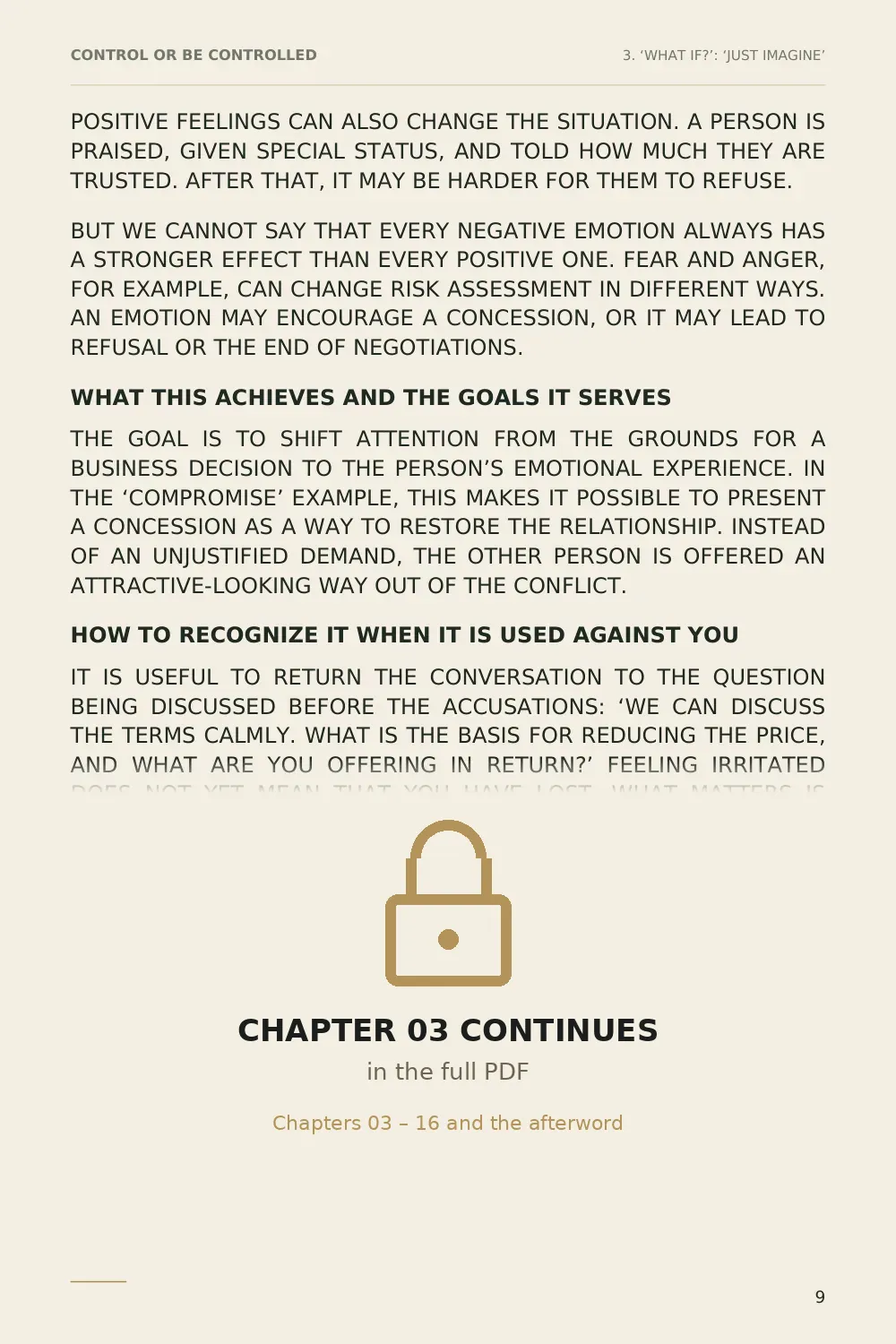
| A client asks for a discount with no reason. After a heated exchange you “meet halfway” — and pay for it. | How emotions turn an unjustified demand into a “compromise”. |
| You asked for the full cost. An hour later you have answered ten questions and still do not have it. | How questions take over the direction of a conversation. |
| You were called the best on the team — and took on a second job without discussing pay. | How praise and a sense of obligation make it harder to talk about terms. |
| The price was agreed, then “my manager has to approve it” — and new demands arrived. | Authority that is never in the room. |
| You asked for evidence and ended up having to prove the proposal is wrong. | How the burden of proof is moved onto you. |
What you will find inside
16 techniques, one question: what changed in the terms?
Closeness and trust
How a stranger is made to feel like ‘one of us’, how someone else’s reputation is borrowed to lower your guard, and how a common enemy turns criticism into loyalty.
Emotions and obligation
How a heated exchange becomes a ‘compromise’, how a picture of the future replaces the calculation, and how gratitude and praise make it harder to say no.
Who steers the conversation
How questions take over the direction of a meeting, how your own priorities are re-defined for you, and how a retelling of your words changes what you ‘promised’.
Roles and positions
Feigned weakness, an approver who is never in the room, contrasts with ‘others who could take your place’, and how a mistake becomes a problem you now solve together.
Keeping the question in view
After every technique: what it achieves, the goals it serves, and the calm questions that bring the discussion back to the terms of the deal.
Read the material before you decide
Free: the introduction and chapters 01–02
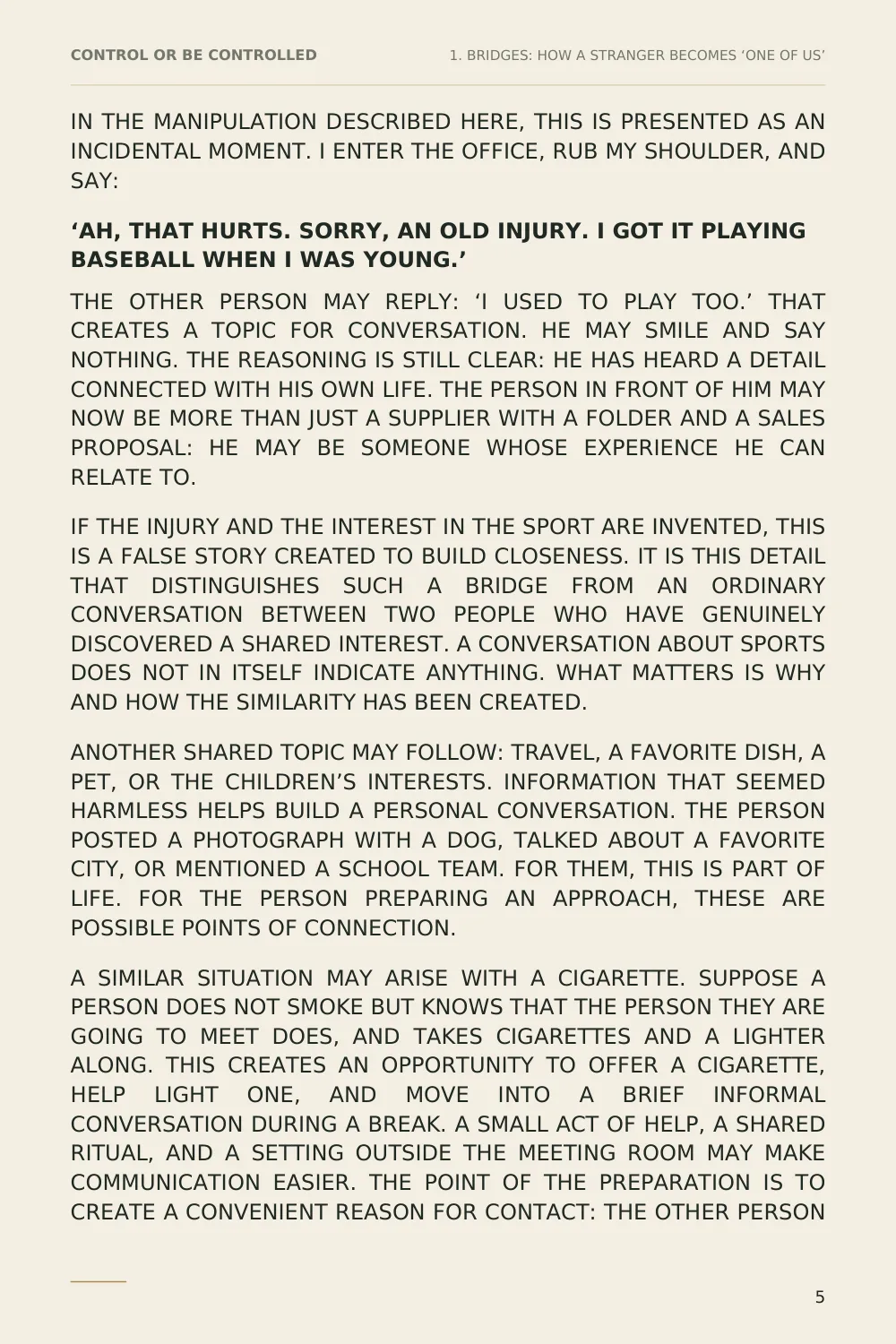
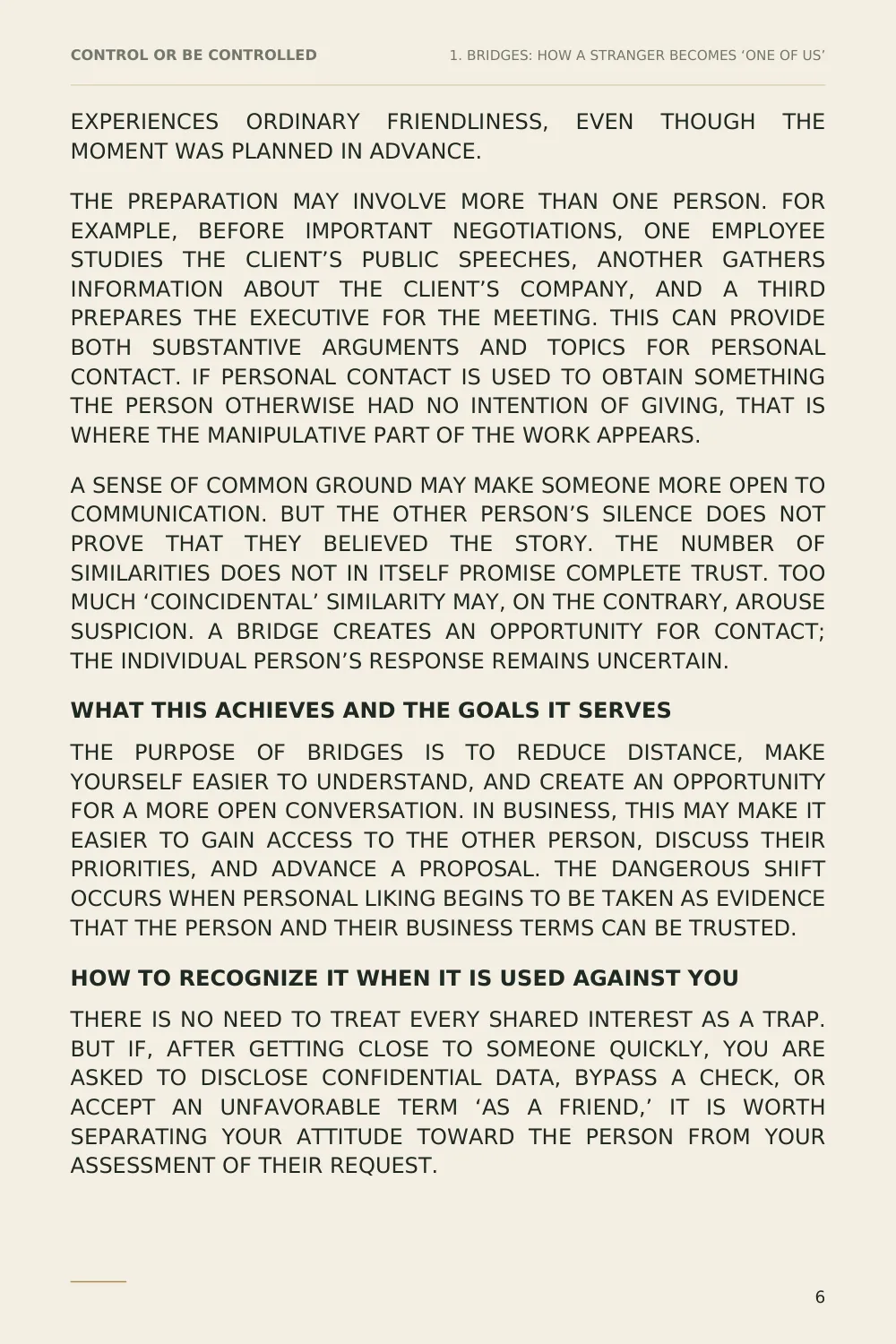
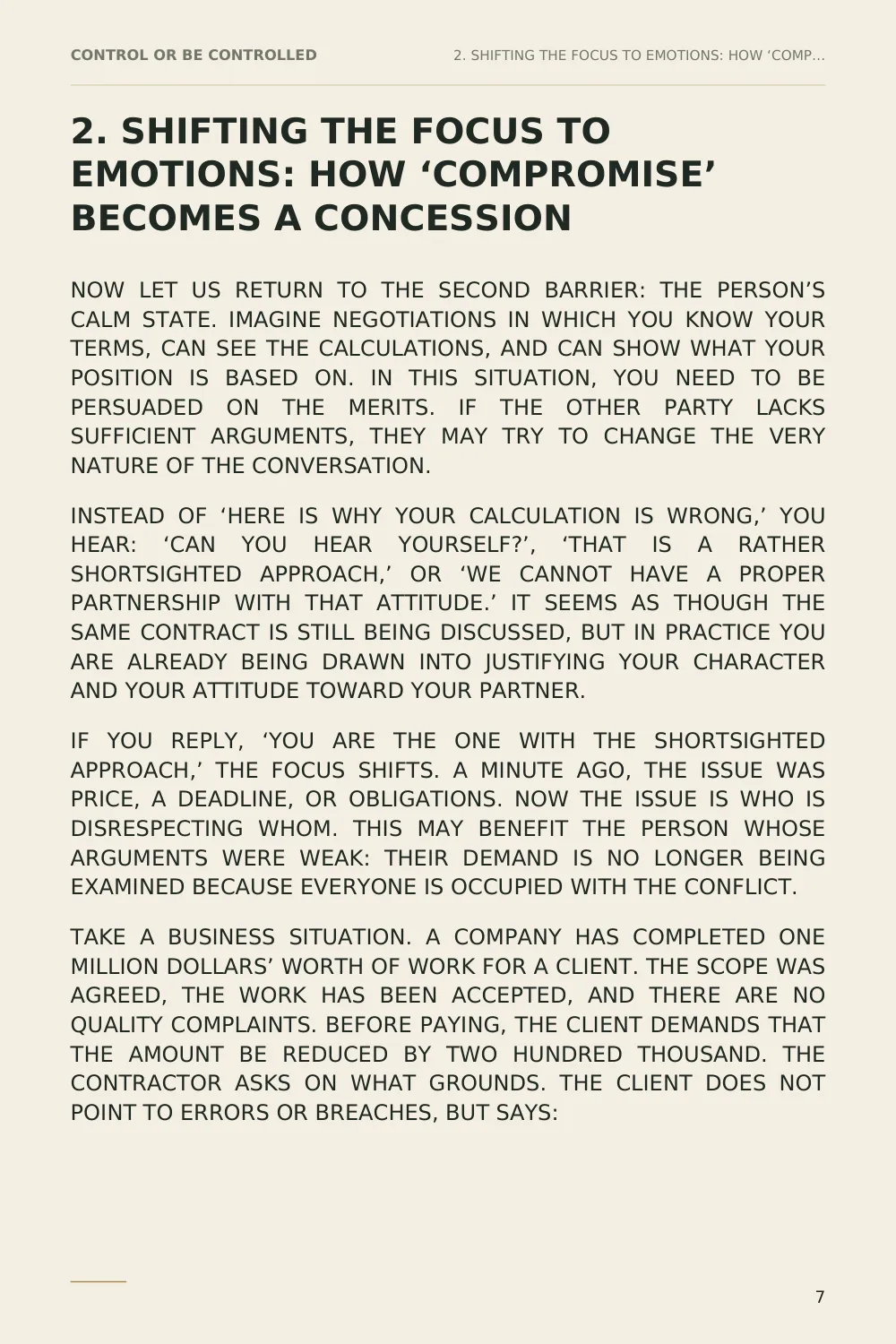
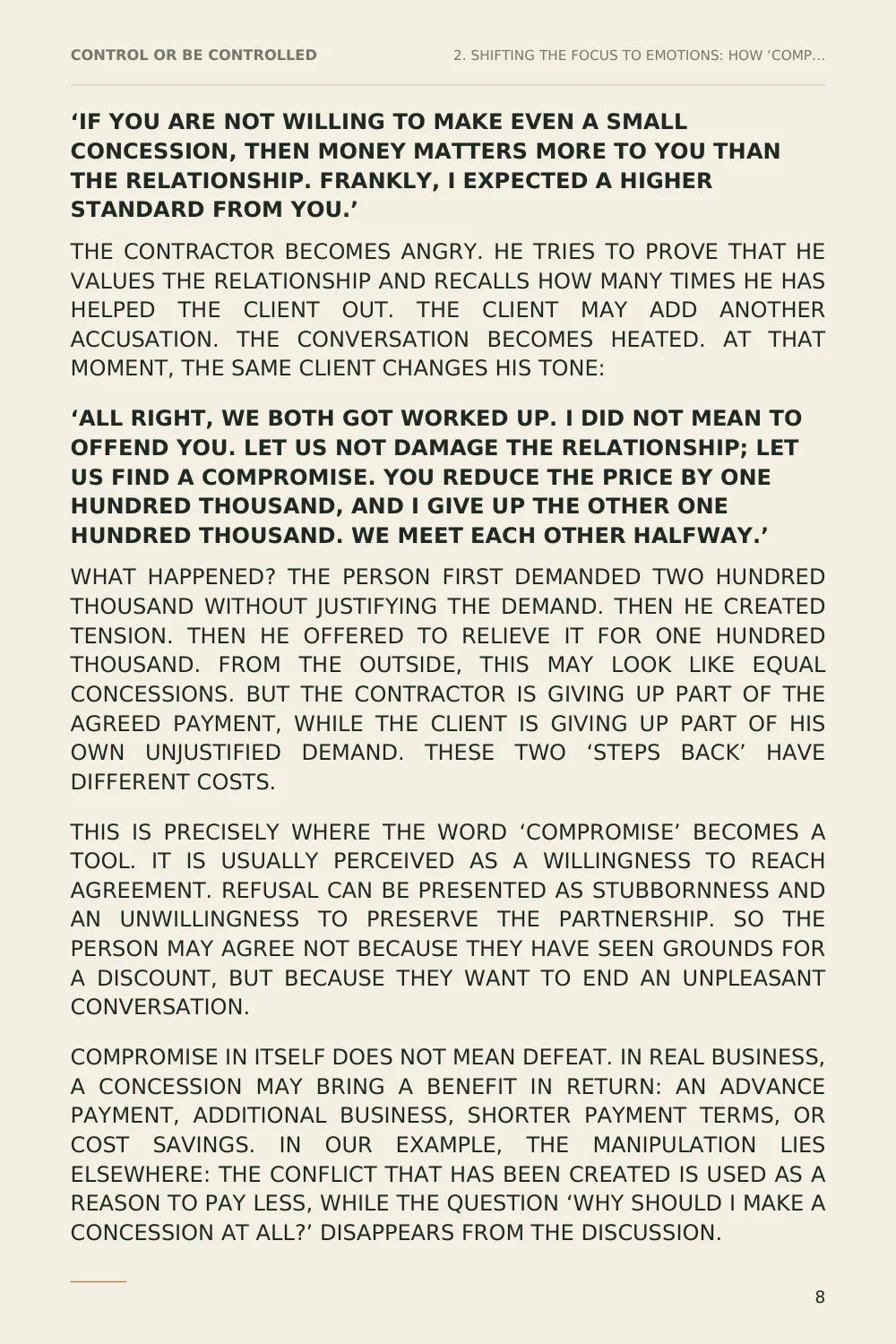
Bridges — how a stranger becomes “one of us” — and Shifting to emotions — how a “compromise” becomes a concession. Read them in full on this page. No sign-up.
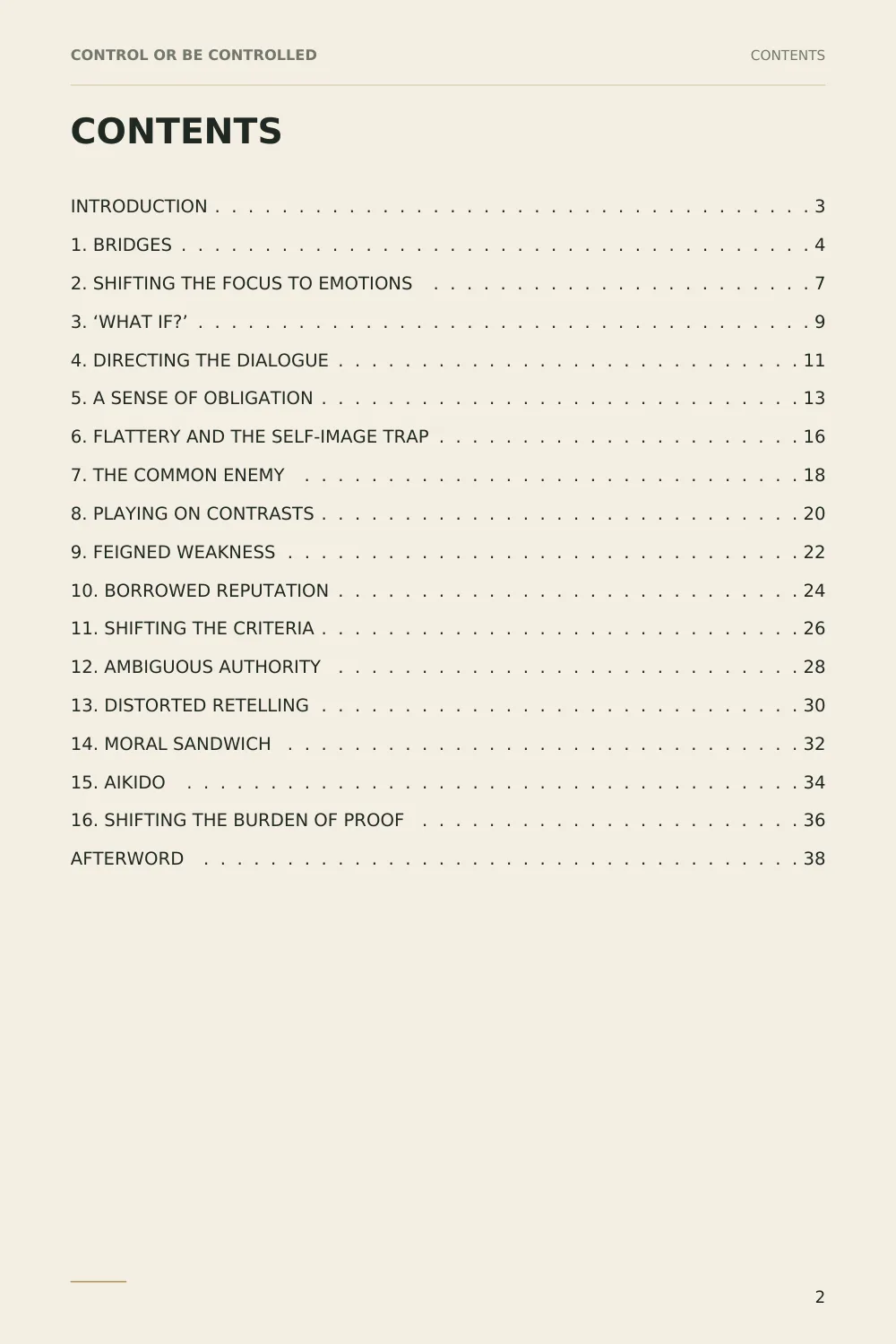
Contents
16 chapters and an afterword
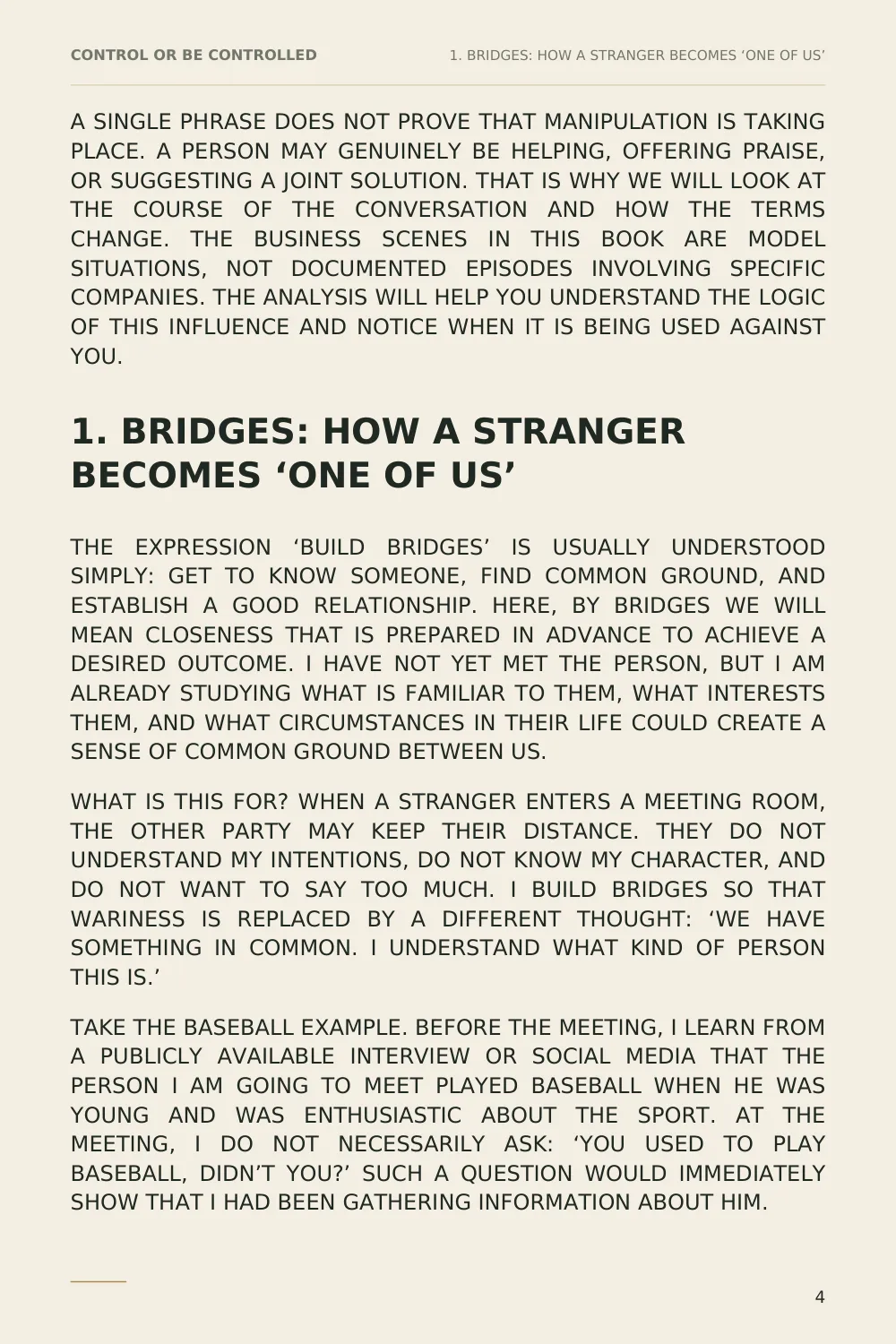
- 01Bridges: how a stranger becomes “one of us”Free
- 02Shifting to emotions: how “compromise” becomes a concessionFree
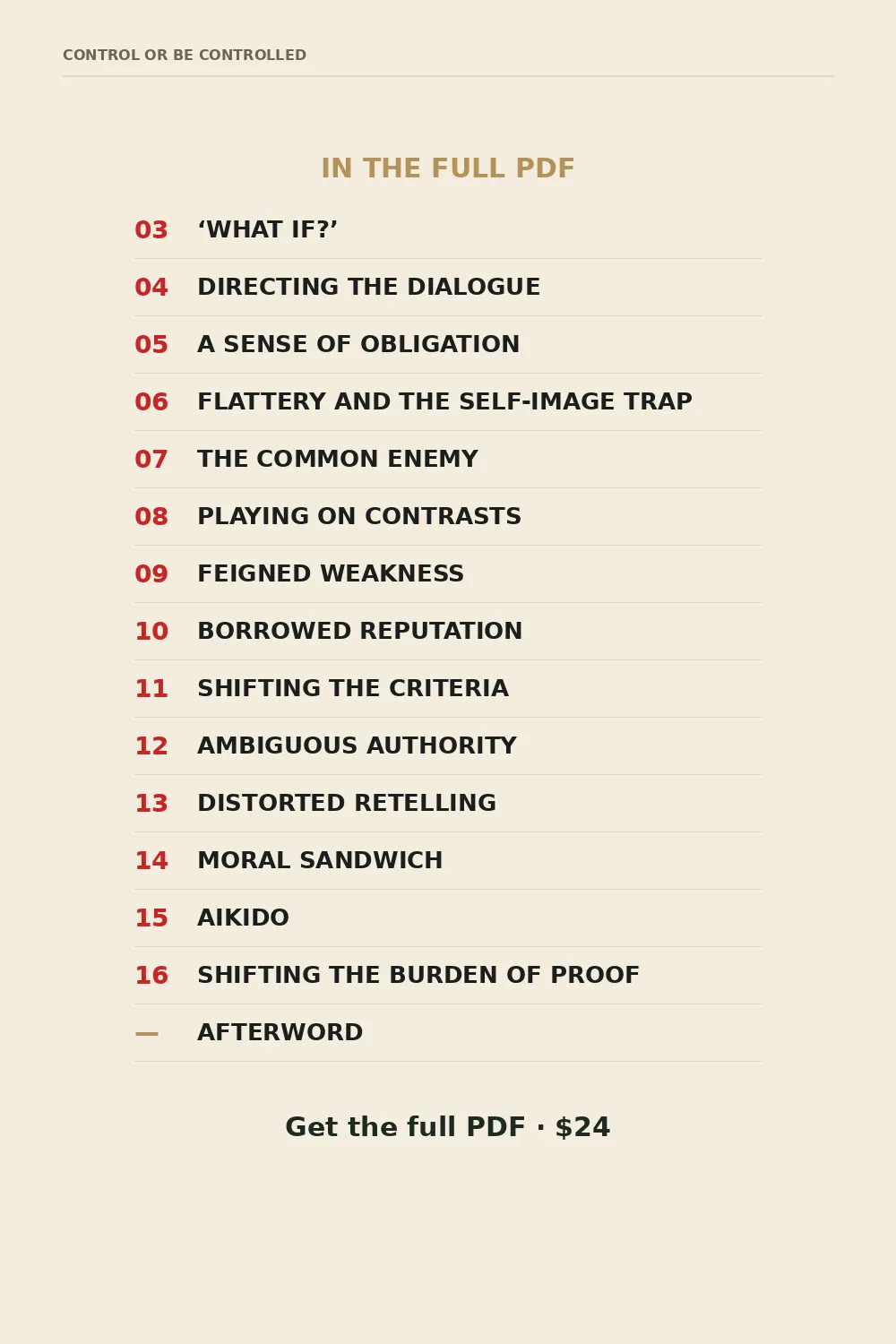
- 03What if: “just imagine”
- 04Directing the dialogue: taking over the direction of a conversation
- 05A sense of obligation: how an ordinary conversation is turned into a favor
- 06Flattery and the self-image trap: “was I wrong about you?”
- 07The common enemy: “you and I are on the same side”
- 08Playing on contrasts: “there are others who can take your place”
- 09Feigned weakness: “it’s easy for you, but we have nowhere to turn”
- 10Borrowed reputation: “Tony talks to us, so we can be trusted”
- 11Shifting the criteria: “you yourself said what matters to you”
- 12Ambiguous authority: “now I need to get approval”
- 13Distorted retelling: “you yourself promised this”
- 14Moral sandwich: how to make someone else’s success seem inappropriate
- 15Aikido: “yes, I made a mistake. Let’s solve it together”
- 16Shifting the burden of proof: “prove that I am wrong”
- —Afterword
Who it is for
For anyone who negotiates, sells, buys or manages people
Business owners, sales and purchasing managers, team leaders and freelancers who sit across the table from clients, suppliers, partners or their own management. Read it before an important meeting — or after one that ended with a deal you did not plan to make.
Before you buy
Questions
What exactly do I get?
One PDF file: CONTROL OR BE CONTROLLED, 40 pages, 16 chapters and an afterword, in English. You download it right after payment, and the download link also arrives by email.
Can I read part of it first?
Yes. The contents, the introduction and chapters 01 and 02 are open on this page in full, with no sign-up. Open the book or press “Read the free preview”.
Does the book teach people to manipulate?
It explains how these techniques work so that you can recognize them in a negotiation or at work. Each chapter ends with how to notice the technique when it is used on you and how to return the conversation to the terms.
Is this a subscription?
No. It is a one-time purchase of $24 (USD). There are no recurring charges.
How can I pay?
By card, Apple Pay or Google Pay through Stripe’s secure checkout. We never see your card details.
CONTROL OR BE CONTROLLED
40 pages · 16 chapters · English · PDF · $24
Professional reading on negotiation and workplace communication, not legal or psychological advice. The business scenes are model situations.

