
How to calculate PTO accrual, carry-over and leave cover
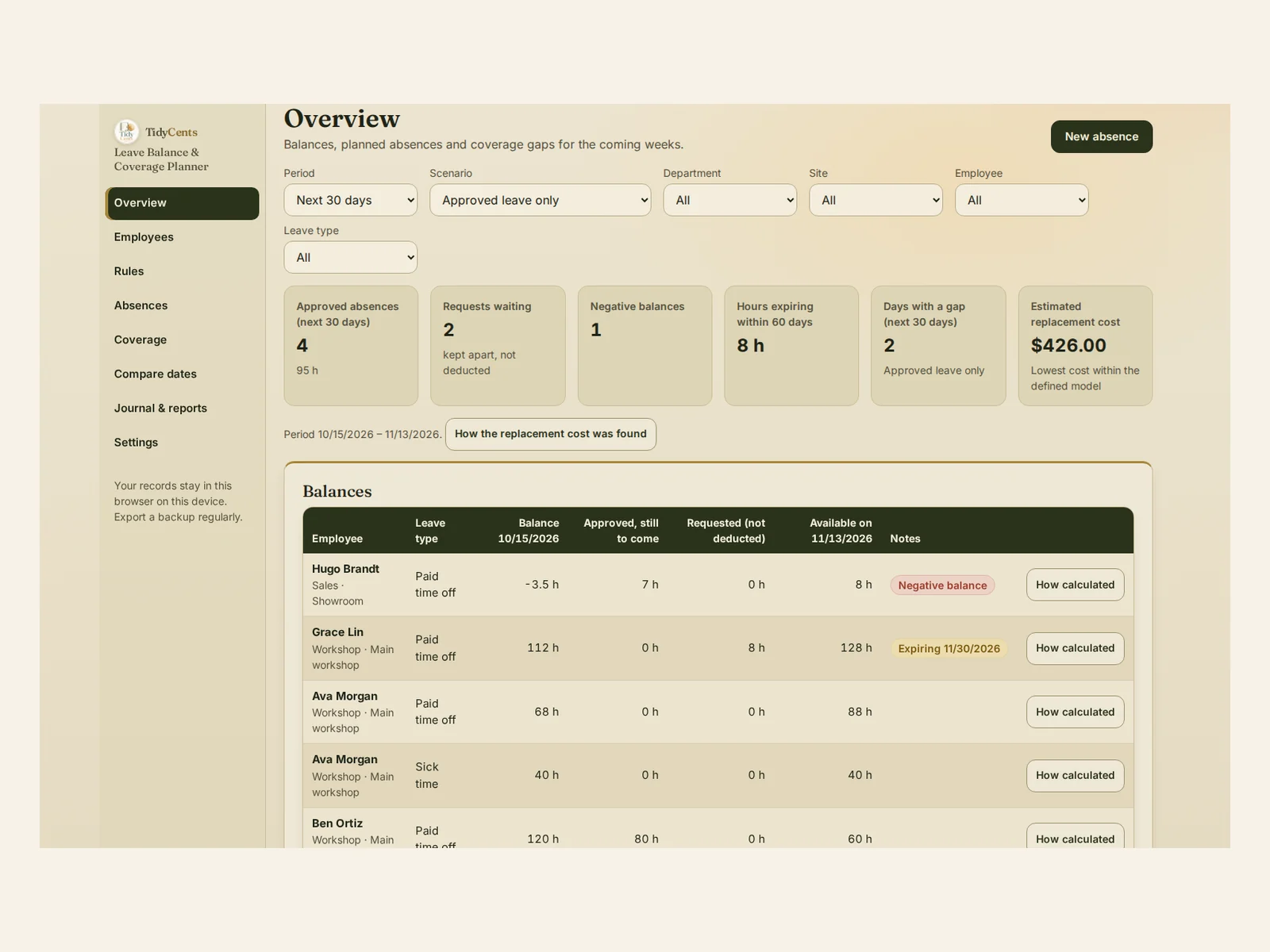
To calculate PTO accrual, start from the opening balance, add each accrual up to the cap, subtract the hours each absence actually touched in that person's schedule, and apply carry-over and expiry on the dates your own policy sets. The balance is only half of the answer: before approving leave, check that the people who stay can still fill every position on those days. In the example below, one employee's statement goes from 58 h to 48 h over four months, and a one-week request can cost $0.00 or $329.00 in cover depending on the start date.
Why a leave balance is easy to get wrong
A leave balance looks like one number, but several rules move it at different moments:
- Accruals stop at a cap. Hours above the cap are lost, not saved for later.
- A day is not always eight hours. Someone who works seven hours a day uses seven hours for a full day off.
- Carried hours often expire. Hours moved into the new year may be usable only until a set date.
- Requests are not approvals. A waiting request should not reduce the balance until it is approved.
- A balance says nothing about cover. An employee may have the hours while the team lacks the skill that person brings.
The formula
- Balance = opening + accrued + adjustments + restored − used − expired − closed at year end.
- Accrual = the rate for the period, accepted only up to the cap; the rest is recorded as lost to the cap.
- Hours used = the working hours of that person's own pattern that the absence covers.
- Carried hours = the year-end balance up to your carry-over limit; the rest is closed.
- Replacement cost = paid hours (at least the minimum call) × rate + fixed fees, for each replacement you need.
A worked example
The numbers come from the demo of Leave Balance & Coverage Planner: a small workshop with a showroom, where staff accrue 12 h a month up to a cap of 120 h.
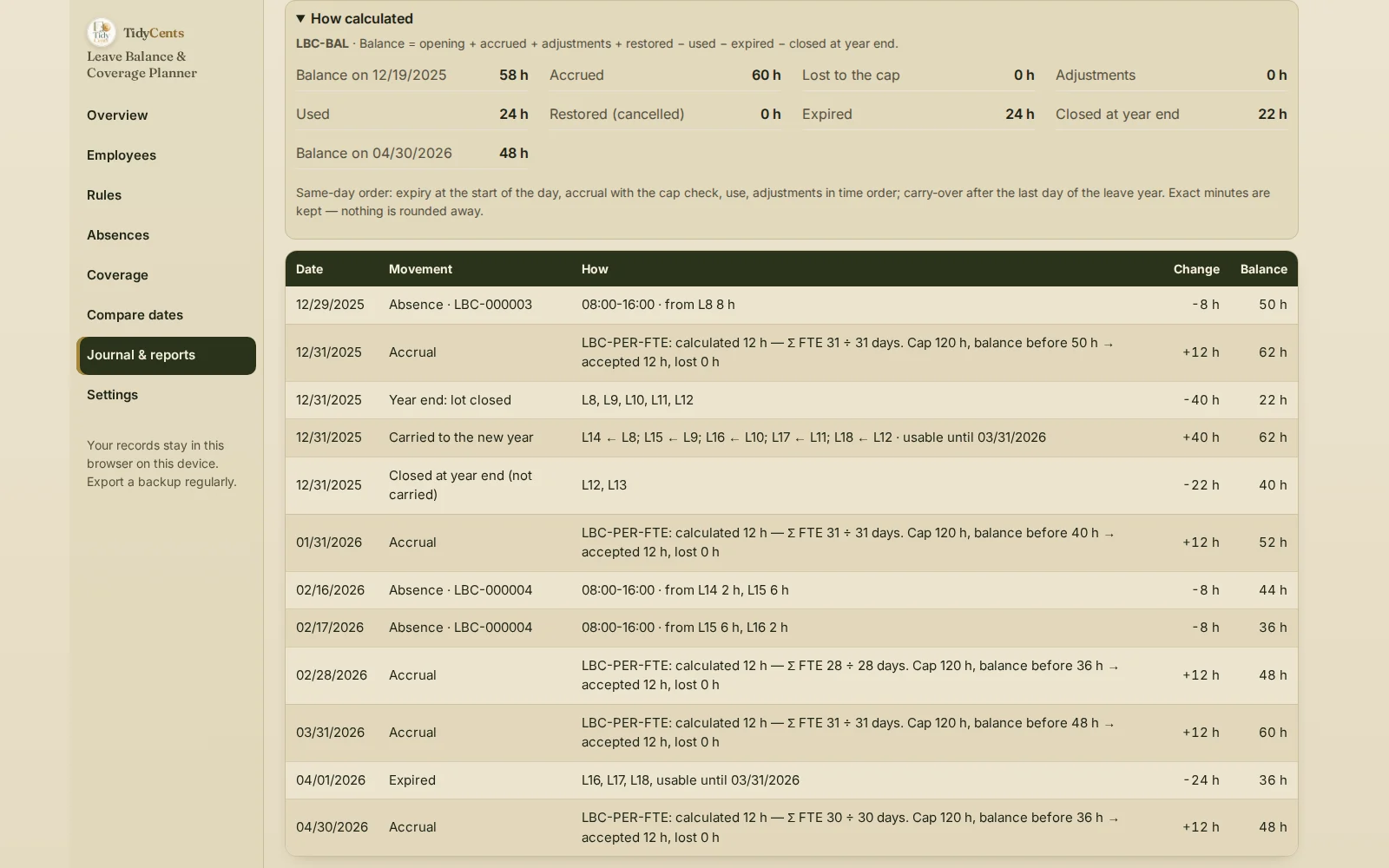
One employee's statement. On December 19 the balance is 58 h. Over the next four months the "How calculated" view lists every movement:
| Movement | Hours |
|---|---|
| Opening balance | 58 h |
| Five monthly accruals of 12 h | +60 h |
| Three full days off (8 h each) | −24 h |
| Not carried at year end | −22 h |
| Carried hours that expired | −24 h |
| Balance on April 30 | 48 h |
At year end the balance is 62 h: 40 h are carried into the new year, usable until March 31, and 22 h are closed. In February the employee takes two days, and 16 h of them come from the carried hours. The other 24 h of carried time expire on April 1. Check: 58 + 60 − 24 − 22 − 24 = 48.
What the cap does. A plain example: an employee has 70 h, the monthly accrual is 20 h and the cap is 80 h. Only 10 h are accepted and 10 h are lost to the cap. Two full days off later, the balance is 64 h.
Can the team cover it? On October 23, two people are off. The day check splits the day into three time pieces. From 08:00 to 10:00 the workshop needs 3 people and has 2; from 10:00 to 16:00 it needs 4 and has 3; from 16:00 to 17:00 it is covered. Counted skill by skill, the day looked fine, but one person cannot fill two positions at once, so the finishing position stays empty. The lowest extra spend among the replacement options entered is a freelance finisher for $224.00.
Which week is cheaper? Another employee asks for 7 calendar days of PTO (40 h), starting any day from November 2 to November 23. That gives 22 possible periods; all fit her balance and all can be covered. The first five start dates cost $0.00 in replacements. From November 7 the absence needs call-ins on one day, and the extra cost is $329.00.
Step by step: calculate PTO and check cover
- Write down your policy as dated rules: accrual rate, cap, allowed negative balance, carry-over limit and expiry date.
- Enter each person's working pattern, so a day off uses the hours that person really works.
- Record the opening balance with its date.
- Post accruals on their dates, checking the cap each time.
- Keep requests apart from approved absences until you decide.
- Check cover by position and skill for every day of the request, not by head count.
- Price the replacement with each option's minimum call and fees before you approve.
- Close the year with carry-over and expiry, and keep the statement for the employee.
Common mistakes
- Counting eight hours for every day off. Part-time and seven-hour patterns end up with the wrong balance.
- Adding accruals above the cap. The balance on paper then exceeds what the policy allows.
- Forgetting expiry dates. Carried hours vanish on a date nobody wrote down.
- Deducting requests that were never approved. The balance drops for leave that may not happen.
- Counting people per skill separately. One person covering two skills can hide a real gap.
- Ignoring the minimum call. A two-hour shift may be paid as three.
When a tool helps
A spreadsheet can add accruals. It rarely checks the cap on each date, uses each person's own schedule, tracks carried hours with their expiry, and then tests cover position by position with the cost of each replacement. Leave Balance & Coverage Planner does, and every balance opens to its calculation. It applies only the leave policy you enter, in any country and currency; it does not decide statutory leave entitlement. Exact arithmetic, no AI guesses. To check hours and pay before payroll, see Shift-to-Pay Control.
Open the demo with the workshop above — every screen, no sign-up — then enter your own leave rules and people.
Related guides: check timesheets before payroll, can I afford to hire an employee and how many jobs per day for field service.
FAQ
How do I calculate PTO accrual per month?
Multiply the accrual rate by the share of the period the person worked, then add it to the balance only up to the cap. In the example, 12 h a month are added until the balance reaches 120 h.
What happens to PTO above the cap?
It is not added. The hours above the cap are recorded as lost to the cap. With 70 h, a 20 h accrual and an 80 h cap, only 10 h are added.
How does carry-over with an expiry date work?
At year end, hours up to your carry-over limit move into the new year and the rest is closed. Carried hours are used first and expire on the date your policy sets. In the example, 24 h of carried time expired on April 1.
How do I know if the team can cover a vacation?
List the positions each site needs in each part of the day and assign the people who are available, one position per person. If a position stays empty, price the replacement before you approve.
This is decision support, not legal advice: the tool applies your own policy and does not check it against employment law.
Tools mentioned in this guide
 Interactive tool
Leave Balance & Coverage Planner
Know how much leave each employee has, whether the team can cover it, and what a replacement would cost.

