How to price candles — true cost per candle, then margin
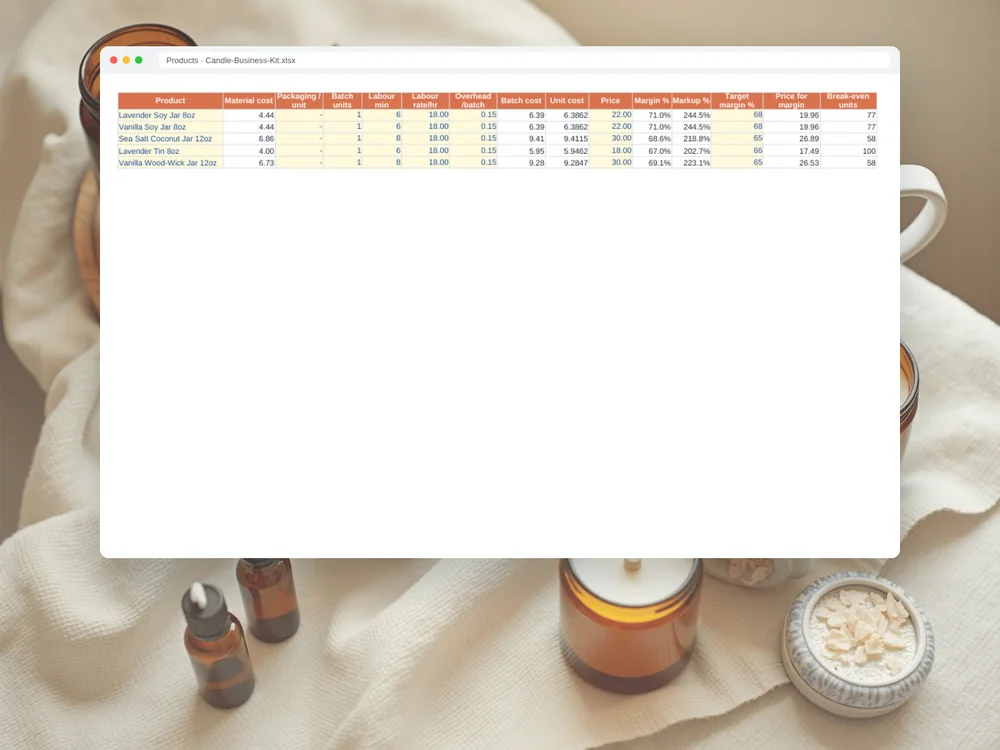
Price a candle in two steps: first find its true cost — wax, fragrance oil, wick, vessel and labels at the amount each candle really uses, plus your pouring and finishing time and a share of overhead — then set the price for the margin you want: price = cost ÷ (1 − target margin). In the example below, an 8 oz soy jar costs $6.39 to make. Selling it at $22 leaves a 71% margin; the popular "double the material cost" rule would price it at $8.88 and leave only 28%.
Why "double the material cost" fails
Rules of thumb like "materials × 2" or "materials × 3" are popular because they are quick. They fail for three reasons:
- They ignore your time. Pouring, wick centring, topping up sink holes, labelling and packing take minutes per candle, and those minutes have a cost.
- They hide small items. A wick, a warning label and a brand label are cents each — but on every candle.
- They confuse markup with margin. A 100% markup sounds generous; it is a 50% margin. If you plan to sell wholesale at half the retail price, there is nothing left.
The formula
- Cost per gram or piece for each material = pack price ÷ (pack size × usable %). Wax lost to spills and the bottom of the pitcher is cost you paid for.
- Material cost per candle = sum of quantity used × cost per unit, for every material in the recipe, including the vessel, wick and both labels.
- Labour per candle = minutes per candle ÷ 60 × your hourly rate.
- True cost per candle = materials + labour + overhead share.
- Margin = (price − cost) ÷ price. Markup = (price − cost) ÷ cost.
- Price for a target margin = cost ÷ (1 − target margin).
- Break-even candles per month = monthly fixed costs ÷ (price − cost per candle).
A worked example: an 8 oz soy jar
A fictional candle maker pours a lavender soy candle in an 8 oz jar. Materials:
| Material | Pack | Usable | Used per candle | Cost |
|---|---|---|---|---|
| Soy wax | 10 kg for $80.00 | 98% | 200 g | $80.00 ÷ 9,800 g × 200 = $1.63 |
| Fragrance oil | 454 g for $31.80 | 100% | 16 g (8% load) | $31.80 ÷ 454 × 16 = $1.12 |
| Cotton wick | — | — | 1 | $0.14 |
| 8 oz jar with lid | — | — | 1 | $1.35 |
| Warning + brand label | — | — | 1 + 1 | $0.08 + $0.12 = $0.20 |
| Materials | $4.44 |
Labour: 6 minutes per candle at $18 an hour = 6 ÷ 60 × $18 = $1.80. Overhead share per candle: $0.15.
True cost per candle = $4.44 + $1.80 + $0.15 = $6.39.
Now the prices:
- At $22 retail: profit $22 − $6.39 = $15.61. Margin = $15.61 ÷ $22 = 71.0%. Markup = $15.61 ÷ $6.39 = 244.3%. Same candle, two very different-looking percentages.
- "Materials × 2": $4.44 × 2 = $8.88. Profit on the true cost = $8.88 − $6.39 = $2.49, a margin of 28.0%.
- For a 68% target margin: $6.39 ÷ (1 − 0.68) = $6.39 ÷ 0.32 = $19.97.
- Wholesale at half of retail: $11.00 − $6.39 = $4.61, a margin of 41.9%. That only works because retail was built on the true cost; at $8.88 retail, half would be $4.44 — below cost.
Break-even: with $1,200 of monthly fixed costs (studio rent, website, insurance, market fees), at $22 you need $1,200 ÷ $15.61 = 76.9 → 77 candles a month before anything is profit.
Curing is part of the price question too
Soy and coconut candles usually need one to two weeks to cure before the scent throw develops. That does not change the cost per candle, but it changes when you can sell what you poured: a batch poured today is stock you have paid for and cannot ship yet. Planning pours around cure dates keeps you from selling weak-smelling candles — and from running short before a market.
How to do it in the kit
The Candle Business Kit is one Excel and Google Sheets file that does this arithmetic for every candle you make:
- On Materials, list each wax, fragrance, wick, jar, tin and label with pack price, pack size and usable %. Cost per gram, millilitre or piece is worked out for you.
- On Recipes, enter what goes into each candle.
- On Products, add labour minutes, your hourly rate and overhead. You get the cost per candle, margin and markup side by side, the price for a target margin and the break-even candles.
- On Curing, enter the pour date and cure days per batch for a ready-to-sell date and a CURING / ALMOST / READY flag.
- The stock room flags each material OK, REORDER or OUT OF STOCK, and the Dashboard adds up sales, profit, stock value and the tax to set aside.
Change one wax price and every candle, price and margin updates. Any currency, no macros, nothing locked.
Price every candle from its true cost — one file, any currency.
FAQ
What is a good profit margin for candles?
There is no single right number; it depends on your costs, channel and market. What matters is that the margin is calculated on the true cost, including labour, and that it leaves room for wholesale or market fees if you sell that way. Test your price against the break-even number of candles you can realistically sell each month.
Should I include my own time if I make candles myself?
Yes. If you leave it out, your profit is really your wage, and you cannot see whether the business pays you. Use the hourly rate you would accept for the work.
How do I cost fragrance oil by percentage?
Fragrance load is a share of the wax weight. At 8% in 200 g of wax you use 16 g; multiply by the cost per gram of your oil. Weighing in grams is more reliable than measuring by volume.
What is the difference between margin and markup?
Margin is profit as a share of the price; markup is profit as a share of the cost. A 50% markup is a 33% margin. Pricing for a target margin avoids the confusion.
Do jars, wicks and labels belong in the cost?
Yes, every one of them, once per candle. They are small amounts, but on hundreds of candles they decide whether a price works.
This is decision support, not financial or tax advice.