Le budget base zéro : comment donner une mission à chaque dollar

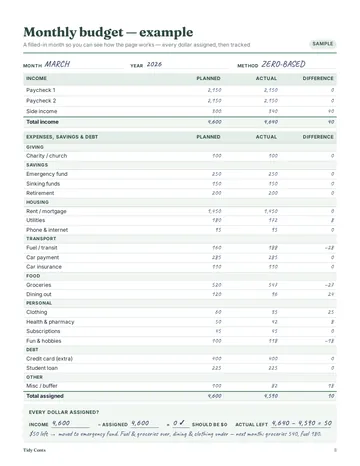
La plupart des budgets sont un compte rendu de ce qui s'est passé. Le budget base zéro est une instruction donnée avant que quoi que ce soit ne se passe : chaque dollar qui arrive ce mois-ci reçoit à l'avance une mission nommée, jusqu'à ce qu'il ne reste plus rien de non affecté.
Toute la méthode tient en une ligne de calcul.
revenus − affectations = 0
Ce zéro est l'essentiel, et c'est la partie que l'on comprend mal. Il ne signifie pas tout dépenser. L'argent affecté à votre fonds d'urgence, à votre retraite ou à une révision de voiture prévue dans neuf mois est affecté. Il n'est simplement pas non affecté. L'argent non affecté est le problème que la méthode existe pour résoudre, car l'argent non affecté devient immanquablement de l'argent dépensé sans que personne n'ait décidé qu'il devait l'être.
Voici un mois, de bout en bout.
Le mois
Un foyer avec deux revenus. Revenus nets après impôts, qui arrivent à deux dates :
| Revenu | Montant |
|---|---|
| Paie, le 1er | $2,350 |
| Paie, le 15 | $2,350 |
| Travail à temps partiel du conjoint | $700 |
| Total à affecter | $5,400 |
Pour donner l'échelle : le Bureau of Labor Statistics des États-Unis a fait état de dépenses annuelles moyennes de $78,535 par unité de consommation en 2024, pour un revenu moyen avant impôts de $104,207 (Consumer Expenditures — 2024, publié le 19 décembre 2025). Ce foyer dépense moins que cette moyenne, ce qu'il est utile de savoir avant de comparer vos propres chiffres à ceux de qui que ce soit.
Voici maintenant les affectations, en cinq groupes.
Factures fixes — $2,684
Même montant, même date, aucune décision à prendre.
| Ligne | Montant |
|---|---|
| Loyer | $1,650 |
| Électricité et gaz | $155 |
| Eau | $45 |
| Internet | $60 |
| Deux forfaits mobiles | $70 |
| Assurance auto | $142 |
| Assurance habitation | $18 |
| Garde d'enfants | $480 |
| Streaming et salle de sport | $64 |
| Sous-total | $2,684 |
Dépenses courantes — $1,135
Variables, et c'est là que le mois se gagne ou se perd vraiment.
| Ligne | Montant |
|---|---|
| Courses | $620 |
| Restaurants et cafés | $180 |
| Carburant | $185 |
| Maison et hygiène | $95 |
| Nourriture et forfait vétérinaire de l'animal | $55 |
| Sous-total | $1,135 |
Fonds de réserve — $325
Des coûts connus qui n'arrivent pas tous les mois. Chacun est un montant annuel divisé par douze.
| Ligne | Par mois | Par an |
|---|---|---|
| Révision et pneus de la voiture | $90 | $1,080 |
| Immatriculation du véhicule | $20 | $240 |
| Noël et anniversaires | $65 | $780 |
| Dentiste et santé | $50 | $600 |
| Réparations du logement | $60 | $720 |
| Vêtements | $40 | $480 |
| Sous-total | $325 | $3,900 |
Dettes — $612
| Ligne | Montant |
|---|---|
| Minimum de la carte de crédit | $95 |
| Supplément sur la carte de crédit | $205 |
| Prêt auto | $312 |
| Sous-total | $612 |
Épargne — $644
| Ligne | Montant |
|---|---|
| Fonds d'urgence | $444 |
| Complément retraite | $200 |
| Sous-total | $644 |
L'équilibre
| Groupe | Affecté | Part du revenu |
|---|---|---|
| Factures fixes | $2,684 | 49.7% |
| Dépenses courantes | $1,135 | 21.0% |
| Fonds de réserve | $325 | 6.0% |
| Dettes | $612 | 11.3% |
| Épargne | $644 | 11.9% |
| Total affecté | $5,400 | |
| Revenus | $5,400 | |
| Reste à affecter | $0 |
Les parts sont arrondies à une décimale et totalisent donc 99.9%. Les dollars totalisent exactement $5,400, et c'est cette colonne qui doit être juste.
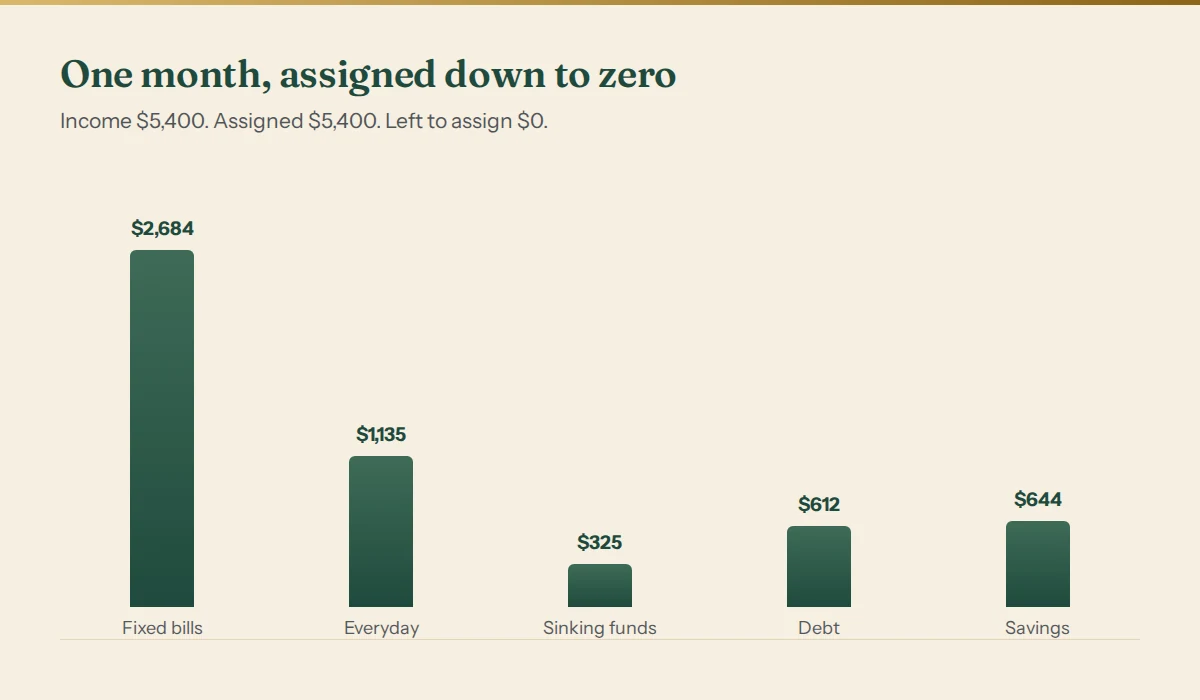
Remarquez la ligne du fonds d'urgence : $444. Pas $450, pas $400. La dernière ligne que vous remplissez est celle qui équilibre la colonne, et ce chiffre bancal est la méthode qui fonctionne, pas une erreur d'arrondi. Si vous vous surprenez à arrondir la dernière ligne à quelque chose de propre, vous avez cessé de faire un budget base zéro pour faire un budget approximatif, c'est-à-dire exactement ce que vous vouliez laisser derrière vous.
Remarquez aussi que les factures fixes absorbent 49.7% du revenu avant même la moindre décision discrétionnaire. C'est le chiffre le plus utile de la page, et il est invisible dans tout budget qui n'impose pas l'équilibre du total. La moitié de l'argent de ce foyer est engagée avant que quiconque ait choisi quoi que ce soit.
Les fonds de réserve sont ce qui fait tenir l'ensemble
Le groupe de $325 paraît modeste, et c'est pourtant lui qui permet à l'ensemble de survivre à mars.
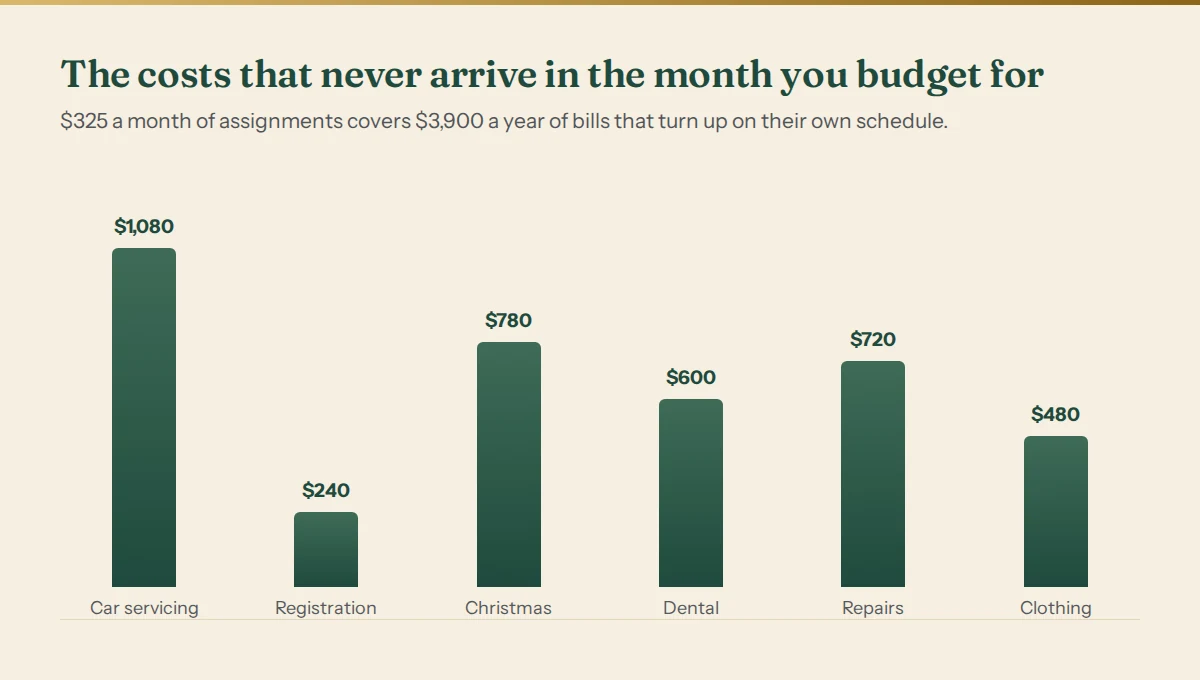
Ces six coûts totalisent $3,900 par an. Dans un budget sans fonds de réserve, ils ne sont pas moins élevés, ils sont simplement non budgétés : ils surgissent sous la forme d'une révision à $540 un mois qui n'avait pas de place pour elle, et finissent sur une carte. Les fonds de réserve ne sont rien d'autre que l'aveu que la révision de la voiture n'est pas une surprise. Vous savez qu'elle arrive, vous savez à peu près combien elle coûte, et la seule vraie inconnue est le mois.
Affectez $325 à ces lignes chaque mois, et les dépenses de Noël en décembre comme la révision d'avril sont déjà payées au moment où elles arrivent. C'est aussi pourquoi « je n'ai rien épargné ce mois-ci mais rien n'a mal tourné » est une façon trompeuse de juger un mois. Le guide des fonds de réserve explique comment fixer les montants annuels.
Un contrôle de bon sens pour vos catégories
Si vous n'avez jamais établi de budget complet, le plus difficile n'est pas le calcul. C'est de ne pas savoir si $620 de courses, c'est raisonnable.
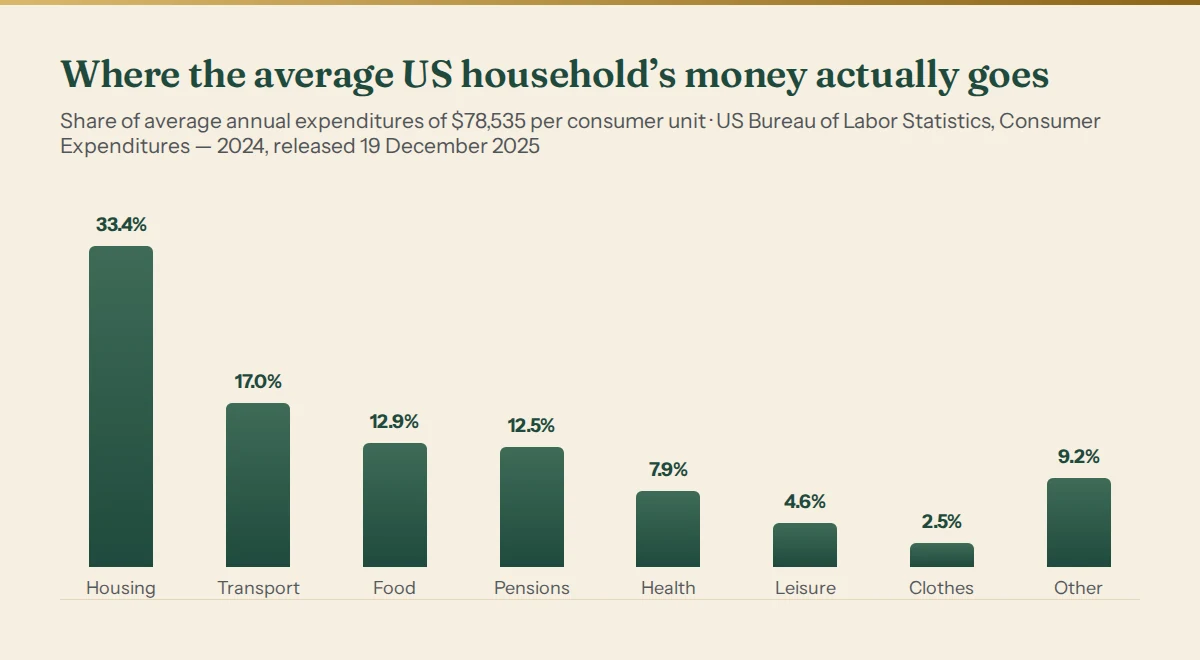
Dans cette enquête, le logement représentait 33.4% des dépenses de l'unité de consommation moyenne, le transport 17.0%, l'alimentation 12.9% (dont $6,224 par an à domicile et $3,945 à l'extérieur), les assurances personnelles et la retraite 12.5%, la santé 7.9%, les loisirs 4.6% et l'habillement et les services 2.5%.
Utilisez ces chiffres comme repère, pas comme objectif. Le chiffre du BLS pour le logement est plus large que le seul loyer, puisqu'il inclut l'énergie, l'entretien de la maison et l'ameublement ; les lignes comparables du mois d'exemple (loyer, gaz et électricité, eau, internet) totalisent $1,910, soit 35.4% du revenu. Assez proche de la situation nationale pour dire à ce foyer que le logement n'est pas son point aberrant. Vos catégories peuvent s'écarter fortement de la moyenne et rester justes pour vous. La comparaison sert à repérer la ligne qui est le double de ce que dépensent les autres — généralement une ligne que vous n'avez pas regardée depuis deux ans.
Ce qui se passe quand vous dépassez
Au bout de deux semaines, les courses ont absorbé $693 pour $620 affectés. Dans un budget classique, c'est un échec qu'on note puis qu'on oublie. Dans un budget base zéro, c'est un problème arithmétique qui n'a qu'une seule solution valable : l'argent doit venir d'une autre ligne nommée.
| Ligne | Avant | Après |
|---|---|---|
| Courses | $620 | $693 |
| Restaurants et cafés | $180 | $107 |
| Total des dépenses courantes | $1,135 | $1,135 |
Le groupe totalise toujours $1,135 et le mois s'équilibre toujours à zéro. Rien n'a mal tourné — une décision a été prise et enregistrée, et c'est à cela que sert un budget. L'alternative, dépasser de $73 en silence et le découvrir en fin de mois, ce sont les mêmes $73 sans aucune information.
C'est l'habitude qui fait fonctionner la méthode, et c'est celle que l'on saute. Le budget base zéro n'est pas un acte de planification réalisé une fois le 1er du mois. C'est un rapprochement continu : chaque fois qu'une catégorie dépasse, une autre baisse le jour même.
Là où le budget base zéro échoue vraiment
Trois vrais modes d'échec. Aucun ne se règle en faisant plus d'efforts.
1. Les revenus irréguliers. La méthode commence par demander combien d'argent vous allez recevoir ce mois-ci. Si vous êtes freelance, payé à la commission ou au pourboire, vous ne le savez pas, et un budget bâti sur une supposition est pire que pas de budget du tout. Ne budgétez pas non plus sur votre mois moyen — une moyenne est un chiffre que vous n'atteignez souvent pas. Fixez-vous un salaire sur un percentile prudent de votre propre historique, faites le budget base zéro de ce montant chaque mois, et laissez l'excédent des bons mois dans un coussin. La méthode des percentiles pour les revenus irréguliers détaille le calcul.
2. Le premier mois est vraiment écrasant. Vingt-cinq lignes assemblées de mémoire en une seule séance, c'est ainsi que meurent la plupart des tentatives. L'enquête 2026 de Debt.com sur les budgets (publiée le 13 juillet 2026, 1,051 adultes américains) a montré que parmi ceux qui ne font pas de budget, « cela prend trop de temps » était pour la première fois la raison principale, citée par 34% d'entre eux, contre 16% l'année précédente — et 24.34% de plus disaient avoir déjà fait des budgets sans que cela les ait jamais aidés. Ce sont deux plaintes sur l'effort et le bénéfice, pas sur l'arithmétique. La solution : commencez par les factures fixes et une seule catégorie de dépenses courantes, affectez tout le reste à une seule ligne appelée « divers », et éclatez cette ligne au cours des deux mois suivants, à mesure que vous découvrez ce qu'elle contient réellement. Un budget de six lignes que vous tenez vaut mieux qu'un budget de vingt-cinq lignes abandonné le 9.
3. Le problème du report. C'est celui dont personne ne vous avertit. En fin de mois, il reste $118 non dépensés répartis sur les catégories courantes. Qu'en faites-vous ? Il n'y a que deux réponses cohérentes, et l'échec consiste à n'en choisir aucune.
- Les reporter. Les courses du mois suivant commencent avec $118 déjà dedans. Confortable, et cela gonfle discrètement votre base jusqu'à ce que vous ne sachiez plus ce que coûte un mois normal.
- Les balayer. Remettez à zéro toutes les catégories courantes en fin de mois, déplacez les $118 vers un objectif nommé, et commencez le mois suivant à partir de vos affectations. Plus propre, et chaque mois devient comparable au précédent.
Le balayage est le meilleur choix par défaut, avec une exception : les fonds de réserve doivent toujours être reportés, car le report est toute leur raison d'être. Un fonds pour la révision de la voiture remis à zéro chaque mois n'est pas un fonds. La règle est donc : les fonds de réserve se reportent, les catégories courantes se balaient, et vous décidez qui est quoi en créant la ligne, pas en fin de mois quand vous voulez l'argent.
Il existe une quatrième situation qui n'est pas un échec de la méthode, mais qu'on prend souvent pour tel. Si vos factures fixes et vos remboursements minimums de dettes dépassent vos revenus, aucun ordre d'affectation n'y remédiera. Le budget base zéro vous le dira dès la première tentative, clairement et en dollars, ce qui est une information réellement utile mais pas une solution. C'est un cas pour un conseil gratuit et agréé en matière de dettes, pas pour un meilleur tableur.
L'appliquer chaque mois
- Partez du plan du mois précédent, pas d'une page blanche. Au bout du troisième mois, les factures fixes et les fonds de réserve ne bougent presque plus et l'exercice prend quinze minutes.
- Saisissez d'abord les revenus, et seulement l'argent dont vous êtes sûr. Une prime que vous toucherez peut-être s'affecte quand elle arrive, pas avant.
- Affectez dans l'ordre : factures fixes, puis fonds de réserve, puis remboursements minimums de dettes, puis dépenses courantes, puis tout ce qui reste à l'épargne et au remboursement supplémentaire.
- Imposez un total à zéro. La dernière ligne prend un chiffre bizarre. Laissez-la faire.
- Faites le point chaque semaine, et déplacez de l'argent entre les lignes chaque fois qu'une catégorie dépasse.
- Balayez les catégories courantes en fin de mois, reportez les fonds de réserve, puis recommencez.
L'étape 4 est la seule qui exige un total cumulé mis à jour pendant la saisie, et c'est pourquoi cette méthode a sa place dans un tableur plutôt que sur papier. Notre Grand Tableur Budget Annuel fait le contrôle du zéro pour les douze mois, avec des soldes de fonds de réserve qui se reportent tout seuls, et le Budget par Paie fait la même chose par date de paie si votre argent arrive deux fois par mois plutôt qu'une. Ou construisez-le vous-même : tout ce qui précède tient en vingt-cinq lignes, un SUM et une cellule qui le soustrait de vos revenus.
En bref
Donnez à chaque dollar une mission nommée avant le début du mois, imposez que le total soit exactement égal à vos revenus, et laissez la dernière ligne être un chiffre disgracieux. Alimentez chaque mois les coûts irréguliers pour qu'ils cessent d'être des urgences. Quand vous dépassez, déplacez l'argent depuis une ligne nommée le jour même plutôt que de le constater après coup. Balayez les catégories courantes en fin de mois et reportez les fonds de réserve. Et si vos revenus n'arrivent pas en blocs prévisibles, réglez d'abord ce problème, car le budget base zéro n'a pas de réponse à une question qu'il ne peut pas poser.
Sources : Bureau of Labor Statistics des États-Unis, « Consumer Expenditures--2024 » (communiqué USDL-25-1586, publié le 19 décembre 2025) ; enquête 2026 de Debt.com sur les budgets (publiée le 13 juillet 2026, 1,051 adultes américains, recueillie via SurveyMonkey).