How much to save each week for Christmas, starting today
Christmas is not an emergency. It is the single most predictable expense in the calendar — same date, every year, known decades in advance — and it is still the expense that most reliably ends up on a credit card.
The reason is not that people are careless with money. It is that the whole cost arrives inside a three-week window, and almost nobody divides it by the number of weeks available beforehand. This guide is that division: what the total actually is, how many weeks are left, and what the alternative costs if you skip it.
The only calculation that matters
weekly = december_total ÷ whole_weeks_remaining
Take 18 December as the deadline — the last working Friday before Christmas, by which point the gifts, the food order and any travel are all paid for. From today, 24 August, there are 16 whole weeks before that date.
The National Retail Federation's annual survey (published 16 October 2025, fieldwork 1–7 October, 8,247 US consumers) put planned holiday spending at $890.49 per person. Divided by 16, that is $55.66 a week.
That is the entire method. What follows is the three places it goes wrong.
The weeks are the variable, not the total
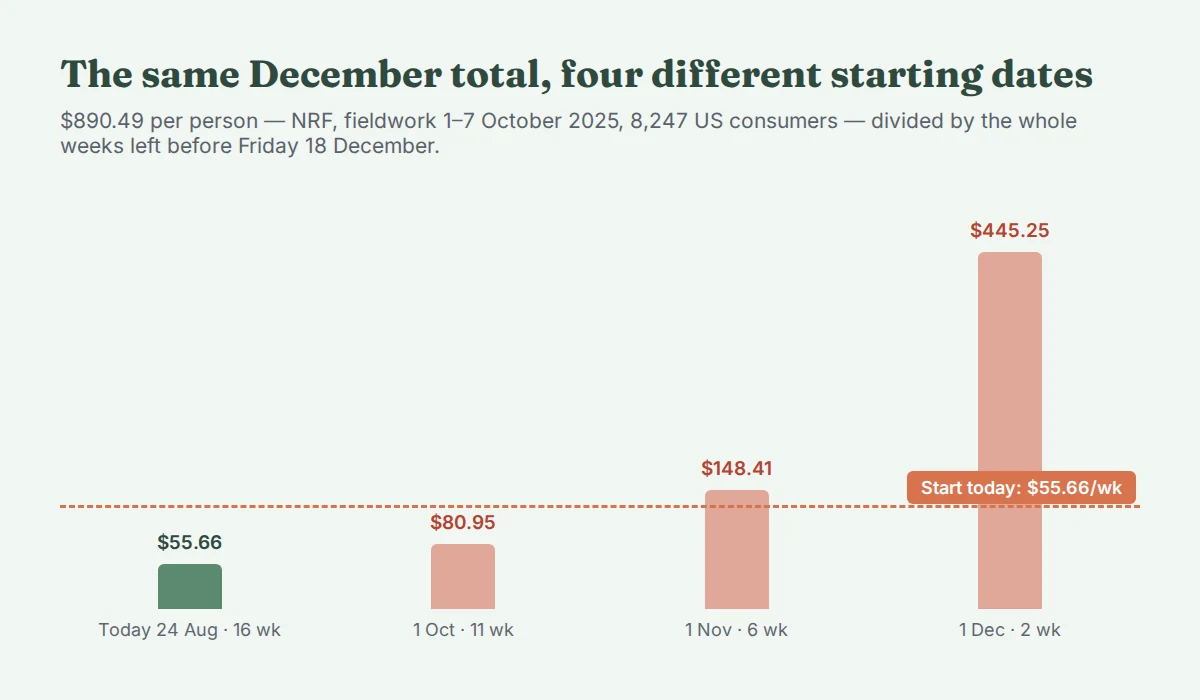
The total is roughly fixed by the time December arrives. The number of weeks is the part you still control, and it is shrinking at a fixed rate whether or not you are using it.
| Start | Whole weeks to 18 Dec | Weekly transfer |
|---|---|---|
| Today, 24 August | 16 | $55.66 |
| 1 October | 11 | $80.95 |
| 1 November | 6 | $148.41 |
| 1 December | 2 | $445.25 |
Nothing about the shopping changes across those four rows. The same presents, the same food, the same people. The only difference is how many pay packets the cost is spread across — and by 1 December there are two of them, which is not saving, it is paying.
Count whole weeks, not part-weeks. Today to 18 December is 116 days, which is 16 weeks and 4 days; rounding that up to 17 gives you a smaller, friendlier weekly figure and a plan that is short by one transfer. The rounding always has to go against you.
Which total to run it on
Two national surveys measured this in the same fortnight of October 2025 and did not agree, which is worth knowing before you adopt either number as a target.
- NRF asked about the whole basket and got $890.49 per person: $627.93 on gifts for family and friends, $262.56 on non-gift seasonal items — food, sweets, decorations, cards. Sample 8,247, margin of error ±1.1 points.
- Gallup (published 28 October 2025, fieldwork 1–16 October, 1,000 US adults) asked only about gifts and got a mean of $1,007, with a margin of error of ±$78. In the same poll, 37% said they would spend $1,000 or more and 31% said up to $499.
Gallup's gift-only mean is larger than NRF's entire basket. Both are real measurements of real people; they use different instruments, different samples and different question wording, and the sensible reading is that they bracket a range rather than that one of them is the answer.
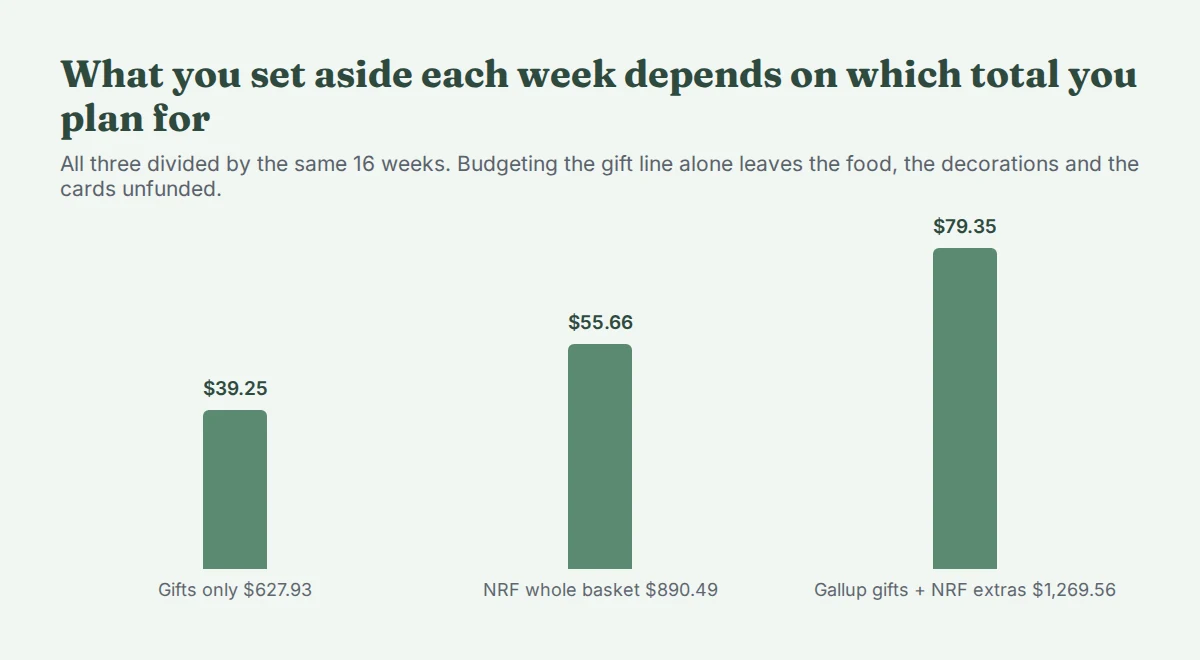
Budget the gift line alone and you are setting aside $39.25 a week. Take NRF's whole basket and it is $55.66. Put Gallup's gift figure on top of NRF's non-gift line — $1,007 plus $262.56, or $1,269.56 — and it is $79.35.
Pick the top of the range if you have no data of your own. Better still, use last December's bank statement, because your own household is the only sample of size one that describes you.
The part that is never in the plan
The most useful thing in NRF's split is the second line. Gifts are 70.5% of the total. The other 29.5% — $262.56 — is food, sweets, decorations and cards.
Almost nobody budgets that. Gift spending has a list attached to it: names, ideas, a rough figure each. The non-gift half has no list, arrives as forty small transactions across six weeks, and is invisible until the statement lands. A plan built on the gift number alone is not slightly optimistic; it is short by $262.56, which is exactly the amount that tends to show up as "I do not know where it went".
If you already run sinking funds, this is the argument for splitting Christmas into two lines rather than one.
The money leaves earlier than you think
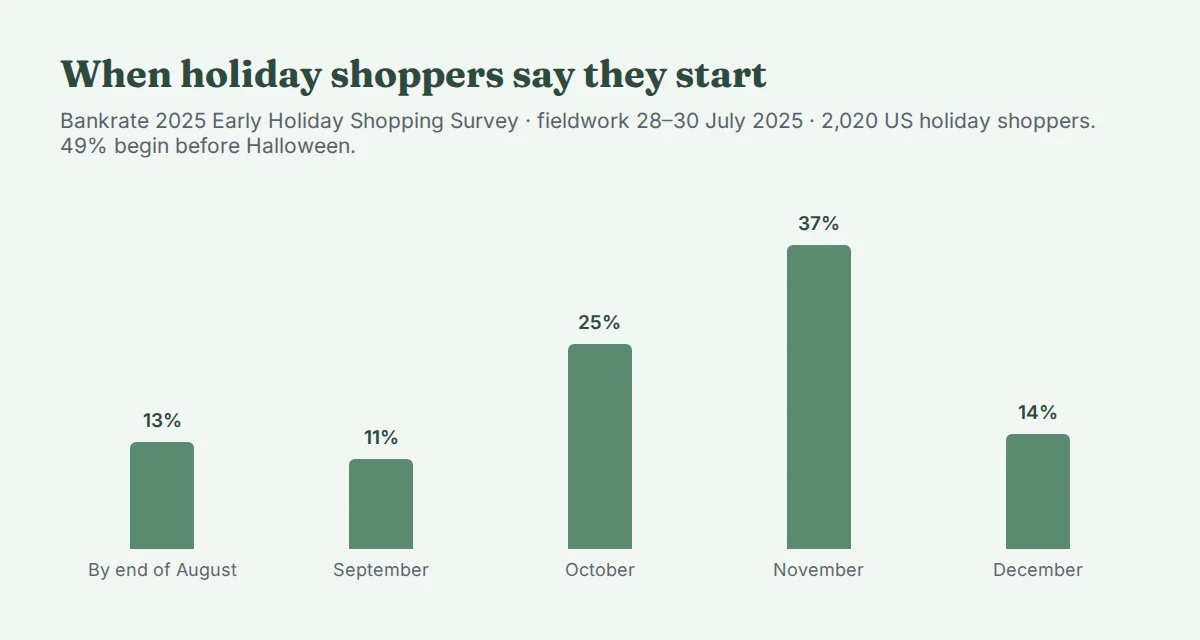
49% of holiday shoppers say they start before Halloween: 13% by the end of August, 11% in September, 25% in October. Only 14% wait until December.
That matters for the timing of the fund rather than its size. If half the spending starts in October, a plan that finishes funding on 18 December is funding the purchases after they have been made. Two adjustments follow:
- Aim to be about half funded by 31 October. Nine of the sixteen weeks have gone by then, so half the fund is a soft target you should already be past — and it is enough to cover the early shopping without borrowing from the rest.
- Keep it in a separate account you can actually reach. Not the current account, where it becomes ordinary money, and not anything with a notice period.
The same Bankrate survey found only 24% of shoppers expect to budget for holiday spending at all, while 29% said it would strain their budget and 27% described themselves as stressed about the cost. Those three numbers are the same finding stated three ways.
What the alternative costs
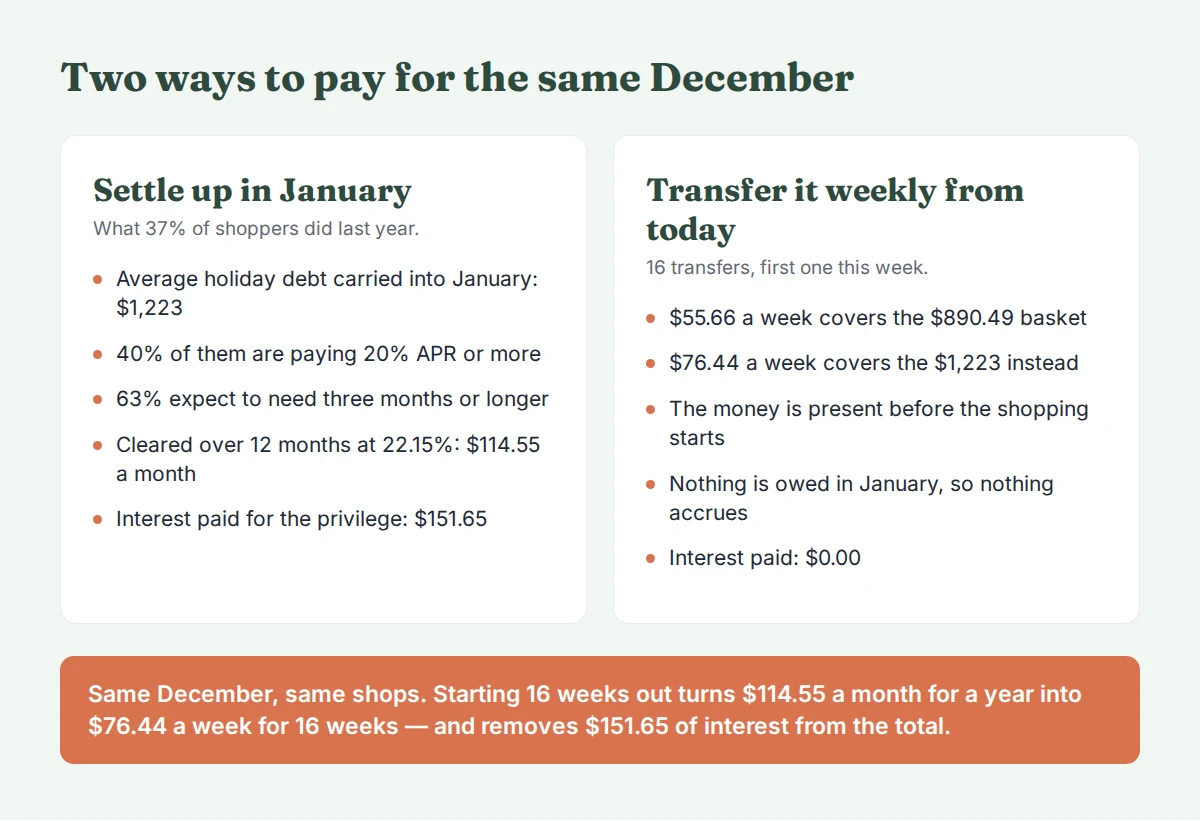
LendingTree surveyed 2,032 US consumers between 10 and 15 December 2025. 37% had taken on holiday debt, averaging $1,223 — up from $1,181 the year before. Among parents of children under 18 it was 48%, averaging $1,324. 63% expected to need three months or longer to clear it, and 40% were paying an APR of 20% or more.
The Federal Reserve's G.19 release of 7 August 2026 puts the average rate on credit card accounts assessed interest at 22.15% for May 2026 (20.94% across all accounts). At that rate, on the average $1,223 balance, in level monthly payments:
| Cleared over | Monthly payment | Interest paid |
|---|---|---|
| 3 months | $422.81 | $45.42 |
| 6 months | $217.20 | $80.21 |
| 12 months | $114.55 | $151.65 |
Spread the same $1,223 across the 16 weeks that are still available instead, and it is $76.44 a week and no interest at all. The comparison is not between two amounts of money — it is between $114.55 a month for twelve months and $76.44 a week for sixteen, and the second one is over before the first one has started.
None of that is an argument about willpower. It is an argument about sequence. Money assembled before the shopping costs what it costs; money assembled after it costs more.
Running it
- Set the deadline first, not the amount. 18 December, or your own last realistic shopping day.
- Count the whole weeks between now and then. Round down.
- Pick the total. Last December's statement if you have it, the top of the survey range if you do not.
- Divide, and set up the standing transfer the same day. A weekly transfer you have to remember is a plan that ends in week three. Our free budget calculator will show you where the weekly figure has to come out of, if it is not obvious.
- Split gifts from everything else and give the second line about 30% of the total, which is where NRF's data puts it.
- Check at the end of October. Half funded by then, or the December end of the plan is doing work the October end should have done.
- In January, write down what it actually cost. That is next year's total, and it beats every survey in this article.
The honest limits
- $890.49 is per person, not per household. NRF surveys individuals. Two adults planning together should expect a household figure closer to double, before any children are counted.
- These are US figures. The arithmetic is currency-agnostic — the division does not care — but the totals are not, and you should replace them with your own as soon as you have a year of history.
- A mean is not your number. Gallup's own margin of error is ±$78, and the spread underneath the mean is far wider than that: 31% of respondents were under $499 while 37% were over $1,000.
- It cannot make room that is not there. If $55.66 a week does not exist in your budget, the calculation has told you something true and useful — the December total needs to come down, and August is a much better month to decide that in than November.
The short version
The total is not the variable. The weeks are, and there are 16 of them left. Divide the December figure by the whole weeks remaining, use a total that includes the 30% that is not gifts, automate the transfer today rather than deciding weekly, and be half funded by Halloween because that is when half the spending starts.
If you would rather not build the sheet yourself, the Christmas Budget & Gift Planner has the per-person list, the non-gift lines and the weekly countdown already set up — and there is a free sample pack if you want to see how we lay these out before spending anything.