
How to balance a cash drawer at the end of a shift
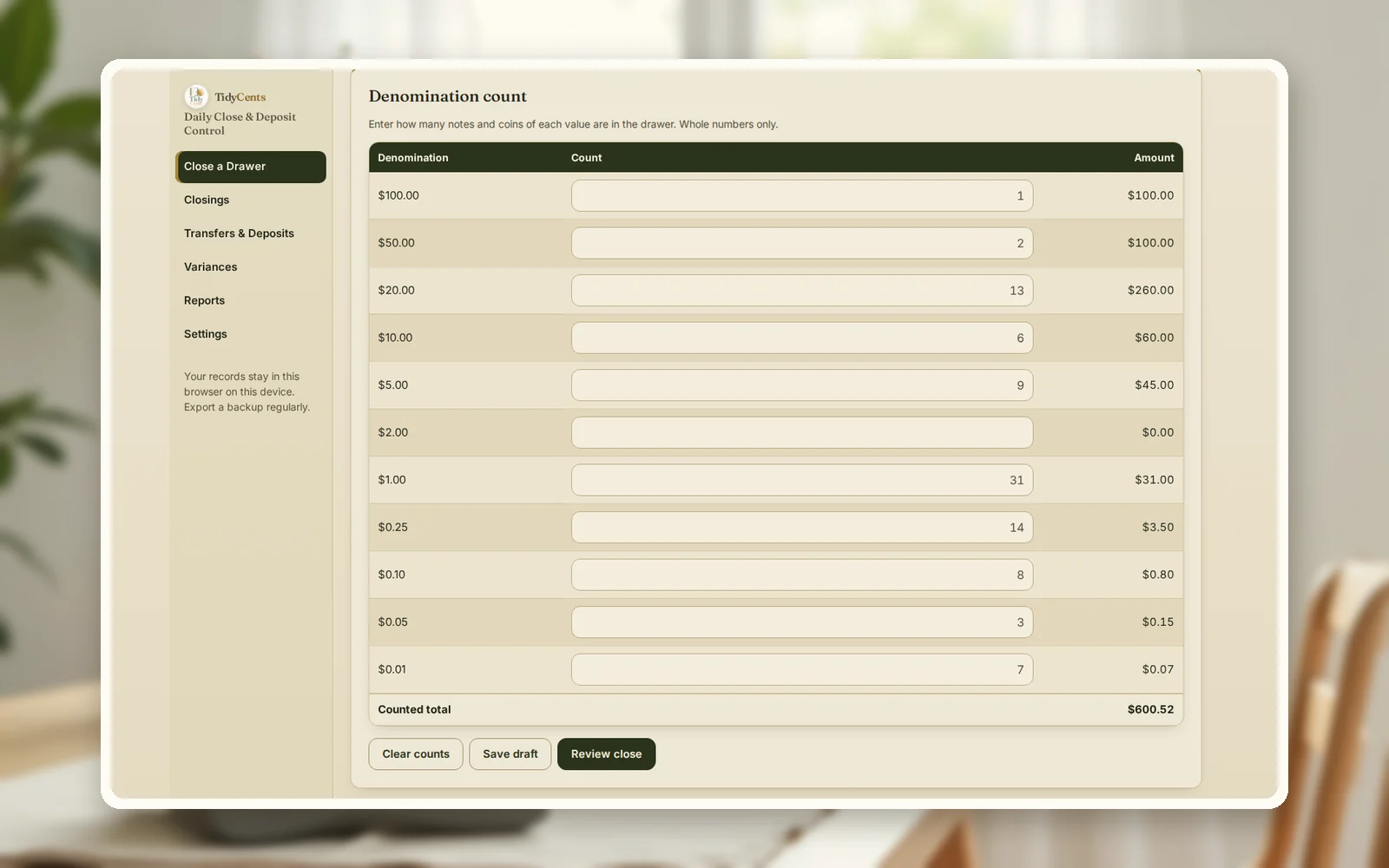
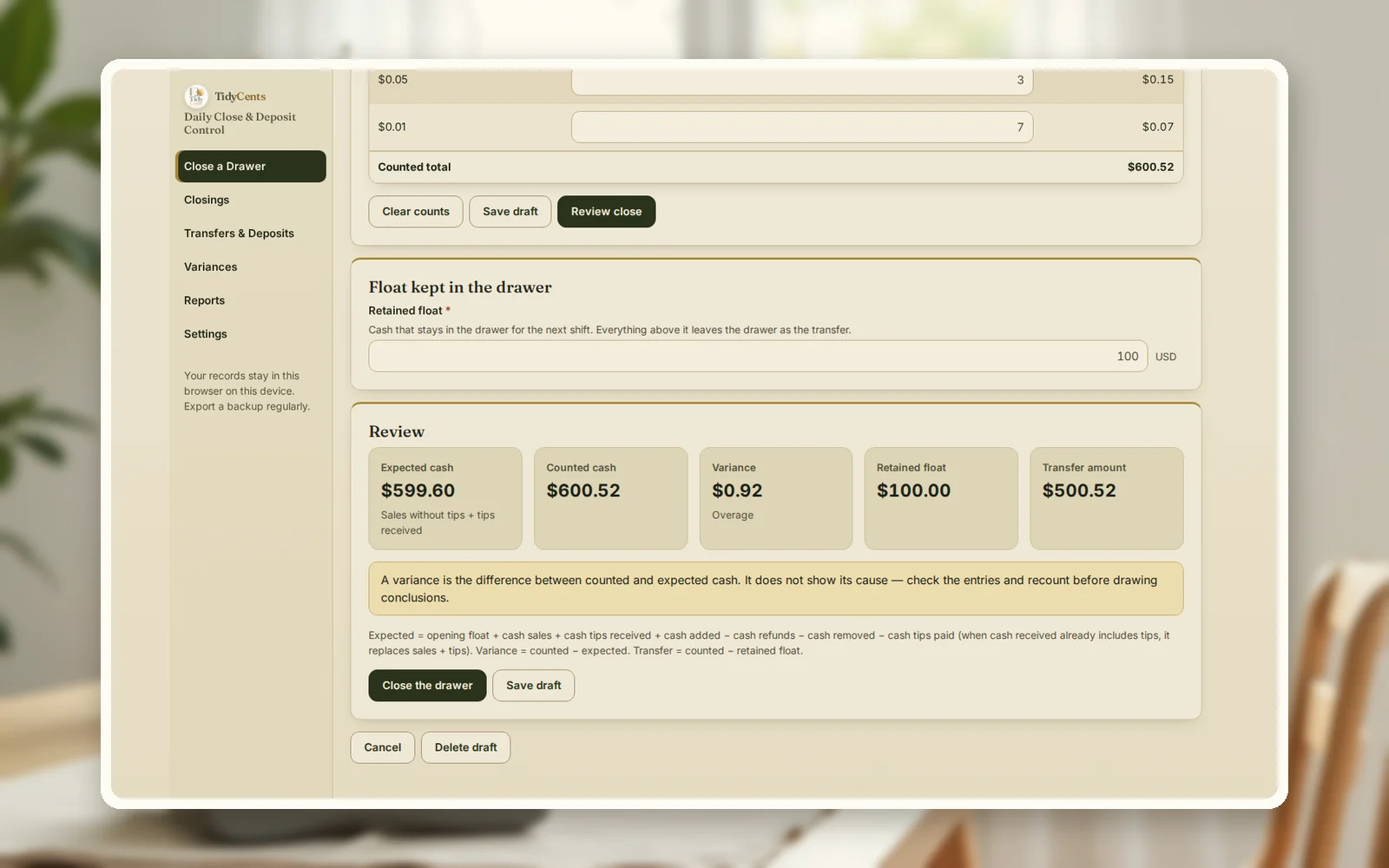
To balance a cash drawer, work out what should be in it (opening float + cash sales + cash tips received + cash added − cash refunds − cash taken out − cash tips paid out), count what is actually there by denomination, and record the difference as the variance. Then keep the planned float for the next shift and send the rest — the transfer — to the safe or the bank, with a number you can follow. In the example below, a café's front counter expects $599.60, counts $600.52, and bags $500.52. Across one week of 13 closings, the shortages add up to $14.70, most of it on one register.
Why "the till was a bit short" is not enough
Small differences are normal: wrong change, a coin in the wrong slot, a refund not written down. The trouble starts when nobody can tell which:
- Expected cash is guessed, not calculated. Without tips, refunds and cash taken out in the formula, every close looks off.
- The count is a single total. A count by denomination can be checked; a number on a sticky note cannot.
- The transfer is not tracked. Cash leaves the drawer in a bag and reaches the bank days later — or does not, in full.
- Variances are not looked at over time. A $2 shortage once is noise; the same register short five times is a pattern.
The formula
- Expected cash = opening float + cash sales + cash tips received + cash added − cash refunds − cash removed (paid-outs, petty cash) − cash tips paid out.
- If your till reports cash received including tips, use that instead of cash sales + tips, and do not add tips twice.
- Counted cash = Σ denomination × number counted.
- Variance = counted − expected. Negative is a shortage, positive an overage.
- Transfer = counted − float you keep in the drawer for the next shift.
- Undeposited = transfer − amounts already deposited from it. It should reach zero.
A worked example
The numbers are the demo of Daily Close & Deposit Control: a fictional café with two registers — a front counter with a $100 float and a patio bar with a $150 float — and a tolerance of $2 per close.
One close, step by step. The front counter on 11 October:
| Line | Amount |
|---|---|
| Opening float | $100.00 |
| Cash sales (without tips) | +$503.80 |
| Cash tips received | +$30.00 |
| Cash refunds | −$4.20 |
| Cash tips paid out to staff | −$30.00 |
| Expected cash | $599.60 |
| Counted cash | $600.52 |
| Variance | +$0.92 |
| Float kept for tomorrow | $100.00 |
| Transfer to the safe | $500.52 |
The overage of $0.92 is inside the tolerance. The count is saved by denomination, so anyone can check it later.
A recount the next morning. On 9 October the same register expected $640: a $100 float, $600 of cash sales and $40 of tips received, minus $20 of refunds, $50 taken out and $30 of tips paid. The evening count showed $635, a $5 shortage, and a bag of $535 went to the safe. The next morning the owner found three $1 notes in the coin tray and corrected the count to $638. The variance became −$2, inside the tolerance — and the drawer now owed $3 more to the transfer. The original bag was not rewritten; the correction shows the $3 gap, with the reason and who made it.
What a week shows. Over 13 closings from 1 to 9 October, 6 had a variance. Shortages total $14.70, overages $0.10. Of the shortages, $11.50 came from the patio bar on three evenings — a reason to look at how that register is run, not a verdict on any one person.
Following the money to the bank. On 4 October a deposit of $2,561.40 covered the six bags from 1 to 3 October. A second deposit of $2,292.35 on 10 October covered four bags in full and $500 of the $535 bag from 9 October, with a $2.50 bank fee — so $35 of that bag still shows as not yet deposited, and two bags from 8 October are still waiting.
Step by step: balance a drawer and follow the cash
- Start every shift with a known float, counted and written down.
- Record cash taken out or added during the shift, with a reason: supplier paid in cash, change from the safe.
- At close, take the till's figures: cash sales, tips, refunds — and know whether its cash figure includes tips.
- Count by denomination, notes and coins separately.
- Compare with expected cash. If the variance is outside your tolerance, recount before you write a reason.
- Keep the planned float, bag the rest with a seal or bag number, and note who handed it over and who received it.
- Match each deposit to the bags it contains, record bank fees, and clear what is still undeposited.
- Review variances weekly by register and shift.
Common mistakes
- Forgetting tips in or out. Cash tips received and paid out both change what should be in the drawer.
- Counting tips twice. If the till's cash figure already includes tips, do not add them again.
- Writing a reason before recounting. Many shortages are counting errors, like notes in the coin tray.
- Changing the original record. Correct it with a reason and keep the history.
- Treating a bag as banked. Until the deposit is matched, it is still your cash risk.
- Judging people by one close. Look for patterns by register and shift over weeks.
When a tool helps
A paper count sheet works for one drawer and one person. With two registers, several people, tips both ways, paid-outs, bags that wait for the bank and deposits that cover several days, it is easy to lose track. Daily Close & Deposit Control calculates expected cash for each close, keeps the count by denomination, flags variances outside your tolerance, records corrections without rewriting the original, follows each bag to the deposit that contains it and shows what is still undeposited. Exact decimal arithmetic, no AI guesses. At month end, the Month-End Reconciliation & Evidence Desk matches deposits with the bank and your books.
Open the demo with the café above — every screen, no sign-up — then add your own registers and closes.
Open Daily Close & Deposit ControlAll taxes, accounts and invoices tools
Related guides: how to reconcile card payouts with bank deposits, how to check timesheets before payroll and the true cost of a return.
FAQ
How much float should I keep in a cash drawer?
Enough change for a normal opening rush, set per register and kept the same every day. In the example, the front counter keeps $100 and the patio bar $150. A fixed float makes every close comparable.
What is an acceptable cash variance?
There is no single rule; set a tolerance that fits your volume and stick to it. The demo uses $2 per close. A variance inside the tolerance is still recorded; one outside it gets a recount and a reason.
Should tips go through the drawer?
They can, as long as you record cash tips received and cash tips paid out. If your till's cash figure already includes tips, use that figure instead of adding tips separately.
What if the count was wrong after the cash was bagged?
Correct the close with a reason, and keep the original. The difference between what should have left the drawer and what was bagged shows as an extra transfer or a return to the drawer.
How do I know all the cash reached the bank?
Give every bag a number, record each deposit with the bags it contains, and watch the undeposited balance. When it reaches zero, every bag has been banked.
This is decision support, not accounting, tax or employment advice.


