
How to split a parent's care costs between siblings
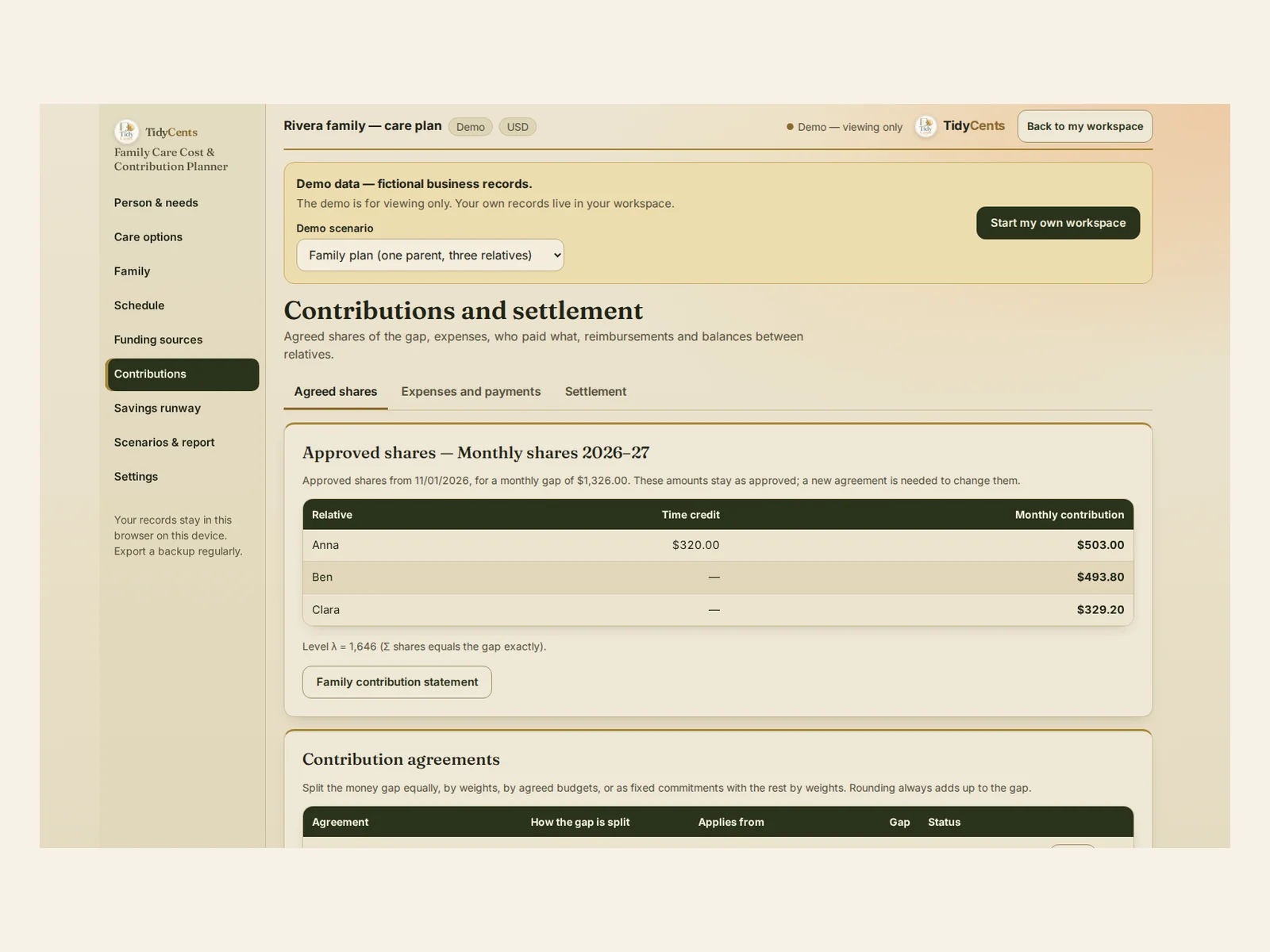
To split a parent's care costs, first agree on the care arrangement and its monthly cost, subtract the income and funding that are confirmed, and share only the remaining gap — by equal parts, agreed weights, budgets or fixed amounts — with a credit for time given only where the family agrees to one. Then check two things the split does not show: that every required hour of care is actually covered, and how long any savings will last. In the example below, a $3,000 monthly gap is shared $1,400, $960 and $640 after one sibling's $200 time credit.
Why care costs are hard to share
Care money gets complicated quickly, and disagreements usually come from what was left unsaid:
- The cost depends on the arrangement. Home visits, a day programme and a residence are priced in different ways.
- Minimum visit charges add up. A short visit can be billed as a much longer one.
- Not all funding is certain. Expected support is not the same as confirmed income.
- Time is not money unless agreed. A sibling who visits every day gives something real, but it only changes money shares when everyone agrees it should.
- A cheaper arrangement may leave gaps. Hours nobody covers are a problem, not a saving.
The formula
- Funding gap = approved monthly care costs − confirmed external funding; expected sources are shown separately.
- Visit cost = hourly rate × the longer of the actual time and the minimum billed time, plus night, weekend and travel charges as quoted.
- Each person's share = their weight × a common level − any agreed time credit, with the level set so the shares add up exactly to the gap.
- Value of time given = hours × an agreed reference rate, for information unless a time credit is agreed.
- Savings runway = how many payments on the real payment calendar the savings cover in full.
A worked example
These figures follow the control examples used to test Family Care Cost & Contribution Planner.
The gap. The approved arrangement costs $4,000 a month and confirmed income and support cover $1,000. The family gap is $3,000 a month.
Sharing it. Three siblings agree weights of 50, 30 and 20.
| Sibling A | Sibling B | Sibling C | Total | |
|---|---|---|---|---|
| Weights only | $1,500 | $900 | $600 | $3,000 |
| With a $200 time credit for A | $1,400 | $960 | $640 | $3,000 |
With the credit, the common level becomes $3,200: A pays 50% of it minus $200, B pays 30% and C pays 20%, and the shares still add up to the gap exactly. If A has given 10 hours of care and the family notes a reference rate of $20 an hour, that time is worth $200 — but without an agreement it is shown for information only, and the shares stay $1,500, $900 and $600.
Visit minimums. A home-care quote charges $20 an hour with a 3-hour minimum per visit. A 2-hour visit costs $60, and two separate one-hour visits on the same day cost $120 when the provider does not combine them — the same as six hours of care.
How long savings last. If the $3,000 monthly gap is paid from $30,000 of savings starting January 1, the savings cover 10 payments in full. The last fully paid bill is October 1; the November 1 payment is the first that cannot be paid, with a shortfall of $3,000.
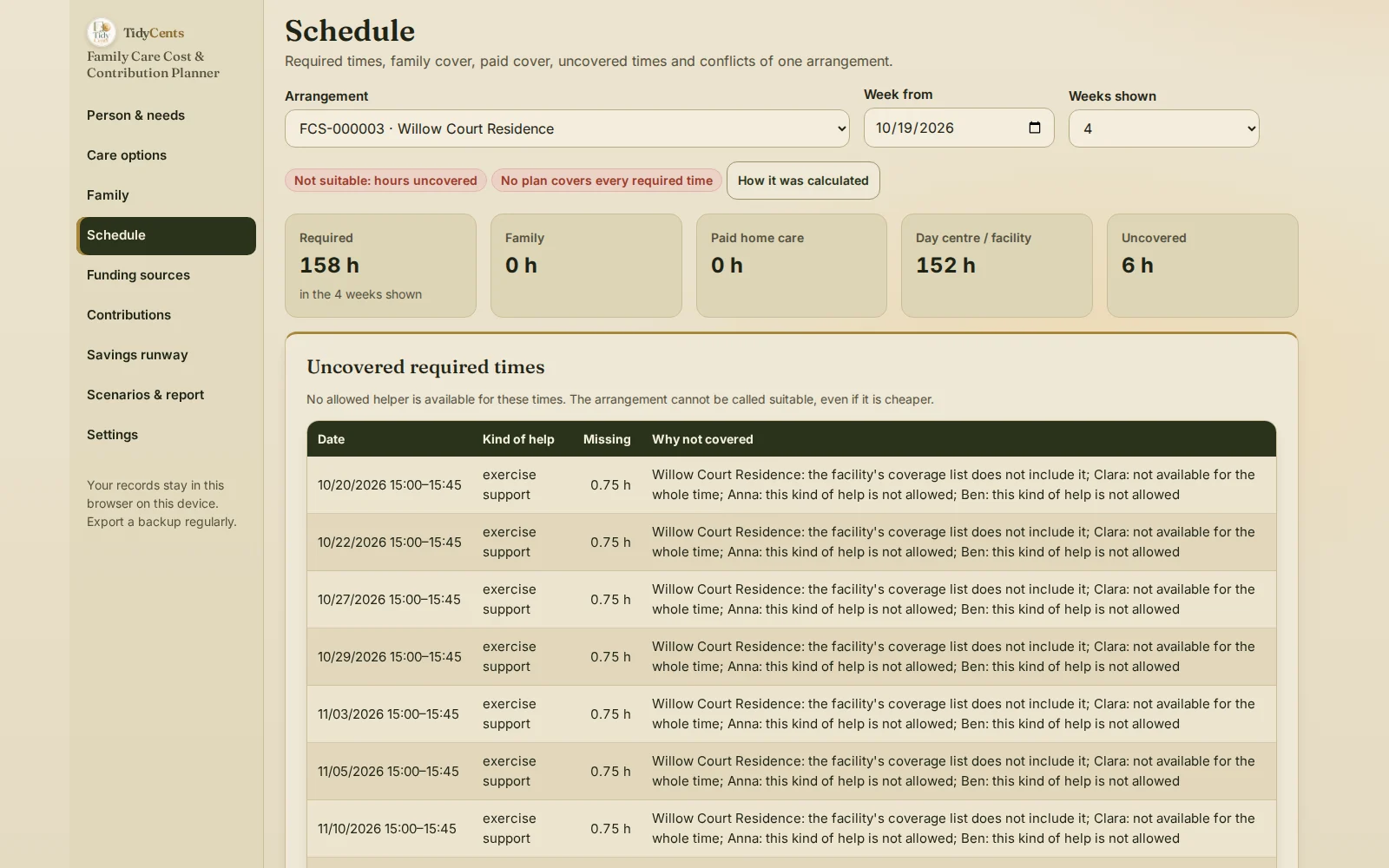
What the demo shows. In the demo, one parent's care is shared by three relatives. The approved monthly gap is $1,326; with a $320 time credit for one relative and weights of 50, 30 and 20, the shares are $503.00, $493.80 and $329.20. A residence option looks complete at first, but over 4 weeks it covers 152 of 158 required hours: exercise support twice a week is not on the residence's list and no relative is available, so 6 hours stay uncovered and the arrangement is marked not suitable, whatever its price.
Step by step: set up a family care agreement
- Describe the care needed in your own words: days, times, place and how many helpers at once, from the professional information you have.
- Collect written quotes and enter each provider's prices, minimum visits, night and weekend rates and fees.
- List what each relative can do and when, with weekly and monthly hour limits.
- Build the arrangements and check that every required hour is covered by someone allowed to do it.
- Separate confirmed income from expected sources, and calculate the monthly gap.
- Agree how to split the gap: equally, by weights, by budgets or as fixed amounts, and whether time counts.
- Check the savings runway on the real payment dates.
- Record payments and reimbursements, and print a statement everyone can see.
Common mistakes
- Comparing arrangements by price alone. One with uncovered hours is not a cheaper version of the same care.
- Ignoring minimum visit charges. Short visits can cost far more than their length suggests.
- Counting expected support as certain. Base the gap on confirmed money and plan for the rest.
- Turning time into debt without agreement. It only affects money when the family agrees a time credit.
- Rounding shares so they no longer add up. Every cent of the gap should be allocated.
- Forgetting when savings run out. Know the first bill that cannot be paid well before it arrives.
When a tool helps
A spreadsheet can divide a number by three. It rarely schedules every required hour against family availability and provider rules, applies minimum visits and night rates, keeps confirmed and expected funding apart, shares the gap with weights, caps and time credits that add up to the cent, and shows the savings runway on real payment dates. Family Care Cost & Contribution Planner does, and every figure opens "How calculated". It does not determine care needs, benefit eligibility, legal obligations between relatives or whether a provider is suitable. Exact arithmetic, no AI guesses. To plan the savings side, see Savings Goals & Sinking Funds Tracker.
Open the demo with the family above — every screen, no sign-up — then enter your own care needs, quotes and relatives.
Open the demoFamily Care Cost & Contribution Planner — $14.90
Related guides: sinking funds, how big should an emergency fund be and budgeting on an irregular income.
FAQ
How do siblings split the cost of a parent's care?
Agree on the arrangement, subtract confirmed income from its monthly cost, and share only the gap by a rule everyone accepts. In the example, a $3,000 gap split by weights of 50, 30 and 20 gives $1,500, $900 and $600.
Should the sibling who provides care pay less?
That is for the family to decide. If you agree a time credit, it reduces that person's money share and the others' shares rise so the gap is still covered — in the example, $1,400, $960 and $640.
How do I compare home care with a residence?
Compare the monthly cost and the funding gap, but first check that each arrangement covers every required hour. In the demo, a residence leaves 6 of 158 hours uncovered, so it is not a complete option.
How long will savings pay for care?
Count how many payments the savings cover in full on the real payment dates. In the example, $30,000 covers 10 monthly payments of $3,000.
This is decision support, not medical, legal, tax or benefits advice.
Tools mentioned in this guide
 Interactive tool
Family Care Cost & Contribution Planner
Compare care arrangements, cover the required hours and agree who contributes money and time.

