Savings challenges, ranked by what they actually bank by Christmas
Every savings challenge is really two numbers: the big one on the pin, and the date you would have to have started to reach it. The pin never shows the second number.
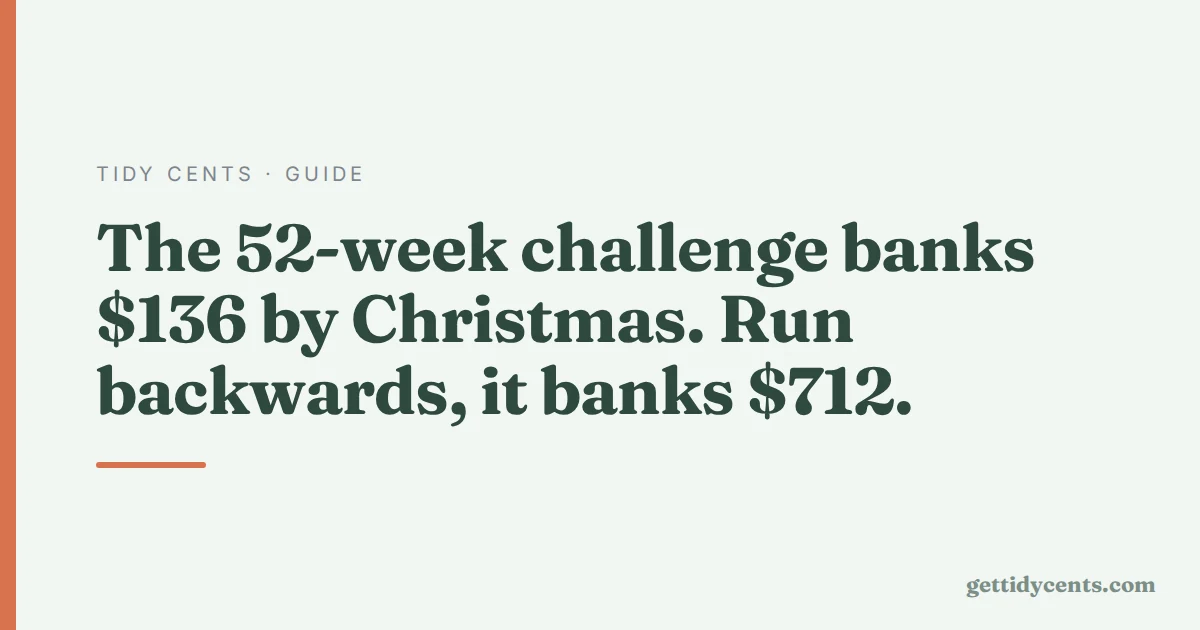
The 52-week challenge saves $1,378 — if you started in the first week of January. The penny challenge saves $667.95 — same condition. Start either of them now, with Christmas as the deadline, and you get a completely different result, because these challenges are calendar-shaped: the deposits are laid out across a specific year, and joining late means keeping whichever end of the schedule happens to be left.
This guide re-runs the popular challenges on the calendar that actually remains — and ranks them by the only number that matters in August: what is in the jar on 18 December.
The window: 16 whole weeks
Between today, 25 August, and Friday 18 December — the last working Friday before Christmas, by which point the shopping needs to be paid for — there are 115 days, which is 16 whole weeks and three days. Count the whole weeks only; the three spare days are not a week you can deposit in. (Why the rounding always has to go against you, and what the season costs per week from four different start dates, is covered in the countdown guide.)
Sixteen weeks is the ruler. Here is every challenge measured with it.
The ranking
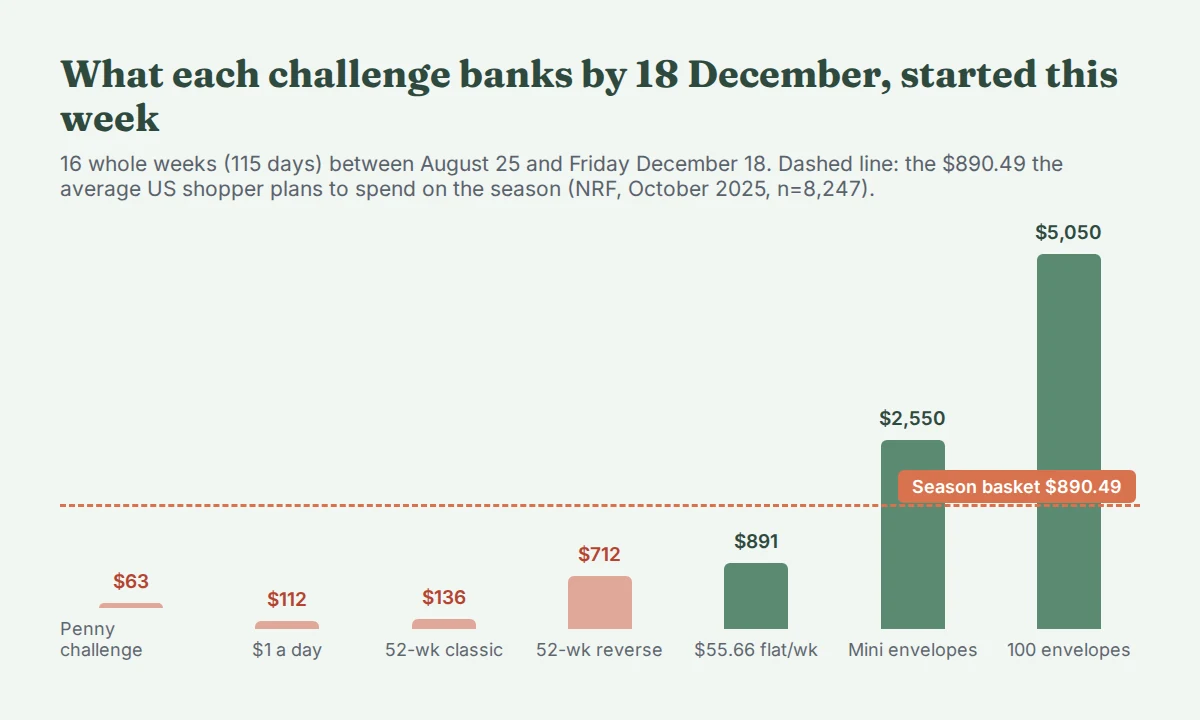
| Challenge | Deposits between now and 18 Dec | Banked by 18 Dec |
|---|---|---|
| Penny challenge (from day 1) | 1¢ … $1.12, daily | $63.28 |
| $1 a day | $1 × 112 days | $112 |
| 52-week classic | $1, $2 … $16 weekly | $136 |
| 52-week reverse | $52, $51 … $37 weekly | $712 |
| Flat transfer | $55.66 × 16 weeks | $890.56 |
| Mini envelopes (capped at $50) | 100 envelopes in 100 days | $2,550 |
| 100-envelope challenge | $1–$100 envelopes in 100 days | $5,050 |
Two things jump out of that table.
First, the three gentlest challenges — penny, $1 a day, classic 52-week — land between $63 and $136. Real money, and a real habit. But against the $890.49 the average shopper plans to spend on the season, they cover 7–15%. If the jar is meant to pay for Christmas rather than decorate it, the famous beginner challenges cannot get there from an August start, no matter how faithfully you colour the boxes.
Second, the spread between the weakest and strongest schedule is eighty to one — from the same shelf of printables, over the same 16 weeks. Which challenge you pick matters more than how disciplined you are about it.
Direction is worth $576
The clearest illustration is the 52-week challenge against its own mirror image. Both use the identical list of amounts, $1 to $52. The classic version climbs; the reverse version descends. Joining in August, the classic gives you deposits 1 through 16 — the cheap end. The reverse gives you deposits 52 down to 37 — the expensive end.
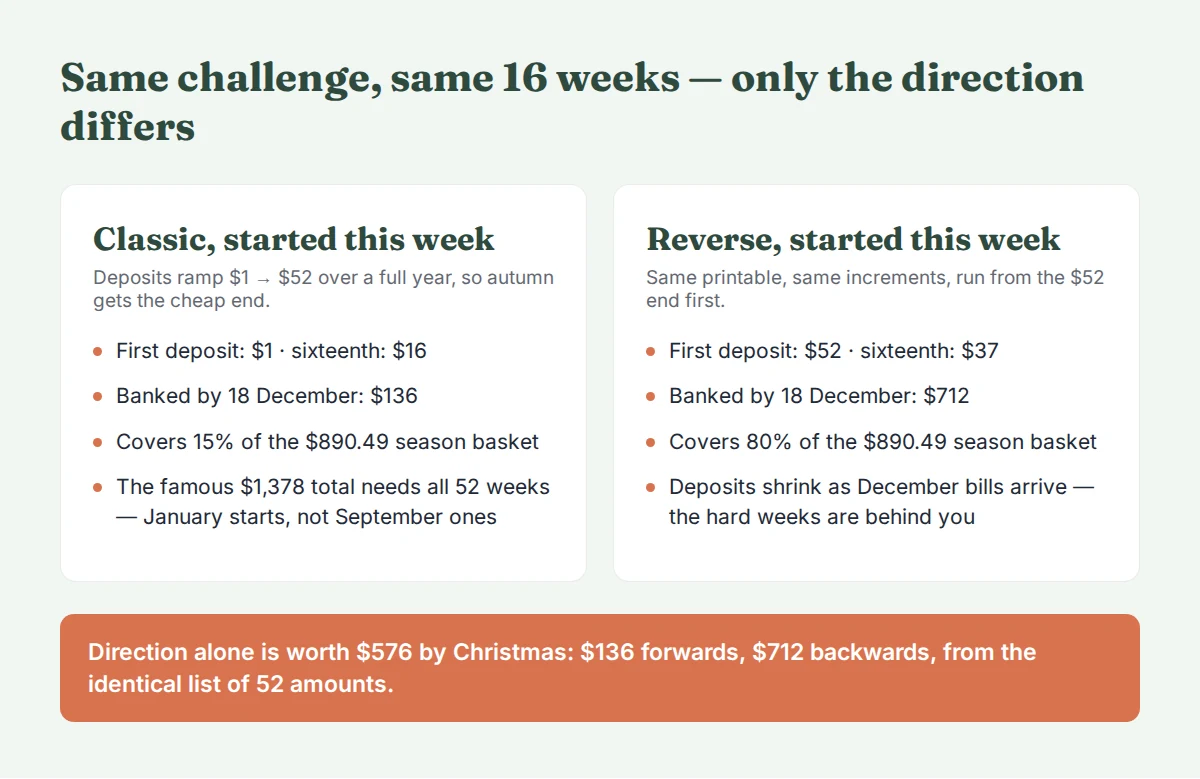
$136 forwards, $712 backwards. Same paper, same habit, same sixteen ticks — a $576 difference from nothing but the direction you run the list.
The reverse version has a second advantage that has nothing to do with arithmetic: its deposits shrink as December approaches. The $52 and $51 weeks happen in September, while the calendar is quiet; by the week the school concert and the food order and the travel all collide, the challenge is only asking for $37. The classic version does the opposite — it saves its biggest asks for exactly the weeks your budget is busiest. That is a fine shape for a January start, when the expensive end lands in a quiet autumn eleven months of habit later. It is the wrong shape for an August one.
The weekly rate nobody prints on the pin
The other number the pin never shows: what the challenge costs per week while you are inside it. The totals above make the envelope challenges look like the obvious winners. Their weekly rate is why they are not — for most people.
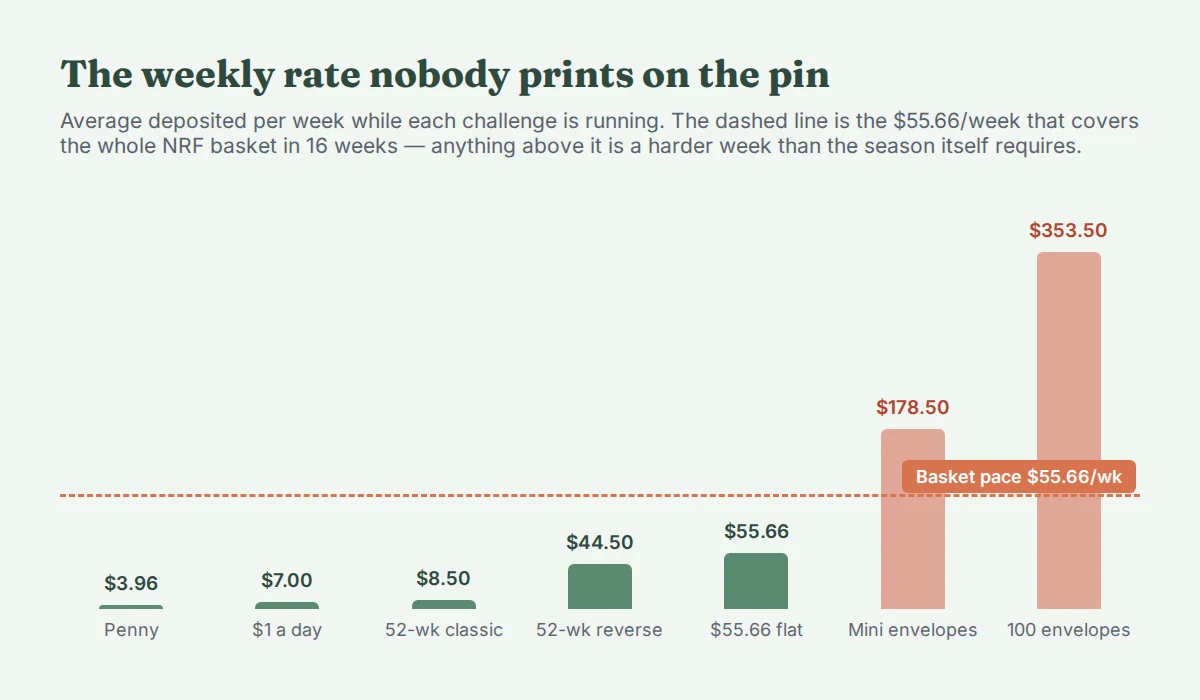
The 100-envelope challenge banks $5,050 in 100 days — which is an average of $353.50 a week, every week, for fourteen weeks straight. Drawing the envelopes in random order shuffles which week is brutal, not whether it is: the average is fixed by the total. The mini version, with envelopes capped at $50, still averages $178.50 a week. These are excellent challenges for a genuinely spare income, and they do fit the calendar — started today, the 100 days end on 2 December, and you can start as late as 10 September and still finish by the 18th. But an envelope challenge is a $350-a-week commitment wearing a $12-envelope costume, and it should be chosen the way you would choose any other $350-a-week commitment.
The honest matchmaking rule comes down to one question: can you pay the challenge's worst week in your worst week? If yes, it will finish. If no, it will end in week six with a guilty pause — and a paused challenge banks its smallest deposits and skips its biggest.
Which challenge for which target
- Building the habit, $100–150 by Christmas — the classic 52-week start ($136) or $1 a day ($112). Gentle, near-invisible, and precisely as far as they go.
- Most of the presents, ~$700 — the reverse 52-week ($712). The strongest schedule per unit of pain on the list: it front-loads September and coasts into December.
- The whole season, ~$890 — the flat transfer: $55.66 a week for 16 weeks is $890.56, matching the average planned basket almost to the dollar. No printable required — one standing order. The arithmetic behind that number, including what changes if you start later, is the countdown guide.
- A four-figure cushion — the $1,000 starter-fund schedule ($20 a deposit, three deposits a week) reaches $960 by 18 December and finishes the last two deposits before Christmas Day. Steadier than envelopes at a similar altitude: every deposit is the same size, so there are no brutal weeks to survive.
- $2,500–5,000, spare income to commit — the envelope challenges, eyes open, at $178.50 and $353.50 a week respectively.
Two popular challenges are missing from the chart on purpose. The $5-bill challenge (bank every $5 note you touch) has no schedule at all — its yield is however much cash you happen to handle, which in a card-first wallet can be $0. And a no-spend month banks your baseline spending, not a printable's number; it can outperform everything here or save nothing, and any chart claiming otherwise would be decoration. Both are fine companions. Neither is a plan.
Paper helps, if the paper does the maths
A challenge succeeds on two mechanics: the schedule fits your actual weeks, and each tick is visible. That second part is why printed trackers outlive banking apps for this job — the thermometer on the fridge is a progress bar the whole household can see.
Our savings challenges bundle has all 22 schedules from this article's family — classic and reverse 52-week, both envelope challenges, the $1,000 starter fund, the penny challenge, and a Christmas fund page with real weekly amounts for four different start months — and every box prints its own amount and the running total, so being behind or ahead is never a mystery. The totals in it were computed and verified the same way the numbers in this article were. If the challenge is feeding a specific December, the Christmas budget planner turns the jar into a gift list with a per-person cap, and the savings goals tracker runs the same logic in a spreadsheet for every other date the calendar repeats — because Christmas is only the largest of the expenses that arrive on schedule. (The general method is sinking funds.)
Sixteen weeks is enough for any target on the chart. Fifteen is enough for most of them. The list of 52 amounts does not care which end you start from — but the jar does, by $576.