
How long can my business survive without sales?

Your business can survive for as long as the cash you can actually spend covers the bills that do not stop when sales do. Runway = (cash + money customers already owe you − bills you already owe − the reserve you refuse to touch) ÷ monthly costs that keep running. For the business in the example below that is 83 days — and the quick "cash divided by costs" answer most people use gives a different, wrong number.
The calculation takes ten minutes with your bank balance and last month's bills. It is worth doing before you need it, because the answer changes what you do this week, not next quarter.
The formula
Runway is a ratio of two things you can look up, not estimate:
- Money you can spend: cash in the bank, plus invoices customers owe you that you expect to collect, minus supplier bills you already owe, minus your minimum reserve.
- Monthly outflow that does not stop: rent and other fixed costs, payroll, loan repayments, the owner's pay, and any tax you set aside each month.
Divide the first by the second and you have months. Multiply by 365 and divide by 12 and you have days, which is the unit that makes people act.
When sales do not stop but fall, replace "outflow" with the gap between that outflow and the gross profit you still earn. Gross profit is revenue minus the direct cost of what you sold — not revenue itself, because the materials, stock or subcontractors behind a sale leave with it.
Step by step
- Write down today's cash across every business account.
- Add invoices you are owed and will realistically collect. Leave out anything you have already chased twice without a reply.
- Subtract supplier bills you already owe. They leave the account whether sales happen or not.
- Subtract your reserve — the balance you never want to go below (a month of payroll is a common choice; the point is that you choose it).
- Add up the monthly costs that keep running with zero sales: fixed costs, payroll, loan payments, owner pay, tax set-aside.
- Divide step 4's result by step 5's total. That is your zero-sales runway in months.
- Repeat with a realistic drop instead of zero: monthly gap = running costs − gross profit at the lower sales.
A worked example
A small studio has $48,000 in the bank and wants to keep $6,000 as a reserve. Customers owe it $14,500; it owes suppliers $4,200. Every month it pays:
| Monthly cost | Amount |
|---|---|
| Rent, software, insurance | $5,200 |
| Payroll | $9,800 |
| Loan repayment | $1,100 |
| Owner pay | $3,000 |
| Total that keeps running | $19,100 |
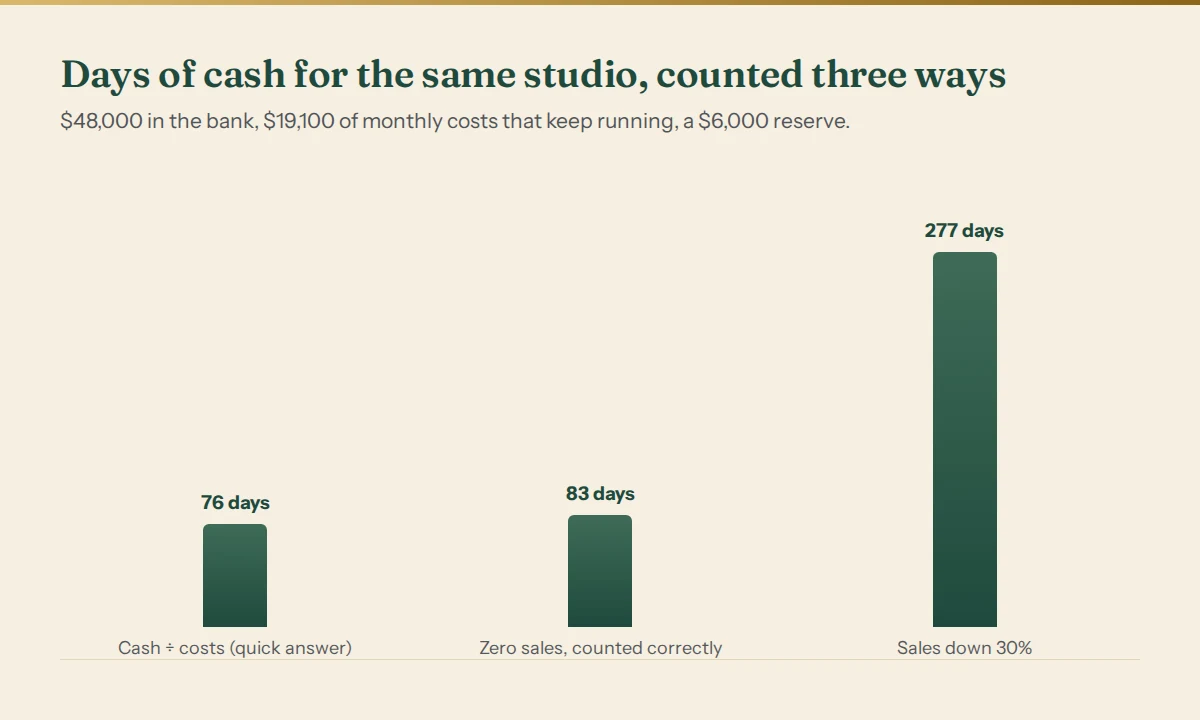
The quick answer: $48,000 ÷ $19,100 = 2.51 months, or 76 days. It is wrong twice over — it spends the reserve, and it ignores the money moving in and out that is already committed.
The correct zero-sales answer: $48,000 + $14,500 − $4,200 − $6,000 = $52,300 you can spend. $52,300 ÷ $19,100 = 2.74 months, or 83 days.
A more likely shock — sales fall 30%. The studio normally sells $46,000 a month at a 45% gross margin, so it earns $20,700 of gross profit and keeps $1,600 after the $19,100 of running costs. If sales drop 30%, gross profit falls to $14,490 and the business loses $4,610 a month. On the $42,000 above its reserve, that lasts 9.11 months, or 277 days.
The line in between: the studio breaks even as long as sales fall by less than 7.7% — its $1,600 monthly surplus divided by $20,700 of gross profit. That single number is often more useful than the runway itself: it tells you how small a slowdown already starts eating your cash.
For context, the JPMorgan Chase Institute's study of 597,000 small businesses found that the median one held 27 cash buffer days — the days of outflows its cash balance could pay if inflows stopped (JPMorgan Chase Institute, Cash is King, 2016). Their measure divides the cash balance by all outflows and does not subtract a reserve or add receivables, so it is not the same number as the one above — but it is a sober reminder that a few weeks is common, not rare. The same study found a wide spread by industry, from 16 days for restaurants to 47 for real estate; the full industry table, with sources is on our answers page.
Common mistakes
- Dividing by revenue instead of gross profit. A $10,000 sale with $6,000 of materials only brings in $4,000 toward your bills.
- Forgetting the lumpy bills. Quarterly tax, annual insurance and a yearly software renewal fall inside the runway even though they are not monthly. Spread them into the monthly total.
- Counting the reserve as spendable. If you would never let the balance hit zero, zero is not your deadline.
- Assuming every invoice arrives on time. The customer who already pays late will pay later when business is slow.
- Leaving out the owner's pay. If you stop paying yourself, you also need to know how long you can live that way.
FAQ
What is a good runway for a small business?
There is no official figure. What matters is whether your runway is longer than the time it would take you to react — cut a cost, collect an invoice, win replacement work. If that takes three months and your runway is two, you have a problem even if two months sounds reasonable.
Should I include a line of credit?
Show it separately. Borrowed money extends the runway, but it has to be repaid, and a bank can reduce or withdraw a facility when your numbers weaken — which is exactly when you would draw on it.
How often should I recalculate?
Monthly, and any time something large changes: a new hire, a lost customer, a big order. The inputs take minutes to update once they are written down.
Is runway the same as break-even?
No. Break-even is the sales level where you stop losing money; runway is how long you last while you are losing it. You need both: the example studio's break-even drop is 7.7%, its 30%-drop runway is 277 days.
Quick check first: the free cash runway calculator gives your runway now, with no sales at all and at a ladder of sales drops, and the sales drop calculator finds how far sales can fall before the reserve breaks.
Check your own numbers
The Business Decision X-Ray then runs nine tests day by day on your whole business — revenue and cost shocks, payment delays, customer dependency and deals — and ends with a dated action plan. Open demo of every section, no sign-up; then from $40 a month.
The example above uses the same runway formula as our free runway calculator. It is decision support, not financial, tax or legal advice: the answer is only as good as the numbers you enter.

