
How to compare family health plans beyond the premium
To compare family health plans, add each plan's yearly premiums to what your family would owe providers for the same visits, tests and prescriptions under that plan's deductibles, copays, coinsurance and out-of-pocket limits — then repeat for a quiet year and an expensive one. The plan with the lowest premium is not always the one with the lowest total, and the answer can change with how much care you use. In the example below, the plan with the lower premium costs $150 less in a year with one $5,000 hospital bill, and $1,800 less in a year with no care at all.
This guide is about US employer and individual health plans, in US dollars. It compares costs under the plan terms you enter; it does not recommend treatment, confirm coverage or decide eligibility.
Why premiums alone mislead
A plan has two prices: what you pay to be covered and what you pay when you use it:
- Deductibles shift cost to the first bills of the year. A low premium often comes with a high deductible.
- Coinsurance and copays continue after the deductible. Until the out-of-pocket limit is reached.
- Family deductibles work in two ways. Embedded and aggregate deductibles give different bills for the same care.
- Pay periods matter. Premiums deducted every two weeks come out 26 times a year, not 24.
- HSA money is not the same as cost. Your own deposits move money between your accounts; employer money lowers the cost.
The formula
- Yearly premiums = premium per deduction × number of deductions in the plan year.
- What you owe for a service = the allowed amount up to the remaining deductible, then copay or coinsurance on the rest, until the out-of-pocket limit is reached.
- Insurance and care cost = yearly premiums + everything owed to providers.
- Household cash outflow = premiums + bills paid from your own pocket + your own HSA deposits.
- Economic result = insurance and care cost − employer HSA or HRA money − the tax effects you confirm.
A worked example
The numbers below follow the control examples used to test Family Health Plan Compare. One person needs one hospital service with an allowed amount of $5,000.
| Plan A | Plan B | |
|---|---|---|
| Monthly premium | $300 | $450 |
| Deductible | $2,000 | $500 |
| Coinsurance | 20% | 10% |
| Out-of-pocket limit | $4,000 | $2,500 |
| Yearly premiums | $3,600 | $5,400 |
| Owed for the $5,000 service | $2,000 + $600 = $2,600 | $500 + $450 = $950 |
| Insurance and care cost | $6,200 | $6,350 |
Plan A costs $150 less in this year. In a year with no care, the gap grows to $1,800, the difference in premiums. In the worst case, when the out-of-pocket limit is reached, Plan A totals $3,600 + $4,000 = $7,600 and Plan B $5,400 + $2,500 = $7,900.
Embedded or aggregate deductible? A family plan has a $1,000 individual and a $2,000 family deductible with 20% coinsurance. One family member has $3,000 of allowed care. With an embedded deductible, that person pays $1,000 and then 20% of $2,000: $1,400. With an aggregate deductible, the whole $2,000 must be met first: $2,000 plus 20% of $1,000, $2,200.
Three totals with an HSA. Plan A's $6,200 is paid partly from an HSA. The employer puts in $1,000, the household deposits $2,000, and $2,600 of bills are paid from the account. The HSA ends the year with $400, the household's cash outflow is $5,600, and the economic result after the employer's money is $5,200, with no tax effect entered.
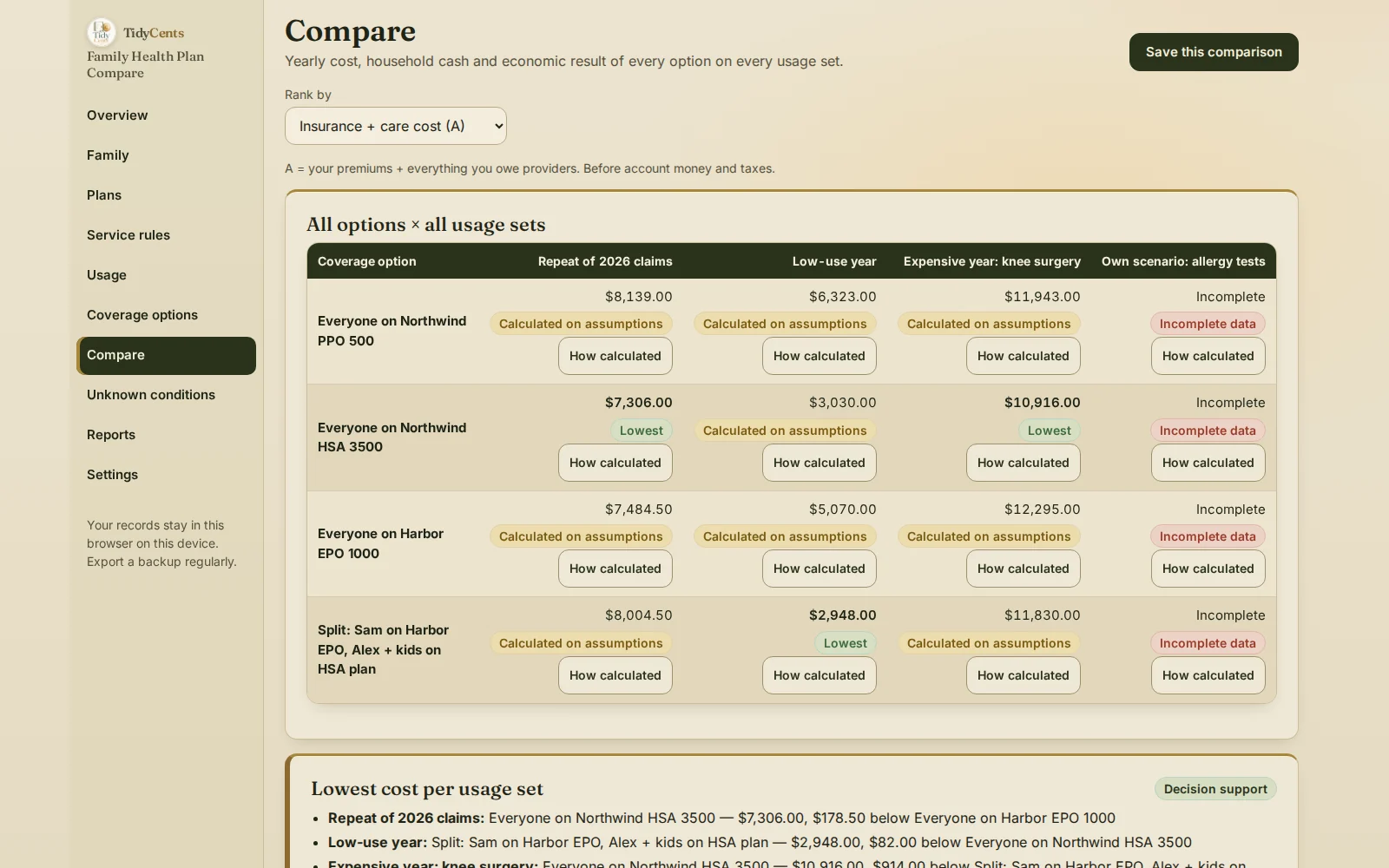
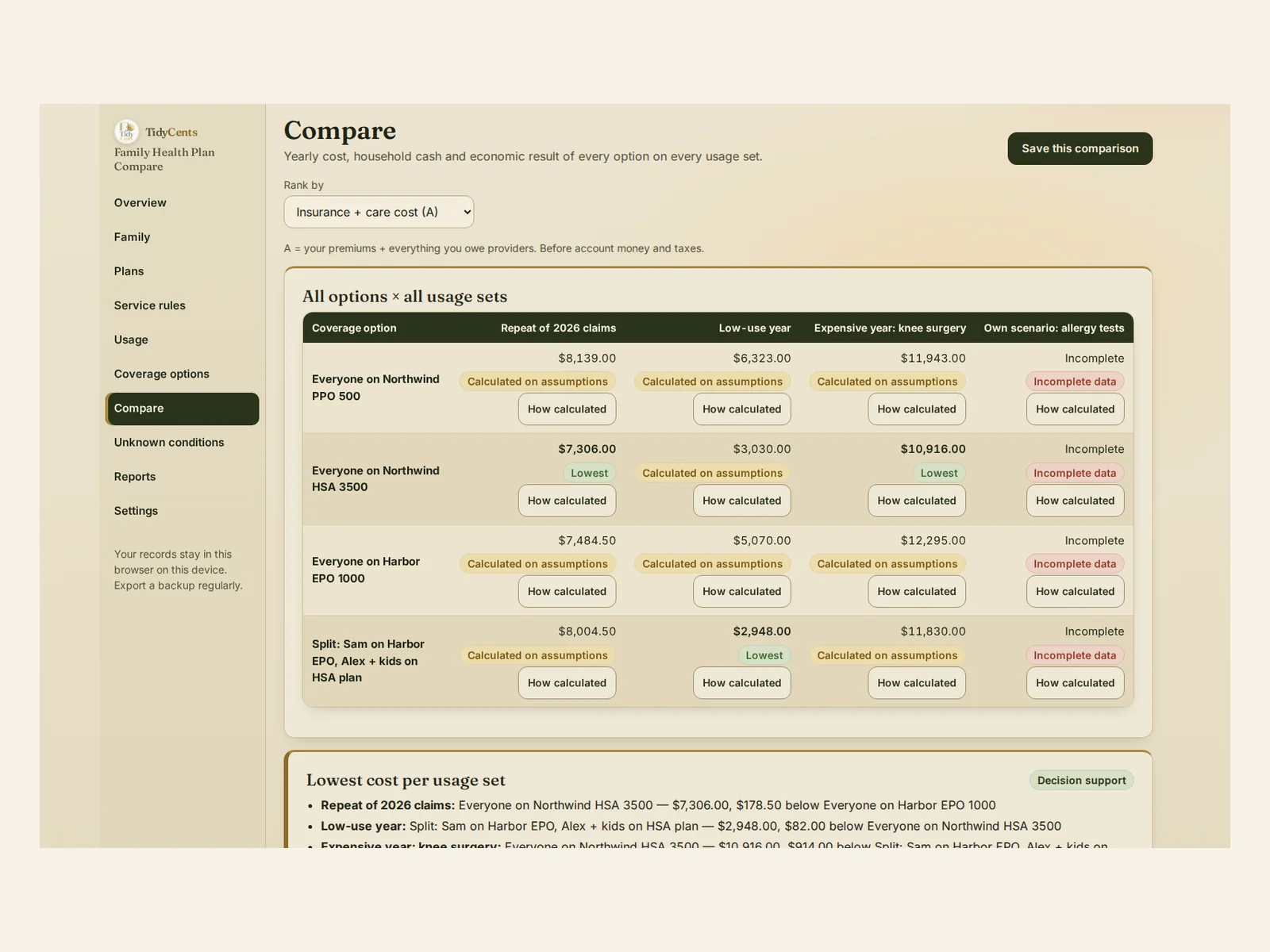
What the demo shows. A fictional family of 4 compares 3 plans, including splitting the family between two employers' plans. Repeating last year's claims, everyone on a high-deductible HSA plan costs $7,306, $178.50 less than everyone on an EPO. In a low-use year, a split — one adult on the EPO, the other adult and the children on the HSA plan — costs $2,948, $82 less than everyone on the HSA plan. In an expensive year with a knee surgery, everyone on the HSA plan costs $10,916, $914 less than the split. A fourth scenario with allergy tests is not ranked until its missing prices are entered.
Step by step: compare your family's plans
- List the family by alias and role, and tick the plans each person may join.
- Copy each plan's terms from its summary of benefits: premiums per pay period and tier, deductibles, out-of-pocket limits and account money.
- Enter one service rule per type of care: copay, coinsurance, and whether each counts toward the deductible and the limit.
- Enter your care events with dates and allowed amounts: last year repeated, a low-use year and an expensive year.
- Set up coverage options, including splitting the family between plans.
- Compare every option on every usage set and look at why the lowest option changes.
- Check the monthly cash need, not only the yearly total.
- Close the unknowns: a missing allowed amount is a question for the plan, not a guess.
Common mistakes
- Choosing on premium alone. The bills you pay when you use the plan can outweigh it.
- Using the billed amount instead of the allowed amount. Cost sharing is based on the allowed amount.
- Assuming the deductible is per person. An aggregate family deductible can cost more for one person's care.
- Counting your own HSA deposits as a cost. They stay your money; employer money is what lowers the cost.
- Counting 24 pay periods instead of 26. Biweekly deductions happen 26 times a year.
- Comparing only one kind of year. The lowest option can change between a quiet and an expensive year.
When a tool helps
A spreadsheet can add premiums. It rarely replays each dated visit through deductibles, coinsurance and limits in the right order, handles embedded and aggregate family deductibles, keeps HSA, FSA and HRA money apart from cost, and tests a split family across plans. Family Health Plan Compare does, and every result opens "How calculated". It applies only the plan terms and rates you enter; it does not calculate subsidies or eligibility. Exact arithmetic, no AI guesses. To check a bill you already received, see Medical Bill & EOB Checker.
Open the demo with the family above — every screen, no sign-up — then enter the plans you are offered.
Related guides: how to check a medical bill for errors, how big should an emergency fund be and sinking funds.
FAQ
How do I compare the total cost of two health plans?
Add each plan's yearly premiums to what you would owe for the same care under its deductible, coinsurance and out-of-pocket limit. In the example, Plan A totals $6,200 and Plan B $6,350 for one $5,000 service.
What is the difference between an embedded and an aggregate deductible?
With an embedded deductible, each person has their own deductible inside the family one. With an aggregate deductible, the whole family deductible must be met before cost sharing starts for anyone. In the example, the same $3,000 of care costs $1,400 or $2,200.
Is a high-deductible plan with an HSA cheaper?
It depends on how much care your family uses and how much the employer puts into the HSA. In the demo, the HSA plan is lowest in two of three usage sets and a split family is lowest in the low-use year.
Should I count my HSA deposits as a cost?
No. Your own deposits are a transfer between your accounts and the balance stays yours. Employer contributions are what reduce the cost.
This is decision support, not insurance, tax or medical advice.
Tools mentioned in this guide
 USInteractive tool
Family Health Plan Compare
Compare health plans using the same family visits, prescriptions and financial rules—not premiums alone.

