How to price a menu item from your recipe cost
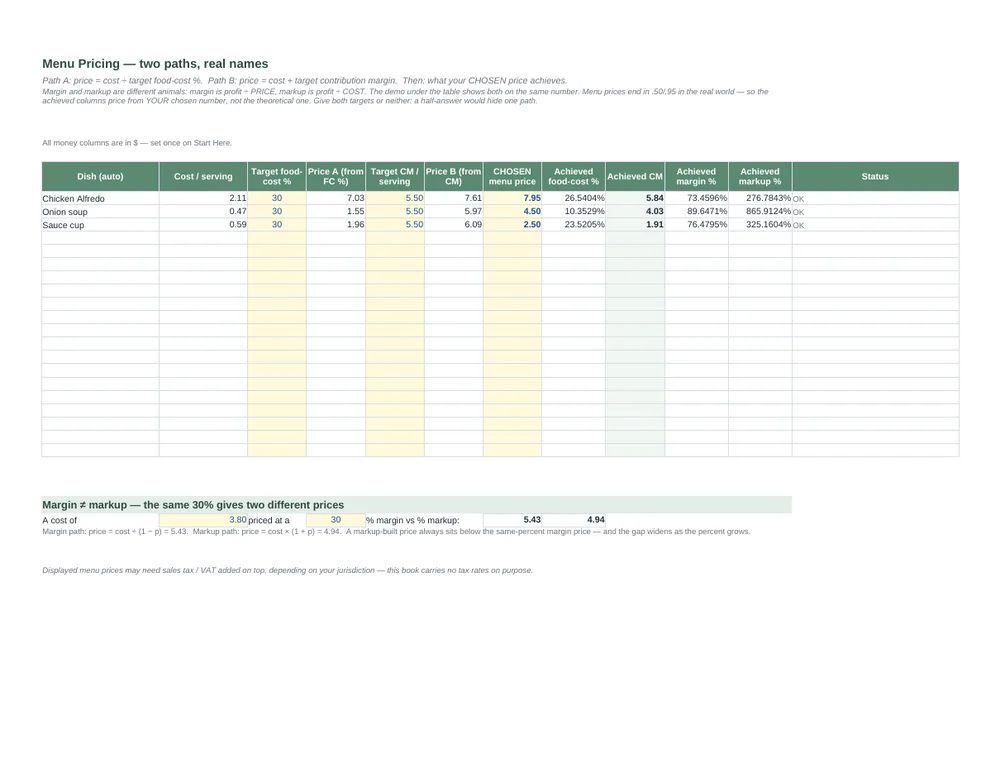
To price a menu item, first find its true cost per serving, then use one of two formulas: price = cost per serving ÷ your target food-cost %, or price = cost per serving + the money you want each plate to contribute. A dish that costs $2.11 per serving priced at a 30% food cost is $2.11 ÷ 0.30 = $7.03; priced to contribute $5.50 per plate it is $2.11 + $5.50 = $7.61. Then check what the price you actually print on the menu — say $7.95 — really achieves. Most pricing mistakes happen before the formula: in a cost that ignores trim, or in a "30% margin" that is quietly applied as a markup.
Step 1: the cost per serving has to be the edible cost
An invoice tells you what you paid for the whole ingredient. You cook with less of it. The share you can actually use is the yield: peel, trim, bones and drained liquid are paid for but never reach the plate.
Cost per usable unit = invoice price per unit ÷ yield.
Example: a 5 kg sack of onions costs $4.50.
- As purchased: $4.50 ÷ 5 kg = $0.90 per kg
- At an 88% yield: $0.90 ÷ 0.88 = $1.0227 per kg, about $1.02
- Difference: 1 ÷ 0.88 = 1.136, so the onion you actually cook with costs 13.6% more than the invoice suggests
That gap is different for every ingredient — fish loses a very different fraction from flour — so one "waste %" row for a whole recipe has the wrong shape. Measure the yield of the ingredients that matter most in your own kitchen; a published average is not your knife.
The same logic applies to anything you make in a batch. A sauce, a dough or a stock has its own cost per litre or kilogram, and every dish that uses it should draw on that number, so that when butter goes up the sauce and every dish using it move together.
Step 2: two pricing formulas — and they are not the same thing
Path A — target food-cost %. You decide what share of the price the food should be.
Price = cost per serving ÷ target food-cost %
Path B — target contribution margin. You decide how much money each plate should leave after its food cost, to pay for rent, wages and profit.
Price = cost per serving + target contribution per serving
Neither is "right". Path A keeps the food cost as a stable share of sales; Path B protects the money a cheap dish contributes, which a percentage can make very small. Many owners compute both and pick a price between them.
A worked example
A chicken Alfredo costs $2.10996 per serving once every ingredient is costed at its edible yield and the batch sauce is included. The targets are a 30% food cost and $5.50 of contribution per plate.
- Path A: $2.10996 ÷ 0.30 = $7.0332 → $7.03
- Path B: $2.10996 + $5.50 = $7.60996 → $7.61
Real menus do not print $7.03. Say you choose $7.95. Now check what that price achieves:
- Food cost %: $2.10996 ÷ $7.95 = 26.54%
- Contribution per plate: $7.95 − $2.10996 = $5.84
- Margin %: $5.84 ÷ $7.95 = 73.46% (100% − 26.54%)
- Markup %: $5.84 ÷ $2.10996 = 276.78%
Four numbers, one plate. The chosen price beats both targets: food cost is below 30% and the contribution is above $5.50.
The margin-versus-markup trap
A margin is a share of the selling price. A markup is a multiple of the cost. The same "30%" gives two different prices.
On a plate costing $3.80:
- 30% margin: $3.80 ÷ (1 − 0.30) = $3.80 ÷ 0.70 = $5.43
- 30% markup: $3.80 × 1.30 = $4.94
That is $0.49 apart on one dish, every time it is sold. If a template asks for a "profit margin %" and then multiplies the cost by (1 + that %), it has applied a markup and handed you the lower price. Name the number you mean, and check the result both ways.
Step 3: price the menu, not just the dish
A dish can have a healthy food-cost % and still be a poor use of the menu. Menu engineering — the published Kasavana and Smith method — compares each dish on two axes:
- Popularity: its share of units sold against a threshold based on the number of items on the menu (commonly 70% of an equal share: with 15 items, 0.70 × 1/15 ≈ 4.67%).
- Contribution: its contribution per plate against the menu's sales-weighted average.
High on both is a star; popular but low-contributing is a plowhorse; high-contributing but rarely ordered is a puzzle; low on both is a dog. The dish that sells the most is not automatically the star — it may be the one that most needs a price or portion review.
What about a "normal" food-cost percentage?
You will see 28–35% repeated everywhere. Treat it with care: the figure is rarely sourced, and your right target depends on your rent, staff costs, format and market. Set your own target from your own numbers and see the price it implies, rather than borrowing someone else's.
Two more things to decide yourself: whether your displayed prices must include sales tax or VAT where you trade, and what a delivery platform takes under your contract. Both change the price a customer sees without changing your food cost.
How to do it in the tool
The Recipe Cost & Menu Pricing Spreadsheet does these steps in 9 linked sheets, in any currency:
- Ingredients — enter each purchase pack, its price and your measured yield; it returns the cost per edible recipe unit.
- Sub-Recipes — cost a batch sauce or dough once; any dish can use it as an ingredient.
- Recipes & Dishes — the cost per serving builds itself from those two sheets.
- Menu Pricing — Path A and Path B side by side, then the food-cost %, contribution, margin % and markup % of the price you actually choose. The Alfredo above is the shipped example.
- Menu Mix — stars, plowhorses, puzzles and dogs from your own sales counts, with both thresholds computed from your mix.
- Price Watch — enter a supplier's new price and see which dishes it hits hardest per serving.
Everything is plain formulas you can read: no AI guesses, no hidden constants, and a Checks sheet that turns red when an input is missing.
FAQ
What is the formula for food cost percentage?
Food cost % = cost per serving ÷ menu price × 100. At $2.11 and $7.95 it is 2.10996 ÷ 7.95 = 26.54%. To go the other way, price = cost ÷ target food-cost %.
Should I use food-cost % or contribution margin?
Use both as a check. A percentage keeps food cost proportional to sales; a money target makes sure cheap dishes still leave enough to cover your fixed costs. If the two prices are far apart, that tells you something about the dish.
Why is my real cost higher than my recipe cost?
Usually because the recipe uses invoice prices instead of edible yields, or because sub-recipes and garnishes are left out. Waste, over-portioning and price changes after costing add more on top.
Can I convert cups to grams for costing?
Only with a factor you measure for that ingredient. Weight-to-volume depends on density: a cup of flour and a cup of honey do not weigh the same, so a single conversion table will be wrong for most ingredients.
How often should I re-price?
Whenever a major ingredient price moves, and at least each time you reprint the menu. Re-cost first, then check whether your printed price still meets your targets.
To do this with your own recipes, the free recipe cost calculator costs each dish from pack price through your measured yield, and the free menu engineering matrix sorts the whole menu by popularity and margin.
This guide is general information to help you calculate, not financial advice.