Cost per mile in trucking: how to calculate it, deadhead included

Cost per mile is everything the truck costs in a period ÷ every mile it drove in that period, empty miles included. Add the fixed costs (truck payment, insurance, permits) to the variable costs (fuel, maintenance, tires, your own pay), divide by total miles, and you have the cost of moving the truck one mile. The rate you quote is a different number: because a load pays for loaded miles alone, the break-even rate per loaded mile = total costs ÷ loaded miles. In the example below the truck costs $1.85 a mile but needs $2.18 per loaded mile just to break even.
What goes into cost per mile?
Split the costs into two groups, because they behave differently.
- Fixed costs arrive every month whether the wheels turn or not: truck and trailer payments, insurance, plates and permits, ELD and phone, accounting. Per mile they fall as miles rise.
- Variable costs grow with every mile: fuel, maintenance and repairs, tires, and driver pay — for an owner operator, the pay you take for yourself. Per mile they stay roughly flat.
Tolls, scale fees and parking belong to a particular trip; add them to that trip rather than averaging them into the rate.
How do you calculate cost per mile?
- Fixed cost per mile = fixed costs for the month ÷ total miles for the month.
- Fuel cost per mile = diesel price per gallon ÷ miles per gallon.
- Variable cost per mile = fuel per mile + maintenance, tires and driver pay per mile.
- Cost per mile = fixed cost per mile + variable cost per mile.
- Break-even rate per loaded mile = (variable cost per mile × total miles + fixed costs) ÷ loaded miles.
"Total miles" means loaded plus deadhead. Take them from odometer readings or your logs, not from the miles on the rate confirmations.
Step by step
- List a month of fixed costs. Use the monthly equivalent of annual bills such as insurance.
- Count total miles from the odometer, and loaded miles from the trips.
- Measure fuel economy between two full tanks: miles driven ÷ gallons added. A partial fill gives a false figure.
- Price fuel per mile at what you actually paid per gallon.
- Add the other variable costs per mile: maintenance, tires, your pay.
- Divide to get cost per mile, then the break-even rate per loaded mile.
- Check each trip against those numbers before you accept it.
A worked example: one truck, one month
These are example inputs, not industry averages. An owner operator has $4,000 of fixed costs a month: a $2,300 truck payment, $1,200 of insurance, $300 of permits, plates and ELD, and $200 of other overhead. The truck runs 10,000 miles a month, of which 8,500 are loaded and 1,500 empty — 15% deadhead. It averages 6.4 mpg, and diesel costs $3.84 a gallon.
| Cost line | Per mile | For 10,000 miles |
|---|---|---|
| Fuel: $3.84 ÷ 6.4 mpg | $0.60 | $6,000.00 |
| Maintenance and repairs | $0.16 | $1,600.00 |
| Tires | $0.04 | $400.00 |
| Driver pay | $0.65 | $6,500.00 |
| Variable costs | $1.45 | $14,500.00 |
| Fixed costs: $4,000 ÷ 10,000 miles | $0.40 | $4,000.00 |
| Cost per mile | $1.85 | $18,500.00 |
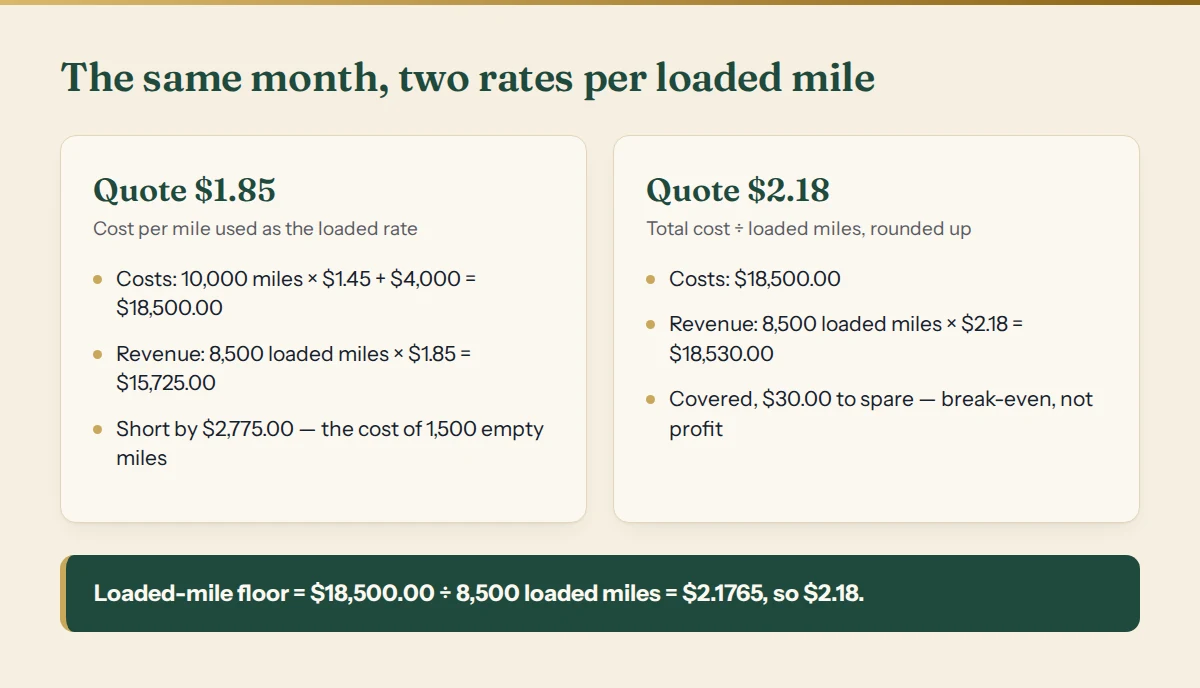
The month costs $18,500.00. Spread over all 10,000 miles that is $1.85 a mile. But the loads pay for 8,500 miles, so the break-even rate is $18,500.00 ÷ 8,500 = $2.1765, rounded up to $2.18 per loaded mile.
Why must the rate per loaded mile cover deadhead?
Nobody pays for the drive to the pickup or the empty run home, yet the truck burns the same fuel and wears the same tires. If you quote $1.85 per loaded mile, the 8,500 loaded miles bring in $15,725.00 against $18,500.00 of costs — $2,775.00 short, exactly the cost of the 1,500 empty miles at $1.85. At $2.18 the month brings in $18,530.00: covered, with $30.00 to spare. That is break-even, not profit; your margin sits on top of it.
How much does one trip really make?
Trip profit = revenue − fuel − tolls − other variable costs − the trip's share of fixed costs. Count fuel and variable costs on every mile of the trip, loaded and empty.
A load pays $1,500 for 600 loaded miles — $2.50 per loaded mile, well above $2.18. Reaching the pickup takes 150 empty miles, and the route has $42 of tolls. That is 750 miles in all, 20% of them empty.
| Line | Calculation | Amount |
|---|---|---|
| Revenue | $1,500.00 | |
| Fuel | 750 miles ÷ 6.4 mpg = 117.1875 gal × $3.84 | −$450.00 |
| Tolls | −$42.00 | |
| Maintenance, tires, driver pay | 750 × $0.85 | −$637.50 |
| Share of fixed costs | 750 × $0.40 | −$300.00 |
| Trip profit | $70.50 |
The profit is $70.50, a 4.70% margin. Leave out the deadhead and the same load seems to cost 600 × $1.85 + $42 = $1,152.00 and make $348.00; the 150 empty miles cost $277.50 of that. Per mile driven, the load pays $2.00, not $2.50.
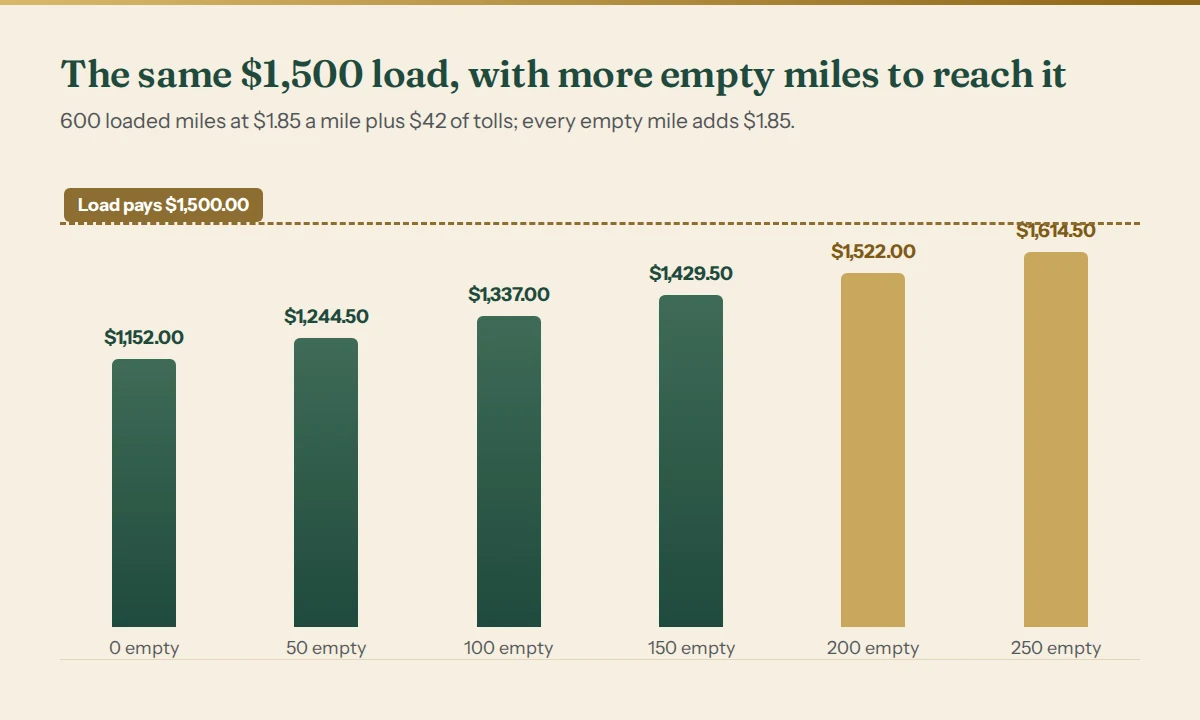
The break-even point for this load is $348.00 ÷ $1.85 = 188.1 empty miles. And if the 150 empty miles are a given, the lowest rate that covers the trip is $1,429.50 ÷ 600 = $2.3825, so $2.39 per loaded mile — not the $2.18 monthly average, because this trip carries more deadhead than the month does.
Common mistakes
- Dividing by loaded miles alone when working out cost per mile. It hides fuel economy and makes the truck look cheaper to run in the month you drive more empty.
- Quoting cost per mile as the rate. Cost per mile is spread over all miles; the rate has to be spread over loaded miles.
- Leaving your own pay out. Without it, "profit" is just your wage, and a rate that seems to work pays you nothing.
- Using a fuel economy figure from a partial fill. Measure between full tanks; a $0.32 rise in diesel at 6.4 mpg adds $0.05 a mile, or $500.00 over 10,000 miles.
- Averaging tolls into the rate. A route with heavy tolls needs its own price.
- Never revisiting the numbers. Fuel, insurance and miles move; recalculate every month.
Fuel tax is a separate calculation from cost per mile; see how to calculate IFTA fuel tax. If you are deciding how to finance the truck itself, lease or buy equipment compares the two.
Track it trip by trip
Fleet Fuel & Trip Profit Control does this arithmetic on your own records. It measures fuel economy between two confirmed full fills, records loaded and empty distance on every trip, adds driver time, tolls, maintenance and a share of fixed vehicle costs, and shows the minimum price at your target margin. It compares planned and actual trips and vehicles, and exports to CSV. Miles or kilometres, gallons or litres, exact decimal arithmetic, no AI guesses. Open the free demo first; the tool is $24, one-time.
This is a costing method, not tax, legal or accounting advice.
Tools mentioned in this guide
 Interactive tool
Fleet Fuel & Trip Profit Control
See what each trip earns after fuel, empty miles, driver time and vehicle costs.
 US · 2026