Social Security 2027 COLA increase chart — what 3.6% adds to your check

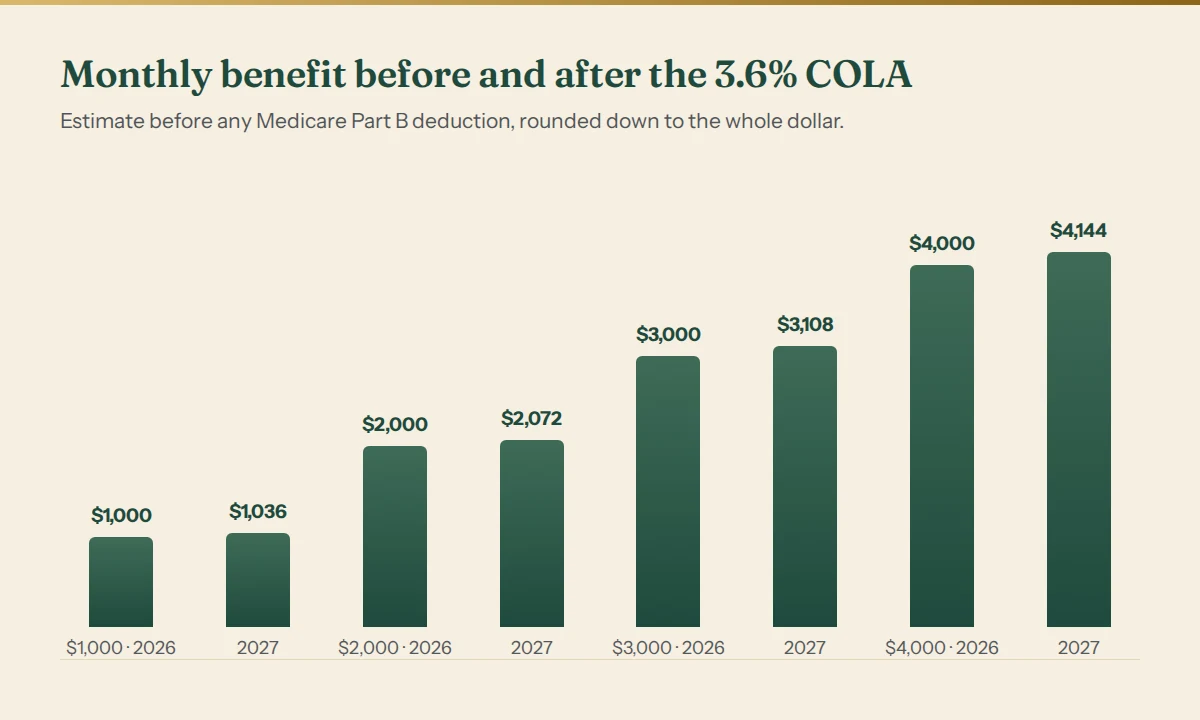
Social Security benefits rise 3.6% for 2027. Multiply your current monthly benefit by 1.036 and round down to the whole dollar: $1,000 becomes about $1,036, $2,000 becomes $2,072 and $4,000 becomes $4,144. The higher benefit is paid from January 2027; SSI recipients see their higher payment on 31 December 2026. The figure that actually lands in your account can be lower, because any Medicare Part B premium is deducted after the increase — and the 2027 Part B premium had not been announced as of 21 October 2026.
Every official number below comes from the SSA 2027 fact sheet and the SSA announcement of 14 October 2026. The dollar estimates are our own arithmetic on those numbers. This is general information, not legal or tax advice.
How do you calculate your 2027 COLA increase?
The formula has two steps:
- New benefit = current monthly benefit × 1.036, rounded down to the whole dollar.
- Monthly increase = new benefit − current benefit; × 12 for the year.
Step by step:
- Find your current gross benefit — the amount before Medicare is taken off. It is on your 2026 benefit letter or in your my Social Security account.
- Multiply by 1.036. On $1,500: $1,500 × 1.036 = $1,554.
- Round down to the whole dollar. SSA does not round up.
- Subtract the 2027 Part B premium, once it is published, if it is deducted from your check.
SSA's own estimate shows the same arithmetic at work: the average retired worker's benefit goes from $2,095 to $2,170 ($2,095 × 1.036 = $2,170.42, rounded down).
Social Security 2027 COLA increase chart
Estimated monthly benefit after the 3.6% COLA, before any Medicare Part B deduction. Your letter from SSA is the final word; it can differ by a dollar or so because SSA applies the COLA to an underlying amount, not to the rounded check.
| Monthly benefit in 2026 | Estimated 2027 benefit | Increase per month | Increase per year |
|---|---|---|---|
| $500 | $518 | $18 | $216 |
| $750 | $777 | $27 | $324 |
| $1,000 | $1,036 | $36 | $432 |
| $1,250 | $1,295 | $45 | $540 |
| $1,500 | $1,554 | $54 | $648 |
| $1,750 | $1,813 | $63 | $756 |
| $2,000 | $2,072 | $72 | $864 |
| $2,250 | $2,331 | $81 | $972 |
| $2,500 | $2,590 | $90 | $1,080 |
| $2,750 | $2,849 | $99 | $1,188 |
| $3,000 | $3,108 | $108 | $1,296 |
| $3,250 | $3,367 | $117 | $1,404 |
| $3,500 | $3,626 | $126 | $1,512 |
| $3,750 | $3,885 | $135 | $1,620 |
| $4,000 | $4,144 | $144 | $1,728 |
A worked example
A retired couple receives $2,250 and $1,250 a month in 2026. After the COLA: $2,250 × 1.036 = $2,331 and $1,250 × 1.036 = $1,295. Together that is $3,626 instead of $3,500 — $126 a month, $1,512 a year more, before Part B. If both have Part B deducted, the net rise is $126 minus twice whatever the 2027 premium increase turns out to be. Budget on the gross figure only until that premium is announced.
What is the Social Security wage base for 2027?
The maximum earnings subject to Social Security tax rise from $184,500 to $192,300 — an increase of $7,800. The tax rates do not change: 6.2% for Social Security and 1.45% for Medicare on employees (7.65% together), and 15.3% for the self-employed. Medicare tax has no earnings cap at all. A quarter of coverage rises from $1,890 to $1,970 of earnings.
What is the maximum Social Security tax for the self-employed in 2027?
Self-employed people pay both halves of the Social Security part, 12.4%, on net earnings up to the wage base:
- 2027 maximum: 12.4% × $192,300 = $23,845.20.
- 2026 maximum: 12.4% × $184,500 = $22,878.00.
- Increase: $967.20.
An employee pays half of that, 6.2% × $192,300 = $11,922.60, and the employer pays the other half.
Two details decide whether you actually reach that cap. First, self-employment tax is charged on 92.35% of net profit, so you hit the $192,300 base at a net profit of about $192,300 ÷ 0.9235 = $208,229.57. Second, W-2 wages you earn in the same year use up the base first; only what is left applies to your self-employment income. Medicare's 2.9% keeps running above the cap, which is why the total bill does not stop growing.
These 2027 figures apply to income earned from 1 January 2027. The return you file in early 2027 still covers tax year 2026 and the $184,500 base. For how much of each payment to set aside in the meantime, see how much to set aside for taxes when self-employed; if a quarterly payment slipped, see what a missed quarterly estimated tax payment costs.
What is the Social Security earnings limit for 2027?
If you claim before full retirement age (FRA) and keep working, the earnings test can withhold part of your benefit:
- Under FRA all year: limit $25,560 a year (was $24,480). SSA withholds $1 for every $2 above it.
- In the year you reach FRA: limit $67,920 a year (was $65,160), counting only earnings before the month you reach FRA. SSA withholds $1 for every $3 above it.
- From the month you reach FRA: no limit.
Worked example: you are 63 and earn $35,000 in 2027. The excess is $35,000 − $25,560 = $9,440, so about $9,440 ÷ 2 = $4,720 of benefits is withheld over the year. If instead you reach FRA in 2027 and earn $75,000 before that month, the excess is $7,080 and about $2,360 is withheld.
How much is the SSI payment in 2027?
The federal SSI payment standard rises from $994 to $1,029 a month for an individual (+$35) and from $1,491 to $1,544 for a couple (+$53). The resource limits stay at $2,000 and $3,000. The first higher payment arrives on 31 December 2026 — it is the January payment paid early, not an extra one. Many states add a supplement on top of the federal amount.
2026 against 2027: the limits side by side
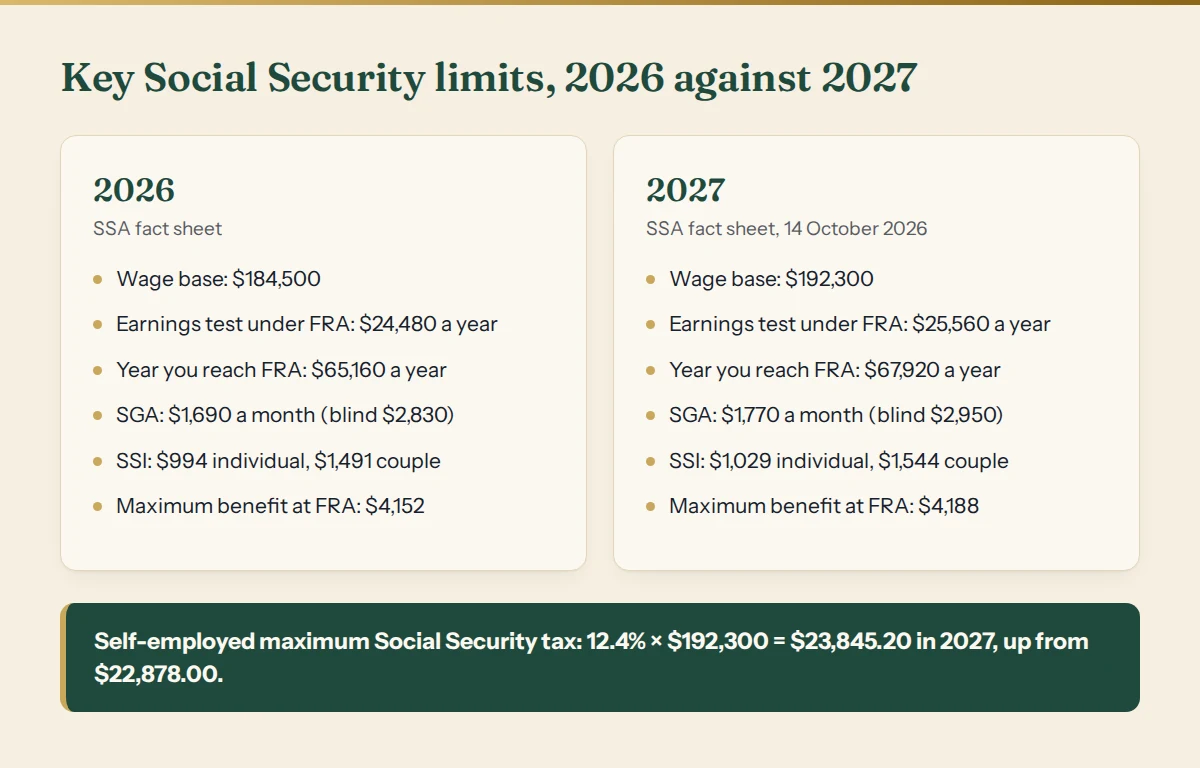
For disability benefits, substantial gainful activity (SGA) rises to $1,770 a month (from $1,690), or $2,950 if you are blind (from $2,830). A trial work month now counts from $1,270 of earnings (was $1,210).
Common mistakes
- Applying the COLA to the maximum benefit. $4,152 × 1.036 would be about $4,301, yet the 2027 maximum at FRA is $4,188. The maximum describes a new retiree with top earnings in every year, recalculated each year; it is not a current check plus 3.6%.
- Planning on the gross increase. The Part B premium is deducted after the COLA, so the net rise can be smaller.
- Rounding up. SSA rounds down to the whole dollar.
- Treating the 31 December SSI payment as a bonus. It is January's money.
- Using the 2027 wage base on your 2026 return. It applies to 2027 earnings only.
- Assuming withheld benefits are gone for good. SSA recalculates your benefit at FRA to credit months that were withheld.
Plan the self-employed side in a spreadsheet
If part of your income is self-employment, the Social Security cap is only one line of the bill. Our US Self-Employed Tax Engine works through tax year 2026 — self-employment tax with the $184,500 base, income tax, the section 199A deduction and the quarterly payment that keeps you penalty-free — with every rate cited to its IRS or SSA source. It shows the calculation rather than a guess, and it is a planning workbook, not tax advice.